Giuseppe

707 posts

Giuseppe

Giuseppe

@GiuseppeSPX

Katılım Şubat 2022
16 Takip Edilen100 Takipçiler
Giuseppe
Giuseppe@GiuseppeSPX·
@AsTheRain1 @FrLavery Dear Sir, can you explain why having a title without having authority would be contrary to the teaching of Mystici Corporis?
English
1
0
0
73
God is My Judge🍄
God is My Judge🍄@AsTheRain1·
@GiuseppeSPX @FrLavery By the way, Thesis clergy say that the juridical elements of the Church were *not supposed to be separated* from the invisible element, but that they have been since the great apostasy. Pius XII says they *cannot be separated* because Christ wills it so.
God is My Judge🍄 tweet media
English
2
2
16
1.8K
Fr. Gabriel Lavery
Fr. Gabriel Lavery@FrLavery·
Bp. Sanborn believes he belongs to the same church as this dancing "priest," since he believes he belongs to the same "legal Church" as this man does and because no one has declared this man, or the religion he belongs to, to be non-Catholic.
Fr. Gabriel Lavery tweet media
English
6
5
32
1.7K
Giuseppe
Giuseppe@GiuseppeSPX·
"If any man eat of this bread, he shall live for ever" (Jo. 6, 52) It is important to reflect on the present tense of the verb "to eat". The Lord does not say if any man "has eaten" this bread. We must always strive to be worthy of Him to enter His Kingdom.
English
0
0
0
24
Giuseppe
Giuseppe@GiuseppeSPX·
@AsTheRain1 @FrLavery The Thesis does not know a juridical church opposed to the perfect society which is the church.
English
1
0
0
118
God is My Judge🍄
God is My Judge🍄@AsTheRain1·
@GiuseppeSPX @FrLavery Sure, because a "juridical church" or "juridical element of the church" which leads souls to hell and is forbidden to attend, independent from a remnant church which maintains the Faith, is perfectly compatible with Christ's will for a perfect society furnished with all elements.
English
1
1
5
181
Anthony
Anthony@Catholicizm1·
The Sedes tremble when they see this man.
Anthony tweet media
English
20
1
119
4.6K
Giuseppe
Giuseppe@GiuseppeSPX·
@MattGaspers @StephenKokx @TheWMReview Can I ask you whether in Vatican II and in universal teachings of Paul VI's successors you see some errors in matters of faith and morals or merely some "problems of language"?
English
0
0
0
75
Matt Gaspers
Matt Gaspers@MattGaspers·
Sure, I’m happy to answer. I just discussed all four of the Church’s marks, as well as her three attributes, on my channel (1:17:12 and following): youtube.com/live/kWwbzIJS1… The “post-Vatican II Church,” as you call it, manifests the mark of catholicity by the fact that it remains widely diffused throughout the whole world and still has a large number of members. In the words of Msgr. Van Noort, it still “include[s] in its membership a vast number of men from many different nations” (Christ’s Church, p. 146 aroucapress.com/christs-church). “The mark of catholicity,” he says, “means exclusively that catholicity in fact which should always be found in the true Church: its morally universal diffusion. That this sort of catholicity when viewed concretely — that is, as comprising genuine unity and the unbroken preservation of that unity throughout many centuries without recourse to military might — amounts to a moral miracle, no one of good sense will doubt. Such God-given unity, therefore, cannot be a property of a false religion” (ibid., p. 164). Now, you and Sean clearly deny that the “post-Vatican II Church” possesses “genuine unity” in terms of doctrine and worship, and I agree that real problems persist in those areas, but the fact remains that the “post-Vatican II Church” has never bound Catholics to believe anything heretical. Regarding catholicity, you and Sean argue that the “post-Vatican II Church” lacks the property of catholicity by right (de jure): youtube.com/watch?v=5EbeX9… In Sean’s words, “It doesn’t hold that it has the destiny and right for all men to enter her. It doesn’t hold that all men have to do that.” As evidence, he cites a few non-magisterial documents, e.g., the Balamand Declaration (1993), the Gifts and Calling of God are Irrevocable (2015), and concludes that the existence of such documents completely undermines catholicity de jure and vindicates the sedevacantist position. Perhaps he is unaware that the latter document’s Preface explicitly states, “The text is not a magisterial document or doctrinal teaching of the Catholic Church…” christianunity.va/content/unitac… For your part, you cited Vatican II’s Lumen Gentium and Unitatis Redintegratio, which I agree contain some problematic language. Nevertheless, LG does in fact teach that “the Church, now sojourning on earth as an exile, is necessary for salvation. … Whosoever, therefore, knowing that the Catholic Church was made necessary by Christ, would refuse to enter or to remain in it, could not be saved. … Wherefore to promote the glory of God and procure the salvation of all of these, and mindful of the command of the Lord, ‘Preach the Gospel to every creature’ [Mark 16:16], the Church fosters the missions with care and attention” (LG, arts. 14, 16). This is a clear example of catholicity de jure in the Council itself. Tellingly, Sean ends with an ad hominem jab against his theological opponents, i.e., “we [sedes] are being honest about how it [the crisis in the Church] affects us and trying to work out how to explain it, whereas other people are not.” Now that I’ve answered your question, will you reciprocate and answer mine? Here they are, once again: • Where is the Catholic Church today, which you claim still exists on earth but is not the “Conciliar/Synodal Church” (whose visible head is Pope Leo XIV)? • To whom should someone go who wants to be received into the Catholic Church today? The SSPX? The CMRI? The RCI? • What about someone who has cut himself off from the Church by heresy, schism, or apostasy? Who currently has the authority to lift the censure and receive such a person back into the Church?
YouTube video
YouTube
YouTube video
YouTube
English
14
9
49
10.1K
Matt Gaspers
Matt Gaspers@MattGaspers·
Dear @StephenKokx and @TheWMReview, I listened to your “Where Is the Church?” podcast today, hoping for a substantive answer to that very question. After nearly an hour and ten minutes, you finally addressed it as follows: youtube.com/watch?v=5EbeX9… Stephen: “What sort of light can you shed on those thorny questions, when it comes to jurisdiction and where the Church actually is?” Seán: “…in a sense, the Church is where she’s always been. She is the body of men who are baptized, who profession the Faith, and are subject to legitimate pastors where they are — where they are. Now, as I said earlier on, they’re not here.” Seán went on to say he does “believe there must be, indeed, living legitimate successors to the Apostles. Exactly where they are, that’s a difficult question. It’s not one that I’m afraid to answer, but it’s a long question; it’s a long answer; it’s a complicated answer; and it requires an element of good will on the part of people who you’re speaking to — and if someone doesn’t really grasp the nature of the crisis, they’re just going to hear that kind of explanation and think, ‘That’s just totally contrived,’ or, ‘That’s just impossible.’ So, I’d be happy to discuss that, but I think it does need a full treatment.” I’m confused. The title of your show was literally, “Where Is the Church?” and yet you chose not to provide any sort of substantive answer. Why? Because only those who “really grasp the nature of the crisis” and are of “good will” are able to understand your explanation? With all due respect, that sounds rather gnostic and patronizing to me. Also, Seán, the fact that you “don’t see a problem” with your inability to identify “living legitimate successors to the Apostles” is astounding. You claim to accept Fr. Berry’s teaching (as all Catholics should) that “the Church must have a legitimate, or formal, succession of pastors to transmit apostolic authority from age to age” (The Church of Christ, p. 78 amazon.com/Church-Christ-…), yet you are unable to identify even a single such pastor on earth today — and you don’t find that even a little problematic? But back to “the nature of the crisis.” What is it, according to you both? Based on your comments during the show, I think it can be summed up as follows: (1) Vatican II was a revolutionary event that established an entirely new religion. (2) As a result, and since 1965, the Catholic Church has been “obscured” by an entirely separate entity, the “Conciliar/Synodal Church,” which holds and teaches the new religion established by Vatican II. Well, my question remains: Where is the Catholic Church today, which you claim still exists on earth? Let’s make it even more practical: To whom should someone go who wants to be received into the Catholic Church today? The SSPX? The CMRI? The RCI? What about someone who has cut himself off from the Church by heresy, schism, or apostasy? Who currently has the authority to lift the censure and receive such a person back into the Church? These are not “gotcha” questions, gentlemen. This is me engaging you in good faith, seeking real answers to very serious questions on which the salvation of souls depend (extra Ecclesiam nulla salus).
YouTube video
YouTube
English
9
9
66
17.7K
Giuseppe
Giuseppe@GiuseppeSPX·
@AsTheRain1 @FrLavery These words, if anything, transfix Lefebvrism, which opposes an "Eternal Rome" to a "Temporal Rome" (and in which true Pastors oppose the Church), certainly not the Thesis.
English
1
0
0
141
God is My Judge🍄
God is My Judge🍄@AsTheRain1·
@FrLavery Pius XII, in Mystici Corporis, directly addresses those who would claim that a "juridical church" can exist separately from other parts of the Church. "They introduce this distinction altogether wrongly, for they do not understand..."
God is My Judge🍄 tweet media
English
4
8
25
2K
Chris Jackson
Chris Jackson@BigModernism·
I actually agree with @MattGaspers here. Not that Sean did not respond on Stephen’s show necessarily. But that the big platform sedes (@NovusOrdoWatch @TheWMReview @vaticancatholic @FrDesposito @FrLavery ) need better answers and need to directly respond to these questions. For some reason many of them are reluctant to do so. Reasons like the points below are why I’m not a sede, though people like Mark Lambert simply say I am anyway to attack me, as they aren’t concerned with accuracy. I believe you shouldn’t commit yourself to a position you can’t fully defend. Every major sede personality should be responding to Gaspers interview of Siscoe and Salza, yet many refuse. If they truly are correct about the crisis I believe that’s a missed opportunity. youtube.com/live/kWwbzIJS1… I have taken much flak for even being nice towards sedes and including them in the conversation. I believe they do deserve a place in the discussion and people like Gaspers shouldn’t use the term as a scare word and villainize them or automatically discount their position or contribution to the discussion. That said, they need to be able to offer targeted defenses of what they believe when it is publicly attacked or else people will assume they have no answer.
YouTube video
YouTube
Chris Jackson tweet mediaChris Jackson tweet mediaChris Jackson tweet mediaChris Jackson tweet media
English
13
3
36
11.9K
Giuseppe
Giuseppe@GiuseppeSPX·
@vrody_jerome_ The canonical weight of the bull has nothing to do with the argument it makes about the value of the UPA.
English
0
0
0
28
Gerónimo María Díaz
Gerónimo María Díaz@vrody_jerome_·
And if you bring up the Cum Ex objection there may just not be hope for you and you're just helplessly retarded. Cum ex is a disciplinary bull that doesn't bind doctrine and was only relevant to its immediate context, which has been revived by sedevacantists because it seems to favor them. But it has zero canonical weight, mostly because it was abrogated by Vacantis Apostolicae Sedis. So Cum Ex has zero weight after 1945. Also, ordinary magisterium has consistently taught that once there is universal peaceful acceptance, that fact alone resolves any doubt and guarantees legitimacy. A random far-fetched countereformation-era papal bull does not change this fact
English
2
0
8
239
Gerónimo María Díaz
Gerónimo María Díaz@vrody_jerome_·
That the bishops of the Church teach a different religion than Catholicism is a private judgement, which cannot override the fact that John XXIII, Paul VI, JPI, JPII, Francis and Leo XIV were universally and peacefully accepted by the entire Church AS A WHOLE. The only credible sedevacantists are palmarians and other mystical schizos because at least they have the excuse that Admin changed the rules for them. There's no credible argument — that I've seen, at least — against the fact that sedevacantism requires denying UPA or at least changing it in some way.
Novus Ordo Watch@NovusOrdoWatch

For a man who has a Ph.D. in philosophy, Taylor Marshall has pretty bad logic. No sedevacantist denies there is a divinely-instituted hierarchy in the Catholic Church. What we deny is that this hierarchy can consist of people who teach a different religion. The rest is mystery.

English
4
1
20
1.9K
Giuseppe
Giuseppe@GiuseppeSPX·
@vrody_jerome_ In general, while I understand the relevance the UPA can have in relation to the validity of the ELECTION, I don't understand how the UPA can change the fact that the electee doesn't REALLY accept the papacy. It's impossible for a person to accept what he doesn't want to accept.
English
0
0
1
88
Matt Gaspers
Matt Gaspers@MattGaspers·
Exactly right. In the words of Fr. E. Sylvester Berry (d. 1954), “the Church must have a legitimate, or formal, succession of pastors to transmit apostolic authority from age to age. … It is not sufficient, therefore, that a [particular] church have valid Orders [i.e., validly ordained bishops/priests]; it must also have a legitimate succession of ministers, reaching back in an unbroken line to the Apostles, upon whom our Lord conferred all authority to rule His Church.” (The Church of Christ, p. 78) amazon.com/Church-Christ-… This is essential to the Church’s mark of apostolicity, as well as to her attribute of visibility, as Fr. Berry explains: “When we say that the Church of Christ is visible, we mean primarily that it is a society of men with external rites and ceremonies and all the external machinery of government [e.g., bishops with ordinary jurisdiction, which comes from the Pope; cf. Pius XII, Mystici Corporis Christi, n. 42] by which it can easily be recognized as a true society.” (ibid., p. 37) No more legitimate hierarchy = no more visible Church. It’s that simple.
Dr Taylor Marshall™️@TaylorRMarshall

If a sedevacantist tells you that every diocese on earth is vacant, that person has lost the Catholic faith: If anyone saith that, in the Catholic Church, there is not a hierarchy by divine ordination instituted, consisting of bishops, priests, and ministers; let him be anathema. (The Council of Trent, On the Sacrament of Order, Canon VI.)

English
12
5
40
9.8K
Dr Taylor Marshall™️
Dr Taylor Marshall™️@TaylorRMarshall·
If a sedevacantist tells you that every diocese on earth is vacant, that person has lost the Catholic faith: If anyone saith that, in the Catholic Church, there is not a hierarchy by divine ordination instituted, consisting of bishops, priests, and ministers; let him be anathema. (The Council of Trent, On the Sacrament of Order, Canon VI.)
English
69
49
528
40.9K
Novus Ordo Watch
Novus Ordo Watch@NovusOrdoWatch·
For a man who has a Ph.D. in philosophy, Taylor Marshall has pretty bad logic. No sedevacantist denies there is a divinely-instituted hierarchy in the Catholic Church. What we deny is that this hierarchy can consist of people who teach a different religion. The rest is mystery.
Novus Ordo Watch tweet media
English
21
25
123
26.8K
Giuseppe
Giuseppe@GiuseppeSPX·
Annual IMBC pilgrimage to the Holy House of Loreto.
Giuseppe tweet media
English
0
0
2
63
Fr. Gabriel Lavery
Fr. Gabriel Lavery@FrLavery·
Some powerful words from Cappellari (the future Gregory XVI) on the certainty that Christ gives power to an imperfect general council to cast off a false or doubtful Pope and elect a true one. This is from his inspiring book on defense of the papacy, republished in a new edition during his own papacy. We need great minds like this today, not minds constrained by narrow legalism which ignores the supreme law of Christ and distorts the very purpose of laws. Christ has given greater assurances to His Church than some seem to imagine! “[The Council of Constance] had every right, I would say, the obligation, to provide for the security of the whole Church by deposing Benedict, without it being possible to infer from this that it had an equal right to depose an evidently legitimate Pope. In fact, it pronounced and executed its final sentence, not on the basis of its own authority over the Pope, but on the well-founded supposition that he was not such: in which case the power of the Church is evidently certain, just as it is evidently certain that Jesus Christ, wanting the government he founded for the security of the faithful to be immutable, visible, and perpetual, must have provided the Church with all those means necessary to prevent it from being governed by an illegitimate head. Therefore, he must infallibly have conferred on it the right to be able, in uncertainty and in reasonable and well-founded doubt concerning the legitimacy of a Pope, to proceed to the election of another. And this, especially, when the one whose legitimacy is reasonably suspect does not fail to harass it in a thousand ways; so that God himself would have to be accused of not having sufficiently provided for its indefectibility, if in such circumstances he had not provided it with the appropriate faculties.” (Cappellari [future Gregory XVI], Il Trionfo della Santa Sede e della Chiesa, pp. 93-94. Edition of 1832 during his papacy.)
English
2
14
57
3.3K
AugustineMary
AugustineMary@austinemarie777·
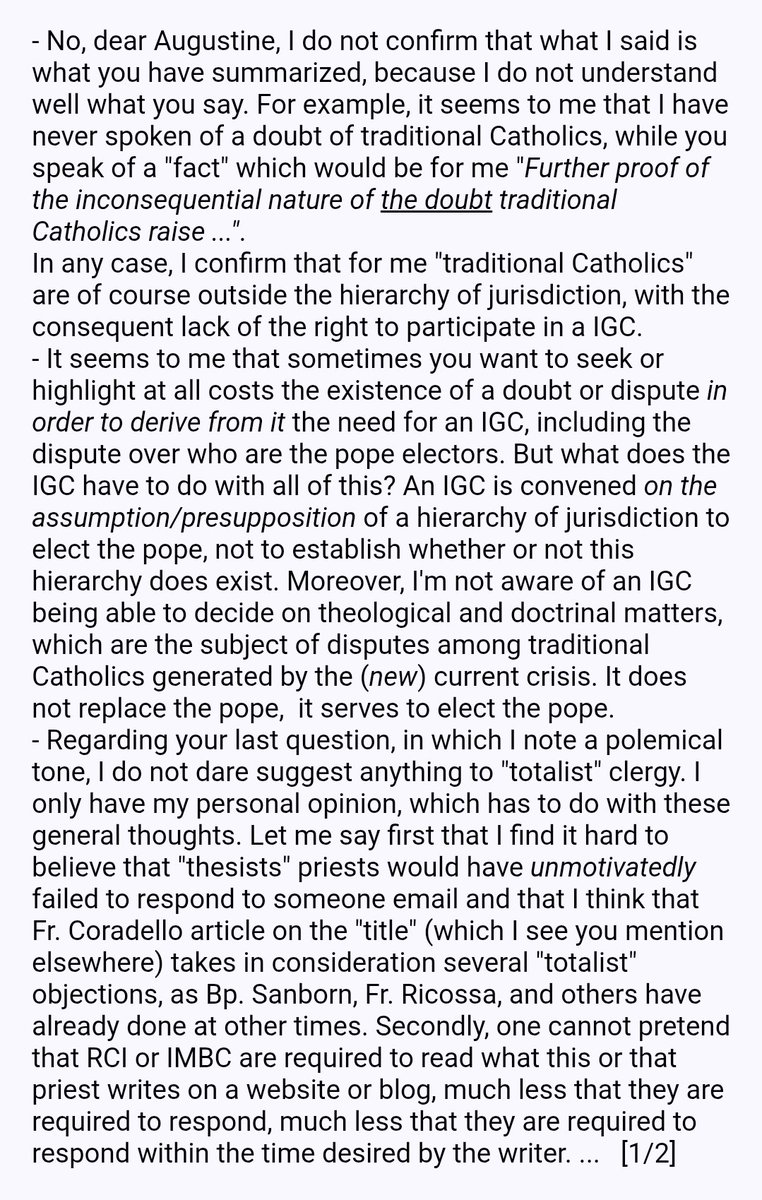
Good argument. In summary, you are arguing that since there is no actual hierarchy today, no objective positive doubt as to the legitimacy of the papal claimant or his electors has been, or can be raised. The disputation traditional Catholics make are inconsequential, since they are outside the hierarchy of jurisdiction. Further proof of the inconsequential nature of the doubt traditional Catholics raise is the fact, as the proponents of the Thesis see it, that traditional Catholic clergy are radically unable to resolve the doubt even if legitimate since they lack jurisdiction in the external forum. Please confirm I understand your argument. I consider it a good argument because I know you make it based on the presumption that traditional Catholic clergy are entirely outside the hierarchy of jurisdiction. Those who accept that traditional Catholic clergy can constitute an Imperfect General Council to resolve the crisis actually all presume the opposite: that traditional Catholic clergy enjoy and exercise jurisdiction in the external forum. As I have written before, this question of jurisdiction in the external forum is a fundamental debate that needs to be resolved, together with the juridcal status of the Novus Ordo Church as a distinct non-Catholic sect. These two form the bedrock principles for an Imperfect General Council by traditional Catholic clergy today. Regarding proper theological discourse, how do you suggest "totalist" clergy and knowledgeable laymen present arguments outside social media for consideration by the IMBC and ICR? Is publishing on a website enough like @FrOkerulu, @TheWMReview, and several others have done? Is sending arguments by email enough as some have done? Or would articles by "totalists" be published on Sodalitium? Please graciously advise what means are welcome for fruitful theological exchange, the type Bp Guérard des Lauriers himself had with the SSPX during his lifetime.
English
1
0
0
56