Germain

1K posts

Germain banner
Germain

Germain

@Gobos_

Building something new - AI to reduce cognitive loads / Scaled SaaS $0-$100M ARR / French American / Sailing, tech, politics

Katılım Mart 2014
1.6K Takip Edilen537 Takipçiler
Germain
Germain@Gobos_·
There's an open question as to who owns the interface with the human...the Foundation Models have started prying eyeballs from Legacy App UIs but I think another path will emerge. Legacy Apps have incumbent advantages and Enterprises shouldn't build workflows on Foundation Model Client Apps this early in the game. The Interface Wars continue...
English
0
0
1
298
Germain
Germain@Gobos_·
@gokulr The Interface Wars…I’d be surprised to see dashboard companies give up their grip on the user so easily.
English
0
0
1
316
Gokul Rajaram
Gokul Rajaram@gokulr·
HEADLESS The reason more “dashboard” software companies will push to become headless stores (that is, become “pipes” companies) is for two reasons: (A) one of the most durable opportunities in software is to become the singular data store for all structured or unstructured context for a certain domain or function (or heck, for the entire organization). (B) once a function or org embraces you as the data store, you price based on compute and storage, and beautifully compound and grow as the org context inevitably explodes over time, the way other compute/storage businesses like Databricks and Datadog have durably and steadily compounded over time. Now, of course, the challenge is that as soon as you open up to 3rd party agents, some of these agents, being venture funded companies themselves and run by ambitious entrepreneurs, will try to suck all the context out of you, reduce you to a CRUD database, and ultimately offer a version of you to their customer for free, bundled with their agents. Meanwhile, you will likely offer your own bundled free or low priced agents as alternatives to the most commonly used third party agents. This war between headless context stores and agentic workflow startups is just starting. Will be interesting to see who can commoditize their complement first.
English
39
39
557
76.4K
Germain
Germain@Gobos_·
@a16z Apps currently hold/own the user through the interface; very surprised to see how many people assume they’ll just give that up.
English
0
0
1
129
a16z
a16z@a16z·
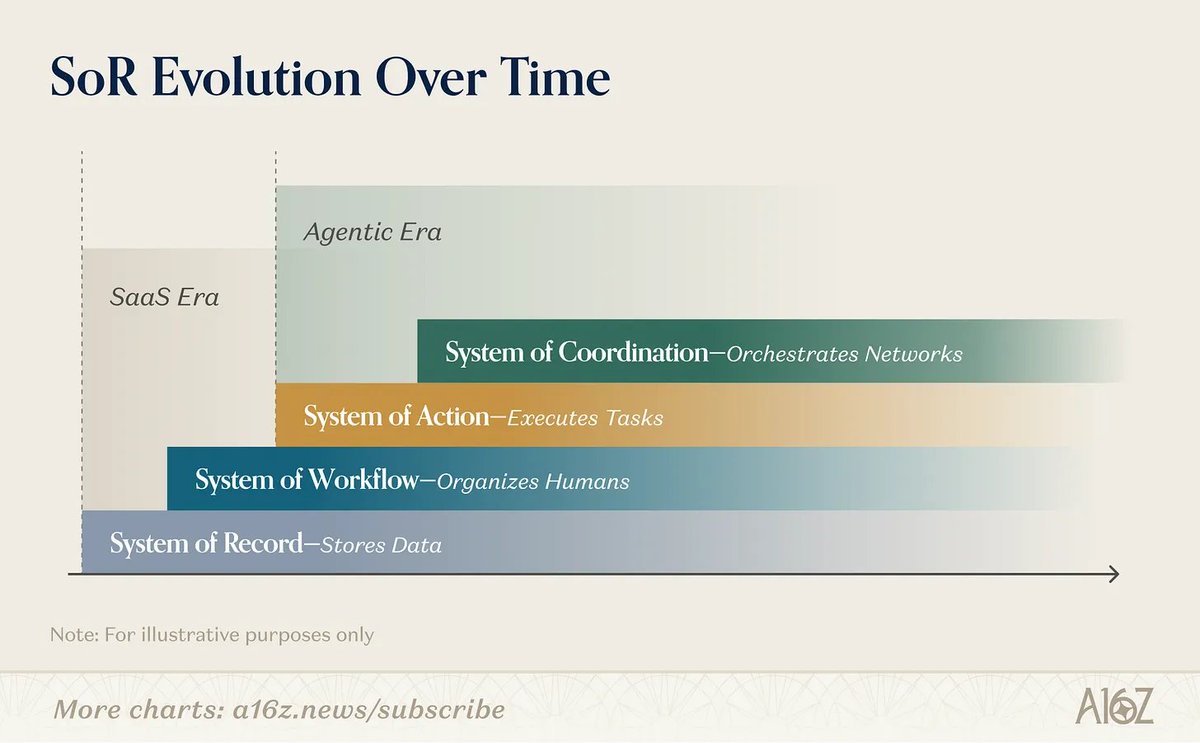
As system of record incumbents shift to headless agents, they are making an implicit bet that the data layer will remain the source of value. Startups will compete on a new set of factors, like proprietary data, owning the action layer, real-world execution, and selling to technical buyers. The next generation of systems of record is already starting to look agentic such that they capture the context, initiate the work, and record the data exhaust. Full piece from a16z's Seema Amble: a16z.news/p/is-software-…
a16z tweet media
Seema Amble@seema_amble

x.com/i/article/2054…

English
33
74
585
134.3K
Germain
Germain@Gobos_·
@edsim Building something new to address this. Model pickers aren’t primarily about iteration & flexibility, they’re freedom & future-proofing.
English
0
0
1
68
Ed Sim
Ed Sim@edsim·
existential question: as every frontier lab, OpenAI, Anthropic, now Google, offers FDEs to solve the enterprise last-mile problem, it gets folks up and running fast. but doesn’t it also accelerate vendor lock-in? Grumblings on token costs are rising...optionality over time will be super important
Matt Slotnick@matt_slotnick

Google Cloud steps up their efforts in the FDE wars with increased hiring and a $750M commitment to their ecosystem transformation partners via @ThomasOrTK

English
23
6
66
21.8K
Germain
Germain@Gobos_·
Agents will (mostly) be an artifact. End-users won’t interact with a bunch of agents…they’ll express intent and the orchestrator will decide whether & which agents are needed. Agents are backend.
English
0
0
2
13
JN Jack | Cold Email
JN Jack | Cold Email@jn_jackk·
Need investor contacts for your startup? I've built a searchable database of 9,000+ investors - angels, VCs, and accelerators you can reach out to immediately. It comes with verified emails, LinkedIn, and even phone numbers. Want access? Like this post Comment "INVEST" Follow me so I can DM you the link I'll send it over ASAP. P.S.: If you are serious about fundraising (now or in the future), you should grab it right away.
JN Jack | Cold Email tweet media
English
611
30
627
48.5K
Germain
Germain@Gobos_·
@jasonfried True. Though probably 90/10 at this point.
English
0
0
0
320
Jason Fried
Jason Fried@jasonfried·
The last 20% isn't most of the work, it's all of the work.
English
99
312
3.1K
143.8K
Germain
Germain@Gobos_·
@bencasnocha @lessin The private chats / networks phenomenon in SF confirm this. The industry has matured from rebels to aristocrats.
English
0
0
0
42
Ben Casnocha
Ben Casnocha@bencasnocha·
Tech is not the underdog anymore. It is the dominant global industry and the central cultural force of our time, as @lessin has pointed out. To work in tech today, in the broad macro sense, is no longer inherently rebellious. It is often the act of someone joining the societally dominant consensus. Within tech, of course, there are still relative Davids and Goliaths. Seed-stage startups, Fund 1 VCs, boutique law firms, and upstart service providers are still the pirates. Big Tech, Big VC, Big Law, Big Anything are the navy. So if you work at Google, Sequoia, or Cooley, you are working in the dominant industry in society at the *macro* level, and at a dominant, safe institution at the *micro* level. That is two layers of establishment safety! And yet many people in Big Tech and Big VC still narrate themselves as rebels. As entrepreneurs. They feel misunderstood by the media, by Washington, by the system. But this is mostly self-flattering mythology. I will say that, as ever, it is more fun to be a pirate than to join the navy...
English
5
4
17
2.3K
Joshua Kushner
Joshua Kushner@JoshuaKushner·
make data centers aesthetically beautiful
English
207
156
2.3K
930.4K
Germain
Germain@Gobos_·
@ajambrosino Yes! CLI and chronological chat are UI regressions…though perhaps necessary to build the new OS with malleable UI, headless apps, Agents, memory
English
0
0
0
356
Andrew Ambrosino
Andrew Ambrosino@ajambrosino·
as we’ve worked on Codex, particularly with the app, this has started to become obvious. feels like a generational moment to rethink fundamental IA/UI assumptions computer use in particular exposes how much of the current OS paradigm is cruft at the same time, there’s been a beautiful simplicity in returning back to local file systems as context after everything became bespoke cloud things— but that’s even more reason to think hard about the OS
Sam Altman@sama

feels like a good time to seriously rethink how operating systems and user interfaces are designed (also the internet; there should be a protocol that is equally usable by people and agents)

English
57
38
890
498.7K
Germain
Germain@Gobos_·
@nicbstme It depends… Voice is high bandwidth for output but vision has higher input throughput; I think. Also “I like the third from the left on the second row” actually takes more time than clicking on the choice.
English
0
0
0
86
signüll
signüll@signulll·
the future interface is probably three layers: 1. ambient intent capture voice, location, calendar, screen context, messages, habits, biometrics, etc. the system understands what you’re trying to do before you explicitly “open” anything or augments your intent deeply. 2. agentic execution the actual work happens through agents operating software, apis, browsers, documents, email, calendars, workflows, payments, support systems, whatever. most “computer use” becomes machine to machine clerical labor. 3. ephemeral verification ux humans still need to inspect, compare, approve, edit, reject, or enjoy things. that’s where gui survives but as disposable, task specific surfaces generated for the moment.
English
130
200
2K
132.1K
Sam Altman
Sam Altman@sama·
feels like a good time to seriously rethink how operating systems and user interfaces are designed (also the internet; there should be a protocol that is equally usable by people and agents)
English
1.8K
780
12.4K
1.6M
Germain
Germain@Gobos_·
This is a big step to replacing the static interface with malleable intent-based UI. Screens are just black mirrors reflecting our goals and creativity.
𝖊𝖉𝖉𝖎𝖊 𝖏𝖎𝖆𝖔@eddiejiao_obj

What if your whole computer were just pixels streamed to you from a model? I’ve been working with @zan2434 and @drewocarr to imagine a version of generative computing that’s much more flexible and visually rich than the GUIs we have today. (Video is sped up and edited)

English
0
0
1
226
Germain
Germain@Gobos_·
Inbox Agents will convert email from a push from the sender to a pull from recipient. Before : Marketing sprays emails hoping to get you at the right time. Tomorrow : Inbox Agent knows when to surface the newsletter that matters regardless of when it was sent. Conclusion : email marketing needs to shift from colorful noise to structured signal.
English
0
0
0
21
@jason
@jason@Jason·
We started an AI founder twitter group... reply with "I'm in" if you're a founder and want to be added
English
10.8K
135
4.6K
903.2K
Germain
Germain@Gobos_·
@Hadley How much would Claude Code be worth on its own? 50b +/- ? How much is the Q4’25/Q1’26 mindshare shift from OAI to Anthropic worth? How much would you pay to be the top Foundation model by usage?
English
0
0
1
310
Hadley Harris
Hadley Harris@Hadley·
I’m just a lowly seed investor, but I don’t get Cursor at $50B. Every frontier dev I know has moved off Cursor and off IDEs entirely. Only laggards are still on it. And dev tools always move from thought leaders to laggards, never the reverse.
English
131
5
328
101.6K