Thierry from arvy 🇨🇭@ThierryBorgeat
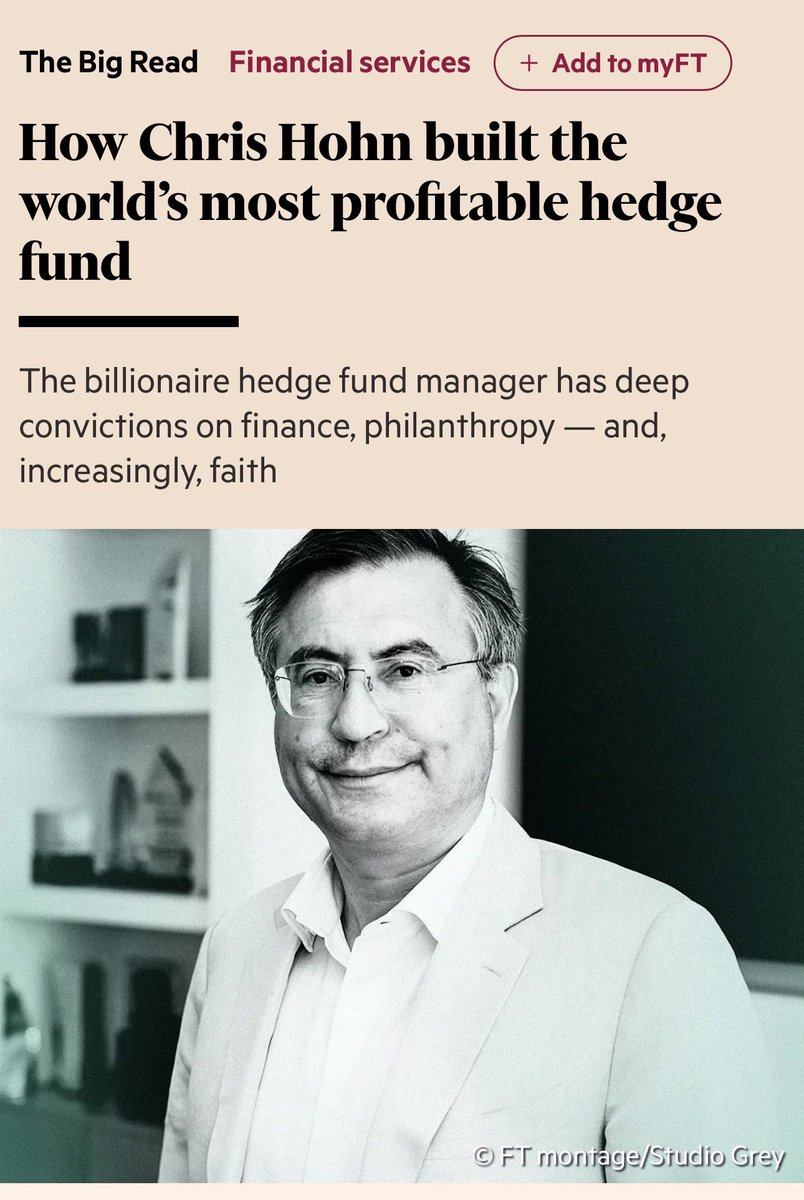
Chris Hohn did a 90-minute sit-down with Nicolai Tangen and then dropped an investor letter the FT got hold of last week.
You’d think the guy who printed a record $18.9B last year would be doing victory laps. Instead he’s quietly rewiring his whole portfolio.
My favorite takes from both:
1.The most important thing in investing isn’t growth. It’s barriers to entry. Growth without a moat is the airline industry: 5% volume growth for 100 years and basically zero cumulative profit.
2.There are only about 200 companies on earth he considers high-quality and investable. His fund holds 15.
3.Average holding period: 8 years. Some positions 13. “You have to hold the company forever, because the stock market may be at very bad prices when you want to sell.”
4.His real test for a moat: can the company price above inflation? A 20% margin business that prices 1% above inflation grows profits 5% faster than revenue. Forever. Almost no companies can do this.
5. Industries he won’t touch: banks, autos, retail, insurance, tobacco, asset managers, fossil fuel utilities, airlines, wireless telecom, media, advertising. On banks: “sooner or later someone without a lot of intelligence comes to run them, and then it can be toxic.”
6.On AI generally: call centers go bankrupt. Indian outsourcing coders are next. But for everyone else, AI lowers costs and raises productivity. Companies with real moats become MORE valuable.
7. Here’s the punchline. The FT got hold of his investor letter. He cut his Microsoft stake from 10% of the fund to 1%. Roughly $8B sold. He’d held it since 2017 through a 400% rally. His reason: AI could disrupt Office and Azure faster than the market thinks.
8.He moved that capital into Alphabet. Doubled it from 3% to 5%. Now his largest tech position. The world’s best quality investor sold Microsoft and bought Google because he thinks Google’s moat is more durable in an AI world. Not the consensus trade.
9.The underlying thesis: “AI eats software.” If AI agents do the work humans used to pay per-seat SaaS licenses for, the whole SaaS model gets re-rated. Oracle, Adobe, Salesforce all ~40% off highs. Microsoft 25% off. Market is starting to agree.
10.When to sell? Not when something gets expensive. When conviction drops. Valuation is one variable, conviction is the other. What kills you isn’t being wrong, it’s permanent loss of capital.
11.He admits hardcore activism doesn’t work anymore. Too much of the shareholder base is passive index funds. And even when activism wins, you usually win in a bad business. “The business always wins.”
12.Counterintuitive take: there are more good companies in public markets than in private equity. The best businesses are too big for PE to buy. And when public companies sell something to PE, they’re selling the assets they want to get rid of.
13.On intuition: “thinking without thinking.” Pattern recognition from 20 years of reps. It’s how he sniffed out Wirecard while the German establishment was defending it. “Most investors trust authority too much.”
14.He basically stopped shorting. “You’re going to be eventually right but not be able to fund the losses.” The first guy to short Wirecard had to cover 19 years before it hit zero. Buffett told him he and Charlie studied shorting and concluded it was too hard.
15.He gives almost everything away. ~$500M a year. $10 prevents an unwanted pregnancy in Africa. $40 saves a child from severe malnutrition. $50 prevents permanent blindness.
16.Tangen asks: advice to young people? Hohn, who runs the world’s most profitable hedge fund: “Go on a spiritual path.” The guy who made $18.9B last year ends the interview saying only purpose and meaning matter.
The headline: the world’s best quality investor just sold his biggest tech compounder because he thinks AI is breaking the moat. Quietly, with conviction, on an 8-year horizon, while everyone else is still buying the AI winners of 2023.