Graham Coop

33K posts

Graham Coop banner
Graham Coop

Graham Coop

@Graham_Coop

Popgen @UCDavis. @[email protected] . Tweets, grammar, & spelling are my views only.He/him. #OA popgen book https://t.co/R6I2dcaEGf

Katılım Temmuz 2012
2.4K Takip Edilen18.5K Takipçiler
Sabitlenmiş Tweet
Graham Coop
Graham Coop@Graham_Coop·
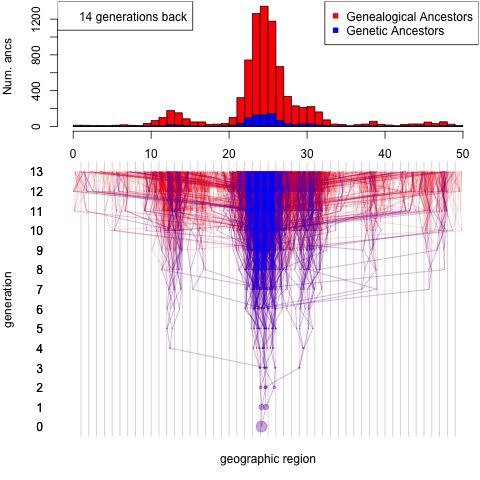
Your ancestors lived all over the world, but relatively few of them were your genetic ancestors (does that matter?) gcbias.org/2017/12/19/162…
Graham Coop tweet media
English
25
291
708
0
Graham Coop retweetledi
Sasha Gusev
Sasha Gusev@SashaGusevPosts·
A few thoughts on Herasight, the new embryo selection company. First, the post below and the white paper imply that competitors like Nucleus have been marketing and selling grossly erroneous risk estimates. This is shocking if true! 🧵
Alex Strudwick Young@AlexTISYoung

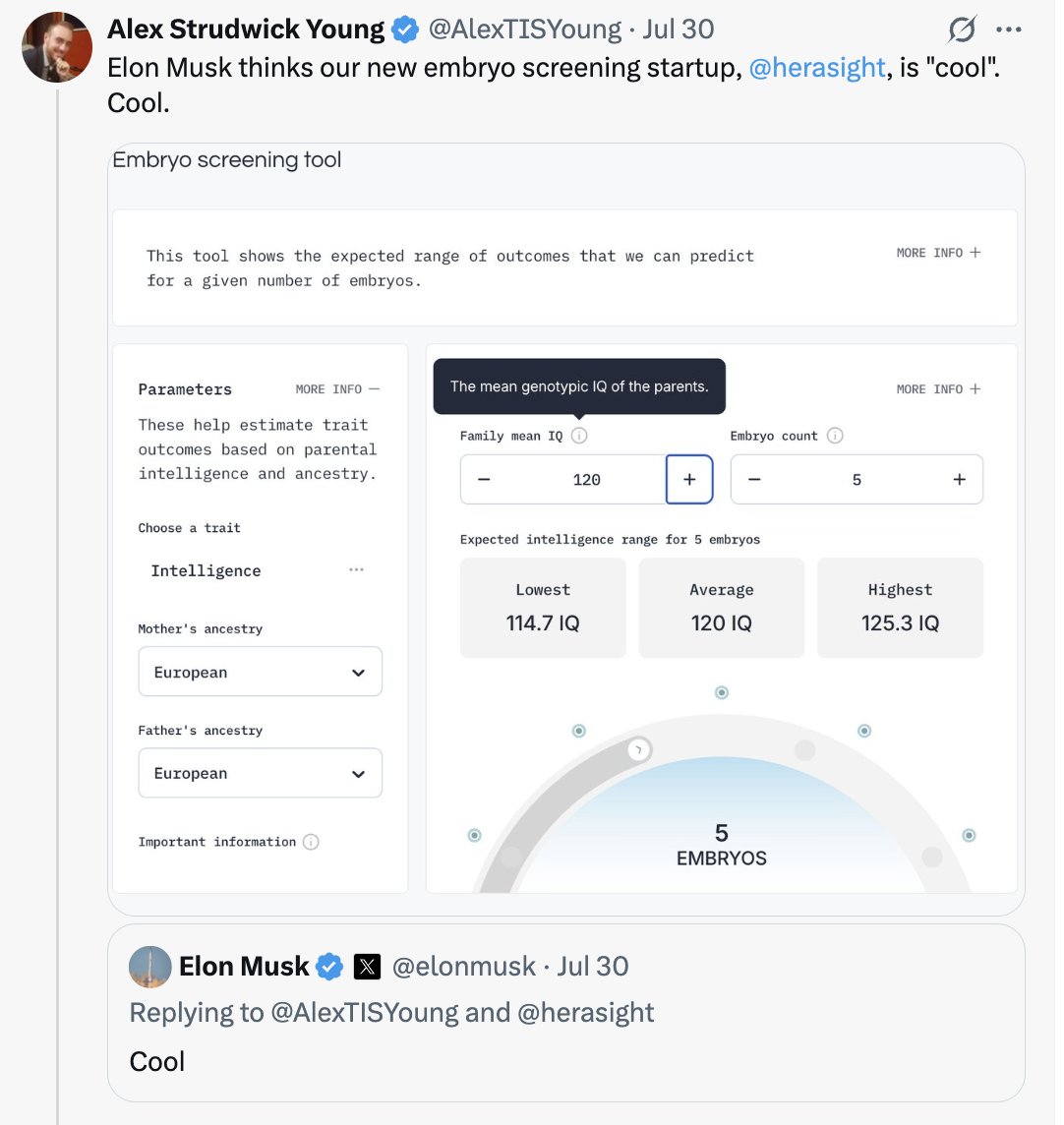
At @herasight, we wanted to compare our genetic predictors (PGS) to those from @nucleusgenomics. However, in many cases, we couldn’t reconcile plausible performance of their PGSs with customer risk reports we saw — this may have misled customers about their disease risks.
English
5
50
298
51.4K
Graham Coop
Graham Coop@Graham_Coop·
These embryo-selection startups are clearly feeding into an alt-right ecosystem that revels in techno-futurism much as such movements have in the past. GWAS participants & parents navigating IVF deserve better than being used as tools to attract the attention of edge lords.
English
0
5
30
4.1K
Graham Coop
Graham Coop@Graham_Coop·
Herasight, named after the goddess who threw her disabled child off a mountain, seems focused on public outreach using embryo selection for IQ to win over far rightwing pseuds & techbros
Graham Coop tweet mediaGraham Coop tweet media
English
2
3
25
2.3K
Graham Coop
Graham Coop@Graham_Coop·
It is depressing, but all too predictable, how swiftly we’ve gone from the Social Science Genetic Association Consortium offering reassurances about the uses of behavioural polygenic scores to one of their lead authors marketing embryo selection for IQ
Graham Coop tweet media
English
6
18
102
13.6K
Graham Coop retweetledi
Kiran Savage-Sangwan
Kiran Savage-Sangwan@ksavage713·
#PrivateEquity owned Global Medical Response is also one of the biggest funders of #Prop35. The same PE firm that bankrupted Toys R Us is coming for our Medi-Cal program. #NoOn35 @healthaccess @JimWoodAD2 @CPEHN @CourageCA
Health Access CA@healthaccess

#PrivateEquity is everywhere. Let's start here: Shell, Exxon, Chevron, Unocal don't own gas stations. They are "Sometimes [owned] by private equity firms and they can raise prices very liberally because -- simply because -- they can" abc7.com/california-gas… 🧵


English
0
2
4
2.8K
Graham Coop retweetledi
Sasha Gusev
Sasha Gusev@SashaGusevPosts·
I wrote a bit about the two very interesting studies of siblings/families from last week. Tan et al. family GWAS (medrxiv.org/content/10.110…) and Sidorenko et al. sibling heritability estimates (nature.com/articles/s4158…). A few surprising findings summarized here: 🧵
Sasha Gusev tweet media
English
2
37
180
41.8K
Graham Coop
Graham Coop@Graham_Coop·
@AlexTISYoung @SashaGusevPosts It's also not obvious why one would be interested in that particular LATE, so it seems easiest to say that unbiased estimates of the effects from family studies require that heterogeneity in effect sizes is random wrt genotypes. 4/n
English
1
0
2
392
Graham Coop
Graham Coop@Graham_Coop·
@AlexTISYoung @SashaGusevPosts As you say, we show that for a single causal allele, family studies provide an unbiased estimate of the average allelic effect in the children of heterozygotes (a LATE). But I don’t think that's what people think of when they hear that it is an “unbiased estimate of a DGE” 3
English
1
0
2
319
Alex Strudwick Young
Alex Strudwick Young@AlexTISYoung·
Thanks for a nice writeup @SashaGusevPosts! A few comments: 1. "Though, it is worth noting, the family GWAS can also introduce some biases by effectively only testing the children of heterozygous parents at each variant (see: [Veller, Przeworski, Coop, (2024)] for more), or due to cross-sibling effects or non-random mating." I don't agree with this reading of Veller, Przeworski, and Coop, which I reviewed for PNAS. They show that FGWAS estimates a 'local average treatment effect', i.e. the average effect of the allele in families with heterozygous parents. This can be different from the average treatment effect (across all parents) under certain scenarios, but FGWAS does not 'introduce bias' in the sense that standard GWAS also does not estimate the average treatment effect when there is heterogeneity of effects across families w.r.t. heterozygosity. Whether non-random mating can introduce bias into FGWAS effects depends upon exactly how you define your estimand: it doesn't introduce confounding, but can you mean pick up the direct genetic effects of more distant variants on the same chromosome, particularly when the population is out of equilibrium. The practical relevance of this or whether it is truly conceptually distinct from local LD (which we typically don't think of as bias) remains to be shown. 2. The unusually high heritability of smoking in our study may be a scale phenomenon. We transformed effects onto the logistic scale before meta-analyzing them and applying LDSC, so the heritability estimates apply to the logistic scale not the observed. If there's something wrong with what we did or there's a better way of doing this, I'd be happy to hear it. I don't think comparing to cigarettes-per-day is particularly meaningful since cigarettes-per-day is restricted to former and current smokers so is looking a phenotype conditional on your answer to whether you ever smoked. Furthermore, people's answers to cigarettes-per-day are quite variable and likely noisy compared to the true underlying trait. 3. I agree with you about finding the negative direct-NTC correlations somewhat mysterious. While it seems plausible this could result in deflated h2 estimates from standard GWAS population effects, we don't seem to see much evidence for that yet. 4. Your re-analysis of cognitive performance summary statistics with stratified-LDSC is interesting, and I'm glad to see the summary statistics are already being used. However, I'm not totally convinced that stratified-LDSC is an improvement. Hou et al., whom you cite, state "across 126 distinct architectures...stratified LD score regression (S-LDSC) and SumHer yield biases between −64% and 28%". So might you be replacing an upward biased estimator with a downward biased one? Could be worth trying SumHer too. This complexity is part of the reason I prefer IBD based heritability estimators to SNP heritability estimators, although Sidorenko et al. show that even IBD based estimators need to account for recombination rate dependency!
Sasha Gusev@SashaGusevPosts

I wrote a bit about the two very interesting studies of siblings/families from last week. Tan et al. family GWAS (medrxiv.org/content/10.110…) and Sidorenko et al. sibling heritability estimates (nature.com/articles/s4158…). A few surprising findings summarized here: 🧵


English
2
13
65
20.4K
Graham Coop
Graham Coop@Graham_Coop·
Looking for examples for class of STRUCTURE-style bar plot of hunter gather, early farmer, and steppe ancestry proportions for Europeans. Arranged temporally to shows various turn overs. Looking for something broad in temporal scope but simple enough to talk undergrads through.
English
4
0
9
3.9K
Graham Coop
Graham Coop@Graham_Coop·
@GregorGorjanc Thanks. I’m using that but I also want to show some structure-like bar plots before showing the spatially interpolated version
English
0
0
0
205
Gregor Gorjanc
Gregor Gorjanc@GregorGorjanc·
@Graham_Coop See chap3.4 from Pritchard’s book - he got pic from someone that shows time and x-y plane with a lattice of plots. Very clear!
English
1
0
0
335
Graham Coop
Graham Coop@Graham_Coop·
@Urbaninski93 I like that one, but it doesnt show the turn over from WHG to Early famers.
English
0
0
0
265
Graham Coop retweetledi
Jonathan Pritchard
Jonathan Pritchard@jkpritch·
Chapter 3.4 describes how ancient DNA has reshaped our understanding of the human past.
Jonathan Pritchard tweet media
English
1
7
37
16.7K
Graham Coop retweetledi
Jonathan Pritchard
Jonathan Pritchard@jkpritch·
Two new chapters from my free online book in human genetics out this weekend! These complete Part 3 of the book, on human population structure and history: 3.3: Inferring human prehistory from genetic data [this thread] 3.4: Ancient DNA [next thread] web.stanford.edu/group/pritchar…
Jonathan Pritchard@jkpritch

I'm delighted to release the first half of my new open-access online textbook in human population genetics: web.stanford.edu/group/pritchar…

English
6
169
587
61.7K
Graham Coop
Graham Coop@Graham_Coop·
@SashaGusevPosts @jrossibarra Even in simple cases we never got it fully calibrated, nor have better implementations done so IIRC, as while better it not the right model for > amounts of drift. So many people take just an emp. outlier approach, show overlap reasonable genes, but avoid strong abs # statements
English
1
0
1
442
Sasha Gusev
Sasha Gusev@SashaGusevPosts·
@jrossibarra I think that would be the more appropriate model, but it would need to be augmented to work at the individual-level (instead of frequencies) and also handle complex technical/admixture structure.
English
2
0
1
566
Sasha Gusev
Sasha Gusev@SashaGusevPosts·
There was an interesting discussion earlier in the week as to whether a linear mixed model can provide a calibrated test for selection in the presence of drift alone. This is actually pretty straightforward to simulate to let's take a look: 🧵
Sasha Gusev@SashaGusevPosts

@A_A_Zaidi @jgschraiber @epigenci I think there are two interesting questions here: (1) If you just have evenly sampled data from neutral populations, does the GRM capture drift well enough to produce a calibrated test. I.e. if you simulated data from two drifted populations and put it in the model, would you ...

English
1
14
73
28.6K