@AndyMasley Mine was learning it's "daylight saving time" not "daylight savings time". Immediately knew I would be dining out on that factoid for a long time.
I vaguely recall the first time I was ever extremely pedantic was in late 1999 when a friend was excited about the year 2000 and I was really into sharing the fact that the new millennium didn't really start until 2001. First little rush.
A new report claims that the APOE gene alleles accounts for the vast majority of Alzheimer's cases:
"Without strong underlying risks from APOE ε3 and ε4, almost all AD and half of all dementia would not occur."
nature.com/articles/s4440…
"Scientists who revolutionized cystic fibrosis treatment win prestigious Lasker Award" statnews.com/2025/09/11/las…
1. The blood, sweat and tears of the families and scientists working on CF is described in the incredibly moving book Breath from Salt -- the life expectancy chart (below) shows the outcome but not the unreal effort over decades. amazon.com/Breath-Salt-Pa…
2. With genetic/reproductive technologies like carrier screening and embryo selection, in 100 years people will be able to read about CF and other genetic diseases (and these CF drugs) the way today we read about polio and iron lungs.
@johnmilbank3 Early stages are fragile and would be destroyed by existing life. Yes they do, at least all extant life. Yes it has, e.g. all share mechanisms like RNA/DNA that are vanishingly unlikely to evolve more than once. Generally, evolution does not proceed through massive mutations.
If life once emerged from non-life, and animal life from vegetable life, why can’t that happen again later in the emergence of new species? Do they really all evolve from older ones? Has this been shown? Has *any* clear massive mutation ever been demonstrated for certain?
More fear mongering. Is there any documented case of a regular innocent person having suffered anything whatsoever by doing 23andMe or indeed any sort of consumer genetic test?
washingtonpost.com/technology/202…
@doctorveera I don't think that's true. If I'm reading it correctly, in MVP they define hypogonadism as having T less than about 0.5sd below the mean. In UKB they define it as having ICD code E29.1; those seem to be completely different things.
Interesting GWAS of hypogonadism (testosterone deficiency) in the Million Veteran Program (MVP) biobank. The thing that struck me is the contrast in the prevalence of hypogonadism between MVP and UK Biobank: 25% in MVP vs 0.09% in UKB. Cool example of difference in prevalence of clinical conditions between hospital-based cohort (MVP) and healthy volunteer-based cohort (UKB).
Pagadala et al. Nat Comm
nature.com/articles/s4146…
Missed this earlier in the year showing an increase in Neanderthal ancestry by using a higher quality reference genome from the Telomere-to-Telomere project. Also previously unrecognized biases resulting from quality filters in 1000 Genomes.
doi.org/10.1101/2024.0…
@joe_pickrell@AlexTISYoung@vagheesh I don't think there's any (? certainly not much) aDNA from Finland from the last few thousand years. Definitely not enough data to estimate those sorts of allele frequencies.
@mathiesoniain@AlexTISYoung@vagheesh right thanks. do you know if there is ancient dna data on this variant in finland? prediction would be that if there was a bottleneck or similar ~100 generations ago, it started at low/negligible frequency, bumped up to ~2%, and has been declining since then?
@vagheesh@AlexTISYoung@joe_pickrell@genesandhealth Well but the effective selection coefficient is only 0.01 (actually 0.005, since it has no effect in males) here - it will still take a long time to be removed, compared to, say, an additive variant with s=0.1.
@mathiesoniain@AlexTISYoung@joe_pickrell how long ago was the Finnish bottleneck? here it seems to me that s >> 1/Ne, so it should be purged fast. In @genesandhealth, I calculated that rare LoFs (which are much less deleterious than this) have been quite purged rapidly
@AlexTISYoung@vagheesh@joe_pickrell Exactly, the expected frequency change is ~ 1e-4 per generation, so once the bottleneck pushes the frequency up, it will take a long time to remove it.
If it's recessive though isn't the relevant frequency closer to 1/10^4? Given the small founder population, selection against a recessive at this frequency maybe wasn't so effective. There are quite a few highly deleterious alleles with dominant/additive effects at 10^(-4) frequencies in founder populations, right?
@ChrisStringer65 A scenario in which OoA occurs pre-70ka, a part of the OoA population admixes with Neandertals ~50ka and a (Basal Eurasian) part does not, and Eurasians are descended primarily from the first part, but West Eurasians also from the second seems quite plausible
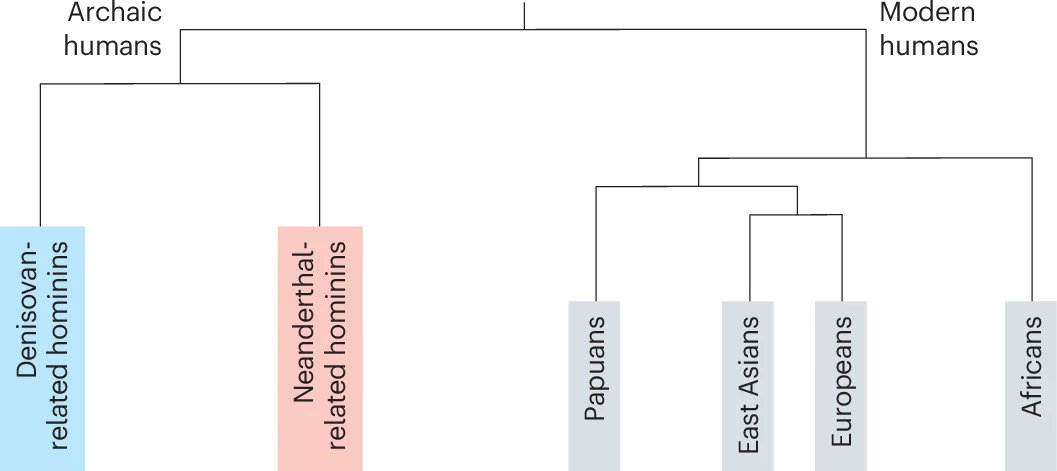
Interesting review paper on denisova introgression into modern humans, but is having Papuans as an outgroup to East Asians and Europeans correct? Is this really the topology (without any introgression)?