Grayson Hoteling

1.6K posts

Grayson Hoteling

Grayson Hoteling

@GraysonHoteling

The Gray Area on Substack🔋 ⬇️

Katılım Ekim 2012
735 Takip Edilen413 Takipçiler
Grayson Hoteling retweetledi

bee🐝
bee🐝@0xbeehive·
WARREN BUFFETT IS NOT TRADING THIS MARKET Two times in history Buffett went this defensive Both times the market crashed hard shortly after In 1999 he said - "Euphoria is the enemy" He was right The Nasdaq dropped 75% and didn't recover for 12 years Now in 2026 he says - "We've never had people in a more gambling mood than now" Same warning. Different bubble And this time his portfolio is screaming louder than his words: - Sell-to-buy ratio - 15:1 - $397 billion in cash The man who called the dot-com crash is not buying a single thing If you can trust one guy in this game, it’s Warren Buffet FOLLOW + NOTIFS ON!
English
69
91
429
105.7K
Grayson Hoteling retweetledi
Henrik Zeberg
Henrik Zeberg@HenrikZeberg·
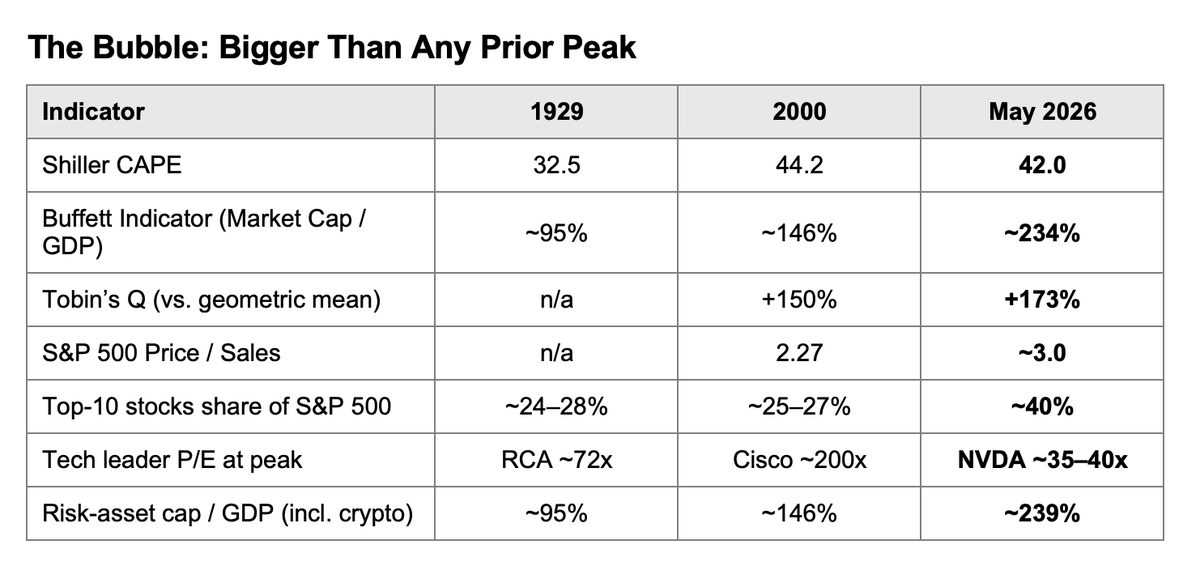
Congratulate yourself!👏👊 We are living in extraordinary times. The Market Bubble is the Largest we have ever seen! We did it! Now - let's push it a bit further before it pops.
Henrik Zeberg tweet media
English
11
69
520
22.9K
Grayson Hoteling retweetledi
The Kobeissi Letter
The Kobeissi Letter@KobeissiLetter·
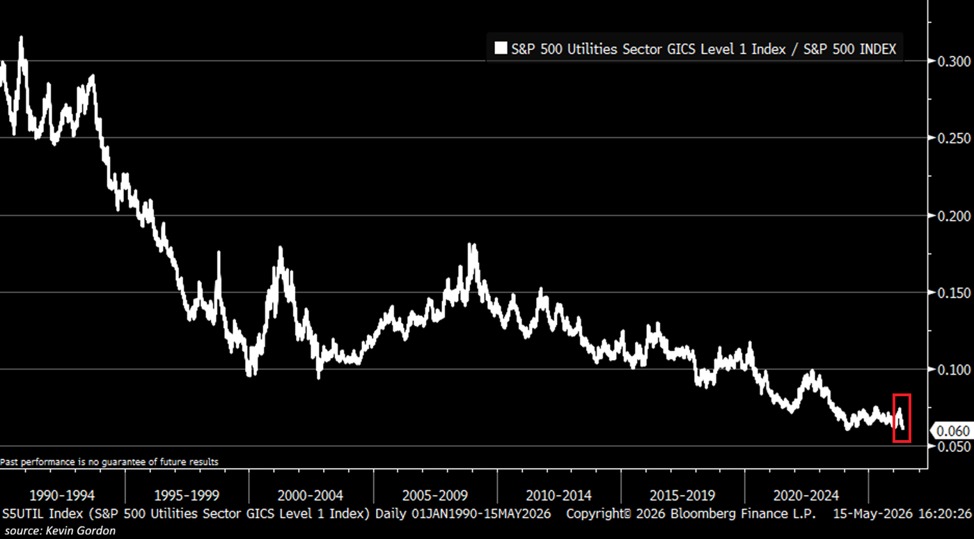
Defensive sectors are experiencing historic relative weakness: The S&P 500 utilities sector relative to the S&P 500 is down to a record low ratio of 0.06. This ratio has declined -40% since the 2022 bear market. Over this period, the S&P 500 has rallied +106% while the utilities sector index has increased just +38%. By comparison, during the 2008 Financial Crisis, the ratio was +200% higher, at ~0.18. Meanwhile, consumer staples, healthcare, and utilities collectively now account for just ~15% of the S&P 500’s market cap, the lowest since at least the 1970s. Defensive sectors are historically unpopular right now.
The Kobeissi Letter tweet media
English
385
121
904
157K
Grayson Hoteling retweetledi
Lance Roberts
Lance Roberts@LanceRoberts·
Here’s a look at stock market concentrations during historical bubbles.
Lance Roberts tweet media
English
22
56
221
44.9K
Grayson Hoteling retweetledi
Handre
Handre@Handre·
Roosevelt's 1933 gold confiscation stands as the most brazen theft in American economic history. Executive Order 6102 forced citizens to surrender their gold coins, bullion, and certificates to the government at $20.67 per ounce under threat of $10,000 fines and ten years imprisonment. The government then immediately revalued gold to $35 per ounce, pocketing a 69% gain on wealth stolen directly from American savers. Roosevelt's stated justification was ending the Great Depression. His actual target was monetary freedom itself. Gold represented the ultimate constraint on government spending and money printing. Citizens holding gold could escape currency debasement by converting dollars into real money. This terrified a political class desperate to finance massive new spending programs without the inconvenience of taxation or borrowing at market rates. The mechanics reveal the operation's true nature. Roosevelt declared a "bank holiday," closed all banks, then announced that reopening required surrendering gold reserves. Citizens faced a choice: comply or lose access to their own bank accounts. Meanwhile, the Treasury exempted itself, foreign governments, and certain industrial users. Jewelry and small amounts remained legal, but only because confiscating wedding rings would have triggered outright rebellion. Free market economists warned this would unleash permanent inflation and government expansion. They were right. Removing gold backing eliminated the final restraint on Federal Reserve money creation. What followed was decades of currency debasement, with the dollar losing over 95% of its purchasing power since 1933. The precedent remains active law today under the Trading with the Enemy Act. Your government already granted itself the power to confiscate your savings whenever "emergency" provides sufficient cover.
Handre tweet mediaHandre tweet media
English
40
312
820
30.9K
Grayson Hoteling retweetledi
Lance Roberts
Lance Roberts@LanceRoberts·
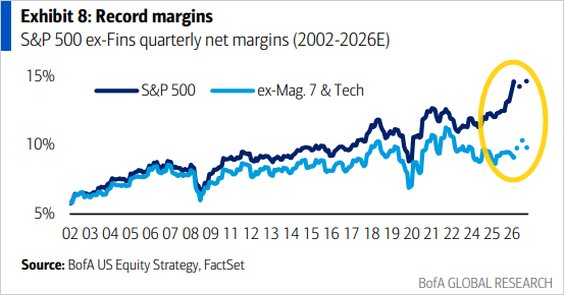
The record levels of profit margins in the S&P 500 are entirely due to just 7 stocks. The other 493, not so much.
Lance Roberts tweet media
English
9
60
262
52K
Grayson Hoteling retweetledi
Lance Roberts
Lance Roberts@LanceRoberts·
Negative view: Capital spending is surging at the expense of cash generation. Positive view: Companies are heavily investing capital into productive investments that will yield future revenue growth and profitability.
Lance Roberts tweet media
English
10
13
66
5.6K
Grayson Hoteling retweetledi
Macro Liquidity by Sunil Reddy
Macro Liquidity by Sunil Reddy@Macrobysunil·
In 1967, Indira Gandhi appealed to Indians: “Don’t buy Gold.” The reason was that India’s foreign exchange position was under stress, imports were becoming difficult, and the currency system needed people to show “national discipline.” But what followed? One of the biggest Gold bull markets in history. From the late 1960s to 1980, Gold exploded higher globally, and in rupee terms the move was even more brutal. This is the real lesson: When governments tell citizens not to buy Gold, they are usually not worried about your jewellery. They are worried about pressure on the currency, pressure on reserves, and pressure on the financial system. Gold doesn’t become important when everything is normal. Gold becomes important when the system starts asking you not to buy it.
Macro Liquidity by Sunil Reddy tweet media
English
88
457
1.7K
303.4K
Grayson Hoteling retweetledi
StockCats
StockCats@RealStockCats·
forever
StockCats tweet media
English
106
97
1.3K
187.7K
Grayson Hoteling retweetledi
Kalani o Māui
Kalani o Māui@MauiBoyMacro·
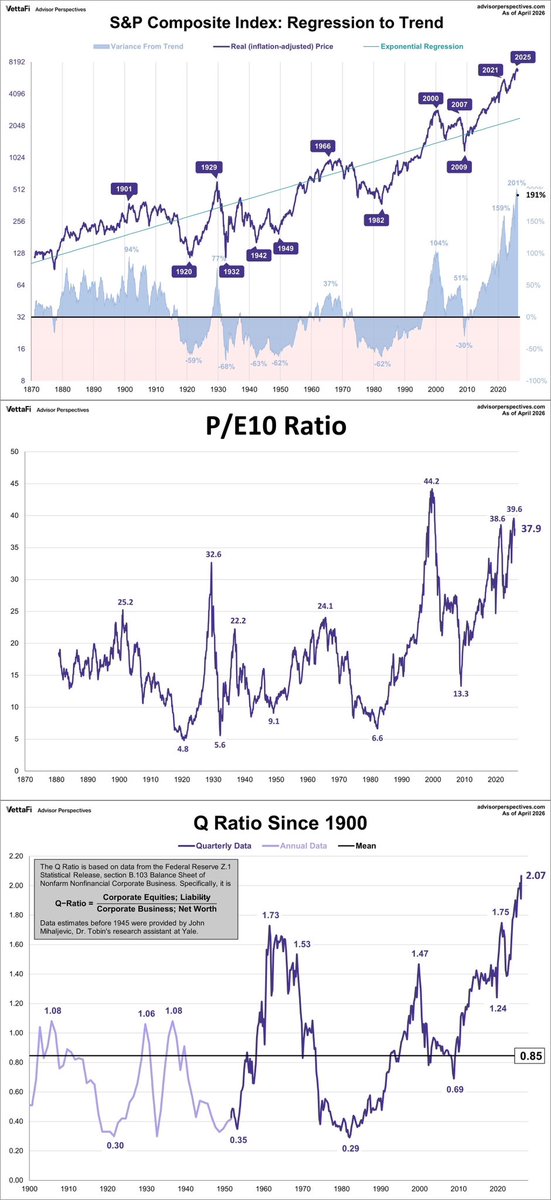
“.. valuations today are not nearly as extreme as they were at the end of 1999. Full stop.” What are you talking about Dan? 👇🏼 At the end of April, the inflation-adjusted S&P Composite Index is 191% above its long-term trend. The historic average for the P/E10 (CAPE) is 17.7. The latest ratio of 37.9 is 69% above its long term trend line. As of April, the latest Q Ratio is 2.07, 144% above its historic average and at the highest level in history.
Kalani o Māui tweet media
Dan Greenhaus@DanGreenhaus

This is a perfectly legitimate point by @RealJimChanos. Too often people dismiss comparisons to the 90s tech rally by saying how strong earnings are or how much "better today's companies are. Thats not entirely accurate. The most accurate observation is simply that valuations today are not nearly as extreme as they were at the end of 1999. Full stop. But thats why focusing on whether this is a "bubble" or not is pointless. How big can the bubble get? When will it end? Who will win? How high is "too high?" Nobody can answer those questions. Better to wait for indications its ending or slowing. As best as I can tell, we have no such indications.

English
6
16
51
5.6K
Grayson Hoteling retweetledi
Kalani o Māui
Kalani o Māui@MauiBoyMacro·
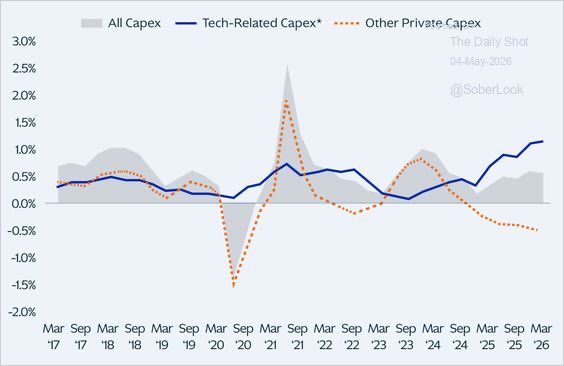
One sector of the economy is (barely) keeping the entire economy afloat. 👇🏼 Chart: KKR - @SoberLook
Kalani o Māui tweet media
English
3
5
25
872
Grayson Hoteling retweetledi
Kacper Piotr Kaminski
Kacper Piotr Kaminski@Kacper_PK_CH·
Fertilizer shortage and El Niño. 👇
Ole S Hansen@Ole_S_Hansen

#Agriculture: Adding to the current fertilizer shortage, which has already raised concerns about global crop yields, NOAA confirms that ENSO-neutral conditions are expected to persist through June 2026 before transitioning to an El Niño from July with a 75% probability - potentially one of the strongest in a generation - raising the risk of droughts and floods in key producing regions, depending on location.

Español
3
7
63
8K