nate bennett

133 posts

nate bennett banner
nate bennett

nate bennett

@H3xanK

Building secure, intelligent systems | AI workflows • Full-stack engineering • Open source advocate • Quantum User Experiences • Opinions expressed are my own

🌴 Pacific Time Katılım Nisan 2024
332 Takip Edilen16 Takipçiler
nate bennett
nate bennett@H3xanK·
“which path do you want to take?” -> “Capture and reverse-engineer the bad packet”
English
0
0
0
3
nate bennett retweetledi
ᴅᴀɴɪᴇʟ ᴍɪᴇssʟᴇʀ 🛡️
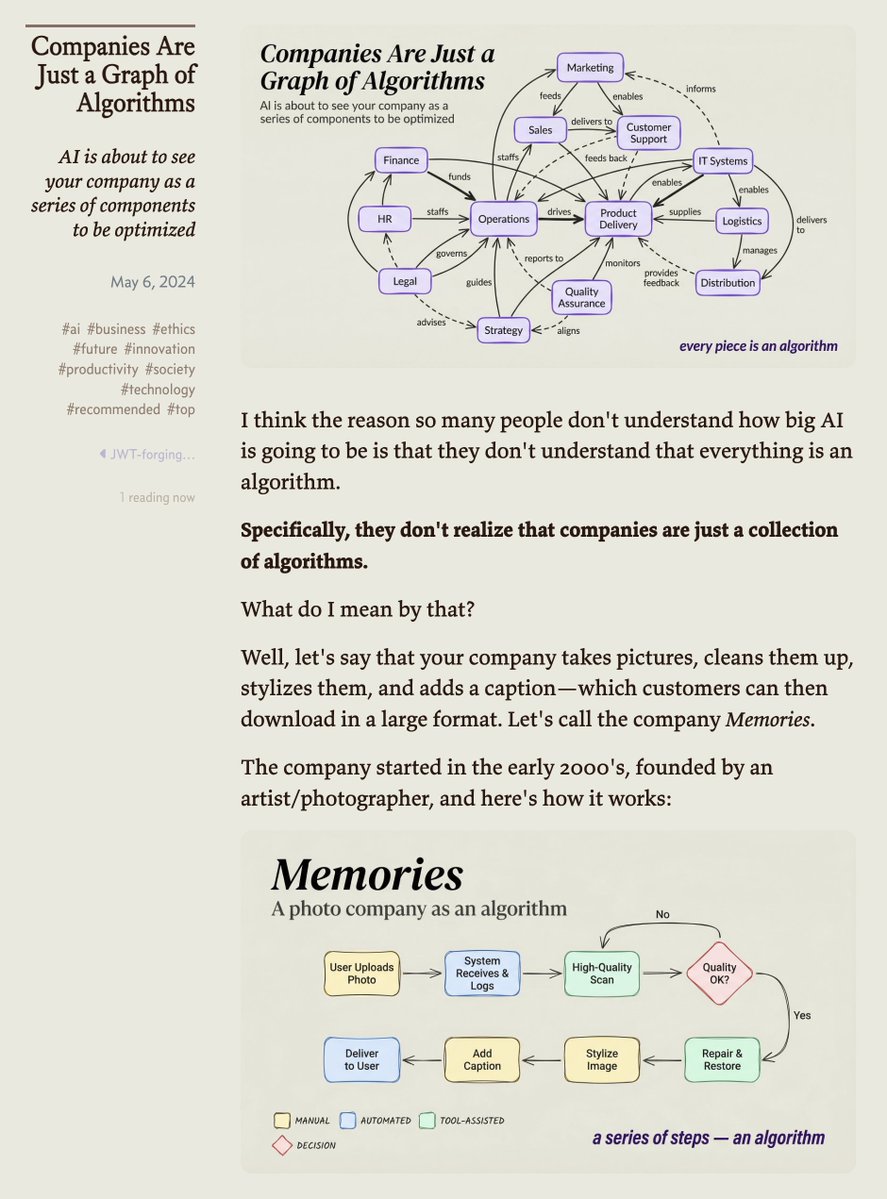
Claude Code is about to release a feature called /workflows that I think will be extremely significant. Especially for Enterprise AI. I talked about this in 2024 in a post called Companies Are Just Graphs of Algorithms. Basically the idea is that all work is just an algorithm, i.e., a series of steps to accomplish a goal. Skills and Cowork have been heading in this direction already, and we've seen what that's done to company valuations in various spaces. Well this is closer to the final form. It's turning the regular, expected work that's done in companies into pseudo-deterministic workflows that follow defined SOPs. The human role will be determining what problems to solve (taste, expeirence, etc), building new products from that, and then optimizing these workflows from above. But the work itself will be these workflows executed according to SOPs.
ᴅᴀɴɪᴇʟ ᴍɪᴇssʟᴇʀ 🛡️ tweet media
English
205
428
3.1K
295.7K
nate bennett
nate bennett@H3xanK·
I have an ssh session using CC remote control from the ssh host, sort of wild it all works
English
0
0
0
7
nate bennett retweetledi
CyrilXBT
CyrilXBT@cyrilXBT·
THE CEO OF Y-COMBINATOR JUST SAID SOMETHING THAT SHOULD MAKE EVERY PROMPT ENGINEER UNCOMFORTABLE. "When someone asks how I prompt my AI, the answer is: I don't. The skills are the prompts." Garry Tan is not talking about better prompting. He is talking about replacing prompting entirely. Here is what he means and why it changes everything. A prompt is something you write every time. A Skill is something you write once and call forever. The difference sounds small. The compounding effect is enormous. Every hour you spend rewriting the same complex prompt from scratch is an hour you could have spent building the Skill that eliminates that prompt permanently. The builders operating at the highest level are not better at prompting. They have stopped prompting entirely. They have a library of Skills that handle every repeating workflow automatically. Type one word. The Skill runs. The output appears. Same quality every time. Here is the 7-day path Garry laid out: Day 1: Read the Skillify 11-item checklist. Day 2: Watch "Don't Build Agents. Build Skills Instead." Day 3: Read "Designing, Refining, and Maintaining Agent Skills at Perplexity." Day 4: Clone GBrain. 30 battle-tested Skills ready to deploy. Day 5: Add GStack. 23 slash-command Skills drop right in. Day 6: Do one workflow. Type /skillify. Watch it become permanent. Day 7: Everything you do more than once is now a Skill. Prompting is the manual labor of the AI era. Skills are the automation layer. The people who make this shift in the next 30 days will not be prompting in 2027. They will be operating. Bookmark this. Follow @cyrilXBT to master every Claude skill system that compounds over time.
CyrilXBT@cyrilXBT

x.com/i/article/2052…

English
50
103
810
137.4K
nate bennett
nate bennett@H3xanK·
my setup has gone totally hyprbolic with Omarchy + local inference + slack bots
English
0
0
0
23
nate bennett retweetledi
Umesh Kumar Yadav
Umesh Kumar Yadav@Umesh__digital·
Dennis Ritchie created C in the early 1970s without Google, Stack Overflow, GitHub, or any AI ( Claude, Cursor, Codex) assistant. - No VC funding. - No viral launch. - No TED talk. - Just two engineers at Bell Labs. A terminal. And a problem to solve. He built a language that fit in kilobytes. 50 years later, it runs everything. Linux kernel. Windows. macOS. Every iPhone. Every Android. NASA’s deep space probes. The International Space Station. > Python borrowed from it. > Java borrowed from it. > JavaScript borrowed from it. If you have ever written a single line of code in any language, you did it in Dennis Ritchie’s shadow. He died in 2011. The same week as Steve Jobs. Jobs got the front pages. Ritchie got silence. This Legend deserves to be celebrated.
Umesh Kumar Yadav tweet media
English
182
1.2K
5.8K
128.7K
nate bennett retweetledi
Cheng Lou
Cheng Lou@_chenglou·
Test-driven development is cool again
English
24
19
184
16.2K
nate bennett retweetledi
Jeffrey Emanuel
Jeffrey Emanuel@doodlestein·
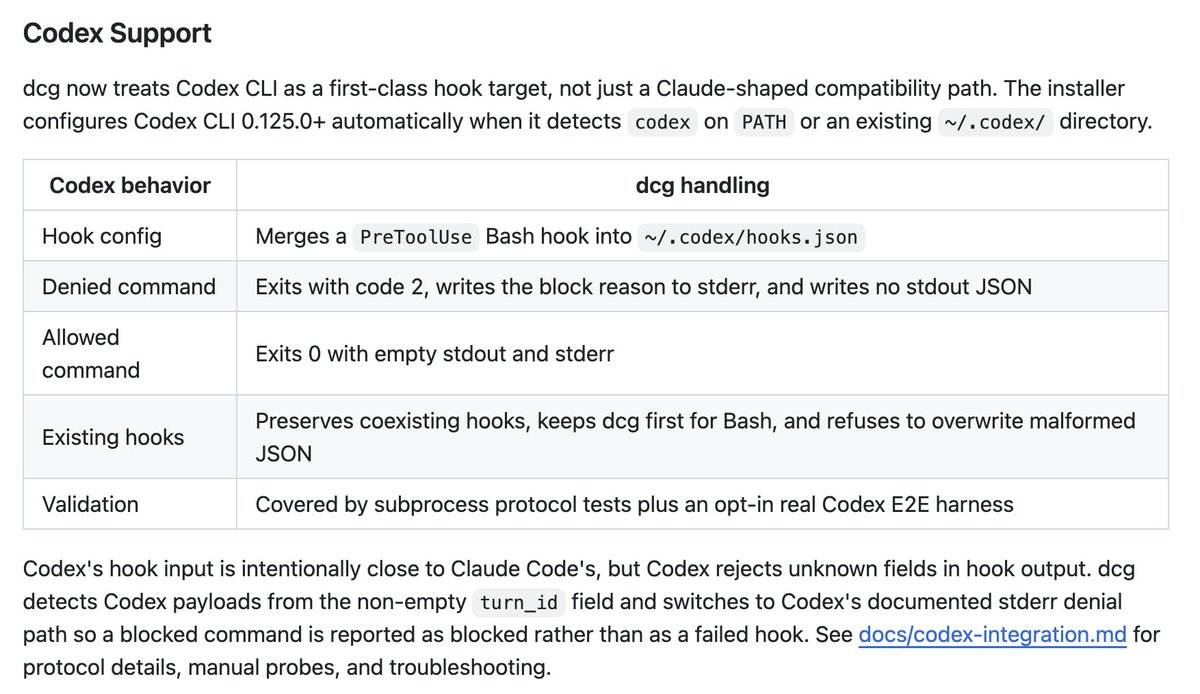
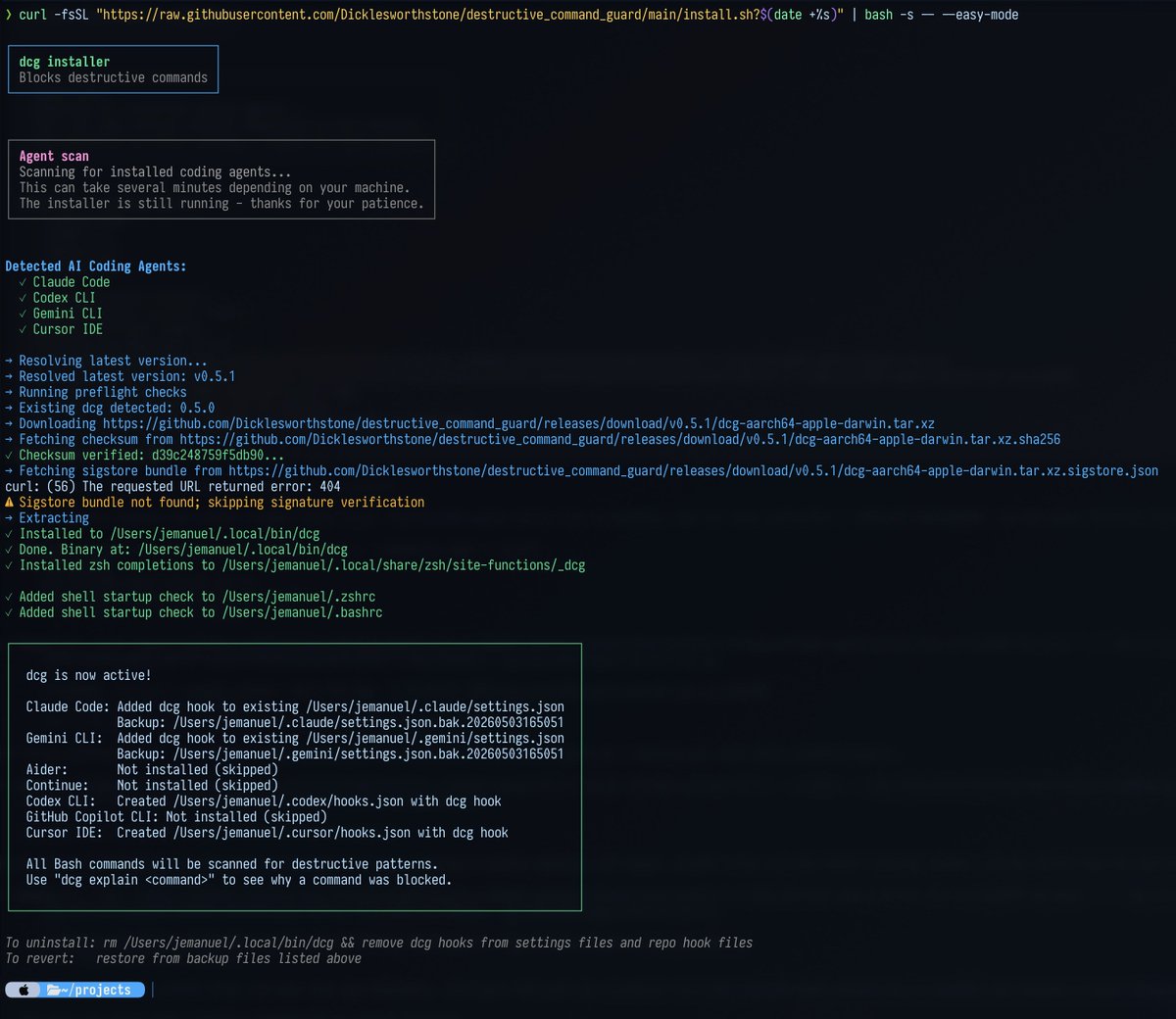
It's now been around 4 months since my open-source dcg tool was first released, and I know from hearing from tons of users that it has saved countless people from disaster at the hands of overeager Claude Code agents. I've continued to make various performance improvements and added additional preset packs to the project, most recently for the Railway API after the recent and infamous incident where someone blamed Claude for wiping their production database. Because of the way dcg is implemented as a "pre-tool-use hook" in Claude Code, there was no way to use it in Codex, since Codex didn't support that kind of hook at all. Until a week or so ago, when they finally added it. So I'm now pleased to say that the latest version of dcg has full support for Codex (plus it also works for gemini-cli if anyone is really using that outside of the 'Plex!). If you're not familiar with dcg yet, I highly recommend checking it out. It's unthinkable to me now to use any coding agent that doesn't support it; it feels like speeding on the highway without a seatbelt on (or more accurately, with a sharp knife strapped to the steering wheel pointed at your heart). Agents just can't be trusted to not occasionally do crazy things that seem sensible to them at the moment, but which are wildly destructive and often irreversible. These bouts of temporary madness often occur soon after compactions, or as a result of context rot caused by excessively long sessions. Not only does dcg mechanically prevent the agents from being able to do that, it explains to them why it did that specifically, and offers them safe alternatives custom-tailored to the specific commands they tried to run. The more agents you have running at the same time on the same project, the more dcg goes from a nice thing to have to being totally indispensable if you don't want to constantly worry about one rogue agent wiping out the work of the other agents with a misguided "git reset --hard HEAD" command. The dcg utility itself is written in hyper-optimized, memory-safe Rust and uses minimal system resources. Because it's totally mechanical (unlike the auto-approve feature in Claude Code, which uses an AI model that adds latency), you can't even notice any delay from it running on every command. dcg is NOT just a cookbook of canned forbidden commands; frontier models are too smart and resourceful to actually be constrained by such a simplistic approach. When they're prevented from running a command one way, they'll try another way; if that also doesn't work, they'll whip up an ad-hoc Bash script or Python program to do what they want. But dcg can detect that as well using its advanced ast-grep mode (which only kicks in when dealing with such heredoc scripts, so that the faster regex-only path can be used when applicable). It's also very quick and easy to expand and customize dcg by creating your own custom preset packs to add to the 50 or so included packs. Just ask Codex to study the existing presets and explain what you want to protect against in your own custom API or tooling, or in a third-party project that's not currently included by default in dcg. So, remember: Friends don't let friends vibe code without dcg. Protect yourself from your agents, and protect them from themselves. You can get it here: github.com/Dicklesworthst… It installs in under a minute on Linux or Mac using the curl-bash one-liner command shown in the README, and automatically detects any supported agent harnesses installed on your machine and configures them for you to use dcg. And if you decide it's not for you, it can be fully uninstalled in seconds using the provided command.
Jeffrey Emanuel tweet mediaJeffrey Emanuel tweet media
Jeffrey Emanuel@doodlestein

Agent coding life hack: I’m 100% convinced that there are hundreds of thousands of developers out there who would love and use my dcg tool if they only knew about it. dcg: destructive_command_guard This is a free, open-source, highly-optimized rust program that runs using pre-tool hooks in Claude Code (CC) and checks the tool call that CC was about to make to see if it’s potentially destructive; that is, could delete data, lose work, drop tables, etc. Get it here and install with the convenient one-liner: github.com/Dicklesworthst… A tool like dcg has several competing goals that make it a careful balancing act and tough engineering problem: 1. Since it runs for every single tool call, it must be FAST. Hence why it is written in Rust and an extreme amount of focus has been placed on making it as fast as possible. 2. It must avoid annoying false positives that waste your time, add friction, and re-introduce you as the bottleneck unnecessarily. I run dozens of agents at once and don’t want them wasting time waiting for me unless it’s needed. Usually, the messages from dcg are enough to get the agent to be more thoughtful about what it’s doing. 3. It’s not enough to just use a simple rulebook where you look for canned commands like “rm -rf /” or “git reset --hard HEAD.” The models are very resourceful and will use ad-hoc Python or bash scripts or many other ways to get around simple-minded limitations. That’s why dcg has a very elaborate, ast-grep powered layer that kicks in when it detects an ad-hoc (“heredoc”) script. But wherever possible, it uses much faster simd optimized regex. 4. A tool like this should really be expandable and have semantic knowledge of various domains and what constitutes a destructive act in those domains. For instance, if you’re working with s3 buckets on aws, you could have a highly destructive command that doesn’t look like a normal delete. That’s why dcg comes out of the box with around 50 presets which can be easily enabled based on your projects’ tech stacks (just ask CC to figure out which packs to turn on for you by analyzing your projects directory). 5. dcg is designed to be very agent friendly. It doesn’t just block commands, it explains why and offers safe alternatives based on an analysis of the specific command used by the agent. For instance, it might stop the agent from deleting your Rust project’s build directories but suggest using “cargo clean” instead. Often, these messages are enough to knock sense into Claude. I really can’t exaggerate just how much time and frustration dcg has already saved me. It should be known and used by everyone who has had these kinds of upsetting experiences with coding agents. dcg is included along with all my other tooling in my agent-flywheel.com project. All free, MIT licensed, with extensive tutorials and other educational resources for people with less experience. Give it a try, you won’t regret it!


English
15
9
94
14K
nate bennett
nate bennett@H3xanK·
Need a AA usability rating for your app? Lots of my work lately has been upgrading usability of apps, you can just make things usable now.
English
0
0
0
4
Hugeicons
Hugeicons@huge_icons·
Are you a web developer? Say hi. 👋
English
55
0
51
4K
nate bennett
nate bennett@H3xanK·
@_DevStorm @GithubProjects I am developing small OSS versions of apps to help people with disabilities, user led development - researching HCI in the age of AI
English
0
0
0
1
Konstantin Goncharov
Konstantin Goncharov@_DevStorm·
@H3xanK @GithubProjects Расскажите свою историю Над чем работали и работаете сейчас? Вижу много проектов os но не совсем понимаю
Русский
1
0
0
12
GitHub Projects Community
GitHub Projects Community@GithubProjects·
| ̄ ̄ ̄ ̄ ̄ ̄ ̄ ̄ ̄ ̄ ̄ ̄ ̄| | Share your GitHub profile. | |_____________| \ (•◡•) / \ / —— | | |_ |_
English
918
42
1.4K
138.3K
nate bennett
nate bennett@H3xanK·
@doodlestein Make the concept modal, have a set of skills that ship for software a set for general audience, I don’t want the tax skill for example in my Claude code sync of the stack - an al la carte approach with over 100+ skills and some of them becoming more generalized
English
1
0
1
200
Jeffrey Emanuel
Jeffrey Emanuel@doodlestein·
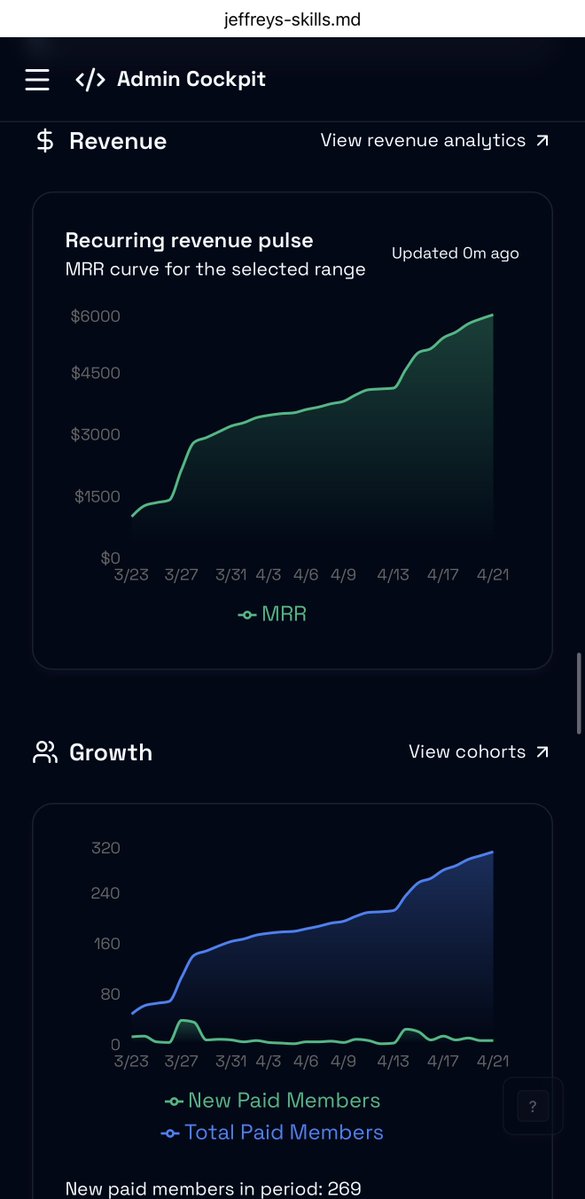
Seeking advice from people who are savvy about marketing for SaaS businesses. My jeffreys-skills.md site has been growing nicely in percentage terms since I launched it around 6 weeks ago. It should hit $6k/month in MRR today at the current growth rate (see pic from my admin dashboard). All this has been with negligible costs besides the ~5% fee to Stripe and PayPal for managing the subscriptions and billing. The site costs basically nothing to run, and I don’t offer a free tier. So far, I’ve done zero paid marketing or advertising. Instead, I’ve just been writing posts about the new skills I’ve been making and how they work. I believe the potential market for my service is pretty huge given that there are now 4 million active users of Codex alone, and many also using Claude Code. Compared to spending $200/month for GPT Pro and Claude Max, paying just $20/month for my site is pretty cheap. So my question is whether I should now start doing non-organic marketing, and if so, how? I know that if I took venture funding (I didn’t, it’s all bootstrapped and I built everything myself), investors would be pushing me to spend a lot to grow faster. But my past experience has been that paid marketing and advertising really doesn’t work very well and dramatically reduces margins. I’d basically be competing against all the other venture-backed AI startups that are burning money in an undifferentiated game. If I’m already growing ~200% a month, should I just keep doing what I’ve been doing and stick with organic content-based marketing that leverages my following on here? Maybe I should instead spend my time and energy making it easier for non-technical users to use and make more general, non-software related skills (like income taxes and wills) that can have broader appeal? Or focus more on business/teams users at a higher price point with enterprise functionality like SSO? (I’ve already built this out, but it’s a lot harder to sell those subscriptions; I don’t have a single teams customer yet!). Curious to hear what people who have been through this think. What do you suggest, @levelsio ? @dhh ? Anyone else? I appreciate any advice people can give me!
Jeffrey Emanuel tweet media
English
42
0
55
8.9K
nate bennett
nate bennett@H3xanK·
I am offering affordable contract software engineering work, remote “camera on” presence - my workflow is your workflow, let me help you get your stuff across the finish line
English
0
0
1
15
nate bennett retweetledi
Kraggi
Kraggi@Kraggich·
@simonw That belief is outdated. The leverage on legacy code is actually higher now, agents grep, trace call sites, summarize modules, and reason across files faster than any human onboarding. Greenfield is where they hallucinate. Maintenance is where they shine.
English
0
1
3
1.1K