
Sabitlenmiş Tweet
HAMZA💀
82.9K posts


HAMZA💀
@HAMZASIMPA10
JUST WANT TO BE ELIGIBLE/ AN OPTIMIST / ATBU / PROUDLY MUSLIM ☪️ / AIRDROP HUNTER
Somewhere Katılım Eylül 2024
4K Takip Edilen3.1K Takipçiler

HAMZA💀 retweetledi

I’m starting to see decentralization differently.
It’s not just about removing control…
it’s about removing hidden control.
Because that’s what really shapes outcomes.
That’s why @permacastapp and @dgrid_ai caught my attention.
permacastapp opens the content layer.
dGrid AI opens the AI layer behind it.
If both stay open,
then influence becomes harder to hide.
That’s a deeper kind of decentralization.

English
HAMZA💀 retweetledi

I was inspired by @LittleGuysWorld
To build this full video game ..
@LittleGuysWorld pj brought back that childhood nostalgia with its cute characters playful Toy Room energy
That wholesome chaos and big adventure feeling pulled me in so much I decided to build a full game inspired by the @LittleGuysWorld
Wanted to turn that same fun community vibe and collectible energy into something interactive in my own way and I’m really happy with how it came out
You can play it both on pc and on mobile
Link to the game:
t-he-l-ittle-g-uys-pi.vercel.app
@LittleGuysWorld

English
HAMZA💀 retweetledi

Did you know @0G_labs provides fast, reliable computing for AI agents and models, combining high performance with verifiable, transparent results making decentralized systems trustworthy and ready for real world scale

Maime Lee 🐐@maimelee
Did you know @0G_labs is a high speed, AI focused blockchain that enables fast, verifiable on chain execution, allowing AI agents to operate independently with low latency and high throughput. They leads others follow
English
HAMZA💀 retweetledi

Advertising has always had a trust problem.
Projects spend heavily, agencies take a cut, creators post content, and no one can clearly prove what actually worked.
A lot of money moves.
Very little clarity comes out.
That model does not scale in a world where attention is fragmented and audiences are smarter.
This is why creator-driven marketing is not just a trend, it is the direction everything is moving toward.
And @RallyOnChain is building the infrastructure for it.
Instead of relying on agencies and closed networks, Rally connects projects directly with creators.
No middle layers.
No hidden selection process.
No guessing.
Here is what makes it different:
Creators pick campaigns, create content, and submit it.
From there, Rally uses AI to evaluate each post based on:
• alignment with the campaign
• accuracy of information
• originality
• engagement potential
The scoring system is transparent.
The weights are visible.
And rewards are distributed onchain.
That alone changes the dynamic.
Because in traditional marketing, results are often subjective.
Here, they are measurable and verifiable.
But the bigger shift is this:
quality starts to matter more than reach.
A creator with a smaller audience but clear, well-structured content can outperform someone with a large following posting low-effort content.
That is a completely different incentive system.
For creators, it means:
effort and clarity finally get rewarded.
For projects, it means:
they are paying for actual impact, not just visibility.
And over time, that creates a stronger distribution network than any large ad budget could.
Because it is built on many aligned contributors, not a few paid voices.
That is why Rally is not just another platform.
It is influence infrastructure.
A system where:
attention is measured
quality is scored
and value flows directly to the people creating it
In the long run, that is what advertising evolves into.
More transparent.
More efficient.
More aligned.
And protocols like @RallyOnChain are how that future gets built.
English
HAMZA💀 retweetledi

hi I am an intern,
My gains got stolen in transit during memescope Monday.
Is there a manager I can talk to?
KITKAT@KITKAT
Regarding recent press coverage
English
HAMZA💀 retweetledi

There is a clear shift underway from building fast solutions to building systems that last. The focus is moving toward infrastructure that can support intelligence, preserve information and remain reliable regardless of external control. This is where the next phase of the internet begins to take shape.
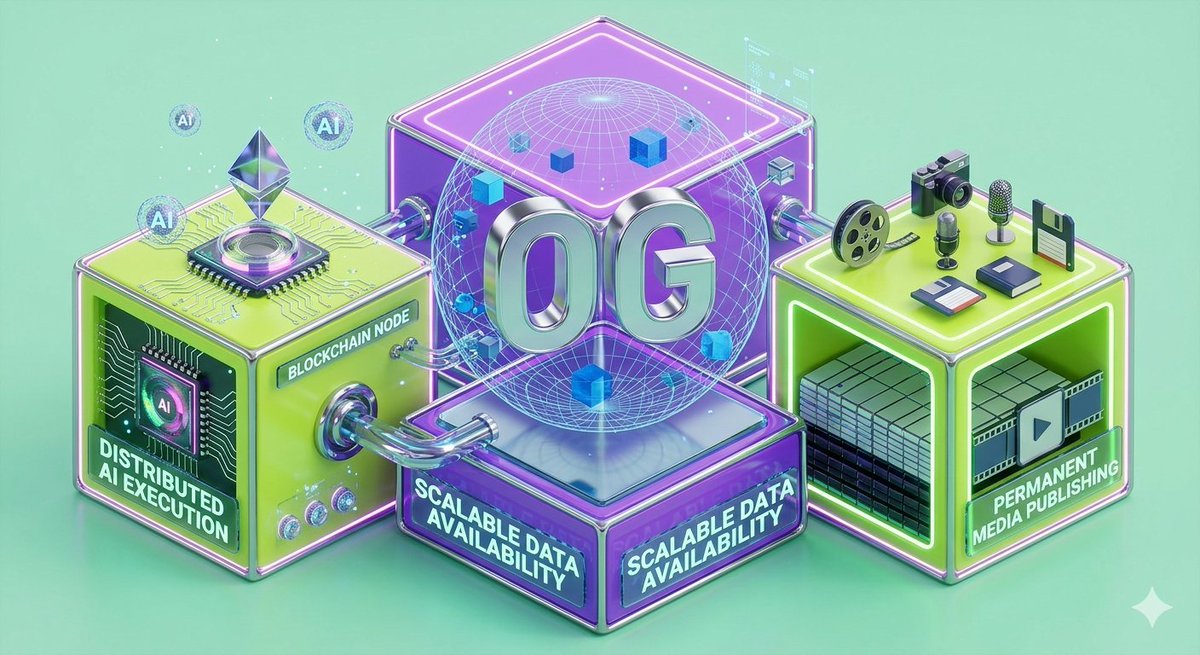
At the foundation is helping define this transition through decentralized AI infrastructure built for scalable data availability and a strong execution layer. This allows AI computation to run efficiently without centralized bottlenecks. Developers gain the flexibility to build powerful applications that scale naturally while maintaining performance and accessibility.
At the same time introduces a more collaborative form of intelligence. Through distributed AI and adaptive learning it enables systems that evolve through shared contributions. Its models ensure continuous improvement, making decentralized intelligence more accurate and resilient as participation grows.
The real strength of this ecosystem lies in how it preserves value this is where becomes essential. By focusing on permanent data stored on the permaweb, it creates a system where information is not only secure but enduring. With decentralized governance, control is shared across the community, ensuring transparency while guaranteeing long term accessibility.
Extending this permanence into content creation, enables permanent publishing for audio content and podcasts. Creators can share permaweb native content that remains accessible indefinitely, transforming ideas into lasting digital assets rather than temporary uploads.
When these layers align a powerful structure emerges:
• 0G Labs → open, scalable AI infrastructure
• Dgrid AI → adaptive, collaborative intelligence
• PermawebDAO + PermaCast → permanent, trusted knowledge
Together these technologies are shaping a future where intelligence is shared, infrastructure is open and data is built to stand the test of time.
@0G_labs
@dgrid_ai
@permacastapp
Crypto Prince@Prince_web03
The more you observe the current wave of innovation the clearer it becomes that the real breakthroughs are not happening at the surface. They’re happening deep in the stack where infrastructure, intelligence and storage are being redesigned to function without centralized control while still delivering reliability. At the infrastructure layer 0G Labs represents this shift clearly. Its decentralized AI infrastructure focuses on scalable data availability and a capable execution layer allowing AI computation to operate smoothly at scale. By removing common bottlenecks it gives developers an environment where advanced applications can grow without being constrained by centralized systems. At the same time Dgrid AI is building a new kind of intelligence layer. Through distributed AI and adaptive learning, it enables systems that improve as more participants contribute. Its collaborative approach turns intelligence into something continuous and shared making outcomes stronger and more reliable with every interaction. Where this all gains long term significance is with PermawebDAO. The concept of permanent data stored on the permaweb introduces a level of certainty traditional systems lack. With decentralized governance, responsibility for maintaining and protecting data is distributed across the community, ensuring transparency and trust over time. Knowledge becomes something that cannot be easily altered or lost. Building on this foundation PermaCast brings permanent publishing into the realm of audio and podcasts. Creators can produce permaweb native content that remains accessible indefinitely, giving their work a lasting presence independent of any single platform. When you step back, a clear structure emerges: • 0G Labs → scalable, decentralized AI infrastructure • Dgrid AI → collaborative, adaptive intelligence • PermawebDAO + PermaCast → permanent, verifiable knowledge Together these layers are quietly shaping an internet that is not just functional but intelligent, collaborative and designed to endure over time. @0G_labs @dgrid_ai @permacastapp
English
HAMZA💀 retweetledi

The strongest projects know when not to rush.
The latest update from @billions_ntwk means more than just a timeline shift. It shows the team cares more about building things properly than chasing quick hype.
Yes, the team originally imagined a $BILL TGE before Q2. But forcing a launch before the foundation is ready would help hype more than it helps the ecosystem.
And Billions is not building something small. It is building trust rails for humans and AI, where identity, privacy, and reputation actually matter.
That is why this kind of update matters to me. When your product is about proving what is real, your rollout should reflect that too.
A fast token launch can create noise for a few days. A stronger ecosystem can create value that lasts much longer.
So I respect the choice to stay transparent, keep building, and focus on getting the rollout right instead of just getting it out.
In the long run, that mindset usually wins.
Billions@billions_ntwk
English
HAMZA💀 retweetledi

📢 THREAD CONTEST ALERT
The Empire is evolving and this is your moment.
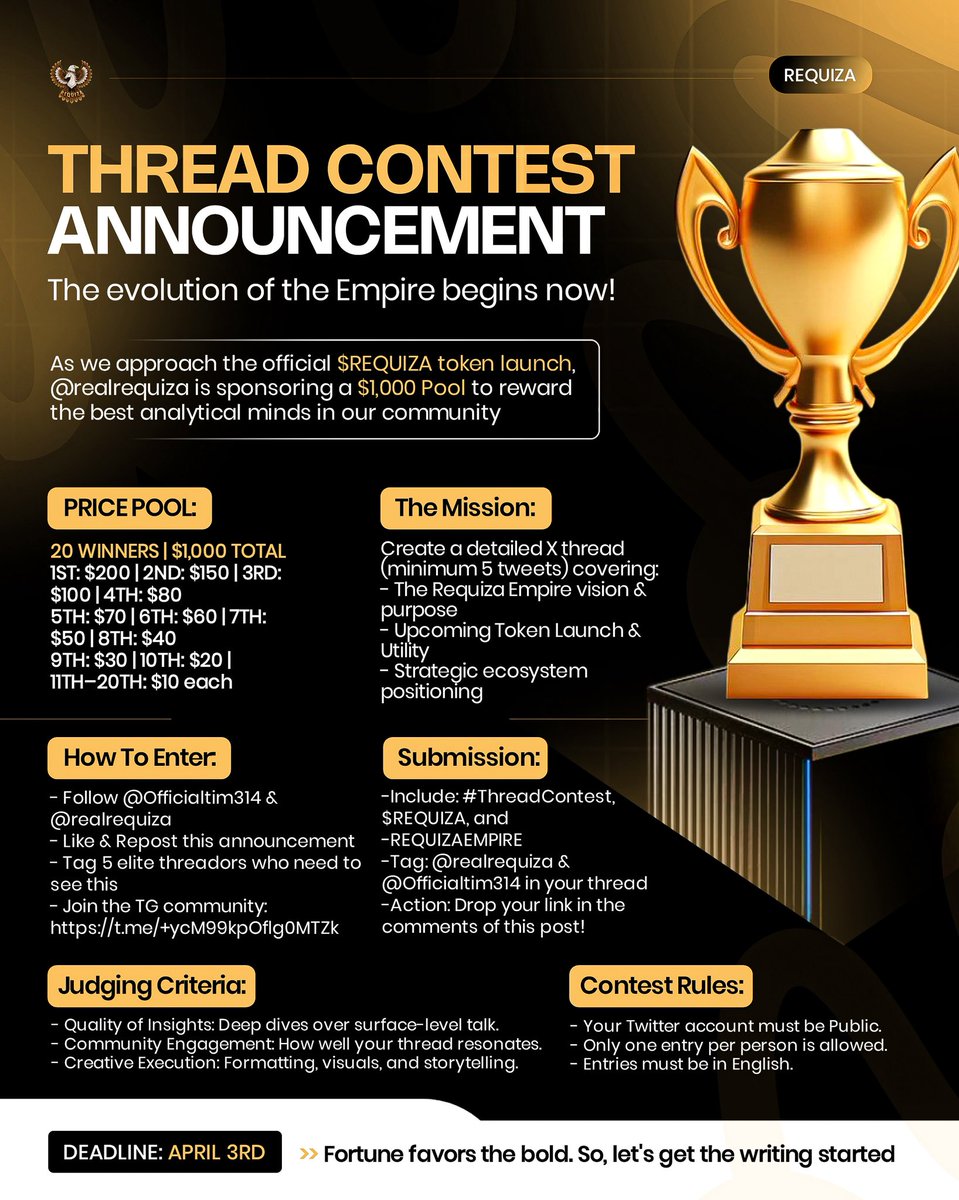
As we get closer to the official $REQUIZA launch, @realrequiza is hosting a $1,000 reward pool for the sharpest minds in the community.
🚀 HOW TO PARTICIPATE
1️⃣ Follow @Apdooul & @realrequiza
2️⃣ Like & repost this post
3️⃣ Tag 5 top thread creators
4️⃣ Join this Telegram group
t.me/requizaempireg…
🎯 YOUR TASK
Create a high-quality X thread (minimum 5 tweets) covering:
• The vision behind Requiza Empire
• Token launch & its utility
• Its position in the ecosystem
📌 SUBMISSION
• Use: #ThreadContest $REQUIZA #REQUIZAEMPIRE
• Tag: @realrequiza & @Officialtim314
• Drop your thread link under this post:
x.com/i/status/20353…
💰 REWARDS (20 WINNERS $1,000 TOTAL)
🥇 1st — $200
🥈 2nd — $150
🥉 3rd — $100
🏅 4th — $80
🏅 5th — $70
🏅 6th — $60
🏅 7th — $50
🏅 8th — $40
🏅 9th — $30
🏅 10th — $20
🏅 11th–20th — $10 each
JUDGING
• Depth of insight
• Engagement level
• Creativity & presentation
📜 RULES
• Public X account required
• One entry per participant
• English only
⏳ Deadline: April 3rd
Be bold. Be creative. Let your voice be heard. ⚔️
English
HAMZA💀 retweetledi

In most systems, stress accumulates silently before it becomes visible. Latency increases slightly. Execution becomes less consistent. Coordination slows. Individually, these signals seem minor. Collectively, they indicate structural strain.
The advantage of a layered architecture like the one emerging across OG Labs, DGrid, Dango, and PermawebDAO is early stress absorption.
@0G_labs absorbs infrastructural strain. Improved throughput and interoperability reduce the likelihood that small inefficiencies compound into congestion.
DGrid absorbs computational strain. Distributed processing handles spikes in demand, smoothing out performance fluctuations that would otherwise impact applications.
Dango reflects stress at the execution layer. Trading platforms act as real-time indicators. When stress is absorbed effectively below, execution remains stable above.
@permacastapp absorbs coordination strain. Governance and permanent storage ensure that increasing complexity doesn’t lead to fragmentation or loss of context.
Stress is unavoidable in growing systems. What matters is where it goes.
When stress is distributed and absorbed across layers, systems remain stable. When it concentrates, systems eventually break.
Resilience is not about eliminating pressure. It’s about designing where that pressure is allowed to exist.
cryptolord001@Brighter6N
There’s a misconception that decentralization automatically leads to resilience. In reality, decentralization without coordination can create a different kind of fragility one where responsibility is distributed, but alignment is missing. Resilience is not just about distribution. It’s about structured distribution. The layered interaction between OG Labs, DGrid, Dango, and PermawebDAO reflects an effort to introduce structure into decentralization. @0G_labs focuses on infrastructural coordination. Scalability and interoperability ensure that distributed systems can still operate as a cohesive whole. Without that cohesion, decentralization becomes fragmentation. DGrid introduces structured compute distribution. It’s not just about spreading workloads it’s about routing them intelligently, verifying outputs, and maintaining performance standards across nodes. That’s where decentralization becomes reliable rather than chaotic. Dango operates in an environment where structure is immediately tested. Financial markets don’t tolerate inefficiency. Execution quality reveals whether the distributed system beneath is actually coordinated or just loosely connected. @permacastapp ensures that coordination persists over time. Governance frameworks align incentives, while permanent storage preserves the system’s memory. Without memory, coordination resets every cycle. Decentralization reduces single points of failure. Structure reduces systemic confusion. The combination of both is what creates durable systems.
English
HAMZA💀 retweetledi

HAMZA💀 retweetledi

The @quipnetwork community is pushing something big making quantum accessible to everyone 🌍
They’re building, and they want creators to help tell that story.
Join the creator program and earn a share of $100,000 in $QUIP rewards.
Join now you're still early
Link: quest.quip.network/airdrop?referr…

🅱️right@emmydoj1
Steady and locked in on $River 🌊 Still a new bird, but I know I’m going to grow strong here. If you’re not on @RiverdotInc yet, this is your sign it’s still early. Don’t miss it. @River4fun
English
HAMZA💀 retweetledi

Improving DeFi Flow with @River4Fun
I've been investigating River4Fun, and one thing sticks out, it's concentrated on resolving fragmentation, a genuine issue in DeFi.
Liquidity is currently dispersed throughout several blockchains. Transferring assets can be expensive, time-consuming, and even dangerous.
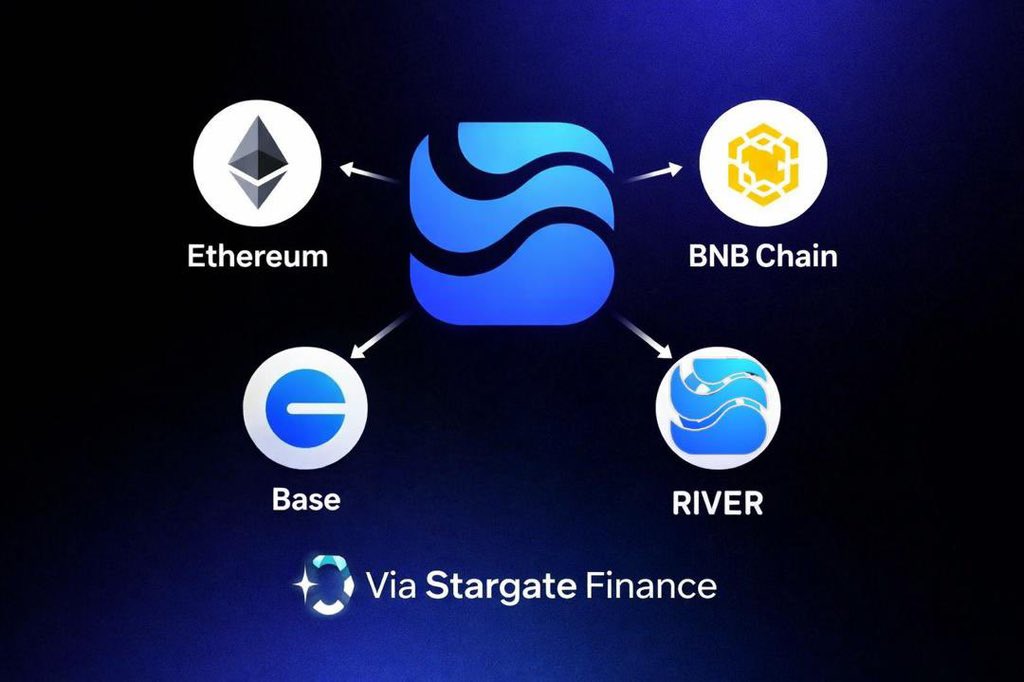
River4Fun presents a more seamless method:
1. satUSD (an alternative stablecoin)
➠ Built for stability and flexibility
➠ Over-collateralized with assets like Bitcoin, Ethereum, and more
➠ Omni-CDP system
➠ Lock your assets on one chain
➠ Mint and use satUSD across multiple chains
➠ No bridging. Not wrapped. There are no delays.
2. Smooth cross-chain experience
➠ Compatible with Ethereum, Arbitrum, Base, BNB Chain, and others
➠ Sync occurs in the background, relieving users of the burden
Why it mattersLiquidity flows as a single, interconnected river rather than being trapped in discrete chains.
This translates to:
➠ Quicker fund access
➠ Improved capital efficiency
➠ A more straightforward DeFi experience
That River4Fun aims to make DeFi more user-friendly, seamless, and accessible on a daily basis.
DeFi's future should be fluid rather than fragmented.
English
HAMZA💀 retweetledi


HAMZA💀 retweetledi

Last time, we spoke on how to get started in GenLayer and what growth looks like
But if you stopped there, you’d still be confused.
Because what actually unlocks those main roles aren’t just levels or activity…
It’s the roles behind the roles.
These ones determine whether you move forward, or stay stuck.
So if you’ve been wondering:
How do people actually get to Synapse, Brain, or even Singularity?
Walk with me.
You don’t jump straight into the main roles.
There’s a layer before them.
Like proof of work roles,
they show your growth and determine if you move forward.
First: Synapse Intern / Brain Intern / Singularity Intern
You don’t become Synapse, you become Synapse Intern first.
You don’t become Brain, you become Brain Intern first.
Same thing with Singularity.
What does that mean? It means leveling matters.
These “Intern” roles are tied directly to your Discord XP level.
Which are only gotten by participating in events, quizzes, and activities…
(Not discord chatting)
This is where consistency in Participation starts to show.
Now here’s where it gets more interesting:
Even if you hit the level…
You still won’t unlock the main roles without the real qualifiers.
Let’s talk about them:
Certified GenFren: You earn it by getting a perfect score in the GenFren Quiz.
I love this one because, it forces you to actually understand GenLayer weekly highlights.
And it also signals that you’re paying attention
And you need this role to get the first role (Synapse) before others ( Brain and Singularity).
So you cant skip it.
The next one is Neurocreative:
It’s earned through creativity and contribution.
Usually through: quality content creation, memes,
winning contests, consistent efforts of creativity over time.
This role tells the team that you are adding value to the Genlayer ecosystem.
And if you’re aiming for higher roles like Brain and then Singularity, it is mandatory to have.
Because at that level, effort alone isn’t enough, quality Impact with consistency is needed.
Now let’s bring it together.
To move into the main roles, you’re stacking things like:
• XP level (intern roles)→ through events
• POAPs → through attendance
• Certified GenFren → through knowledge
• Neurocreative → through contribution
In this order.
You can't jump any, it is a process,
And trust me it is not as stressful as it may look once you start.
If you really want to be in, be fully in.
Doing one part and ignoring the other would be an abslute waste of time.
For example:
High level, but no POAPs
POAPs but no Highlevel
Highlevel and POAPs, but no Genfren or Neurocrative
Is not going to get you there.
Here at @GenLayer one-dimensional activity, is not encouraged.
What is rewarded is well-rounded participation.
If you need the full guide see link below.

/Maryclaire (privacy szn)@Ifeeomaa
A lot of people are just discovering GenLayer right now… and the first reaction is usually the same: “Feels like I’m late.” You open the Discord, see people with roles like Brain, Synapse, Singularity… conversations already flowing, inside jokes forming, events happening every day… And it’s easy to feel like you missed the early wave. But here’s the truth: you didn’t. If anything, this is one of the few communities where starting “late” doesn’t actually put you behind, because GenLayer is structured in a way that rewards how you participate, not when you arrived. The only problem is that it can feel confusing at first. There’s already a full guide, systems, roles, events, XP, POAPs… bloom-rover-b76.notion.site/How-You-Can-Co… But I am here to help you simplify it: If you’re new to GenLayer and feel lost, this is your real starting point. First, understand this: GenLayer is an active ecosystem where your presence compounds over time. You don’t “join and wait.” You join in, and things start unlocking. But the mistake most people make early is thinking: “Let me figure everything out first.” You don’t need to. You just need to enter the flow correctly. Step one is simple: get inside and actually show up. Join the Discord, verify, and land in the (neural-activity channel). This is where everyone starts. Make good conversations. Say what brought you in. That single step moves you from being invisible to becoming part of the system. That’s how you get the first role: Molecule that puts you in the loop of things. Note here growth is not = chatting more. Chatting builds presence, but not progression. What actually moves you forward are two things: XP and POAPs. XP comes from participating in structured activities, that is the quizzes, games, contests, events. POAPs come from showing up consistently to AMAs, spaces, and key moments. So if you’re just lurking or casually chatting, you’ll feel stuck. But the moment you start engaging in events, everything changes. This is why for me @GenLayer feels different from most communities. There’s an actual rhythm to it. Every day, something is happening: Quizzes. Games. AMAs. Content contests. Live sessions etc. If you don’t check in, you miss momentum. If you stay consistent, you naturally level up. That’s why the (Today-at-genlayer) channel is what you should check everyday. It’s basically your daily map to know what is happening. Now let’s talk about the key roles. Molecule. Synapse. Brain. Singularity. Each role is a reflection of your consistency + contribution over time. You don’t apply for them, you ascend into them. Level up → earn XP Show up → collect POAPs Contribute → get recognized That’s it. GenLayer is one of those communities where your effort speaks for you. So my dear friend, start now. Become part of the Genlayer community. Next, we will talk about other roles that are requirements for each of the main roles. GenM guys and Happy weekend.
English
HAMZA💀 retweetledi

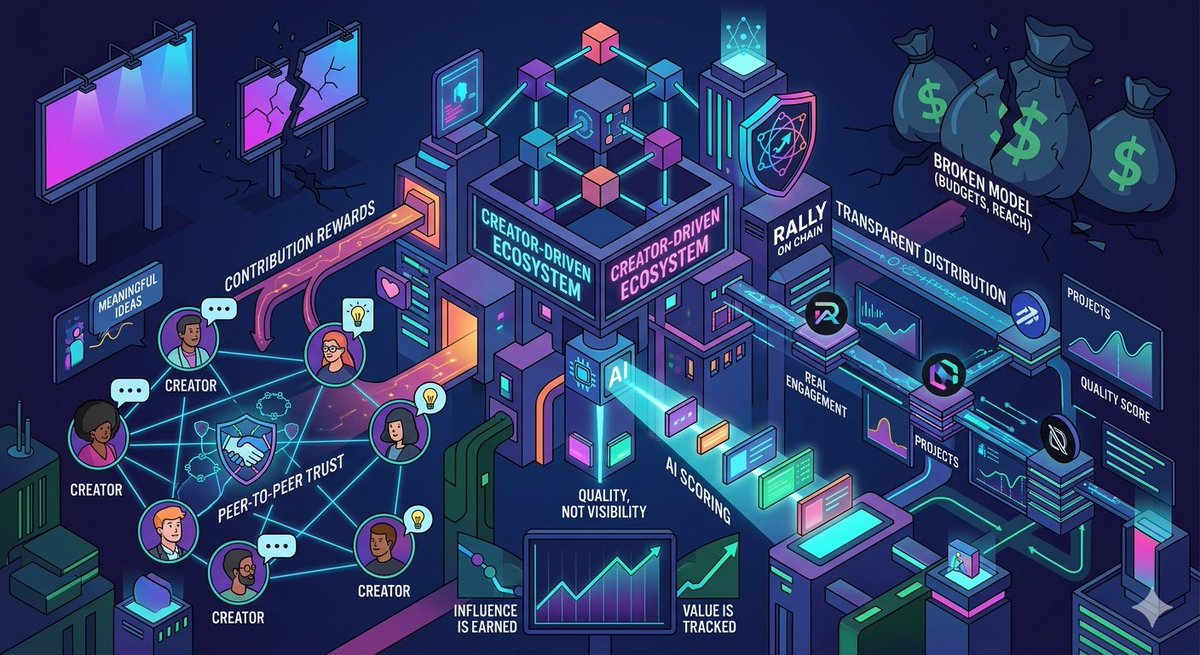
A lot of marketing still runs on budgets, agencies, and reach.
But that model is starting to show cracks.
Attention is fragmented, trust is lower, and many campaigns rely on paid distribution that people scroll past without thinking.
English
HAMZA💀 retweetledi

Indonesia has over 270 million people and one of the fastest-growing digital economies in the world.
But here’s the catch, millions of civil servant records have already been leaked and sold online.
That points to a much bigger issue: digital identity.
And right now, @MandalaChain might be building one of the most practical solutions we’ve seen so far.
Thread 🧵

English
HAMZA💀 retweetledi

Web3 marketing has felt like a loud room with no listeners, but the @RallyOnChain Beta launch finally brings the filter.
This isn't just another dashboard: it is working infrastructure where AI-native verification via GenLayer actually reads and rewards the quality of your narrative.
By moving away from bot-driven metrics toward a quality-first scoring engine, Rally ensures that sharp insights out-earn noisy spam.
Being early to a working protocol is how you win in this space, and farming both stables and Rally Points simultaneously makes this the most capital-efficient move for creators right now.
The rewards are already hitting the dashboard. Real yield, real attribution.
Get Started: waitlist.rally.fun/joinme/amstarl…

English
HAMZA💀 retweetledi

One post I saw recently made a strong point:
If you reward speed, you get noise.
If you reward continuity, you get institutions.
That’s the angle @Permaweb_DAO is pushing - systems should incentivize memory, not just activity. Because without traceable history, governance can’t be audited and disputes can’t really be resolved.
On a different note, @0G_labs is getting attention for its research direction - especially DiLoCoX, which explores how large AI models can be trained more efficiently even on limited bandwidth. That’s a big shift from the usual “only big labs can train AI” narrative.
DGrid AI is focusing on accessibility - making it simple to deploy AI agents that can operate and even evaluate models on-chain through standardized frameworks.
And LightLink is pointing out a real-world constraint: AI demand is pushing hardware costs up, which could make running nodes harder - something most people aren’t factoring in yet.
Different insights, but all grounded in real problems.

English
HAMZA💀 retweetledi

God please save me 🙏
I really need your help 😭
InfoSpace OG@InfoSpace_OG
God please put me on.🙏🏼 Success is all I seek for
Ilorin, Nigeria 🇳🇬 English
HAMZA💀 retweetledi

Web3 isn’t being shaped by noise—it’s being built through deliberate, deeply thought-out infrastructure. Projects like 0G Labs, Dgrid, Permacast, and Dango are quietly outlining what the next phase looks like, each tackling a different layer of the same challenge: making decentralized systems faster, more usable, more intelligent, and relevant beyond crypto-native audiences.
0G Labs stands out with its focus on modular AI infrastructure. This isn’t decentralization for optics—it’s about enabling scalable, high-performance compute that can handle real AI workloads onchain. Its approach to data availability and execution is what matters most, creating a system designed to handle the weight of modern AI demands. While many “AI + blockchain” ideas stay surface-level, 0G is working at the architectural layer where meaningful progress happens.
Dgrid addresses a different but equally important issue: coordinating distributed compute. It’s not just about linking nodes, but making them efficient, productive, and economically aligned. The core idea is orchestration—ensuring compute power is dynamically allocated instead of wasted. This shifts the economics of decentralized infrastructure, making it more competitive with centralized cloud systems while maintaining openness.
Permacast focuses on permanence in a world where information is fleeting and platform-controlled. It’s not just about storing data, but about preserving verifiable, long-term media that can’t be altered or censored. This introduces a new layer of trust to digital content. The real innovation lies in making content outlast the platforms that host it.
Dango, on the other hand, rethinks interaction within Web3. Rather than clunky interfaces and fragmented tools, it pushes toward smoother, more intuitive user experiences. The goal is accessibility without sacrificing decentralization. Because at this stage, the bottleneck isn’t capability—it’s usability.
When you look at them together, the pattern becomes clear. 0G handles intelligent compute, Dgrid optimizes resource coordination, Permacast ensures data permanence, and Dango improves how users engage with the system. These aren’t isolated ideas—they’re complementary layers of a more mature decentralized stack.
The takeaway is simple: the next phase of Web3 won’t be driven by louder narratives, but by stronger infrastructure. And these projects are building exactly that—quietly, intentionally, and with far more depth than most people realize.

0xKAY 🍡@hisoka_sama_
The next big step in decentralized innovation is about coming together, not just making cool discoveries in isolation. That’s exactly what 0G_labs, Dgrid_a, @permacastapp, and Dango are doing—they’re all working together to create infrastructure that not only makes Web3 bigger but also changes how we use, access, and keep it running. This isn’t just a series of improvements; it’s the groundwork for a new standard for DeFi and beyond. What’s happening with 0G_labs is a fresh look at how data is available. Instead of seeing it as just something we have to pay for, it’s becoming a tool that helps us build things in a modular way, opening up a whole new level of flexibility across different systems. This means builders have a whole new way to think about performance—they can now tweak latency, cost, and scalability at the same time. dgrid_ai is also moving beyond just digital limitations by connecting decentralized systems with real-world resource management. It’s creating a model where infrastructure isn’t just virtual but also economically and physically important, making sure decentralized networks contribute to real-world value. This is where DeFi stops being just a concept and starts becoming part of the bigger economic picture. Then there’s Permacastapp, which is quietly changing how we communicate on Web3. Information flow has always been a bit of a bottleneck, but by decentralizing how content is shared and kept, it makes sure that stories, data, and signals aren’t controlled by big, centralized forces. In a world where information is often unevenly distributed, this is a big step toward making things more open and resilient. Finally, @dango brings everything together by making it easy to use and interact with. Infrastructure is only useful if people actually use it, and Dango focuses on how complex systems can be made accessible to everyone. By simplifying access while keeping decentralization in mind, it acts as the door that turns advanced systems into everyday tools. What makes this moment special isn’t just each project on its own, but how they work together. Data, infrastructure, communication, and usability are all coming together to form a unified whole. This is the beginning of a new era where Web3 is no longer just a collection of separate experiments but a connected ecosystem built for growth, importance, and lasting impact.
English