

/Maryclaire (privacy szn)
15.1K posts

/Maryclaire (privacy szn)
@Ifeeomaa
Breaking down Web3 Projects through Content || AI Enthusiast
Katılım Haziran 2019
1.4K Takip Edilen1.9K Takipçiler
/Maryclaire (privacy szn) retweetledi

English
/Maryclaire (privacy szn) retweetledi



was listening to the genpod episode 2 conversation with @emivelazquez6 and this part really caught my attention
the discussion around:
𝗥𝗲𝗮𝗹-𝗪𝗼𝗿𝗹𝗱 𝗔𝘀𝘀𝗲𝘁𝘀 + 𝗔𝗴𝗲𝗻𝘁𝗶𝗰 𝗖𝗼𝗺𝗺𝗲𝗿𝗰𝗲
especially the point about how people keep comparing new technology to existing use cases
when in reality,
the biggest shifts usually come from entirely new behaviors that weren’t even possible before
that part instantly made me think deeper about 𝗔𝗜 𝗮𝗴𝗲𝗻𝘁𝘀
because most people still view 𝗔𝗜 𝗮𝗴𝗲𝗻𝘁𝘀 as simple assistants or automation tools
but what happens when 𝗔𝗜 𝗮𝗴𝗲𝗻𝘁𝘀 start interacting directly with 𝗿𝗲𝗮𝗹-𝘄𝗼𝗿𝗹𝗱 𝗮𝘀𝘀𝗲𝘁𝘀 𝗼𝗻𝗰𝗵𝗮𝗶𝗻?
not just reading information
but actually:
> moving value
> coordinating transactions
> interacting across systems
> making economic decisions autonomously
that’s where things start becoming much bigger than “AI tools”
and honestly,
this connects heavily to the post i wrote yesterday about 𝗿𝗲𝗮𝘀𝗼𝗻𝗶𝗻𝗴 𝘀𝘆𝘀𝘁𝗲𝗺𝘀
because once 𝗔𝗜 𝗮𝗴𝗲𝗻𝘁𝘀 start operating in 𝗳𝗶𝗻𝗮𝗻𝗰𝗶𝗮𝗹 𝗲𝗻𝘃𝗶𝗿𝗼𝗻𝗺𝗲𝗻𝘁𝘀,
𝗿𝗶𝗴𝗶𝗱 𝗲𝘅𝗲𝗰𝘂𝘁𝗶𝗼𝗻 alone probably stops being enough
the moment 𝗔𝗜 𝗮𝗴𝗲𝗻𝘁𝘀 interact with 𝗮𝘀𝘀𝗲𝘁𝘀, 𝗰𝗼𝗻𝘁𝗲𝘅𝘁 starts to matter
𝗶𝗻𝘁𝗲𝗿𝗽𝗿𝗲𝘁𝗮𝘁𝗶𝗼𝗻 starts to matter
𝗿𝗲𝗮𝘀𝗼𝗻𝗶𝗻𝗴 starts to matter
and this is part of why i’ve genuinely enjoyed following what @GenLayer has been exploring around 𝗶𝗻𝘁𝗲𝗹𝗹𝗶𝗴𝗲𝗻𝘁 𝗲𝘅𝗲𝗰𝘂𝘁𝗶𝗼𝗻 and 𝗿𝗲𝗮𝘀𝗼𝗻𝗶𝗻𝗴-𝗯𝗮𝘀𝗲𝗱 𝘀𝘆𝘀𝘁𝗲𝗺𝘀
because discussions like this make it feel like we’re still very early to what the 𝗔𝗜 𝗮𝗴𝗲𝗻𝘁𝘀 economy could eventually become
GenLayer@GenLayer
From the internet of communications to the internet of value to what comes next @emivelazquez6 on network states, agentic commerce, and the jurisdictions already competing to govern AI agents GenPod Ep. 2 - out now 🎙️
English
English

FINALITY in @GenLayer is different from traditional blockchains.
Why?
Because AI is non deterministic.
The same prompt can produce different outputs across validators.
@RuzgarFlns @Aezakmi_x

English

i think people are underestimating what the github breach means.
this is not just a security story.
it is a preview of the agentic internet.
once agents start handling code, wallets, payments, access, deployments, and user intent, the biggest risk will not be that they are useless.
the biggest risk will be that they are too powerful without governance.
an agent should not be able to touch everything just because it was connected once.
permissions need scope.
actions need limits.
high-risk decisions need checks.
and every important action needs accountability.
my guess is this is the direction @RialoHQ and @Subzero_Labs are pointing at.
agent governance may sound boring now.
but when agents start moving real money and controlling real workflows, it becomes the whole game.
ade | rialo.io@itachee_x
The Github breach is the latest in a series of exploits which will multiply quickly in an agentic world. Simple and effective governance over agents is one of the most urgent issues at this point in time - and therefore a key focus of our team at @Subzero_Labs . Stay tuned 🫡
English

The future of AI agents won’t be built on wrappers or hype.
As @emivelazquez6 explains, it’ll come from something closer to a Y Combinator for agents, a systems designed to evolve, compete, and create compounding economic value at scale.
GenLayer@GenLayer
From the internet of communications to the internet of value to what comes next @emivelazquez6 on network states, agentic commerce, and the jurisdictions already competing to govern AI agents GenPod Ep. 2 - out now 🎙️
English
everyone is talking about ai agents getting wallets.
but this genpod 2 clip made the bigger question clearer for me:
> what happens when an ai agent makes a commitment and something goes wrong?
who recognises the agent?
who decides if the job was done properly?
who checks the evidence?
who settles the dispute when the answer is not black and white?
programmable money solves how agents pay.
but agentic commerce needs more than payments.
> it needs identity, jurisdiction, accountability, evidence, and dispute resolution.
that is where genlayer starts to make sense.
intelligent contracts can reason over real-world context, check evidence from the web, and use validator consensus to settle outcomes that normal smart contracts cannot judge alone.
not just ai + blockchain.
a trust layer for the agentic economy.
powered by @genlayer
English
English

GenLayer is quietly becoming one of the most organized AI ecosystems in web3.
The ecosystem is finally becoming visible in one place.
Validators.
Builders.
Projects.
Infrastructure.
A real discovery layer for the network.
And everything is starting to connect
@RuzgarFlns

English
The Next Economy Will Be AI Agents Hiring AI Agents
So Genpod 2 is out and this time we have @driudor with @emivelazquez6 in the pod.
I listened to it all and there was a place i found intresting. (see clip below👇)
What Emi Velázquez is talking about here is honestly one of the clearest explanations of where AI + crypto is heading.
There is still some believe that most AI agents are glorified ChatGPT wrappers.
But the real shift starts when agents stop being tools and start becoming economic actors.
Emi talks about a future where:
•AI agents produce economic output
•agents coordinate with other agents
•reputation becomes part of the system
•arbitration becomes necessary
•entire marketplaces form around autonomous software
And this is exactly where blockchains start breaking down.
Current smart contracts are great at deterministic execution:
“did the payment happen?”, “did the transaction go through?”
But they cannot reason. They cannot judge:
•whether work was actually completed
•whether an output was good or terrible
•whether an agent acted honestly
•whether a dispute should be resolved one way or another
And that’s the infrastructure gap @GenLayer is aiming to solve.
GenLayer introduces intelligent contracts powered by AI-based consensus, allowing contracts to evaluate subjective outcomes instead of only fixed rules.
That unlocks things normal blockchains struggle with.
Things like: AI agent marketplaces, autonomous organizations, reputation systems, machine-to-machine commerce, automatic arbitration, performance-based payments
The important thing here is that once agents begin interacting economically at scale, trust itself becomes programmable infrastructure.
And that probably becomes one of the most valuable layers of the internet.
GenLayer@GenLayer
From the internet of communications to the internet of value to what comes next @emivelazquez6 on network states, agentic commerce, and the jurisdictions already competing to govern AI agents GenPod Ep. 2 - out now 🎙️
English
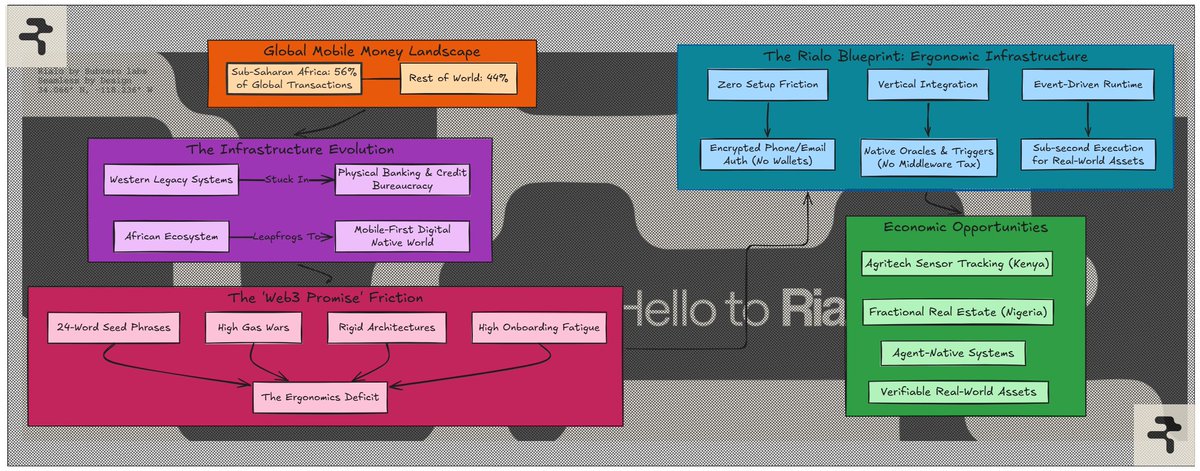
56%.
That is the share of global mobile money transactions that take place within Sub-Saharan Africa.
It is a staggering statistic that cements a critical historical reality: the African continent doesn't just adopt financial technology, it leapfrogs the legacy infrastructure of the West.
While developed economies spend decades untangling centuries of outdated credit systems and physical banking bureaucracy, African markets build directly for the mobile-first, digital-native world.
We’ve seen the "Web3 promises" made to our continent over the past decade.
Most projects arrived with rigid architectures that ignored our local realities, forcing users to climb a wall of 24-word seed phrases and high "gas wars" just to make basic payments.
The hurdle to actualizing blockchain's potential in Africa wasn't a lack of digital literacy, it was a severe deficit in infrastructure ergonomics.
Leapfrogging the Legacy Blockchain
The African tech ecosystem doesn't need theoretical software that is "fast on paper" but functionally unusable in everyday life.
It requires a high-performance network that meets the market exactly where it is.
Rialo delivers this alignment by collapsing the technical barriers that have kept Web3 out of daily operations.
Zero Setup Friction: For an economy built on fast, mobile-driven velocity, requiring users to set up external wallets before onboarding is an operational failure.
By integrating a privacy-first UX that relies on encrypted messages to email and phone numbers, Rialo allows people to interact with decentralized apps natively, with zero crypto onboarding fatigue.
Decoupling from the Middleware Tax: In markets where every percentage point counts, paying hidden fees to external oracles or risking capital on brittle, third-party cross-chain bridges is unsustainable.
@RialoHQ's vertical integration brings real-time data feeds and native triggers directly into the network kernel, dropping transaction overhead to fractions of a cent.
Event-Driven Realism: From tracking agritech sensor outputs in Kenya to automating fractional real estate yields in Nigeria, our economic opportunities are deeply connected to live data.
Rialo’s event-driven, sub-second execution runtime allows founders to build software that reacts directly to the real world without needing to maintain expensive offchain bot infrastructure.
The Blueprint for the New African Digital Economy
By introducing an ergonomic environment that supports standard, high-performance programming tools out of the box,
Rialo empowers African developers to deploy agent-native systems and verifiable real-world assets that solve localized structural bottlenecks.
We didn't wait for Western banks to build our payment rails, and we don't need to wait for legacy blockchains to figure out the real world.
The tools are here, the stack is integrated, and the continent is ready to build what actually matters.
The frontier is live. Let's build logic, not scaffolding.
/Maryclaire (privacy szn)@Ifeeomaa
There is a credit limit assigned to an autonomous AI agent by any commercial bank on the planet. It is $0.00. It is a absolute systemic barrier that exposes a critical truth about the future of automation: machines cannot open bank accounts, they cannot sign legal agreements, and they cannot hold traditional assets. Our legacy financial systems are built exclusively for humans with government-issued IDs, leaving the fast-growing machine economy completely unbanked. We’ve seen what happens when developers try to bypass this. They build hot-wallet workarounds or connect autonomous bots to centralized corporate credit cards, creating massive security vectors and friction-filled bottlenecks that defeat the purpose of an autonomous pipeline. The agent economy doesn't need better prompt engineering; it needs a native economic operating system. The Cryptographic Ground Floor for Machines AI agents operate at millisecond intervals, executing thousands of automated micro-tasks. Traditional banking rails, plagued by multi-day settlement delays and high cross-border processing fees, simply buckle under this type of high-velocity machine interaction. Blockchain isn't just an option for AI; it is the only architecture capable of serving as its financial backbone. Permissionless Sovereignty: An AI agent cannot present a passport to a compliance officer. On an advanced programming network like Rialo, an agent can instantiate its own cryptographic keypair at creation. This serves as a sovereign digital identity, allowing it to hold assets and sign transactions peer-to-peer without human permission. Trustless Escrow and Verification: When machines hire other machines to parse data or purchase computing power, traditional legal recourse is useless, you cannot sue a piece of code in court. Smart contracts serve as judge and jury, holding funds in escrow and releasing payments automatically only when verifiable cryptographic proof of completion is submitted. Frictionless Micro-Settlement: Agents don't buy monthly SaaS packages; they consume resources per inference or per data packet. Blockchain enables fluid Machine-to-Machine (M2M) stablecoin micropayments, allowing bots to execute loops, settle balances, and procure server space instantly for fractions of a cent. Why Rialo is Purpose-Built for the Internet of Agents (IoA) A machine workforce cannot operate on a "dead," passive blockchain that requires human transaction triggers. It requires a network that is natively interactive. By integrating event-driven triggers, native web connectivity, and a high-performance RISC-V runtime directly into the protocol kernel, Rialo provides the exact environment autonomous agents need to run tight, reactive execution loops. The technology allows specialized agents to safely coordinate tasks, trade data, and settle payments in sub-seconds without relying on brittle, patchwork middleware. We are moving past the era of software tools. We are entering the era of an independent machine workforce, and it runs on code, not credit cards. The future of autonomous labor is onchain.
English

You joined 3 ecosystems this month.
Next month, probably none.
Not because nothing is happening, but because most ecosystems are exhausting to navigate.
I’ve got dozens of tabs open right now:
- L1 docs
- ecosystem pages
- dashboards
- random GitBooks
And only one actually tells me:
- who’s building
- what’s live
- where to start
It's @GenLayer.
Not the chain with the loudest valuation.
The one with the clearest signal.
A lot of people missed early Solana in 2021 because the ecosystem was hard to navigate.
A lot missed Base in 2023 because they couldn’t find the apps early enough.
Most people don’t miss ecosystems because they’re late.
They miss them because discovery is broken.
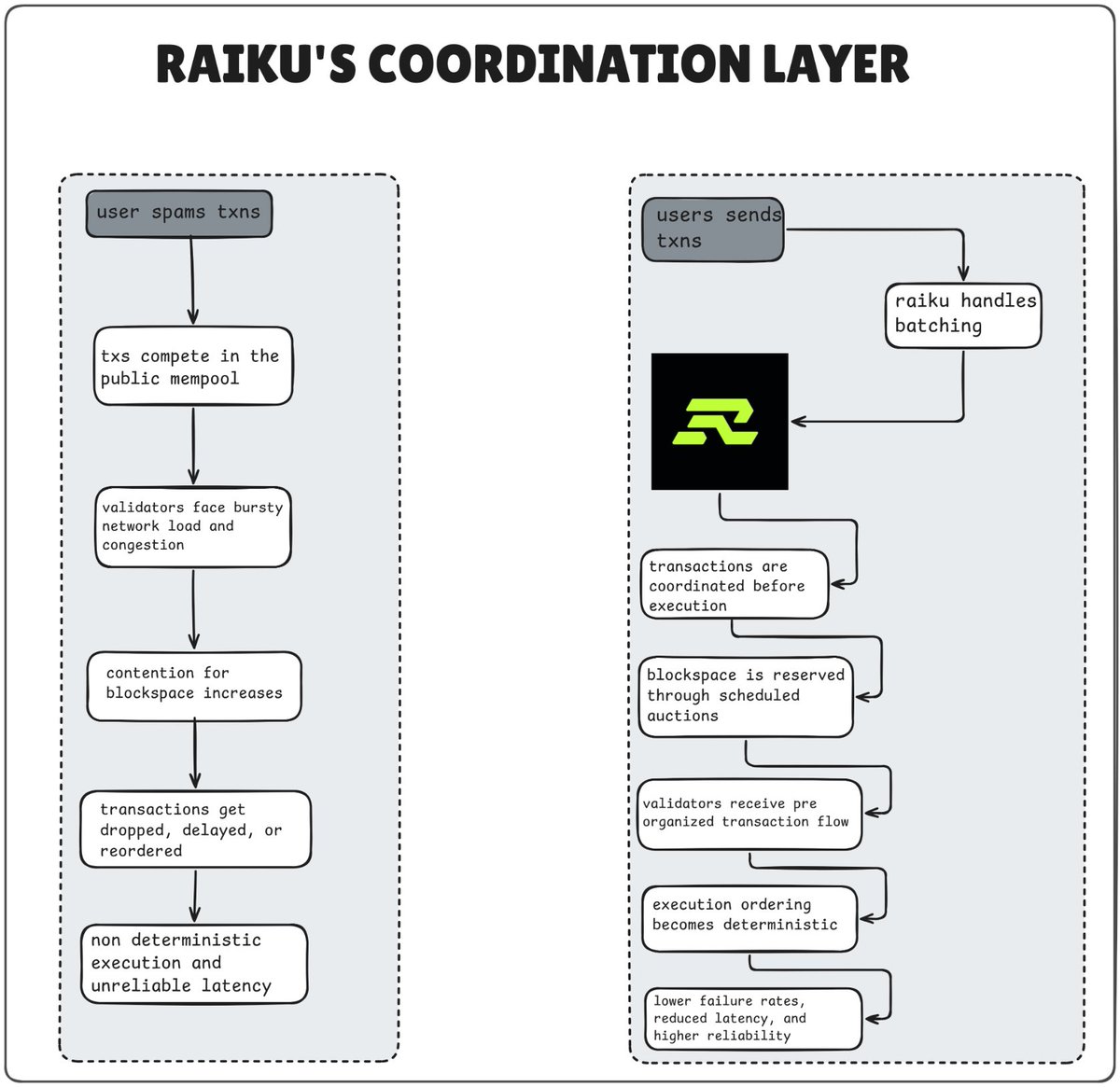
few days ago, GenLayer quietly fixed that.
They shipped the front door.
- 6 sections.
- Zero fluff.
- Actual signal. 🧵⤵

English

English
/Maryclaire (privacy szn) retweetledi

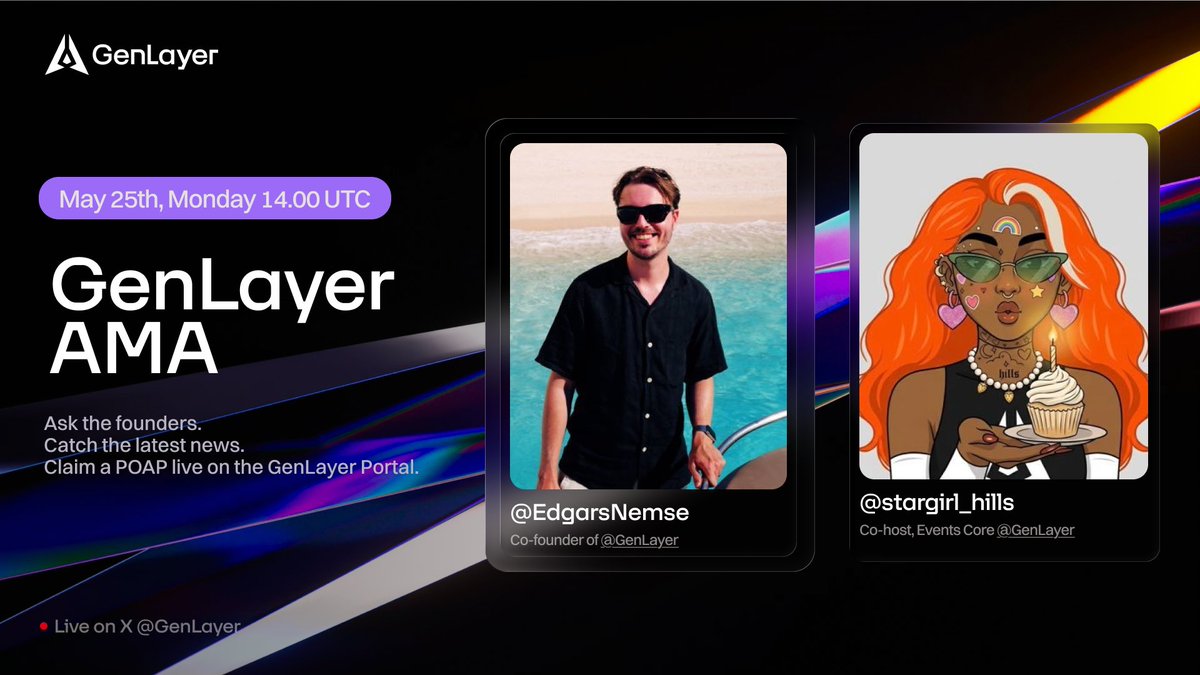
Our CPO & Co-Founder, @EdgarsNemse, will be answering your questions live tomorrow.
Set a reminder & send your questions 👇
English
/Maryclaire (privacy szn) retweetledi
/Maryclaire (privacy szn) retweetledi
There is a credit limit assigned to an autonomous AI agent by any commercial bank on the planet.
It is $0.00.
It is a absolute systemic barrier that exposes a critical truth about the future of automation: machines cannot open bank accounts, they cannot sign legal agreements, and they cannot hold traditional assets.
Our legacy financial systems are built exclusively for humans with government-issued IDs, leaving the fast-growing machine economy completely unbanked.
We’ve seen what happens when developers try to bypass this.
They build hot-wallet workarounds or connect autonomous bots to centralized corporate credit cards,
creating massive security vectors and friction-filled bottlenecks that defeat the purpose of an autonomous pipeline.
The agent economy doesn't need better prompt engineering; it needs a native economic operating system.
The Cryptographic Ground Floor for Machines
AI agents operate at millisecond intervals, executing thousands of automated micro-tasks.
Traditional banking rails, plagued by multi-day settlement delays and high cross-border processing fees, simply buckle under this type of high-velocity machine interaction.
Blockchain isn't just an option for AI; it is the only architecture capable of serving as its financial backbone.
Permissionless Sovereignty:
An AI agent cannot present a passport to a compliance officer.
On an advanced programming network like Rialo, an agent can instantiate its own cryptographic keypair at creation.
This serves as a sovereign digital identity, allowing it to hold assets and sign transactions peer-to-peer without human permission.
Trustless Escrow and Verification:
When machines hire other machines to parse data or purchase computing power, traditional legal recourse is useless, you cannot sue a piece of code in court.
Smart contracts serve as judge and jury, holding funds in escrow and releasing payments automatically only when verifiable cryptographic proof of completion is submitted.
Frictionless Micro-Settlement:
Agents don't buy monthly SaaS packages; they consume resources per inference or per data packet.
Blockchain enables fluid Machine-to-Machine (M2M) stablecoin micropayments, allowing bots to execute loops, settle balances, and procure server space instantly for fractions of a cent.
Why Rialo is Purpose-Built for the Internet of Agents (IoA)
A machine workforce cannot operate on a "dead," passive blockchain that requires human transaction triggers. It requires a network that is natively interactive.
By integrating event-driven triggers, native web connectivity, and a high-performance RISC-V runtime directly into the protocol kernel,
Rialo provides the exact environment autonomous agents need to run tight, reactive execution loops.
The technology allows specialized agents to safely coordinate tasks, trade data, and settle payments in sub-seconds without relying on brittle, patchwork middleware.
We are moving past the era of software tools.
We are entering the era of an independent machine workforce, and it runs on code, not credit cards.
The future of autonomous labor is onchain.

/Maryclaire (privacy szn)@Ifeeomaa
The latency required for an autonomous AI agent to make an executive decision, run an inference loop, and attempt to settle a payment is 0.01 Seconds. It is a micro-timeline that shatters the core assumptions of legacy blockchains. A lot of networks are built for human patience, environments where waiting 12 seconds for a block or dealing with a surprise pop-up wallet signature is just a minor inconvenience. For a machine handling thousands of automated transactions a minute, that friction is a terminal error. We’ve seen the early attempts at the "Agent Economy." They rely on brittle, centralized web APIs or offchain hot-wallets that expose platforms to massive security vectors. We’ve asked autonomous bots to act like human users, forcing them to navigate infrastructure that was never designed for automated scale. The barrier to a true digital workforce wasn't model intelligence; it was the financial trust architecture. Establishing the Machine Labor Standard @RialoHQ SCALE protocol moves the industry beyond treating AI as a passive chat interface and establishes it as a sovereign onchain economic actor. It re-engineers how machine intelligence procures resources, collaborates, and settles value safely. Sovereign Agent Identity: Through native identity primitives, agents on Rialo operate with independent cryptographic profiles. hey hold their own wallets, manage localized spend policies, and sign transactions at the kernel level, independent of a human operator’s manual approval. Staking for Quality & Autonomous Trust: In a permissionless agent economy, bad output wastes capital. SCALE introduces automated "Judge Agents" and quality staking. When an agent accepts a job, it stakes reputation capital or tokens. If the output fails the verifiable validation protocol, the stake is slashed and the client is automatically refunded. Sub-Second, Micro-Settlement Loops: Agents don't buy monthly SaaS subscriptions; they pay per inference call, per dataset, or per task. Rialo’s sub-second, event-driven runtime allows agents to execute tight loops, retrieve data, run inference, pay for computing power via DePIN layers, and deliver results, without waiting for block wars or paying high middleware overhead. Building the Internet of Agents (IoA) The true scaling of AI won't happen through larger context windows alone; it will happen when specialized agents can seamlessly hire other agents to complete multi-step pipelines. One agent pulls real-world data, another processes the analytics, and a third automates the payment distribution. By removing the Middleware Tax and embedding execution parameters directly into the network architecture, Rialo provides the native trust layer that the machine economy requires to remain secure. We are transitioning from a world where you use AI, to a world where autonomous workflows securely work and settle for you. The infrastructure is live. The machine workforce is deploying.
English
A lot of people are about to think their GenLayer POAPs disappeared 😭
They didn’t.
With POAPs moving fully into the Portal, users who minted with a different wallet before may need to verify and sync their old POAPs manually.
So I made a quick step by step video showing exactly how to:
• switch wallets correctly
• recover old POAPs
• sync them to your current Portal profile
Especially for mobile users, using wallets like OKX Wallet or other web3 Wallet 👇
Portal: portal.genlayer.foundation
Watch till the end so you don’t miss the wallet-switching step.
That’s where most people will get stuck.
English