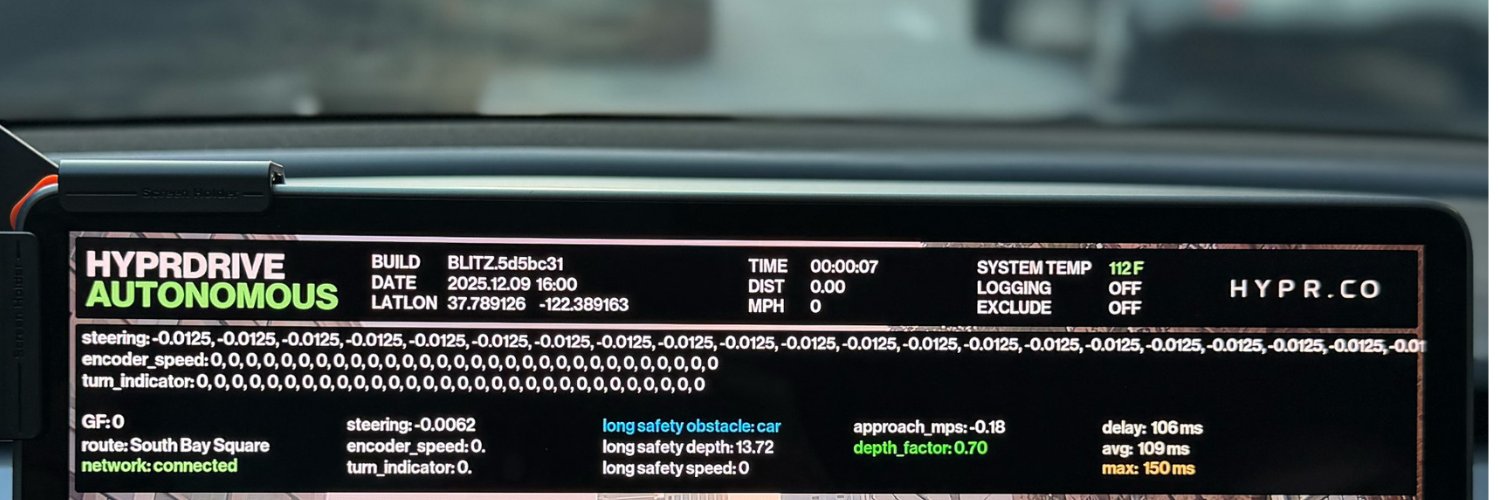
Self-Driving on 33 Watts: Live Demo with @TimKentleyKlay of @HYPR.
HYPRLABS Inc.
29 posts

@hypr
Robots that learn to kick ass as they move🦿🍑 💥

Self-Driving on 33 Watts: Live Demo with @TimKentleyKlay of @HYPR.


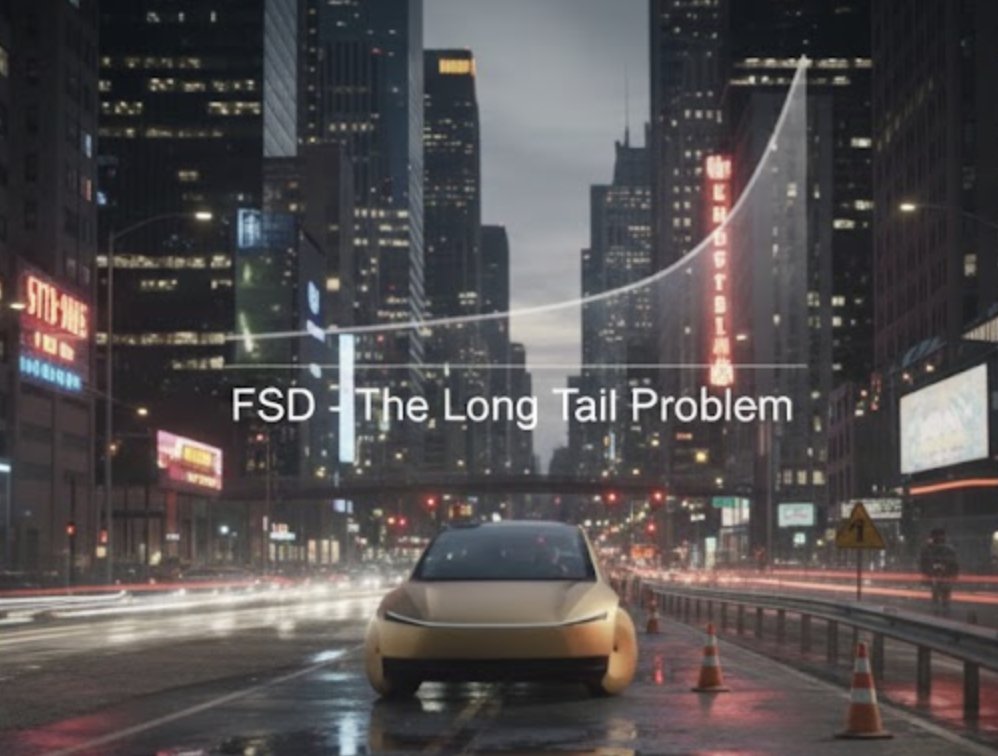
@pbeisel Roughly 10 billion miles of training data is needed to achieve safe unsupervised self-driving. Reality has a super long tail of complexity.


NVIDIA’s CES presentation did not change the autonomy landscape; it merely confirmed it. What was shown was a platform, not a product— a set of tools for partners still attempting to solve problems Tesla is already confronting in the real world. There was no demonstrated path to large-scale deployment, no evidence of long-tail mastery, and no sign of rapid iteration under real operating constraints. NVIDIA validated the difficulty of autonomy and the need for massive data and compute, but it did not demonstrate execution. Tesla, meanwhile, is already operating vehicles autonomously in live environments and systematically working toward removing the safety driver. That difference remains decisive. As a Tesla investor, I probably lost less sleep than Elon did over NVIDIA’s so-called “FSD” announcement. Knowing CES was coming and that NVIDIA would talk up its autonomy stack, I was fully prepared to buy more $TSLA on a dip. FSD remains miles ahead of the competition. 1. Real-world AI requires real-world data. Synthetic data cannot solve the autonomy problem. The tail is the problem. The long tail of edge cases in real-world driving is vastly larger than most people appreciate— longer than the creature it’s attached to. These scenarios do not emerge magically from simulation; they must be experienced. If this is unclear, watch Tesla’s ground game in action. Since June, Tesla has been systematically working through edge cases in Austin and the Bay Area, explicitly targeting safety-driver removal. The effort has been focused, iterative, and relentless (and they are close). 2. NVIDIA’s business is selling chips. At the end of the day, NVIDIA sells high-end training and inference hardware. Jensen all but tells us that real-world AI needs real-world data, while conveniently steering autonomy partners toward buying more GPUs to process it. This is not a criticism; it is an incentive structure. Autonomy is the narrative. Silicon sales are the objective. 3. Legacy OEMs are the customers. That alone tells you nearly everything you need to know about execution risk. Tesla operates with full vertical integration and moves at software speed. Legacy automakers move slowly. While Tesla runs at 100 mph, legacy walks, at best. 4. NVIDIA explicitly validates Tesla’s vision-only approach. CES made one thing clear: vision-first autonomy is no longer a controversial position, it is the direction of travel. Tesla was right. NVIDIA’s platform messaging did not elevate LiDAR-centric stacks as the solution; it centered scalable autonomy around cameras, neural networks, and massive compute. That is a real validation of Tesla’s approach and, at the same time, a quiet nail in the coffin for the LiDAR-chasing crowd. Tesla led with vision when it was unpopular. Now the industry is converging on it. Two years from now and very likely five that reality will be even more obvious. 5. Robotaxi is the objective, not vehicle sales. The true target of FSD is transportation-as-a-service, not selling cars with autonomy features attached. Every Tesla sold is a potential Robotaxi fleet entrant, an Airbnb-style model at global scale. This is where the real value lies. The competitive set is Waymo and Uber, not Mercedes and Ford. (long $TSLA and long $NVDA)

Self-Driving on 33 Watts: Live Demo with @TimKentleyKlay of @HYPR.


Our military K9's are badass just like our soldiers! God bless our troops, God bless America! 🙏 🇺🇸 🫡 🐾

We are excited to announce that Blackbird has led an equity financing of $5.55M in robotics startup @HYPR. Who is behind it? @TimKentleyKlay – the co-founder of @zoox. As the first check writer into Zoox, it is great to have Tim back in the BB fam 💜 👀 hypr.ai