HYPRLABS Inc.

29 posts

HYPRLABS Inc. banner
HYPRLABS Inc.

HYPRLABS Inc.

@hypr

Robots that learn to kick ass as they move🦿🍑 💥

Katılım Eylül 2007
83 Takip Edilen702 Takipçiler
HYPRLABS Inc.
HYPRLABS Inc.@hypr·
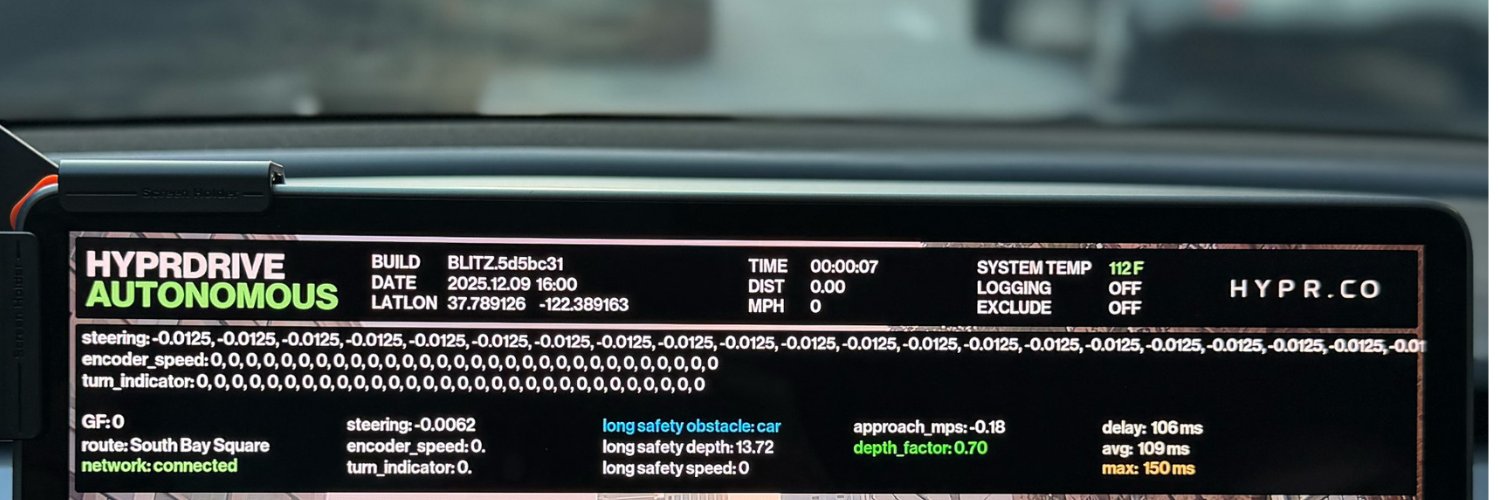
“The best way to train a neural network is at run-time, in-situ, on the robot.” Inside the HYPRDRIVE™ test vehicle: 5 cameras · NVIDIA Orin AGX · 33W compute Real-world autonomy in SF trained on ~1,600 hours of data. Learning happens while driving — not after. This is what run-time learning looks like. Watch the full demo with @TimKentleyKlay & @gbrulte on @RoadToAutonomy: x.com/RoadToAutonomy…
English
0
3
6
567
HYPRLABS Inc.
HYPRLABS Inc.@hypr·
10 billion miles of training data? Watch HYPRDRIVE™ autonomously driving in SF with just 10K miles of training data. Full demo is live on @RoadToAutonomy x.com/RoadToAutonomy…
Elon Musk@elonmusk

@pbeisel Roughly 10 billion miles of training data is needed to achieve safe unsupervised self-driving. Reality has a super long tail of complexity.

English
0
0
2
311
phil beisel
phil beisel@pbeisel·
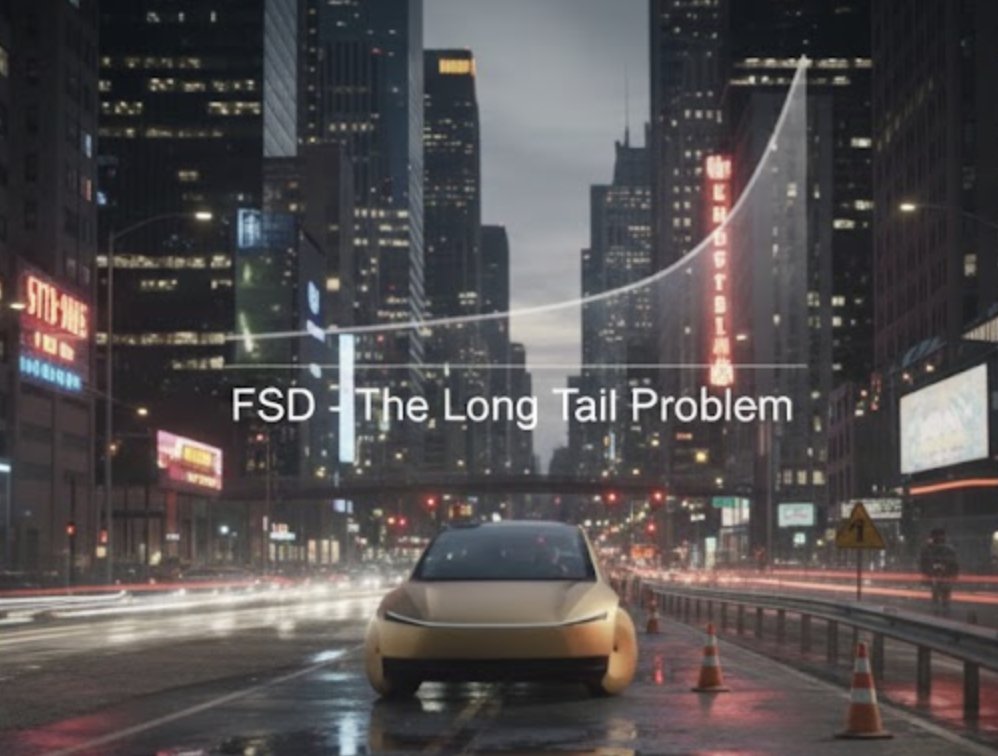
It is understandably difficult for many people to distinguish between a demo and a product. In technology, some products demo well and are already close to their final, production-ready state. For others, the gap between demo and product is enormous. Non-engineers often underestimate the process required to cross that gap. Some problems are vastly harder than their demos suggest, and Full Self-Driving is one of them. With FSD, the transition from a compelling demo to a finished product is exceptionally difficult. The problem space is defined by an effectively unbounded set of edge cases, and progress is dominated by grinding down that long tail. This is why, given my background, it is easy for me to dismiss NVIDIA’s Alpamayo platform. Some have characterized my view as cavalier. I disagree. You have to look at the process Tesla has gone through to get anywhere near the finish line. This has taken years of sustained effort. Even starting with the architectural reset in FSD v12, there has been an enormous amount of work required to systematically reduce the long tail, iteration by iteration, now reaching v14. Today, FSD is running more than 14 million (supervised) miles per day, with approximately 35 Robotaxis operating in Austin and roughly 140 in the Bay Area. Every single day, these vehicles are accumulating real-world miles and encountering rare, high-value edge cases that directly drive model improvements. The notion that someone can “catch up” to this problem primarily through simulation and limited on-road exposure strikes me as deeply naive. This is not a demo problem. It is a scale, data, and iteration problem— and Tesla is already far, far down that road while others are just getting started.
phil beisel tweet media
phil beisel@pbeisel

NVIDIA’s CES presentation did not change the autonomy landscape; it merely confirmed it. What was shown was a platform, not a product— a set of tools for partners still attempting to solve problems Tesla is already confronting in the real world. There was no demonstrated path to large-scale deployment, no evidence of long-tail mastery, and no sign of rapid iteration under real operating constraints. NVIDIA validated the difficulty of autonomy and the need for massive data and compute, but it did not demonstrate execution. Tesla, meanwhile, is already operating vehicles autonomously in live environments and systematically working toward removing the safety driver. That difference remains decisive. As a Tesla investor, I probably lost less sleep than Elon did over NVIDIA’s so-called “FSD” announcement. Knowing CES was coming and that NVIDIA would talk up its autonomy stack, I was fully prepared to buy more $TSLA on a dip. FSD remains miles ahead of the competition. 1. Real-world AI requires real-world data. Synthetic data cannot solve the autonomy problem. The tail is the problem. The long tail of edge cases in real-world driving is vastly larger than most people appreciate— longer than the creature it’s attached to. These scenarios do not emerge magically from simulation; they must be experienced. If this is unclear, watch Tesla’s ground game in action. Since June, Tesla has been systematically working through edge cases in Austin and the Bay Area, explicitly targeting safety-driver removal. The effort has been focused, iterative, and relentless (and they are close). 2. NVIDIA’s business is selling chips. At the end of the day, NVIDIA sells high-end training and inference hardware. Jensen all but tells us that real-world AI needs real-world data, while conveniently steering autonomy partners toward buying more GPUs to process it. This is not a criticism; it is an incentive structure. Autonomy is the narrative. Silicon sales are the objective. 3. Legacy OEMs are the customers. That alone tells you nearly everything you need to know about execution risk. Tesla operates with full vertical integration and moves at software speed. Legacy automakers move slowly. While Tesla runs at 100 mph, legacy walks, at best. 4. NVIDIA explicitly validates Tesla’s vision-only approach. CES made one thing clear: vision-first autonomy is no longer a controversial position, it is the direction of travel. Tesla was right. NVIDIA’s platform messaging did not elevate LiDAR-centric stacks as the solution; it centered scalable autonomy around cameras, neural networks, and massive compute. That is a real validation of Tesla’s approach and, at the same time, a quiet nail in the coffin for the LiDAR-chasing crowd. Tesla led with vision when it was unpopular. Now the industry is converging on it. Two years from now and very likely five that reality will be even more obvious. 5. Robotaxi is the objective, not vehicle sales. The true target of FSD is transportation-as-a-service, not selling cars with autonomy features attached. Every Tesla sold is a potential Robotaxi fleet entrant, an Airbnb-style model at global scale. This is where the real value lies. The competitive set is Waymo and Uber, not Mercedes and Ford. (long $TSLA and long $NVDA)

English
107
175
2K
296.8K
HYPRLABS Inc. retweetledi
The Road to Autonomy®
The Road to Autonomy®@RoadToAutonomy·
Self-Driving on 33 Watts: How HYPR Labs Trained a Model for Just $850 @TimKentleyKlay, CEO & co-founder of @HYPR joined @gbrulte on The Road to Autonomy podcast to discuss how a team of four engineers achieved autonomous driving in San Francisco using just 33 watts of compute and an end-to-end neural network that prioritizes learning velocity over traditional simulation and mapping. Episode Chapters 0:00 Introduction to HYPRDRIVE 1:30 HYPRDRIVE 5:40 Learning Velocity 8:10 Building HYPR 12:23 Training the System 18:55 The Origins of the HYPR Approach 21:36 Building Trust 23:35 Simulation 2 7:07 $850 to Train the Model 30:44 HYPR Robots 33:22 Cameras 35:16 What's Next
English
1
7
16
2.3K
HYPRLABS Inc.
HYPRLABS Inc.@hypr·
Introducing HYPRDRIVE™ our real-world continuous learning AI stack built on our belief that robots learn best when they learn as they move 🦾🎉 Check it out at hypr.co/hyprdrive
English
1
5
8
694
HYPRLABS Inc.
HYPRLABS Inc.@hypr·
Time to share what we've been working on: a new approach to robotic intelligence ⚡️ hypr.co is live.
HYPRLABS Inc. tweet media
English
0
5
7
307
HYPRLABS Inc.
HYPRLABS Inc.@hypr·
Nothing can beat the fundamental domain. We’ve been building.
English
0
0
3
174
HYPRLABS Inc.
HYPRLABS Inc.@hypr·
@teriobrien hello @teriobrien - we noted you follow the account @csom - we would be interested in acquiring this - DM us if you or someone you know wants to sell it for $10K. Thanks!
English
0
0
0
14