
Sabitlenmiş Tweet
Hank
701 posts


As a developer,
Please Slap yourself if you are unable to explain even 10 from below terms :
Indexing
Clustering
Denormalization
Normalization
Read replicas
Leader–Follower replication
Multi-leader replication
Quorum
Consensus
CAP theorem
BASE
ACID
Eventual consistency
Strong consistency
Snapshot isolation
MVCC (Multi-Version Concurrency Control)
Two-phase commit (2PC)
Three-phase commit (3PC)
Write-ahead logging (WAL)
Checkpointing
Compaction
Rebalancing
Resharding
Data locality
Hot partition
Split-brain
Failover
High availability (HA)
Horizontal scaling
Vertical scaling
Load balancing
Connection pooling
Caching
Materialized views
Secondary indexes
Composite index
Covering index
Bloom filter
LSM tree
B-tree
Query planner
Cost-based optimizer
Deadlock
Lock escalation
Optimistic locking
Pessimistic locking
Dirty read
Phantom read
Read skew
Write skew
Data skew
Backpressure
Circuit breaker
Throttling
Rate limiting
CDC (Change Data Capture)
Logical replication
Physical replication
Geo-replication
Federation
Data lake
Data warehouse
Columnar storage
Row-based storage
Time-series partitioning
Hash partitioning
Range partitioning
Consistent hashing
Data migration
Schema evolution
Schema registry
Idempotency
Exactly-once semantics
English
Hank retweetledi

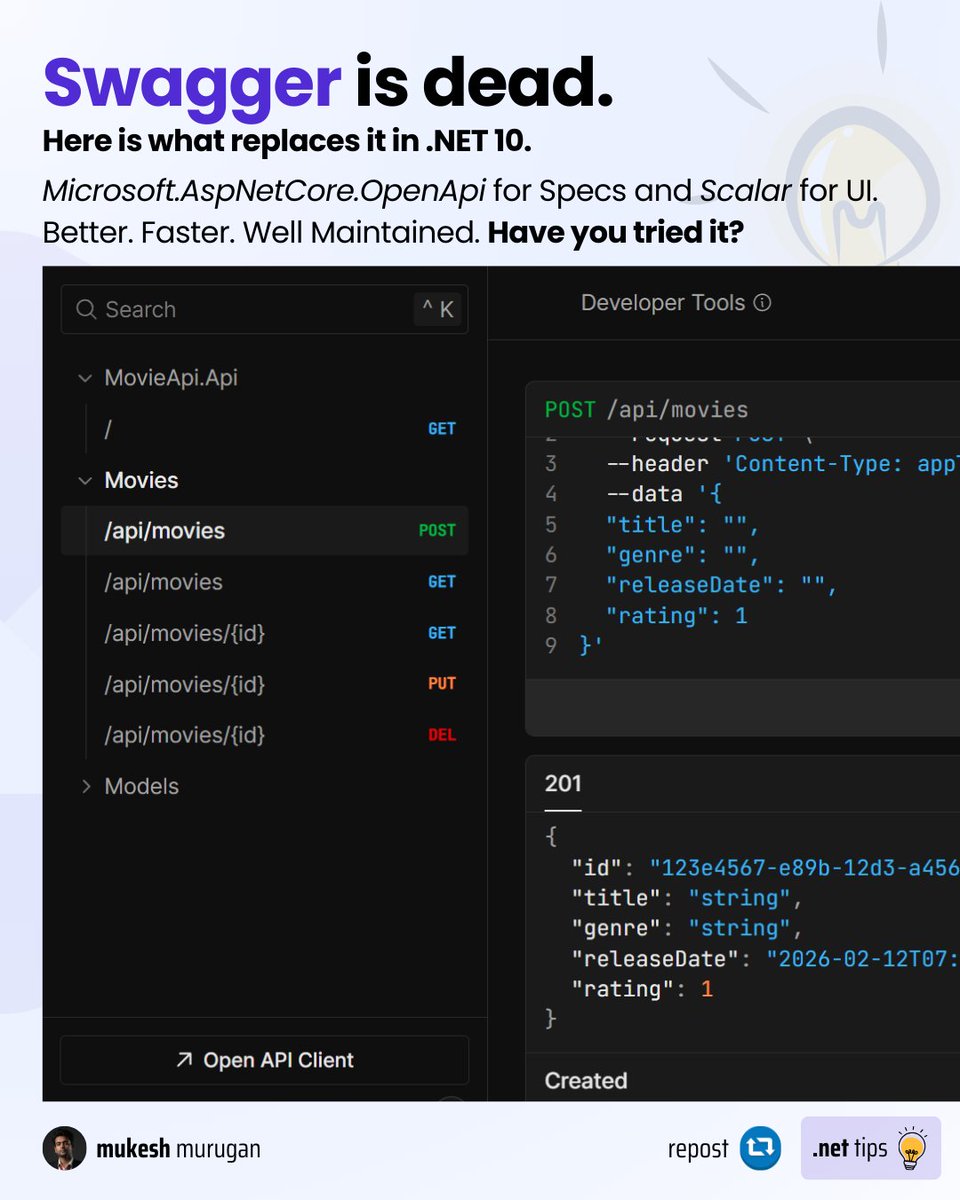
If you're still using Swashbuckle in .NET 10, here's what you missed.
Swashbuckle hasn't had regular updates in over a year.
So, Microsoft dropped it from .NET 9+ templates and built their own.
The replacement: `Microsoft.AspNetCore.OpenApi` — built-in, lighter, maintained.
For a UI: Scalar > Swagger UI. It's faster, better looking, and supports dark mode out of the box.
Migration takes 5 minutes: remove Swashbuckle, add `builder.Services.AddOpenApi()`, done.
Read article to help you migrate -codewithmukesh.com/blog/dotnet-sw…
Repost this to help a fellow developer.
English
Ok....so having now read the debate in the comments about lines of code and features...so "last year" btw....but I digress...what I'm interested in is the architecture, feature sets, and choreography of these systems, and considering many of us don't really "code" anymore, why don't we start sharing specs and architectures rather than code these days? Just feel like it would be more useful, no?
English

The best AI projects are the ones you can actually understand.
nanobot is an open-source personal AI assistant built in just ~4,000 lines of code. That's 99% smaller than the project it's inspired by (Clawdbot has 430k+ lines).
Most AI agent frameworks are bloated and impossible to navigate. nanobot takes the opposite approach and delivers core agent functionality with a codebase you can read on a weekend.
Key features:
- Works with any LLM provider
- Run local models with vLLM
- Connects to Telegram, Discord, and WhatsApp
- Ships with scheduled tasks, persistent memory, and a skills system
Everything you need for your personal AI assistant.
You can get it running in 2 minutes:
𝗽𝗶𝗽 𝗶𝗻𝘀𝘁𝗮𝗹𝗹 𝗻𝗮𝗻𝗼𝗯𝗼𝘁-𝗮𝗶
𝗻𝗮𝗻𝗼𝗯𝗼𝘁 𝗼𝗻𝗯𝗼𝗮𝗿𝗱
𝗻𝗮𝗻𝗼𝗯𝗼𝘁 𝗮𝗴𝗲𝗻𝘁 -𝗺 "𝗛𝗲𝗹𝗹𝗼!"
Here's something worth thinking about:
The LLM alone is not what makes an agent powerful. It's the harness around it: tool execution, memory, context building, and task scheduling. That's where the real engineering lives.
Learning to build effective agent harnesses is quickly becoming one of the most valuable skills you can develop. nanobot gives you a clean, minimal codebase to study exactly that.
That said if you want to understand the full picture before diving into this lightweight version, I also recorded 30 minute video on mastering OpenClaw/Clawdbot, the project nanobot is built on top of.
I have linked the tutorial in the next tweet.

English

@aakashgupta Isn't RAG meant for other use cases though? Claude Code is a coding assistant. That's very different than analyzing 100.000 sales call transcripts for example, right? I am still learning all of this, but I don't think you can generalize RAG in its entirety just because of this?
English

The creator of Claude Code just told you the entire RAG industry is solving the wrong problem and nobody is repricing.
Boris Cherny built Claude Code from scratch. His team ships 80-90% of their code using it. Anthropic’s per-engineer productivity has grown 70% because of it. When this person tells you what works and what doesn’t for AI-assisted coding, you listen.
They started with the standard playbook. Voyage embeddings, off-the-shelf RAG, local vector DB. The setup every enterprise is currently spending millions to replicate. And they abandoned it.
The reason is uncomfortable for anyone selling vector database infrastructure. Agentic search, meaning just letting the model use grep and glob in however many search cycles it needs, outperformed RAG “by a lot.” And when asked what benchmark proved this, Cherny said the quiet part out loud: “This was just vibes. Internal vibes. It just felt better.”
That’s the creator of a tool generating $1B+ in ARR telling you that a model using basic Unix search commands beat a sophisticated retrieval pipeline, and the evidence was vibes-based. The RAG stack didn’t lose on some edge case. It lost on the metric that actually matters for developer tools: does the output feel right.
The second reason is where the infrastructure thesis really breaks down. RAG requires an indexing step. Code drifts out of sync with the index. The index has to live somewhere. That somewhere is a security liability. Cherny specifically said that even Anthropic’s own codebase was too sensitive to upload to a third-party index. If Anthropic won’t trust the RAG security model with their own code, why would anyone else?
Meanwhile, Pinecone has raised $138M. The vector database market is projected to hit $7B by 2029. The RAG market is valued at $2.3B and projected to reach $81B by 2035. Billions in venture capital and enterprise spend are flowing toward making retrieval pipelines faster and more sophisticated.
And the team that actually built the most widely adopted AI coding agent looked at all of that infrastructure and said: grep works better.
RAG still makes sense for document search, customer support, knowledge bases with static corpora. But for the fastest-growing segment of AI tooling, the code generation market, the winning architecture is radically simpler than what the industry is selling.
The real signal here is about where AI development is heading. As models get smarter, the value of pre-computed retrieval indexes goes down. A sufficiently capable model can just search for what it needs in real time, the same way a senior engineer would. The model replaces the pipeline.
That’s the $81 billion question the RAG industry needs to answer. And right now, the person best positioned to know is saying they already answered it.
Boris Cherny@bcherny
@EthanLipnik 👋 Early versions of Claude Code used RAG + a local vector db, but we found pretty quickly that agentic search generally works better. It is also simpler and doesn’t have the same issues around security, privacy, staleness, and reliability.
English
Hank retweetledi

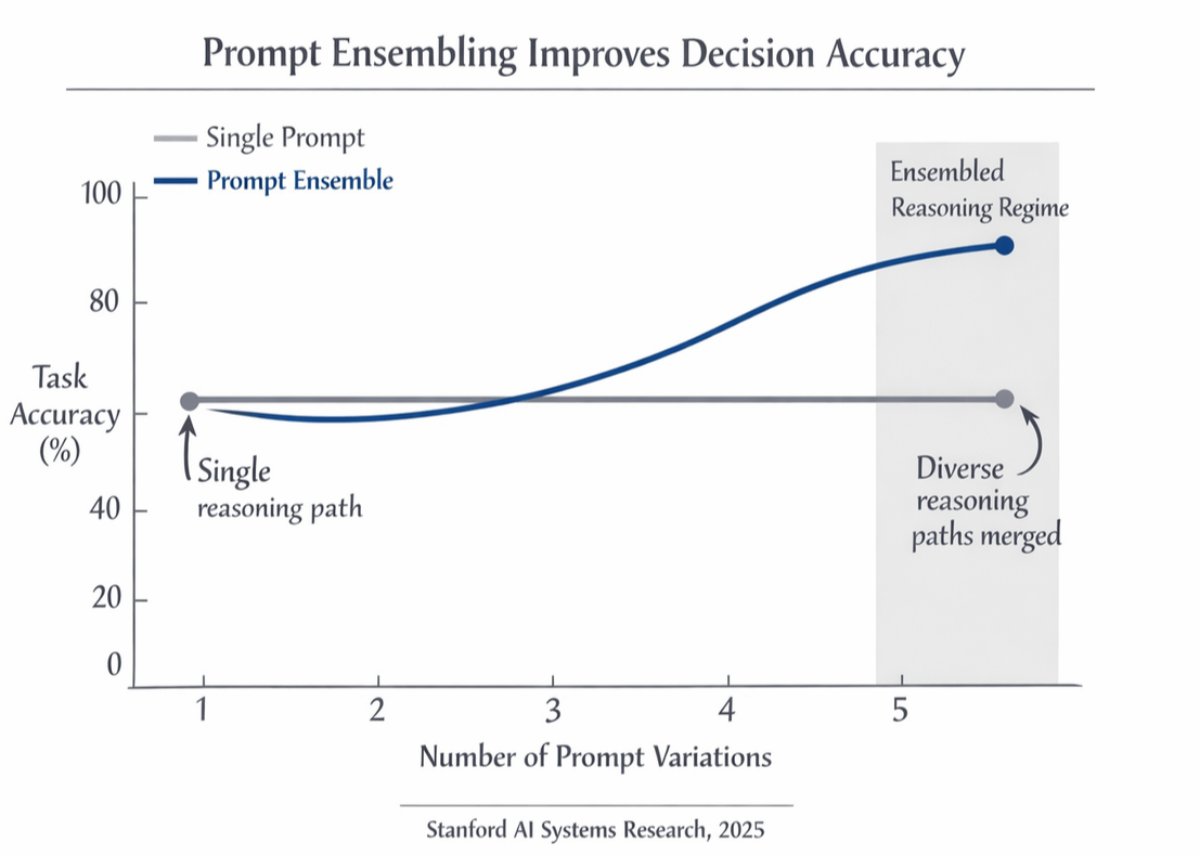
Stanford researchers just published a prompting technique that makes today’s LLMs behave like better versions of themselves.
It’s called “prompt ensembling” and it runs 5 variations of the same prompt, then merges the outputs.
Here’s how it works 👇
English

Joy springs from within, yet we live in a world where external forces constantly knock at the door of our inner peace. Today's interconnected reality means we're perpetually surrounded by influences that shape how we feel—political turbulence, social dynamics, economic strain, the quality of our relationships, and our financial security all leave their fingerprints on our emotional state. Layer onto this the weight of global crises: wars that rage across continents, the rise of authoritarian regimes that erode democratic values, the aggressive spread of religious extremism through digital channels, and the deepening chasms between cultures and communities. Cultivating joy isn't an act of willful blindness to the world's wounds. Think of it instead as tending the lamp we'll need when darkness falls—we fill our inner reservoir not to hoard light, but to have something to offer when the world needs us most. Joy becomes the renewable fuel that powers compassion, the rest that makes resistance sustainable.
*****
This winter, I brought to life something that has lived in my imagination for years—the first annual print edition of The Gurdeep Magazine. It features writing from other contributors alongside my own work. If you feel called to hold this warmth of printed words in your hands, visit Gurdeep.ca/magazine.
English

Right now, nine Supreme Court justices can shape your rights for decades without ever answering to the American people. That’s not balance. That’s not accountability, and that’s simply too much power for too long.
That’s why I’m cosponsoring legislation to establish 18-year term limits for Supreme Court justices, with regular appointments every two years. We need to put an end to strategic retirements, court-packing games, and a system that changes the direction of the country on a single vacancy or lifetime appointment.
Term limits don’t weaken the Court. They modernize it by restoring balance, strengthening accountability, and rebuilding public trust.
This is how we restore confidence in the Court and strengthen our democracy for the long term.
English
@BernieSanders Oh yeah....and all that should go straight to Social Security, and retraining programs, not the general fund.....in addition to current levels, obviously.
English
@BernieSanders Tax LLM tokens. Done
Tax offshore workers for full SS withholding. Done.
Pretty straight forward. Every time a business tries to circumvent American labor....make them pay.
English

Why would corporations like Amazon replace workers with robots? Pretty simple.
Robots don’t need a wage, health care, time off, sick leave, Social Security, Medicare or unemployment benefits.
Maybe it’s time to tax robots & use the revenue generated to help working families.
English


@ChrisAd75482 @piyushmittal But Made in America costs $65. Just sayin'
Prices will go up, but not wages.
English


@smartalek180 @Alaskacryptogi1 @storystandouts @RenaFox56282087 @CPAC First time I've heard of 2 digit people, that's fucking hilarious. So good.
English

@Alaskacryptogi1 @storystandouts @RenaFox56282087 @CPAC There's rly nothing funnier than 2-digit ppl proudly proving their ignorance by trying to look clever when "arguing" w/3-digits.
A suggestion:
Never enter a battle of wits unarmed.
And...
EVERY battle of wits u enter, u will b unarmed.
English

🧵THREAD: What does a Kamala Harris Administration look like?
While presiding over the U.S. Senate as VP she has cast the most tie-breaking votes (33) in history.
These votes are not just politically polarizing but show how damaging a Kamala Harris White House would be.
See for yourself: 👇

English
@theR_Man_ @LakotaMan1 Remember all the talk of "Crisis Actors" at school shootings and the like? This is where we are now.
One group claims fake mass shootings, the other claims fake assassination attempts, welcome to the idiocracy.
English

@LakotaMan1 Several people at this event were hit by BULLETS. One person DIED. How the fuck can you accuse Trump of staging a fake shooting, when people got hit by bullets and died? #LeftyDumFuks
English
@kenjansen @LakotaMan1 Not a Trump fan at all, but he was face down on the floor for a few ticks, so gravity. No idea on the color.
English