Sabitlenmiş Tweet
Hashed Fate
23.8K posts

Hashed Fate
@HashedFate
Oracle supremacist since 2017. Passionate about Chainlink and its impact on the blockchain industry. Views & opinions expressed are my own.
Katılım Ekim 2017
1.6K Takip Edilen54.2K Takipçiler
Hashed Fate retweetledi

Powering the next phase of institutional tokenization with @Chainlink.
CCIP enables seamless movement of BKN across @base , @BNBCHAIN , and @Ethereum, bringing true multichain utility to Brickken’s infrastructure.
Compliance. Interoperability. Adoption.
Chainlink@chainlink
Chainlink Build member @Brickken, an enterprise-grade tokenization platform with $300M+ tokenized, has upgraded to the Cross-Chain Token (CCT) standard as part of its token migration. With this upgrade, users can now transfer BKN across Base, BNB Chain, & Ethereum via CCIP.
English

This is incoherent. “Buying OTC” is just off-exchange buying, which they Evernorth is NOT doing, but fine.
“Deploying yields into buying more XRP” and “increasing XRP per share” are word salad.
XRP isn’t equity, and Evernorth isn’t a crypto hedge fund. You’re just stringing finance buzzwords together and hoping it sounds like alpha.
English

@afi1007 @CatfishFishy Evernorth is buying OTC, deploying yields into buying more XRP. Their goal is to increase the XRP per share. What does Evernorth CEO, which cones from Ripple, know that we dont?
English

Want to resist the Deep State, get adopted by all the banks, disintermediate SWIFT, and replace both the Federal Reserve and the mainstream media all with the click of a single button?
Well, step right up, folks! We have just the magical digital bean for you: $XRP
FinanceBro@FinanceBroYT
🔥🔥🔥THIS IS HOW #XRP REPLACES FEDERAL RESERVE AND MAINSTREAM MEDIA OVERNIGHT!!!🔥🔥🔥

English
Hashed Fate retweetledi

JPM and DBS just showed that real bank money can move on public rails.
That’s progress.
The next challenge?
Making those movements final, legal, and usable across many banks — not just two.
That’s when digital money stops being an experiment and becomes infrastructure.
Watcher.Guru@WatcherGuru
JUST IN: JPMorgan launches blockchain-based deposit token 'JPM Coin' for institutional clients.
English

@el_changusto @Brickken @FolksFinance I like truflation and already have a side stack. Didn't feel the need to add additional
English

Chainlink Rewards S1 allocations locked:
🧊 Brickken – 40 %
🧊 Folks Finance – 35 %
🧊 Mind Network – 25 %
@Brickken → RWA rails for institutions. Tokenizing equity, debt, and funds through Chainlink PoR + CCIP. Direct tie-in to the tokenized-assets boom.
@FolksFinance → Cross-chain lending protocol using CCIP for xLending. Real users, real revenue, and a clean on-ramp for DeFi capital moving multichain.
@mindnetwork_xyz → Fully Homomorphic Encryption + AI privacy. Frontier tech, highest variance bet. If FHE breaks out, it’s a 20–50× narrative play.
English
Hashed Fate retweetledi

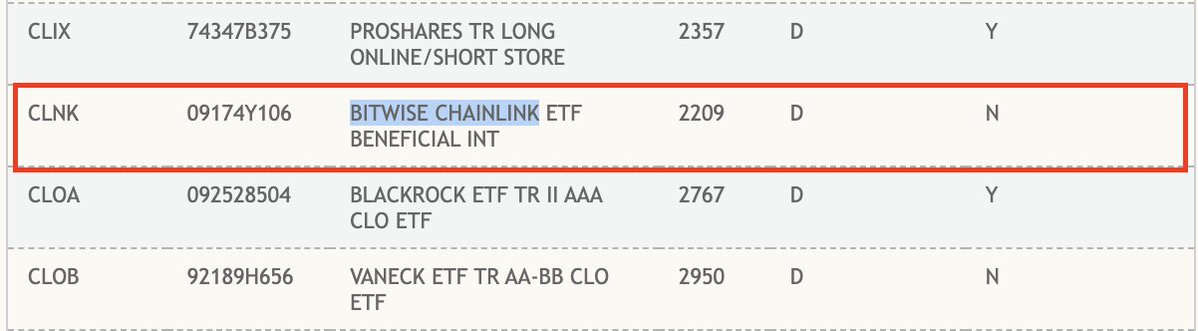
The Bitwise Chainlink ETF (ticker: CLNK) has been added to the DTCC eligibility list. Such listing is part of the standard clearing and settlement preparation process and does not indicate that the ETF has received regulatory approval or completed any other required approvals. dtcc.com/charts/exchang…
English
Hashed Fate retweetledi

@aris_jewels The CLARITY Act has nothing to do with SWIFT’s upgrade. ISO 20022 is just a global data standard, not a crypto thing. SWIFT can roll that out without waiting on any U.S. bill.
English

@HashedFate how can this happen without the clarity act going forward before? we’re kind of in a dead end until the legislators clear the way
English

November 22 is when SWIFT fully switches to ISO 20022, meaning banks will finally start speaking the same data language.
Once every payment rail uses that shared structure, Chainlink can hook in through CCIP and CRE.
Smart contracts will be able to read those messages, automate settlement, and move value across chains and networks without middlemen.
Basically what @TomZschach has been saying all along.
No bridge token needed, sorry XRP crew. Just don’t expect the payoff for LINK to be instant. This is plumbing being laid, not fireworks.

English

CCIP doesn’t claim to create liquidity, it coordinates it.
The difference now is that settlement can be atomic across those existing pools, so you don’t need idle pre-funded accounts or a token pretending to unify liquidity.
The capital isn’t parked, it’s sourced on demand from deep global markets that already trade those pairs in real time.
By around 2017–2018 the shift was effectively underway. That’s when major banks began adopting real-time gross settlement systems (like SWIFT gpi and CLS Now), high-frequency FX liquidity became always-on, and the first large stablecoins (USDT, USDC) proved 24/7 tokenized cash could move value without pre-funding.
From that point forward, liquidity stopped being the bottleneck, the coordination layer was.
English

Please forgive the somewhat canned response here but I have been researching this idea of Chainlink, CCIP, and atomic settlements removing the need for a bridge asset between two counterparties that do not use the same currency/stablecoin and I keep coming back to this response from ChatGPT that no one seems to be able to clarify for me.
Chainlink CCIP and CRE enable secure, automated messaging and workflow orchestration — like triggering cross-chain events, eBL transfers, and conditional payments. That’s powerful.
But atomic messaging ≠ liquidity. To actually move value from Brazil to Hong Kong in different currencies, you still need:
Pre-funded FX pools, or
A market maker with both currencies, or
A liquid bridge asset like $XRP or $XDC to eliminate pre-funding.
Without that, the capital still sits idle somewhere — just under a new name. So CCIP reduces friction, not float.
English

Even LLMs have caught up to the changes happening in these markets, but if you talk to them about XRP’s thesis they’ll still try to fit everything into that 2013 model.
It’ll glaze you with facts that sound right but don’t match today’s reality. Half the time I have to feed it recent Chainlink blog posts just to get it to understand what’s actually live now.
English

Unfortunately, that's one of the limitations of large language models. They get their information from everywhere. If something is said often enough and repeated often enough, the LLM will pick it up, not matter how untrue.
In this case, we see examples provided by verifiable and official sources that cross border transactions do not require liquidity layers or bridge currencies. ChatGPT only believes it does because of the proliferation of this narrative across social media.
English

The liquidity already exists in global FX and stablecoin markets. CCIP just coordinates it so both sides settle at the same time. No bridge token, no parked balances, no middlemen.
Liquidity doesn’t need to be “provided” because it already exists in the markets where banks and LPs operate.
FX desks, stablecoin issuers, and market makers are constantly quoting and settling pairs like USD-EUR, USD-HKD, or USDC-EUR. That’s trillions in live liquidity moving every day.
CCIP doesn’t replace that, it just connects to it. It lets those conversions finalize atomically, so the same liquidity pools can be used instantly without pre-funding or a bridge token.
XRP’s idea made sense in 2013 when cross-border settlement was slow, messaging was fragmented, and there were no tokenized deposits, stablecoins, or atomic settlement rails.
Back then, a neutral bridge asset sounded like a shortcut to skip nostro and vostro pre-funding. But today, real-time FX markets, tokenized cash, CCIP can handle coordination directly.
Liquidity is already deep and on demand, settlement can be atomic without a dedicated intermediary token.
The problem XRP was built to solve has already been solved by better infrastructure.
English

Thanks for the link. Again, I know that atomic settlements speed up the transaction but where does the FX liquidity come from if there are two parties that do not use the same currency/stablecoin? Everything that is being tested right now, even in the article you sent me, shows that FX still has to happen and that pre-funding of the counter parties currency/stablecoin is required unless you have a bridge asset. Please see the ChatGPT analysis and tell me where it's wrong. I'm sincerely seeking an answer that no one seems to know yet.
“Subject to the ANZ internal reserve module for the foreign exchange transaction, ANZ purchases e‑HKD from the HKMA.”
“Using Investor’s deposits, ANZ conducts a foreign exchange transaction of AUD to HKD internally.”
“The use case explores cross‑border transactions … between new forms of digital money and a tokenized money market fund (MMF). The process is two‑fold. First, the investor will acquire e‑HKD via their bank (ANZ) and secondly, will acquire an interest in a Hong Kong‑based MMF using either e‑HKD, or tokenized deposits.”
🧐 Why This Means Nostro/Vostro Is Still Necessary Without a Bridge
Given those lines, here’s why the need for Nostro/Vostro accounts (or something analogous) remains — unless a bridge asset is used.
The FX transactions show one side (ANZ) is converting AUD → HKD before tokenising. That implies the bank must hold or access AUD and HKD liquidity in advance.
The internal “reserve module” suggests the funds/FX have to be settled/held in reserve before proceeding with minting or tokenisation.
If you’re converting from currency A to currency B, you either need:
Pre‑funded deposits of currency B in the receiving jurisdiction (classic Nostro/Vostro setup), or
A liquid bridge asset (neutral, globally tradable token) so you don’t need pre‑funded currency accounts in each jurisdiction/currency corridor.
Without the bridge asset option, you end up with something very similar to Nostro/Vostro: each bank holds liquidity in foreign currency accounts in multiple jurisdictions to ensure settlement can occur when needed.
So the workflow in the pilot demonstrates that while messaging & automation (via cross‑chain/tokenised money) are improved by technologies like Chainlink CCIP or atomic settlement, the underlying need for currency conversion and reserves remains unless you introduce a global bridge asset that both parties trust and can trade instantly.
English

@Acreeto Yeah, no kidding. This part of the stack moves slower than anyone wants.
English

@HashedFate The payoff has been far from instant brother. Fucking hope it hurries up
English

@the5blairs Nostro / Vostro accounts exist because of settlement latency and trust gaps. If settlement becomes atomic, meaning instant and verifiable, there’s no need to pre-fund anything. CCIP collapses that latency window to zero.
English

Each side keeps their money where it already is. CCIP just moves the settlement instructions and proofs so both sides finish at the same time. No one’s parking cash overseas or waiting on a middleman to say it cleared.
Once both legs settle atomically, those parked nostro and vostro balances stop making sense. The coordination layer makes them obsolete.
English