Harshit singh

501 posts

Harshit singh banner
Harshit singh

Harshit singh

@Hashitsingh_29

PhD Scholar ,Assistant Professor working in AI in Drug Discovery

Ayodhya, India Katılım Aralık 2016
1.5K Takip Edilen252 Takipçiler
Harshit singh
Harshit singh@Hashitsingh_29·
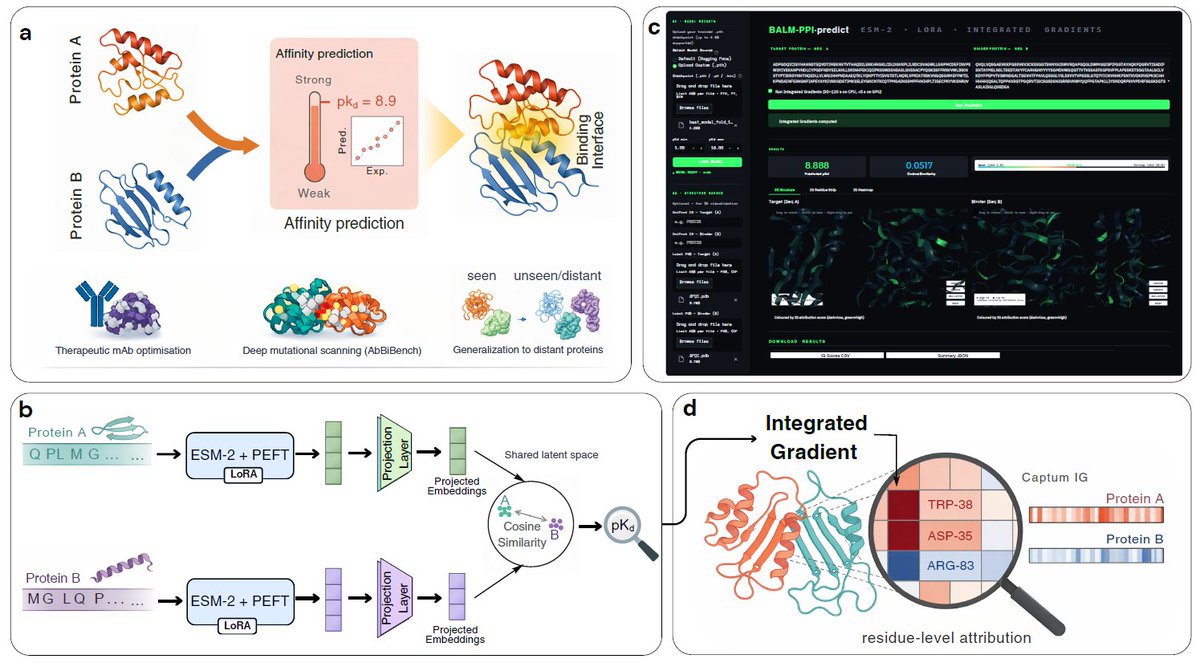
@hirat62363752 Thanks for sharing our paper! We present BALM-PPI, an explainable sequence-based model to predict binding affinity, & achieve strong generalisation. Excited about applications in PPIs & antibody optimisation. biorxiv.org/content/10.648…
English
1
0
2
61
Harshit singh
Harshit singh@Hashitsingh_29·
🙌 Big thanks to all my co-authors for their support and contributions! @gorantlarohan @caithmac Would really appreciate any feedback or thoughts!
English
0
0
5
89
Harshit singh
Harshit singh@Hashitsingh_29·
🌐 Web tool We built a webtool for single/batch predictions, supporting protein–protein and antibody–antigen modes directly from sequence. Returns pKd, similarity scores, and residue-level attributions (via Integrated Gradients), with optional structure visualisation. 🧵9/9
Harshit singh tweet media
English
1
0
4
85
Harshit singh
Harshit singh@Hashitsingh_29·
@biorxiv_bioinfo Thanks for sharing our paper! We present BALM-PPI, an explainable sequence-only approach that learns a shared latent space where cosine similarity correlates with binding affinity ,& achieves strong generalisation. Excited about applications in PPIs & antibody optimisation.
English
0
0
4
70
Harshit singh retweetledi
Sumit
Sumit@_reachsumit·
On Strengths and Limitations of Single-Vector Embeddings Microsoft shows that dimensionality alone cannot explain poor retrieval performance of single-vector embeddings, identifying domain shift and the "drowning in documents" paradox as key factors. 📝 arxiv.org/abs/2603.29519
English
0
22
159
25K
Harshit singh retweetledi
Alex Abrudan
Alex Abrudan@Alex__Abrudan·
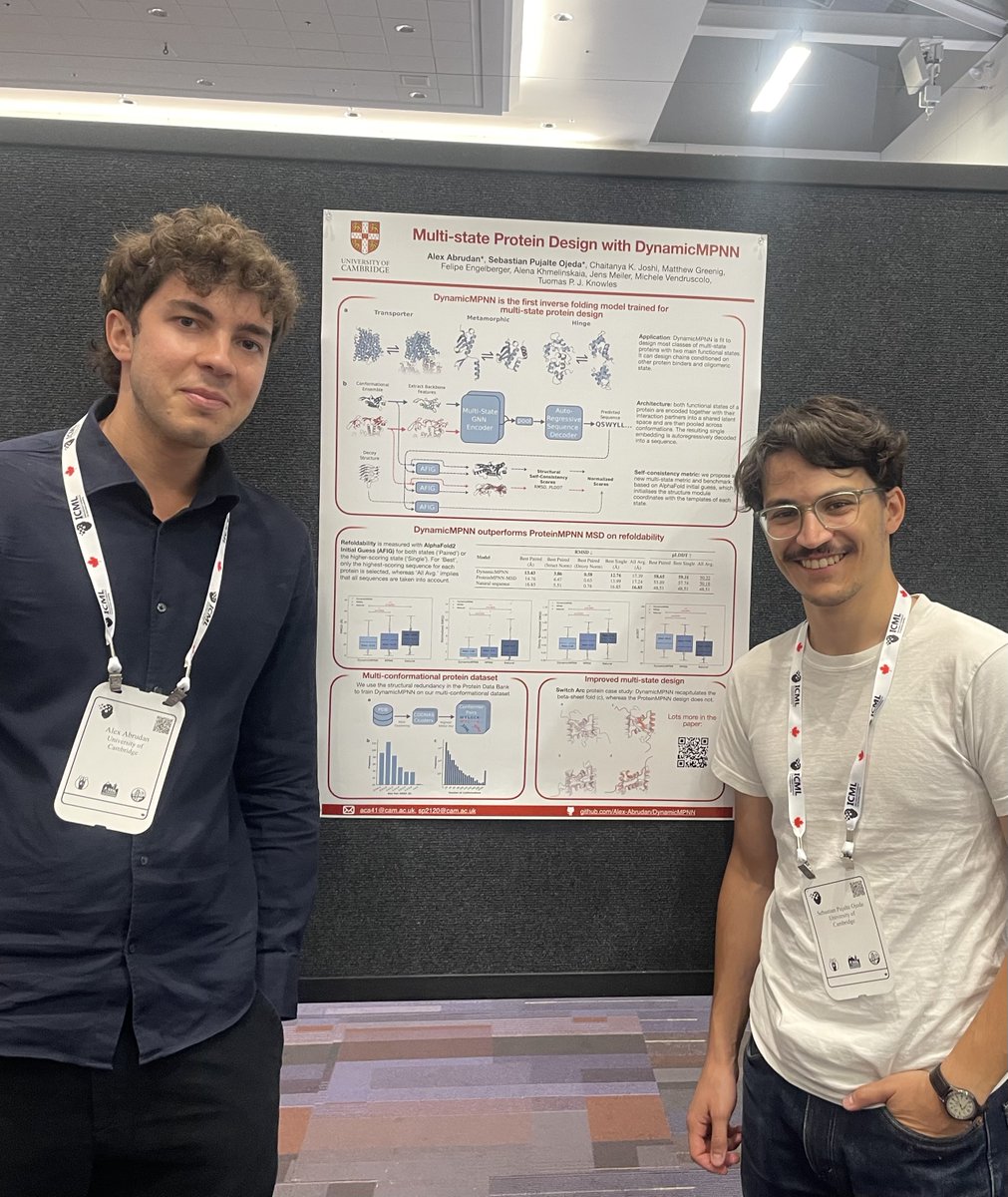
📢 I ’m thrilled to share the first pre-print of my PhD, co-authored with @rumbacarumba! Our work presents the preliminary results on "Multi-state Protein Design with DynamicMPNN". 📄 Paper: lnkd.in/dfs4v3Qt 💻 Github: lnkd.in/dgntqbKR This  project has been quite a journey - we reformulated our approach to multi-state protein design multiple times as we delved deeper into understanding protein dynamics and tackled the challenge of scarce multi-conformational data. We’re also excited that this work was accepted for the 🇨🇦 ICML 2025 GenBio Workshop, where we had a blast 🎉 🔴 Existing multi-state design approaches rely on post-hoc aggregation of single-state predictions, achieving poor experimental success rates compared to single-state design. 🟢 DynamicMPNN is a GNN-based inverse folding model designed to handle most classes of multi-state proteins with two main functional states. It can design chains conditioned on other protein binders and oligomeric states. Key contributions: • Created a new ML-ready dataset of proteins with multiple conformations using sequence redundancy in the PDB. • Evaluated our method on a challenging test set containing 94 biologically relevant metamorphic, hinge, and transporter proteins. • Proposed a multi-state self-consistency refoldability metric and benchmark, which we argue is superior to sequence recovery. • 𝐃𝐲𝐧𝐚𝐦𝐢𝐜𝐌𝐏𝐍𝐍 𝐢𝐦𝐩𝐫𝐨𝐯𝐞𝐬 𝐩𝐞𝐫𝐟𝐨𝐫𝐦𝐚𝐧𝐜𝐞 𝐨𝐯𝐞𝐫 𝐏𝐫𝐨𝐭𝐞𝐢𝐧𝐌𝐏𝐍𝐍 𝐨𝐧 𝐨𝐮𝐫 𝐛𝐞𝐧𝐜𝐡𝐦𝐚𝐫𝐤 𝐛𝐲 𝐮𝐩 𝐭𝐨 𝟏𝟑% 𝐨𝐧 𝐑𝐌𝐒𝐃. Some key lessons we’ve learned: • For better multi-state design, the BioML community needs to develop targeted approaches for specific types of protein dynamics. • DynamicMPNN targets proteins with clear nodes in their energy landscape, i.e. where ‘states’ can be easily discretized and their function still heavily relies on structure and their shape-complementarity with binders, just like for single-state proteins. 𝐒𝐭𝐮𝐝𝐲𝐢𝐧𝐠 𝐨𝐭𝐡𝐞𝐫 𝐤𝐢𝐧𝐝𝐬 𝐨𝐟 𝐝𝐲𝐧𝐚𝐦𝐢𝐜𝐚𝐥 𝐩𝐫𝐨𝐭𝐞𝐢𝐧𝐬 𝐥𝐢𝐤𝐞 𝐢𝐧𝐭𝐫𝐢𝐧𝐬𝐢𝐜𝐚𝐥𝐥𝐲 𝐝𝐢𝐬𝐨𝐫𝐝𝐞𝐫𝐞𝐝 𝐩𝐫𝐨𝐭𝐞𝐢𝐧𝐬 𝐫𝐞𝐪𝐮𝐢𝐫𝐞𝐬 𝐚 𝐝𝐢𝐟𝐟𝐞𝐫𝐞𝐧𝐭 𝐚𝐩𝐩𝐫𝐨𝐚𝐜𝐡. • Care should also be taken when picking the right design targets due to the limited understanding of conformational switch mechanisms. Huge thanks to @chaitjo for all the mentourship and insights we gained from his RNA design project gRNAde, and to all our co-authors Matt Greenig, @Felipe @fengel97, @akhmelinlab , @MeilerLab, Michele Vendruscolo, and my PhD supervisor Tuomas Knowles at @KnowlesLabCamb. Much more to come on this exciting research direction!
Alex Abrudan tweet mediaAlex Abrudan tweet media
English
4
26
119
9.4K
Harshit singh retweetledi
Liwei Jiang
Liwei Jiang@liweijianglw·
In Pluralistic Alignment, we aim to build AI for ALL!! We invite you to submit your creative work advancing this shared vision to the Pluralistic Alignment Workshop at ICML 2026. See you in Seoul!
Pluralistic Alignment Workshop@pluralistic_ai

🚨We are excited to announce the 2nd Pluralistic Alignment Workshop at #ICML2026 in Seoul! Submissions: openreview.net/group?id=ICML.… 🗓️Deadline: May 3 More details pluralistic-alignment.github.io We invite work on pluralistic alignment across technical, philosophical, societal perspectives!

English
1
6
32
6.7K
Harshit singh retweetledi
Ava Amini
Ava Amini@avapamini·
protein language models capture rich structural signals, but where that knowledge lives in the network is still unclear we show that small subnetworks inside PLMs encode structural concepts, from residues to folds journals.plos.org/ploscompbiol/a… @PLOSCompBiol work led by @riavinod_!
Ava Amini tweet media
English
0
30
175
15K
Harshit singh retweetledi
Adib
Adib@adibvafa·
Proteins can now talk. Introducing BioReason-Pro, the first reasoning model for protein function. A thread🧵
English
50
257
1.6K
202K