Yagan Hazard

1K posts

Yagan Hazard banner
Yagan Hazard

Yagan Hazard

@HazardYagan

AP @CollegioCA (since Sept. 2023) | PhD @PSEinfo, visited @Brown_Economics | Econometrics & Labor Economics

Paris Katılım Eylül 2019
2.1K Takip Edilen936 Takipçiler
Sabitlenmiş Tweet
Yagan Hazard
Yagan Hazard@HazardYagan·
We have a 📢 Call for Papers out for our *AI and Society* conference (🗓️ 11-12 June 2026, @Unibocconi). Keynote lecture by the one and only @m_sendhil! Looking forward to your submission, details below! (Papers on AI research methods or AI econ/social impact are all welcome.)
GermainGauthier@PinchOfData

📣 Call for Papers: AI and Society Conference 🗓️ 11–12 June 2026 at Bocconi University Submit full papers: bocconi.eu.qualtrics.com/jfe/form/SV_bp… Please share with colleagues & students!

English

2
13
104
12.3K
Yagan Hazard retweetledi
Aniket Panjwani
Aniket Panjwani@aniketapanjwani·
I just released a free 4 hour course on OpenAI Codex. The course focuses on the Codex Desktop app - which is the best interface for agentic coding with the best agentic coding model: gpt-5.5. I assume zero experience with agentic coding, and help you understand fundamentals such as Skills, MCPs, Plugins, Git, Subagents, and Worktrees. However, I've developed the course so that you're doing practical things with Codex within the first 5 minutes. The theory I present is *always* paired with immediate practical payoff. As a final capstone, I show you how to use Codex effectively for the ideation/brainstorming/planning stages of a project, and then I use this process to develop a novel web app from scratch. The full course is available here: youtu.be/j7d5rs0iMlE I've also created a 229 slide deck mapping to the course. You can find this slide deck in the Classroom section of my Skool server "The AI MBA": skool.com/the-ai-mba
YouTube video
YouTube
Aniket Panjwani tweet media
English
7
41
248
47.2K
Yagan Hazard retweetledi
Jonathan Roth
Jonathan Roth@jondr44·
I’m really excited about this paper! Some of my work has pointed out problems in empirical work, but this one is all about new 🔧s. If you (or your referees) want to know about the mechanisms by which a treatment affects an outcome, you may be interested. A 🧵.
The Review of Economic Studies@RevEconStudies

Want to know about the mechanisms by which a treatment affects an outcome? This paper develops tools for testing hypotheses about mechanisms under weak assumptions. Check it out! New paper by @jondr44 and Kwon: restud.com/testing-mechan… #REStud #EconX #EconTwitter

English
9
116
528
61.2K
Yagan Hazard retweetledi
Princeton Bendheim Center for Finance
Episode 5 of Paul Goldsmith-Pinkham's mini series on Claude Code for Applied Economists is out now! In this episode, "Writing and thinking," Paul showed how Claude can support the writing side of research. Watch now: bit.ly/4s5xuNq On Substack: bit.ly/4srv5wJ
Princeton Bendheim Center for Finance tweet media
English
0
34
197
12.2K
Yagan Hazard retweetledi
Emily Oster
Emily Oster@ProfEmilyOster·
Advice for PhD students in economics about using AI, from the brilliant Isaiah Andrews. This should probably be circulated to all PhD cohorts economics.mit.edu/sites/default/…
English
19
471
2.1K
549.4K
Yagan Hazard retweetledi
Jesús Fernández-Villaverde
Jesús Fernández-Villaverde@JesusFerna7026·
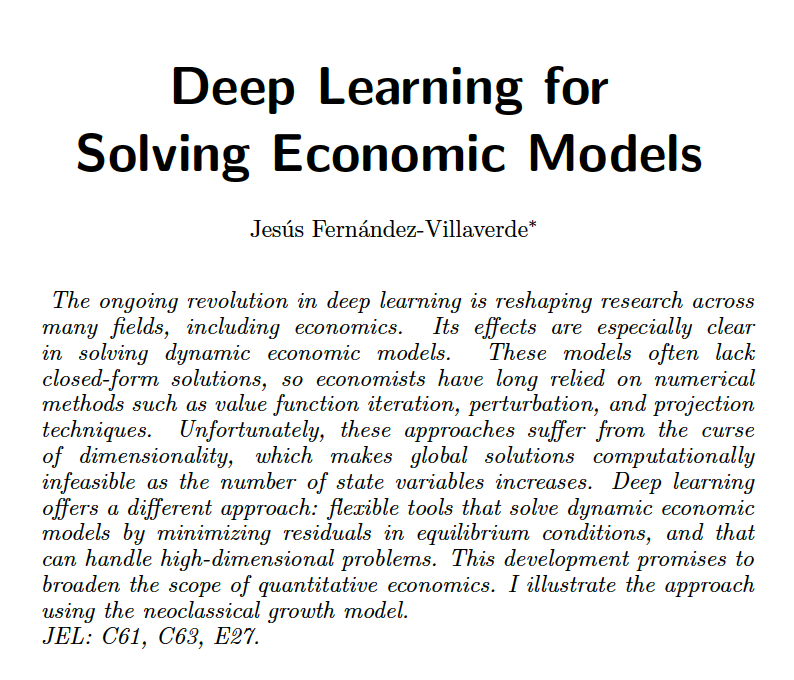
I am very happy that my survey paper, "Deep Learning for Solving Economic Models," is forthcoming in the Journal of Economic Literature (pending final replication checks, which should be quick). The paper benefited greatly from the editor, David Romer, five referees, and many friends who read earlier versions. I believe the result is a solid introduction to the field, though in 48 pages, there is only so much one can do. So, I created a companion webpage: sas.upenn.edu/%7Ejesusfv/dee… where you can find the paper, the code, and some slide decks with my teaching material. My plan is to expand the slides over time, adding new material and updating them as new results appear. I will probably do a thorough revision once the spring semester is over. Those who follow my feed know that I think deep learning is the most fundamental change to computational economics in the last 40 years. I am by now convinced it is more important than the development of Markov chain Monte Carlo methods in the early 1990s or the introduction of projection and perturbation methods in the 1980s. To find a comparable shift, one would probably need to go back to Richard Bellman's invention of value function iteration in 1957. More pointedly, we need to redesign the Ph.D. in economics. Not at the margin. From the ground up. Economists can either fully embrace the deep learning revolution or become irrelevant, as has already happened, I would dare say, to some fields in academia that refused to accept reality. Finally, let me apologize to everyone working in this area whom I could not cite. Space was a binding constraint. And yes, this post was written with the considerable help of AI. There is nothing I am prouder of than the fact that AI is now an integral part of every step I take in my professional life.
Jesús Fernández-Villaverde tweet media
English
20
294
1.3K
131.6K
Yagan Hazard retweetledi
Jesús Fernández-Villaverde
Jesús Fernández-Villaverde@JesusFerna7026·
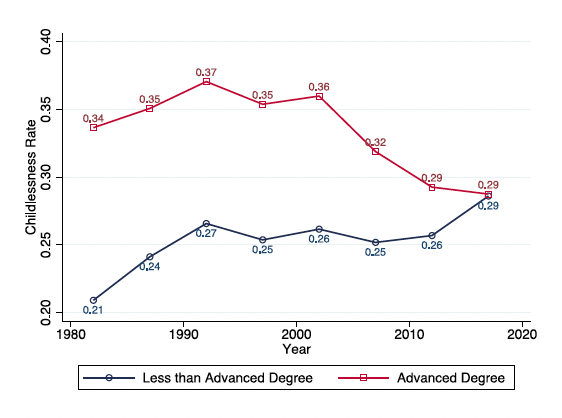
Moshe Hazan(@MosheHazan6), who has done important work on the economics of fertility, reminds me that he has documented the changing slope between fertility and education in advanced economies in several papers. One figure I found particularly clear to share on X is from his paper: “Highly educated women are no longer childless: The role of marketization” sciencedirect.com/science/articl… with David Weiss (a Penn alumnus!) and Hosny Zoabi (@Zoabi_Hosny). The authors compare the rate of “currently childless” among women of 40-45 years of age (i.e., close to the end of their fertile age) with postgraduate degrees (masters, doctorates, professional) vs. that of women of 40-45 years with college education or less in the U.S. By the end of the sample, 2016, both groups of women have the same rate of childlessness. This is a combination of a much lower rate for women with advanced degrees and a much higher rate for women without advanced degrees. My strong conjecture, based on the trends, is that by 2026, the rate of “currently childless” among women without advanced degrees will be noticeably higher than among women with advanced degrees. The authors suggest that this change may be mainly due to women with advanced degrees being able to outsource much of the childcare. But, from the perspective of this post, two thoughts. First, delete from your head the idea that the low fertility of the U.S. is driven by all those women getting MBAs at Wharton instead of starting a family. Women with MBAs at Wharton are doing fine in terms of fertility. Of course, the situation might be different in emerging economies, as younger cohorts of women are receiving education for the first time in history. Second, it seems to me that since those not having children are now women of lower income, policies that would help women who voluntarily desire to have children are policies that help the lower and middle classes in the U.S., not the rich. Keep that in mind next time you assess your support for those policies.
Jesús Fernández-Villaverde tweet media
English
17
67
306
30.9K
Yagan Hazard retweetledi
Rafael Dix-Carneiro
Rafael Dix-Carneiro@dix_rafael·
🚨 Forthcoming in Econometrica! How does trade liberalization affect developing countries with large informal sectors? Informality fundamentally changes how we think about the gains from trade. (1/5)
Econometrica@ecmaEditors

In settings with high informality, the gains from trade are significantly amplified by reductions in misallocation. During economic downturns, the informal sector acts as a buffer against unemployment but leads to larger aggregate real-income losses. econometricsociety.org/publications/e…

English
27
204
1K
206.3K
Yagan Hazard retweetledi
Chad Jones
Chad Jones@ChadJonesEcon·
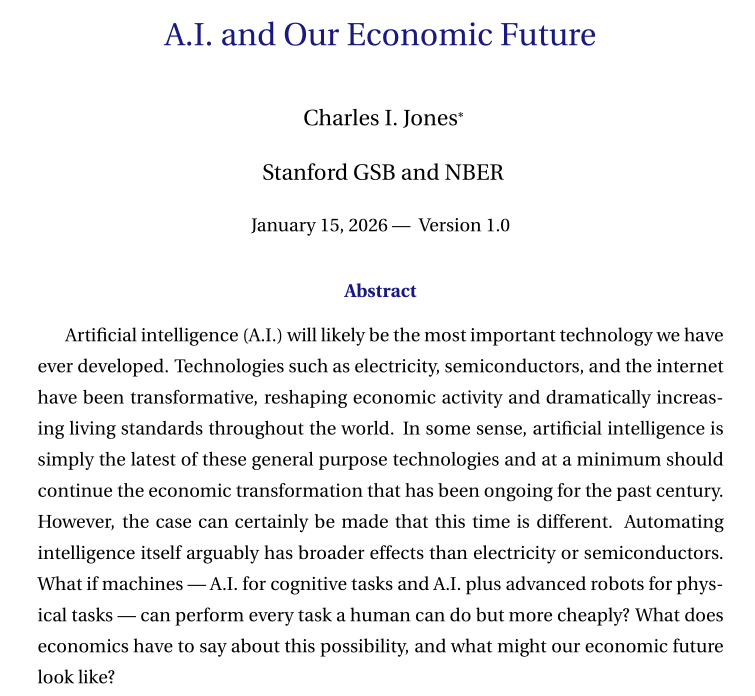
"AI and Our Economic Future" New paper in preparation for the Journal of Economic Perspectives ==> accessible to a broad audience. web.stanford.edu/~chadj/AIandEc…
Chad Jones tweet media
English
31
340
1.4K
413.6K
Yagan Hazard
Yagan Hazard@HazardYagan·
We have a 📢 Call for Papers out for our *AI and Society* conference (🗓️ 11-12 June 2026, @Unibocconi). Keynote lecture by the one and only @m_sendhil! Looking forward to your submission, details below! (Papers on AI research methods or AI econ/social impact are all welcome.)
GermainGauthier@PinchOfData

📣 Call for Papers: AI and Society Conference 🗓️ 11–12 June 2026 at Bocconi University Submit full papers: bocconi.eu.qualtrics.com/jfe/form/SV_bp… Please share with colleagues & students!

English

2
13
104
12.3K
Yagan Hazard
Yagan Hazard@HazardYagan·
@ben_golub Econometric theory isn't far enough from econ I guess? (I mean fully theoretical econometrics)
English
1
1
5
1.9K
Ben Golub
Ben Golub@ben_golub·
If you do applied math (broadly - CS, stats, physics, . . .) - a request/freebie: Refine is a tool that reads papers and finds technical issues, like a referee. We want researchers in diverse areas to try it. If you're willing to, read on. 1/
Ben Golub tweet media
English
17
66
586
60.2K
Brian Jabarian
Brian Jabarian@brian_jabarian·
I will be joining Carnegie Mellon University (@CarnegieMellon) as a tenure-track Assistant Professor at Heinz College, with an affiliation in the School of Computer Science (@SCSatCMU) soon!!
Brian Jabarian tweet media
English
30
11
243
135.3K
Yagan Hazard retweetledi
Brian Albrecht
Brian Albrecht@BrianCAlbrecht·
Some news? I’m writing a book for @stripepress 🎉 THE PRICE CODE is (shockingly) about price theory and teaches the power of rigorous economic reasoning. The book will explain how prices move, what they reveal about the world, and why most popular explanations are just empty
Brian Albrecht tweet media
English
43
55
640
120.8K
Yagan Hazard retweetledi
Jesús Fernández-Villaverde
Jesús Fernández-Villaverde@JesusFerna7026·
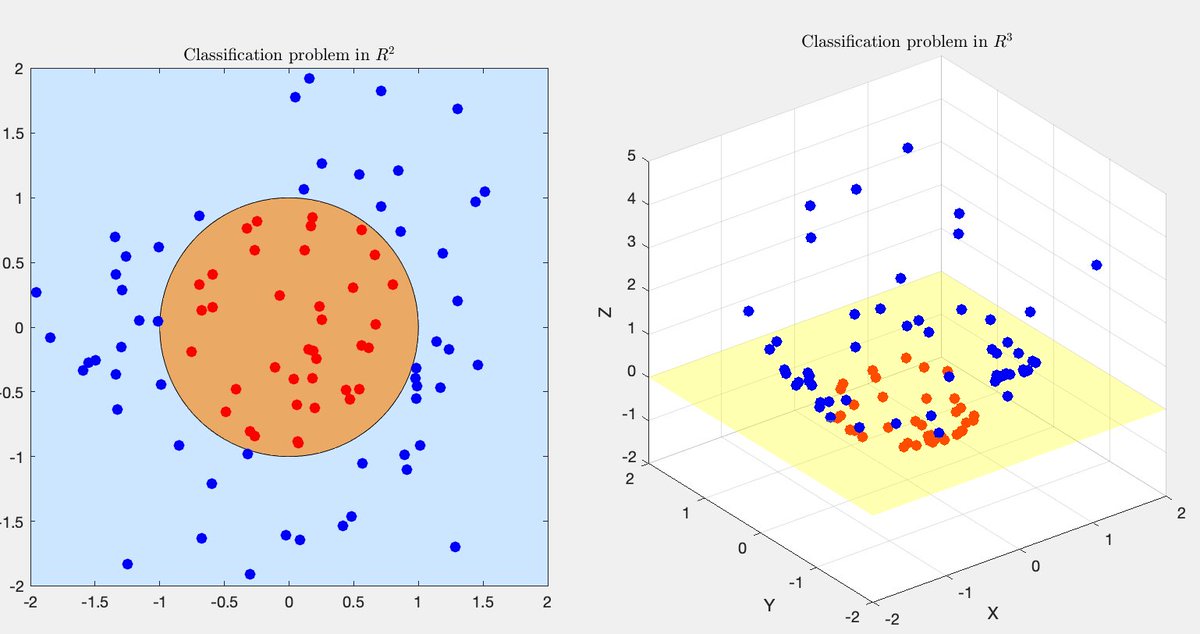
During my lectures last week at the ECB and the Bank of Spain on deep learning, I realized that many people in economics and econometrics often overlook the fact that what constitutes a good representation of the data (the topic of my previous post) depends entirely on the task at hand. A classic illustration I always use to make this point is Cover’s Theorem. Let me start with the intuition. Imagine that you have two-dimensional data (see the left panel of the figure below). The data are already normalized. For example, one dimension may be age, and the other income. The task is to separate individuals inside the unit circle (red dots) from those outside (blue dots). In this toy example, which corresponds to identifying people of middle age and middle income. This classification problem is (relatively) hard in the original 2D space because the decision boundary is nonlinear: checking whether x^2 + y^2 < 1 is not something a linear classifier can easily encode. And while “costly floating-point operations’’ is not the real issue in practice, the key point is that linear separation is impossible in the original coordinates. Now do something simple: map (x,y) into (x, y, x^2 + y^2 - 1). That is, embed the problem from two dimensions into three. The right panel shows the result. In this 3D space, the red points satisfy x^2+y^2 - 1 < 0, so they lie below the plane z = 0, while the blue points lie above it. A single linear cut (the plane z=0) now perfectly separates the two classes. What was nonlinear in 2D becomes linear in 3D. You may have noticed that this is exactly the kernel trick: instead of struggling with a nonlinear boundary in the original space, map the data through a suitable transformation so that the pattern becomes linear in a higher-dimensional feature space. You can find the precise statement of the components of Cover’s Theorem in Thomas Cover’s original 1965 paper: dropbox.com/scl/fi/14rnq9w… But the main message is simple and powerful: A complex pattern-classification problem, when recast nonlinearly in a higher-dimensional space, is more likely to become linearly separable than in its original low-dimensional space, as long as the higher-dimensional space is not too densely populated. This has an important implication that many people often misunderstand. Machine learning is not fundamentally about dimensionality reduction. It is about finding the informationally efficient geometric representation of the data for the specific downstream task you are concerned with.
Jesús Fernández-Villaverde tweet media
English
21
100
709
69.7K