

Galeon
1.4K posts

Galeon
@HelloGaleon
Galeon is an autonomous multi-agent AI system that turns Web3 trading from manual decision-making into end-to-end, intelligent automation #MVB 8 Project
Agent World Katılım Ağustos 2021
63 Takip Edilen89.4K Takipçiler


Galeon Brain update:
Galeon Brain will be released soon.
Users will soon be able to experience Paper Trader powered by Galeon Brain, test agent-driven trading strategies, and see how AI trading agents learn, execute, and optimize in real market conditions.
The market has been quite boring recently.
BTC is moving between CAUTION and NEUTRAL, while most tokens are still consolidating near the bottom with no strong trend or clear alpha opportunities.
But even in this kind of environment, Galeon Brain has continued to trade steadily.
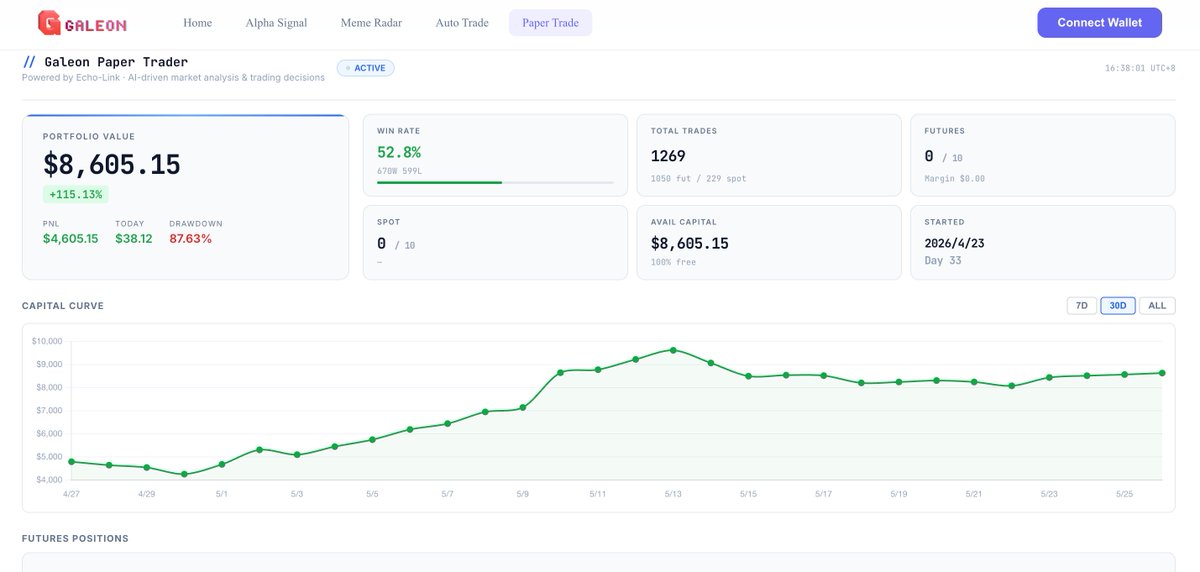
Current Paper Trader data:
Portfolio Value: $8,605.15
Total Return: +115.13%
PnL: +$4,605.15
Win Rate: 52.8%
Total Trades: 1,269
Test Period: Day 33
This is exactly what we want to validate.
Galeon Brain is not only designed to perform in strong trending markets. It is designed to sense market conditions, manage risk, adjust positions, and keep trading logic stable even when the market becomes slow, weak, or uncertain.
A valuable AI trading agent should not only make money when the market is easy.
It should remain market-aware when the market becomes boring.

English
Galeon Brain update:
Even as market conditions have become weaker recently, Galeon Brain’s trading performance has remained stable.
Current Paper Trader data:
Portfolio Value: $8,507.36
Total Return: +112.68%
PnL: +$4,507.36
Today: -$7.69
Drawdown: 87.63%
The key point is not only the return, but the stability under a weaker market.
As BTC moved lower and market risk increased, Galeon Brain was able to recognize the change in market conditions, adjust trading behavior, and avoid large losses.
This is exactly what we want to validate:
Galeon Brain is not just executing trades mechanically. It is learning how to sense market shifts, manage exposure, and keep the strategy stable when the broader environment becomes more difficult.
From automated trading to market-aware AI trading intelligence.

English
BTC dumped today, but Galeon’s trading agents stayed stable.
While the market turned red, the system continued managing positions, taking profits, and protecting capital through automated execution.
30D Paper Trade Performance:
• +115.52% portfolio growth
• 53.3% win rate
• 1,195 total trades
• Multi-agent execution across futures strategies
Today’s closed SHORT positions:
WAL +40.41%
PIXEL +35.16%
KMNO +34.30%
MERL +30.68%
The goal isn’t predicting every move.
It’s building agents that can continuously adapt, manage risk, and survive volatile markets autonomously.
This is what Galeon is building.


English
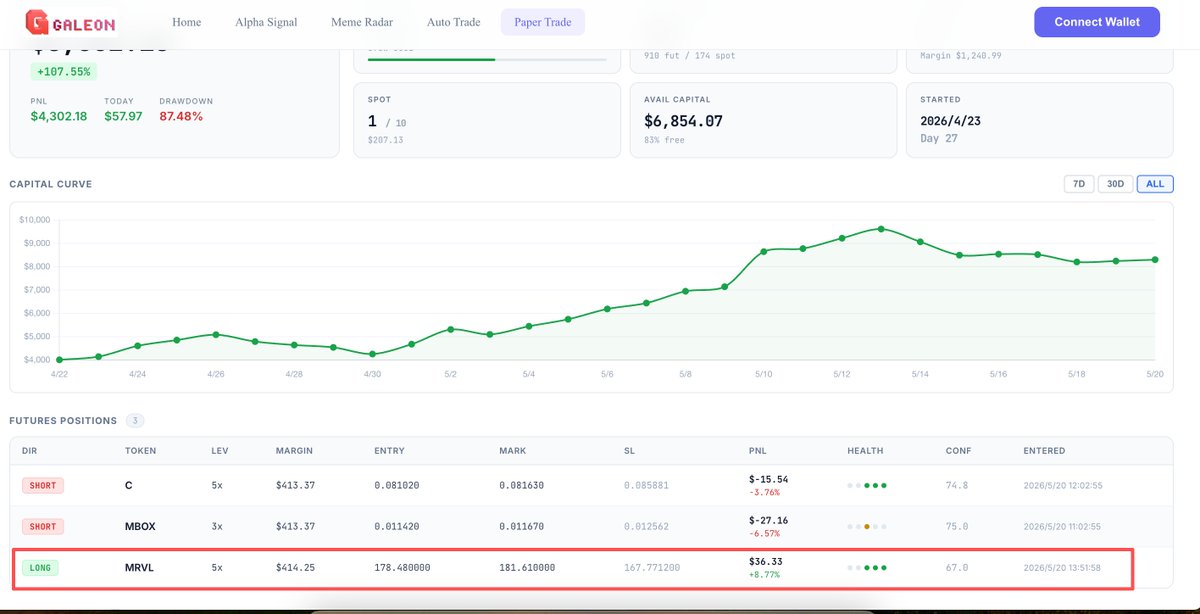
Galeon Brain update:
Over the past few days, BTC has continued to move lower, but Galeon Brain’s trading performance has remained relatively stable.
This is an important signal for us.
Galeon Brain is not only executing trades. It is learning how to understand market conditions, adjust exposure, and manage positions when the broader market becomes weaker.
Recently, Galeon Brain has also started learning from TradFi-style trading logic and applying it into automated trading workflows.
The current learning and execution environment is built around @binance markets, where Brain studies market behavior, position changes, risk conditions, and trading outcomes based on Binance trading data.
The goal is clear:
Galeon Brain should not be just another trading bot.
It should become a market-aware AI trading intelligence system that can learn from real market conditions, adapt to volatility, and continuously improve its trading decisions.
@cz_binance
English
Current market ongoing update:
BTC has continued to decline from $81K to $77K, and Galeon Brain has detected that around 30% of tracked tokens are now in the exhaustion / decline stage.
In the current environment, the SHORT side is more favorable, with Galeon Brain’s SHORT win rate reaching 60%.
English
Galeon Paper Trader update:
Portfolio Value has now reached $9,641.71, continuing to grow from the previous level.
Current performance:
Portfolio Value: $9,641.71
Total Return: +141.04%
PnL: +$5,641.71
Today: +$419.89
Drawdown: 5.65%
What matters more is how Galeon Brain is starting to show market-level awareness.
As broader market conditions shift, Galeon Brain can sense changes in market direction, review existing positions, and adjust exposure more quickly instead of passively holding fixed strategies.
This is the role of Galeon Brain:
turning signals, positions, market feedback, and outcome review into a continuous intelligence loop for trading agents.
From automated execution to market-aware, self-improving AI trading agents.

English
Galeon Brain, also known as Auto Agent Eco-Link, is the cognitive layer that powers Galeon’s AI trading agents and helps them evolve from simple execution tools into intelligent systems that can understand market context, remember previous decisions, review outcomes, and continuously improve future strategies.
In today’s Web3 trading environment, most agents and trading bots can already read data, follow signals, trigger rules, and execute transactions, but they usually lack a deeper thinking structure that allows them to connect what they predicted with what actually happened in the market. This means they can complete tasks, but they often do not build reusable experience from past decisions, missed opportunities, failed signals, or changing market conditions.
Galeon Brain is designed to solve this gap by giving trading agents a shared intelligence layer where signals, reasoning, decisions, execution feedback, and market outcomes can be connected into one continuous learning loop. Instead of treating every market signal as an isolated input, Galeon Brain helps agents understand why a signal matters, how it relates to current market conditions, what risks may exist, and whether similar situations have produced successful or failed outcomes before.
The real value of Galeon Brain is not just automation, but cognitive continuity. It allows agents to remember why a decision was made, evaluate whether that decision was correct, identify where the reasoning was weak, and turn both successful and failed outcomes into future decision support. Over time, this helps agents move beyond fixed rules and one-time analysis toward a more adaptive trading intelligence system.
For users, Galeon Brain makes AI trading agents more useful because it can support the full workflow of signal discovery, market analysis, risk assessment, strategy execution, outcome review, and future optimization. For the Galeon ecosystem, it becomes the foundation for building agents that are not only able to act, but also able to learn from the market and improve through real feedback.
We believe the next stage of AI trading will not be defined only by faster execution or more data sources, but by whether agents can develop stronger reasoning, memory, review, and optimization capabilities. Galeon Brain is our answer to that future: an intelligence layer built to turn Web3 trading agents into self-improving market participants.
English
Galeon Paper Trader update:
Yesterday: +112.07%
Today: +131.44%
Portfolio Value: $9,257.44
PnL: +$5,257.44
Today: +$480.05
Drawdown: 5.65%
Profitability continues to grow steadily.
Paper Trader is powered by Galeon Brain, also known as Auto Agent Eco-Link — the cognitive layer that helps agents understand signals, coordinate decisions, review outcomes, and optimize future strategies.
This is where Galeon Brain turns trading data into a continuous learning loop.
Paper Trader is getting close to mainnet release.
Soon, users will be able to experience agent-driven trading strategies powered by Galeon Brain.

English
Galeon Brain paper trading test update:
Portfolio Value: $8,482.60
Total Return: +112.07%
PnL: +$4,482.60
Win Rate: 52.5%
Trades: 306W / 275L
Test Period: Day 18
The account has continued to grow steadily over the past 18 days, even with normal daily fluctuations and a 5.34% drawdown.
This is why we are testing Galeon Brain through paper trading first.
Every signal, position, result, and mistake becomes part of the learning loop — helping the agent review outcomes, improve decision logic, and move from simple execution to self-improving market intelligence.
From automated trading to agents that learn from the market.

English

这两天把整个系统重构了一遍,分享一下新的经验教训:
1. 构建AI参与的策略系统时,部署的每一个功能都要先问自己一个问题“这个功能是否可以通过纯代码实现?”
如果一个功能可以通过纯代码实现,不论其实现逻辑有多么复杂,都要避免交给AI进行决策;
举个例子,我目前的整个策略系统架构思路是先部署一套高胜率、高盈亏比但交易频率极低的纯算法量化策略,回测结果是一年只有不到10次的交易,但数据极佳。
之所以不交易,是因为策略的决策树内加入了大量过滤因子,正常的行情根本无法触发开仓信号...
然后我再用AI介入决策,通过账户历史数据和策略架构,让其动态的调节过滤器的参数,从而让一个纯算法策略变成一个灵活的交易员...
然后问题就出现了,尽管给AI的提示词已经面面俱到,但随着其迭代参数的次数增多,AI就开始产生了一些自我加强式的方向偏离...
比如上一次改了RSI的范围,发现策略胜率提高,盈利增加,接下来这个改动经验就会被他作为迭代日志用于下一次的优化,上下文逐步变成了不论策略怎么表现,都只会去修改一个核心参数,而且越改越极端...
即使我在全局提示词里增加了所有暴露参数的说明,每次运行上一段时间后,AI都会将注意力逐步卡死在一两个参数上,无法自拔...
因此我不得不花了2天时间,将这部分涉及数据收集与实时分析并动态调参的AI任务变成了纯代码逻辑,整个系统为了适配,不得不做了大量依赖项开发,这在之前由AI决策的时候,完全不需要,它可以自己拉取数据、联网搜索、语义分析然后得出调参结论...
但依旧,没有了AI参与重度决策后,整个系统的运行终于稳定下来了,所以可以确认的一点是,对于交易系统,死代码终归是优于灵活的大模型的!
目前我将AI的工作范围缩减至了社交情绪分析、交易资产搜集(查背景和解锁周期)以及系统监控上,你让 Agent 当一个秘书,远比让他当一个交易员要安全稳定。
所以,如果你还在期待给AI一段提示词,然后他就开始帮你赚钱,还是洗洗睡吧,现阶段的大模型只能实现固定参数下的纯算法策略的执行,相当于帮用户省去了前期开发的麻烦;
但越往后,AI 在一个系统中占据的空间越大,黑盒的不确定性也就越高,有时候还不如找个带单老师来的稳定...
Crypto_Painter@CryptoPainter
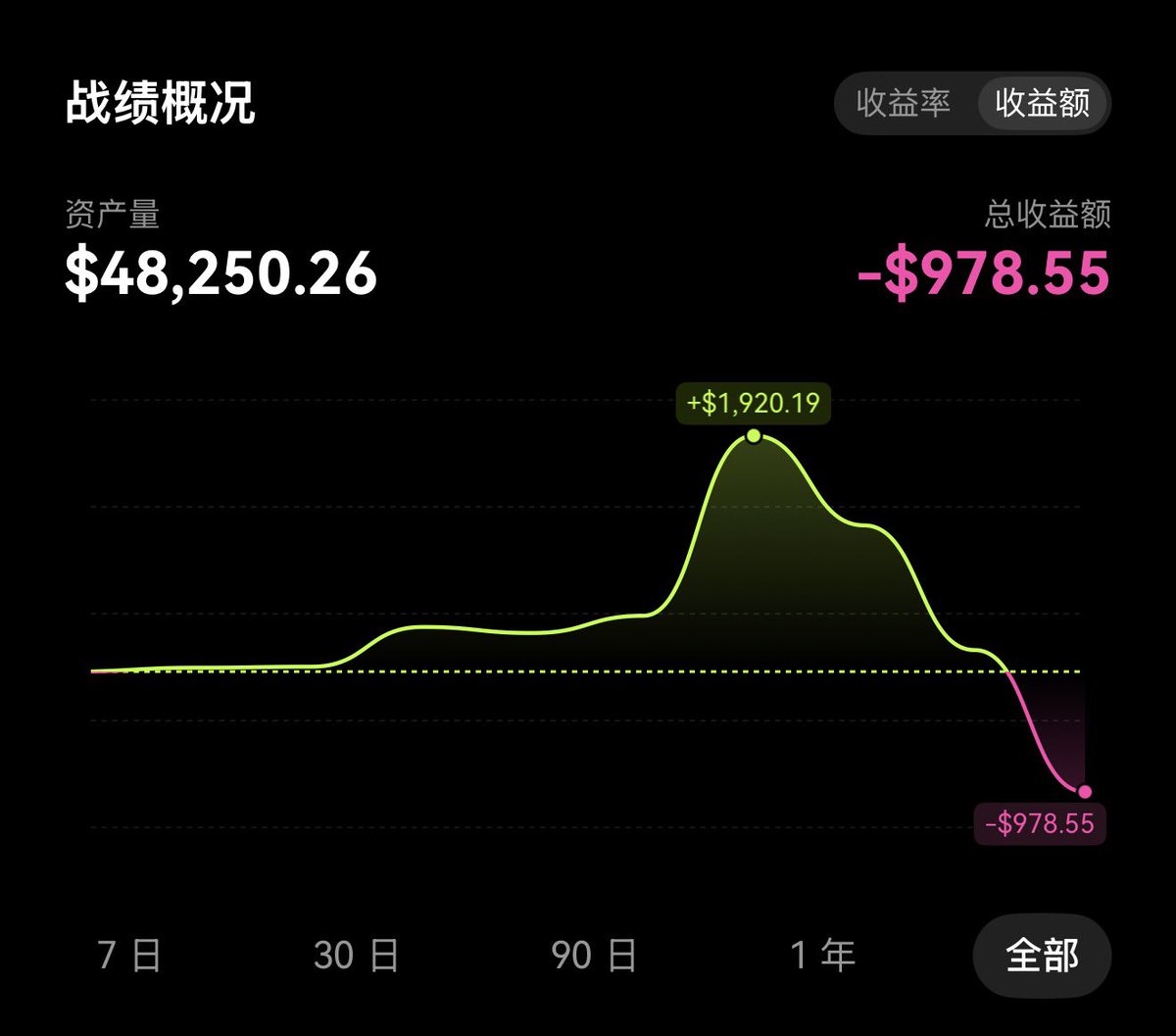
市场就是如此的迷人,小资金跑总是能刚好遇到盈利期,然后刚把资金放大一些,就开始无止境的回撤了… 只好先手动把自进化程序关掉了,这个逼为了赚钱,不停的下超过3M美元的单子,还好被风控程序拦截了…
中文
市场就是如此的迷人,小资金跑总是能刚好遇到盈利期,然后刚把资金放大一些,就开始无止境的回撤了…
只好先手动把自进化程序关掉了,这个逼为了赚钱,不停的下超过3M美元的单子,还好被风控程序拦截了…
Crypto_Painter@CryptoPainter
第二个坑来了! Agent 一天回撤了10%,因为我中间没怎么看,进化系统把策略越改越激进,到后面直接把策略开仓条件限制全部改没了😢… 然后就是瞎JB赌了,所以我不得不赶紧人工介入,给进化系统的权限做了全面限制,可以改参数,但不能连交易逻辑都改了… 顺便把风控回避机制加上了,目前看他已经开始减少风险暴露了,激进程度也开始下降了… 这次领悟到的核心经验:给AI的策略优化权限必须限定框架与参数范围… 它不会理智的、有节制的调参,只会被过往迭代记录污染上下文,认为之前带来盈利的调整是好的,所以会变本加厉的在一条道上走到黑!
中文
Galeon retweetledi

The Google for Startups AI Agents Challenge is now LIVE. 🦾⚡️
Build autonomous systems with @GeminiApp and the recently upgraded Agent Development Kit for a chance to win a share of $90,000 and $500 in @GoogleCloud credits!
Register now to start building: goo.gle/4cpi2pB

English
Galeon Agent Brain: Let Agents Start Thinking for Real
Today’s crypto market does not lack agents.
They can read market data, call tools, execute strategies, generate analysis based on prompts, and even complete certain automated operations on-chain. But most so-called trading agents are still, at their core, more like “automation executors”: they receive signals, match rules, call models, output conclusions, and then move into the next loop.
They look intelligent, but they have not truly developed continuous market understanding.
What they lack is a Brain.
Most Agents in the Market Still Lack a Thinking Layer
Existing agents are usually built around three components: data sources, model calls, and execution logic.
Data sources tell them what is happening in the market. Model calls help them interpret a piece of information. Execution logic decides what they should do next. This structure can complete tasks, but it has one obvious problem: every time the agent looks at the market, it is almost as if it is seeing it for the first time.
It can analyze the current state of a token, but it may not know why it was wrong last time.
It can identify a risk signal, but it may not know whether that risk signal often fails in real markets.
It can make a judgment at a given moment, but it may not be able to connect that judgment with what happens afterward and turn it into reusable experience.
More importantly, it usually only learns from what it has already seen, but not from what it has missed. Tokens that actually rise, common patterns among top gainers, changes in capital preference, and shifts in sentiment cycles often do not automatically enter the agent’s cognitive system.
This is the biggest gap in today’s agents: not a lack of more tools, but a lack of a brain that can continuously think, review, calibrate, and evolve.
Galeon Introduces Agent Brain
Galeon has introduced and begun validating the capability of Agent Brain.
Agent Brain is not a simple prompt, nor is it a one-time LLM analysis module. It is a system structure designed around the agent’s thinking process: allowing agents not only to “see data,” but to understand data; not only to “output judgments,” but to record judgments; not only to “execute actions,” but to review themselves after outcomes occur; not only to “use experience,” but to turn what truly happened in the market into cognitive context for the next decision.
Currently, Galeon Agent Brain has entered internal testing and has already started being used by agents within the Galeon platform. It has been integrated into real agent workflows, supporting market signal understanding, trading judgment records, prediction result tracking, error review, and experience accumulation.
This means Galeon Agent Brain is not just a concept. It is already being used and validated by agents on the platform.
The goal of Galeon Agent Brain is to help agents evolve from executors into market participants with a cognitive feedback loop.
It no longer only asks:
* Can this token be traded now?
* Is this signal bullish or bearish?
* Has a certain rule been triggered?
Instead, it asks deeper questions:
* Why did I make this judgment?
* Has this judgment held true in similar past scenarios?
* Am I over-trusting certain signals?
* Did I ignore the real factors driving the move?
* How are the tokens rewarded by today’s market different from my current logic?
* If I encounter the same structure next time, how should I understand it differently?
This is the difference between Agent Brain and ordinary agents.
Ordinary agents process tasks. Agent Brain forms cognition.
The Core Value of Agent Brain: Giving Agents the Ability to Reflect
The market is not a static set of rules.
The same BTC drop may represent risk release in one phase, but an opportunity for alpha tokens to rise independently in another. The same high price increase may be early acceleration, or late-stage crowding. The same funding rate, trading volume, and open interest changes may point to completely different paths under different market sentiment conditions.
If an agent only reads indicators mechanically, it will quickly fall into a rule illusion: believing it understands the market, while in reality it is just applying old experience to a new environment.
The meaning of Agent Brain is that it adds a reflection layer to the agent.
It connects judgments, outcomes, deviations, and market context. A judgment is no longer an isolated event, but part of future cognition. A mistake is not just a failure, but something that can be extracted into experience. A missed rally is not just regret, but a counterfactual sample: why did the market reward it, and why did I fail to recognize it?
This capability gives agents a real learning path.
From Learning Signals to Learning Market Winners
Traditional trading systems usually only learn from their own trading results: whether the entry was profitable, whether the prediction was correct, and whether the strategy was triggered successfully.
This is important, but far from enough.
Because the most valuable information in the market often comes from the winners the system failed to capture.
If a token enters the Binance spot or Alpha gainers list, it represents the market’s real vote within a certain time window. It may come from a surge in trading volume, changes in on-chain holder structure, the spread of social attention, a narrative catalyst, or a short-term mismatch in capital structure.
Agent Brain needs to learn not only “what I did,” but also “what the market proved.”
This means Galeon Agent Brain can build experience from two directions:
Self-judgment learning: how I judged in the past, and whether the result was correct.
Market-winner learning: what common traits truly rising tokens had, whether I identified them early, and why I missed them.
This turns the agent’s learning from a closed loop into an open loop.
It no longer circles only within its own historical records. Instead, it brings real market winners, missed opportunities, shared patterns, and sentiment shifts into its thinking process.
Agent Brain Does Not Replace LLMs — It Organizes LLM Thinking
An LLM itself is not Agent Brain.
An LLM can generate analysis, but it does not naturally have a stable memory structure, result verification mechanism, experience recall capability, or deterministic risk control. Without a Brain architecture, an LLM can easily become a one-time interpreter: it can always generate something that sounds reasonable, but it may not continuously become more accurate.
The value of Galeon Agent Brain is that it places the LLM inside a system that can be verified, constrained, reviewed, and calibrated.
LLM is responsible for cognition: understanding market states, reasoning through possible paths, and explaining risks and opportunities.
Brain is responsible for memory: storing judgments, market snapshots, outcomes, and experience.
Learning is responsible for review: analyzing judgment deviations and identifying long-term error patterns.
Control is responsible for constraints: mapping cognitive results into stable, auditable, and adjustable decision logic.
This allows the agent’s thinking to stop floating in language and enter a system that can continuously run and be verified.
The Validation Significance of Galeon
The importance of Galeon is not only that it has built an agent capable of analyzing markets, but that it has proposed and started validating a new direction:
Agents should have a Brain.
Currently, Galeon Agent Brain has entered internal testing and has already started being used within Galeon’s real agent system. It is not an idea that only exists in a whitepaper or concept deck. It has been placed inside Galeon’s existing agent workflows, supporting market signal understanding, trading judgment records, prediction result tracking, error review, and experience accumulation.
On the Galeon platform, agents have already begun using Brain to help understand the market. They can record their own judgments, track prediction results, form experience, recall experience in later similar scenarios, and expose their own biases through learning reports.
This means Galeon Agent Brain has started moving from “concept validation” into “real operational validation.”
It is being tested with real market data, real signals, real predictions, and real result feedback. Agents no longer make one-time judgments based only on current inputs. Instead, they begin turning every judgment, every missed opportunity, and every deviation into part of their future cognition.
This represents the first step for agents to move from “passive execution” toward “active cognition.”
Future financial agents, on-chain agents, and information agents should not merely be tool callers. Truly valuable agents will have their own thinking structure: they know what they saw, why they made a judgment, where they missed something, which experiences can be transferred, and which market changes require recalibration.
Galeon Agent Brain is the first systematic attempt in this direction.
Conclusion
The next stage of agents is not more automation, but deeper thinking.
The market does not reward systems that only execute. The market rewards systems that can understand change, review mistakes, identify patterns, and continuously evolve.
The introduction and internal testing of Galeon Agent Brain are designed to give agents this capability.
It allows agents to stop being only observers and executors in the market, and start becoming intelligent entities that can learn the market, understand the market, reflect on themselves, and continuously evolve.
This is also Galeon’s core belief:
The future competition among agents will not be about who calls more tools, but who has the stronger Brain.
English
Galeon retweetledi

Galeon retweetledi

Galeon retweetledi

@motherofqianbei 还得多注意。
近期好几个“VC”接触我们,要投资我们,但是要求我们视频验资,还有指定钱包。这就很奇怪的事情。
我们直接pass掉。
中文

朋友最近卖房,房产经纪让他用USDT付佣金。他完全不懂crypto,找我帮忙出金。我们折腾了一周,做了各种KYC才在欧洲顺利把欧元换成U。结果后来发现,那个房产经纪是骗子。对方让我们开视频会议验资,我朋友差点就点了他们发来的会议链接。
这一通折腾后,我实在觉得钱放他钱包里也不安全。想着干脆把这50万U换回法币,但又麻烦又有磨损。于是我想着不如找个defi fund先放着生息吧。之前聊过还不错的,正打算周一联系一下。
结果今天一打开推特,发现我聊的,都在这次AAVE风波里出问题了。。太难了。
Aave@aave
Update on rsETH incident: According to our analysis, rsETH on Ethereum mainnet is fully backed. Out of an abundance of caution, rsETH remains frozen across Aave V3 and V4 and exposure to the incident is capped. WETH reserves also remain frozen across affected markets including Ethereum, Arbitrum, Base, Mantle, and Linea. Aave is actively validating information and assessing potential resolutions.
中文
We’re excited to announce that Galeon has been selected for Momentum. @Devlabs_club
Galeon is focused on building an end-to-end AgentFi experience for agents. Through the collaborative architecture of Auto Agent Eco-Link and Auto Agent Mesh, Galeon provides a complete autonomous trading workflow covering discovery, analysis, execution, and management, transforming what was once a manual and fragmented trading process into an intelligent, automated, multi-agent collaboration flow.
Our goal is to move Web3 trading from manual decision-making to end-to-end intelligent automation. We look forward to engaging with outstanding founders, partners, and investors through Momentum, refining our product, and continuing to push Galeon’s capabilities forward.

English
The meme monitoring strategy is still in testing, and the official version will be released soon.
Vincent_vin@gg_ch2n
Solana的金狗越来越多了,一早就抓到了80多倍的金狗。 当前策略还在团队测试中,后期会开发放出来,多关注 GN3mUXAgaQwUknYBkPf9HWY7gbFWmP3iVaZebqsgpump @HelloGaleon
English