
Sabitlenmiş Tweet
Sohan
6.7K posts


Sohan
@HiSohan
I collect dots to connect them later. Views are my own. Building https://t.co/QxnsCuozpY Writing on https://t.co/rOzI5yIXfV
Bengaluru, India Katılım Aralık 2011
598 Takip Edilen1.4K Takipçiler

I know our work at NeuroPeek doesn't exactly address this but similar problems exist everywhere. cc @bratrat @srikipedia
LaurieWired@lauriewired
30.9% of genetics papers data are kind of trash because of Excel’s aggressive auto-formatting. Until 2023, there was no global option to disable data conversion. For example, the human SEPT family (1-14) of genes is directly related to cell division and cancer research. I’ll give you one guess as to what that auto-formats to. Yup…turns into a date. Oh, it get’s worse though. Many labs use what are known as RIKEN identifiers. It’s a 10 digit alphanumeric code, kind of like a barcode that identifies a gene sequence. Here’s one: 2310009E13 Uh oh. There’s an “E” in there. Guess what that turns into? A floating point! Excel has a hard limit of 15 significant digits for floats. So, not only did your RIKEN identifier get formatted wrong, but it’s also rounded off to an unrecoverable state. 12.5% of the RIKEN database (Row E) is a disaster. If you know anything about Bioinformatics, you should be losing your mind. Remember, a huge amount of scientific research is meta-analysis. Good luck cross-referencing patterns when ~31% of the data has errors! So basically there’s a giant data hole from 2004-2023, much of which has been standardized into national / official databases, and there’s no good way to fix it.
English
None of us know what consciousness is. And intelligence is conflated with consciousness. But you either believe in panpsychism (in which case consciousness is trivial) or concede that we don't understand consciousness.
We have established that logic gates can and do emulate intelligence because they are turing complete.
English

Could consciousness emerge from logic gates?
Modern AI systems ultimately run on just 3 basic logic gates:
- AND Gate
- OR Gate
- NOT Gate
Individually these gates are extremely simple. But when billions of them are combined together in complex systems, they can process language, generate code, recognize patterns, and simulate human-like reasoning.
If intelligence-like behavior can emerge from massive combinations of simple logic gates, could consciousness emerge too?
And if human brains are also made from simpler units like neurons, is consciousness just an emergent property of complexity?
English
@IndusThink @TheKenWeb @IndianSocietyAI @adityajakki @AKLKO1977 @deepanshuS27 @ravishar313 Gatekeepers keep the gate, disruptors "break through"
English

Wonderful article by @TheKenWeb.
Precisely explains why the @IndianSocietyAI community matters. :)
@adityajakki @AKLKO1977 @deepanshuS27 @HiSohan @ravishar313
English
@ValerioCapraro Humans predict everything, from sensory inputs to societal structure.
English

Important Nature Neuroscience paper shows how humans differ from LLMs.
Many people currently believe that humans are just next-word predictors, like LLMs.
But this new paper by Zou, Poeppel and Ding suggests something more interesting.
The human brain does predict words.
But it does not predict every word with the same precision.
Prediction is constrained by linguistic structure.
When a word continues the current phrase, brain activity tracks word surprisal in a way that resembles an LLM.
But when a word crosses a major phrase boundary, the match weakens.
In other words, the brain does not simply ask:
“What is the next word?”
It also asks:
“What structure am I currently building?”
This challenges one of the most common biases in today’s technological world: the belief that human language works like a large language model.
The answer is: no.
Human language is not just next-token prediction.
*
Paper in the first reply

English

@NTFabiano Hyperconnected autistic brains = built-in quantum WiFi!
No wonder we sync up like a secret neural club, we’re not wired wrong, we’re overclocked for awesome.
English

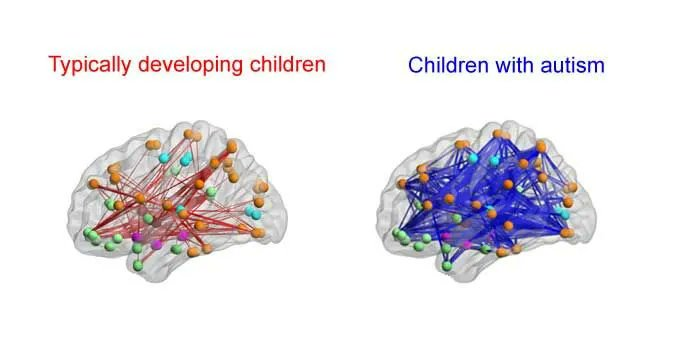
Children with autism have hyperconnected brains.
English
@_svs_ Yes and no. I have done a lot of work through agents. Spend combined $20K in tokens alone. Found patterns, wrote a paper that is being appreciated.
But what I can't shake off is fundamentals. They need to be drilled in. Sometimes unblocking the agents is a few manual changes.
English

Building AI applications is more like gardening than like construction.
When you 'build' something, you know where everything is and how it interacts with its environment and the stresses and strains it takes.
When you garden, you plant seeds and let it grow, keep an eye on the health and intervene only where necessary.
Now that we've unleashed the golems, there's no point in knowing exactly how the system is built. Rather we must train ourselves to spot the diseases - the antipatterns, the two components that should be the same but look different, and so on.
Tools for checking code health and tests for verifying behaviour are all the understanding we need. for the rest, let the agents cook.
English

Another mega AI data center pumping water from the ramsar protected site of East Kolkata wetlands ruining whatever ecosystem left after destruction by the previous govts 😍✌️
(no dear anon in replies, I'm not a commie or a choti chata)
The West Bengal Index@TheBengalIndex
𝗢𝗞𝗔𝗬 𝗚𝗢𝗢𝗚𝗟𝗘, 𝗕𝗘𝗡𝗚𝗔𝗟? In a meeting with the officials from Google, Government of India has proposed that they should keep West Bengal in mind while investing more in India in the near future. Sources claim that they have received a firm assurance in this regard from Google. A high-ranking UnionGov bureaucrat added, "Google's potential investment can be considered an exceptional step in the overall development of Bengal." Google LLC. is currently exploring investments in India, spanning artificial intelligence infrastructure as well as server and drone manufacturing. Government of India has urged global tech companies, including Google, to localize the production of servers, GPUs, and chips in the country.
English

They did a CT scan on a pregnant mother for sharing a 3D reconstruction? WTF???
Bulvar Medya@Bulvarpress
32 haftalık hamile bir kadının bilgisayarlı tomografi görüntülerinden oluşturulan 3 boyutlu rekonstrüksiyon sosyal medyada paylaşıldı.
English
@al0k_91 @bratrat @StuartHameroff @srikipedia No plans yet, but if you want to try we can find something to simulate. Mostly the API isn't stable yet and committing publicly means I can't make breaking changes as easily.
English

@HiSohan @bratrat @StuartHameroff @srikipedia Any plan to make it available on GitHub . Can't wait to try it out.
English

Right, After 40 years cartoon neuron theories can’t simulate behavior of a simple worm.
Thats because each of those 300 or so neurons has about a billion tubulins in hundreds of microtubules where the cognition (and consciousness) originate.
For example see this paper journals.physiology.org/doi/full/10.11…
Signaling among neurons causing axonal firings is mediated by megahertz and gigahertz oscillations in microtubules.
The only theory of consciousness with any supportive evidence is Orch OR
academic.oup.com/nc/article/202…
Prof. Brian Keating@DrBrianKeating
A worm with 309 neurons. Mapped completely since 1986. Forty years later, no simulation reproduces its behavior. Joscha Bach (@Plinz) on what that means for BigTech's plan to upload a human brain. youtu.be/CzjWGkXlK8k
English
if you're a computational neuroscientist, a PhD student working with NEURON/Brian2/Jaxley, or just someone who thinks neural simulation should run on modern hardware without a 1990s-era workflow,
we'd love to hear from you.
would you use something like this? let us know 👇
English
what's next:
- synaptic connectivity between cells in the grid
- scripted "experiments" you can define in Python and render as video
- more morphology types (we're pulling from NeuroMorpho.org)
- offline rendering pipeline for publication-quality output
English
now we render real neuron morphologies as 3D meshes with voltage propagation mapped directly onto the geometry in real time. (still work tbd)
you can see action potentials travel down dendrites. you can see different firing patterns across cell types — regular spiking, bursting, fast-spiking interneurons — all running simultaneously.
English
first: the solver rewrite.
we now have custom implicit solvers (IMEX splitting + Hines cable equation) running entirely on GPU.
what this means in practice — dozens of morphologically-detailed neurons simulated in parallel on a single consumer GPU. full Hodgkin-Huxley channel kinetics. real dendritic trees from published reconstructions.
English