@lisavsworld そりゃヨーロッパの古い神話とか知れば納得です。ただ、理解できるのと知ってるのは違うので、単純に今のキリスト教文化圏の人が日本の神道についてどの位知ってるのかな?という疑問ですよ。
どうなんだろう?という疑問に「違います」と言われるのは訳がわかりません。翻訳の問題でしょうか。
日本語
Hisabon
4.4K posts
@HisabonA
政治関係とサッカー関係のポストを見たり書いたりしています。思想的にはリアリストになりたい保守だと思うんですが、どうも労働関係は左翼的かもしれません。防衛・移民・皇室などに関しては保守です。なるべく冷静なポストを心がけていますがどうかな。

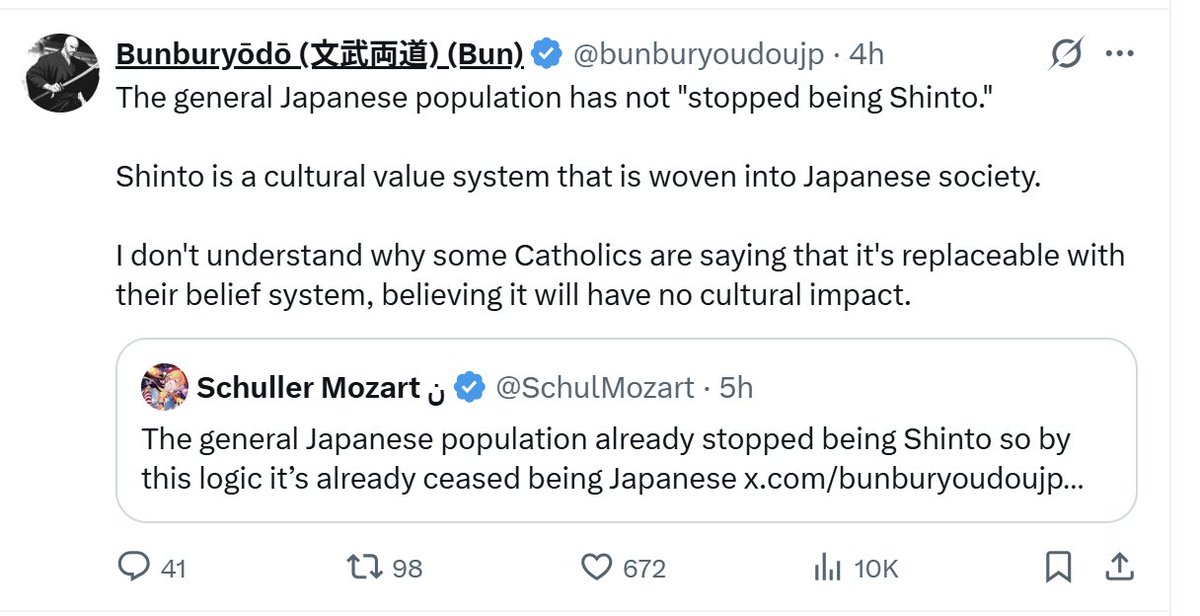
In Japan, religion is virtually indistinguishable from culture. This is not the same in the west. This is where so many mistakes are made when we try to analyze each other's cultural and religious practices. Christmas is *not* a pagan holiday. It is a Christian holiday where people from all over the world incorporate their cultural traditions. The trees we put up and food we eat are cultural. They're not religious. We incorporate them into the religious tradition because they are traditions of the season. Not all traditions are inherently religious. You can observe Christmas without any of these cultural traditions and many Christians actually choose not to engage in them. These traditions are also not universal. Not every person eats Turkey on Christmas and it not expected that you do either. This is not like Japanese New Year's Zōni. Everyone has their own traditions they bring from their own backgrounds. Some people eat roast beef, some have ham... what you eat doesn't matter at all. If someone were a Japanese Christian, they could eat sushi and still call it Christmas dinner. My American family once had sushi for Christmas dinner! That being said, what are the pagan roots, if any? Let's talk about how some spiritual observances influence culture. The Christmas tree is from *my* family's culture of Estonia. Trees were a big part of Estonian paganism and Estonian people greatly respected nature. But the Christmas tree was first erected in Tallinn upon country's conversion to Lutheranism. The Estonian population left paganism behind, but their love of nature remained. Nature became a cultural observance, separated from its spiritual background. It is not anything like the original tree paganism of traditional Estonia. So, the Estonian love of nature was incorporated into their Christmas tradition, which was then adopted by Germany, and eventually spread all over the world. No one ever said the tree was a religious symbol of Christianity. It has the word "Christmas in it" as it is apart of the "Christmas holiday season." But you do not need a Christmas tree at all for the observation of the birth of Christ. As for why we celebrate Christmas in December? Many people point to the winter solstice and how it allowed an easy adaption of those who celebrated winter festivals. But people forget another very obvious holiday that occurs around December... one of which we share a common history with... and that is the Jewish holiday of Chanukah. (Chanukah is mentioned in the Bible, John 10:22.) So there you have it. The Christmas holiday is about Christ. The festival nature of it is cultural. They coincide, but neither requires the other to occur.


@azukiglg @JSzv0X1aPo74876 This is the most incredible dunning krugger moment I have ever seen on twitter. "Christian believers want "to make others acknowledge their own righteousness"" is a statement that only someone who has never spoken to a Christian or even seen a bible could say.




BBQの話はいいとして、この一週間で「日本人は無宗教やから、神Godの愛を説けばチョロいやろ」と思ってたであろうガチ勢は、日本人が「特に哲学のない無神論者」ではないこと、「高圧的に言えば黙り込む口下手で内気な、言いなりにしやすい連中」ではなかったことを知ってしまったかもしんない。 どうしよう。





日本人に改宗を迫るクリスチャンが目立ち始めた Xは順調に地獄に戻りつつある 長く触れ合えば教化しに来るのは目に見えてたからなぁ……