Ian Marschner

66 posts

Ian Marschner

Ian Marschner

@IanMarschner

Biostatistics Professor at @Sydney_Uni and @TrialsCentre

Katılım Eylül 2017
121 Takip Edilen151 Takipçiler
Berry Consultants
Berry Consultants@BerryConsultant·
Dr. Andrew Thomson explains why borderline clinical trial results represent the hardest decisions in the field. When the point estimate falls below the minimally clinically important difference, findings may be statistically significant, but possibly not clinically relevant. This triggers intense scrutiny—questions emerge around estimands, estimation methods, missing data, and the impact of a single patient on results. These cases require rigorous scrutiny and thorough analysis. Discover more on the full episode: berryconsultants.com/resource/33-a-…
English
1
1
9
1.5K
Ian Marschner
Ian Marschner@IanMarschner·
@FOXFOOTY Amazing that the number 1 issue is not on the list. 18 teams. 22games.
English
0
0
1
74
Fox Footy
Fox Footy@FOXFOOTY·
Incoming AFL football boss Greg Swann has several key ticket items for 2026 ⬇ READ MORE: bit.ly/40kUlcZ
Fox Footy tweet media
English
109
7
147
56K
Ian Marschner
Ian Marschner@IanMarschner·
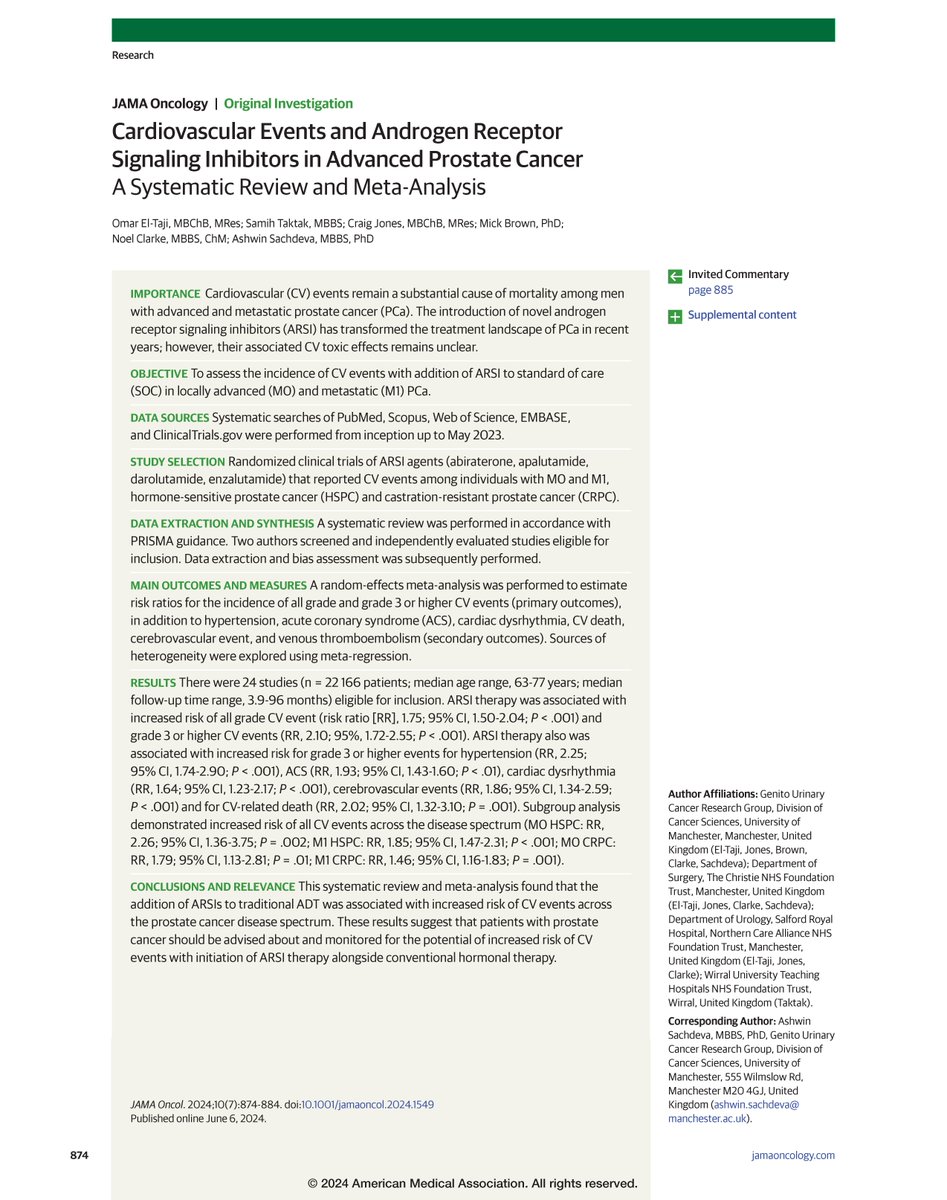
@JAMAOnc Treatments that improve survival provide greater opportunity for adverse events to occur. See the Limitations Section: "improved survival with ARSIs could manifest as a higher captured incidence of CV events. It is impossible to account for this given lack of time to event data"
English
0
0
2
63
JAMA Oncology
JAMA Oncology@JAMAOnc·
Meta-analysis of 24 randomized controlled trials demonstrates an increased risk of CV events amongst patients with advanced and metastatic prostate cancer commencing androgen receptor signaling inhibitors. ja.ma/3LBSGYJ
JAMA Oncology tweet media
English
2
18
35
4.6K
Ian Marschner
Ian Marschner@IanMarschner·
Recent @TheLancet trial uses confidence distribution to conclude “the confidence that the risk ratio is lower than 1 is 97.2%”. Full confidence distribution plot in supplementary material. Excellent way to present trial results as described in Reference 24 thelancet.com/journals/lance…
English
1
3
14
1.4K
Ian Marschner
Ian Marschner@IanMarschner·
@KertViele @syctong @GuyattGH I agree that small concurrently randomised cohorts are a challenge for reporting. I would interpret this as an argument for avoiding design features that produce small cohorts e.g. I would argue we should avoid frequent interim analyses that lead to frequent design adaptations
English
0
0
0
70
Kert Viele
Kert Viele@KertViele·
@syctong @GuyattGH I think this is valuable. Very useful and insightful to recognize the independent “between interim” cohorts and the meta analysis connections. I think people will need to be cautioned not to overreact to noise in the smaller samples within cohort.
English
1
0
0
76
Ian Marschner
Ian Marschner@IanMarschner·
@f2harrell @vandy_biostat Not always. If design choice reflects prior belief then Bayesian inference is affected by multiplicity. As Kass & Wasserstein said (JASA 1996 p.1359): “It could be argued that choice of design is informative and so the prior should depend on the design”
English
1
0
0
120
Ian Marschner
Ian Marschner@IanMarschner·
@f2harrell @vandy_biostat Note that absence of multiplicity issues in Bayesian inference requires the important assumption that you would use the same prior regardless of the design. Reference priors contravene this assumption, yielding different Bayesian inferences for sequential and fixed designs
English
2
1
2
427
Ian Marschner retweetledi
Nalini Joshi
Nalini Joshi@monsoon0·
“Removing the advanced mathematics prerequisite does nothing to address the decline in mathematics enrolments at schools and sends the wrong signal to students.” science.org.au/news-and-event…
English
1
6
33
2.5K
Ian Marschner
Ian Marschner@IanMarschner·
@KertViele Sounds like a great session. I agree that if anyone’s saying data should be thrown away that’s problematic. Also important to recognise that different types of data have different levels of quality. If we pool them then we need to understand the relative contributions of each
English
0
0
0
89
Kert Viele
Kert Viele@KertViele·
If you have a late flight Saturday at ISBS, come see our session on platform trials. I’ll be arguing data is a good thing and we shouldn’t throw it away. (Maybe a little more nuanced…but essentially)
English
1
3
7
1.7K
Gordon H. Guyatt
Gordon H. Guyatt@GuyattGH·
Recent important, useful innovation in conducting and presenting the results of subgroup analysis. Should become standard procedures. doi.org/10.1002/jrsm.1…
English
1
17
54
4.7K
Maarten van Smeden
Maarten van Smeden@MaartenvSmeden·
Once you realize p-values are probabilities relating to observing data rather than probabilities of an hypothesis being true, you are already doing significantly better than most people
English
37
369
3.2K
0
JasonConnor
JasonConnor@JasonConnorPhD·
Stats Q Group sequential trials look at X% of patients(info) for the final timepoint and calc the error spend. Is there an analogous group sequential method but you look at 100% of patients but at a 6m endpoint instead of 12m endpoint? Thanks!
English
3
1
3
1.7K
Ian Marschner
Ian Marschner@IanMarschner·
@predict_addict @austrim_cre @TrialsCentre Thanks for the interesting references but you are talking about prediction whereas I'm talking about inference (a common difference between data scientists and statisticians). It's unclear what you mean by "lack validity" when the context is inference from a randomized experiment
English
1
0
0
131
Valeriy M., PhD, MBA, CQF
Valeriy M., PhD, MBA, CQF@predict_addict·
Interesting, however statistical confidence distributions lack validity guarantees. Conformal Predictive Distributions solved that problem back in 2017 and can be used with any model, any data distribution and any dataset size. proceedings.mlr.press/v60/vovk17a.ht… arxiv.org/pdf/1911.00941… @valeman/how-to-predict-full-probability-distribution-using-machine-learning-conformal-predictive-f8f4d805e420?sk=c8eab1aeefba892777e6c3ee3afcf223" target="_blank" rel="nofollow noopener">medium.com/@valeman/how-t…
English
1
0
0
449
Ian Marschner
Ian Marschner@IanMarschner·
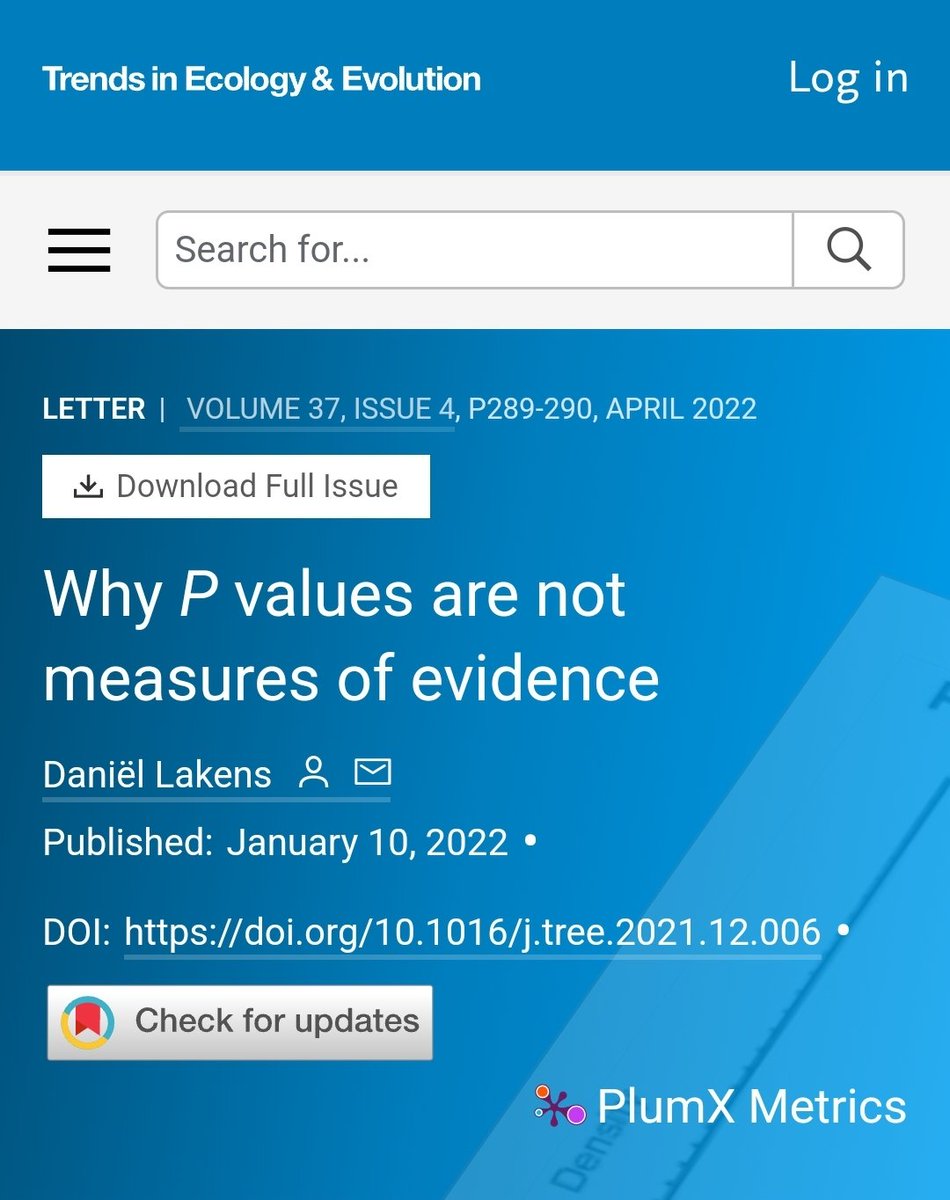
@lakens Your opening argument is based on: “it is just as likely to observe a p-value of 0.001 as it is to observe a p-value of 0.999”. Both of these values have zero probability of being observed (for a continuous p-value distribution) so I’m not sure what the point is you are making
English
0
0
0
149
Ian Marschner
Ian Marschner@IanMarschner·
@syctong Need to be careful of non-proportional odds in such an analysis. The odds ratio for “considerable improvement” is about 12.4 compared to 4.7 for survival, yet they are assumed to be the same. Might be chance variation but important to check or else the odds ratio could be biased
English
0
0
1
56
Stephen John Senn
Stephen John Senn@stephensenn·
@cjsnowdon Spent four years of my childhood (aged 6-10) in the UK. The compulsory milk consumption still gives me nightmares. Thatcher milk snatcher was too late to save me.
English
2
0
3
518