Homo sapiens
17.6K posts

Homo sapiens
@IbeThatonly
One humanity. Freedom from oneself.
Katılım Mart 2016
37 Takip Edilen104 Takipçiler
Homo sapiens retweetledi

% of Population that have gym membership:
🇳🇴Norway → 22%
🇸🇪Sweden → 22%
🇺🇸US → 21.2%
🇩🇰Denmark → 18.9%
🇳🇱Netherlands → 17.4%
🇫🇮Finland → 17.2%
🇨🇦Canada → 16.7%
🇬🇧UK → 15.6%
🇦🇺Australia → 15.3%
🇩🇪Germany → 14%
🇦🇹Austria → 12.7%
🇪🇸Spain → 11.7%
🇫🇷France → 9.2%
🇮🇹Italy → 9.1%
🇵🇱Poland → 8%
🇰🇷South Korea → 7.3%
🇦🇷Argentina → 6.7%
🇵🇹Portugal → 6.7%
🇧🇷Brazil → 4.9%
🇿🇦South Africa → 3.9%
🇸🇦Saudi Arabia → 3.7%
🇯🇵Japan → 3.3%
🇲🇽Mexico → 3.3%
🇨🇳China → 3%
🇷🇺Russia → 2.3%
🇩🇴Dominican Republic → 1.3%
🇪🇬Egypt → 1.2%
🇵🇭Philippines → 0.5%
🇻🇳Vietnam → 0.5%
🇮🇩Indonesia → 0.2%
🇮🇳India → 0.15%
Source: RunRepeat
English

Homo sapiens retweetledi
Korea is ahead of the curve on everything. If you wanted to see where our society was going to be today, just go to Seoul 10 years ago. Every single trend, from looksmaxxing to salaryman margin gambling to jailing former presidents started there first.
They are speed running the end of history, and possibly, whatever comes next, they will be at the beginning.
Roger@rdd147
Koreans have now maxed out margin on KOSPI and are directly going to banks for loans. People that are 60 have never owned trading accounts and now it’s the fastest growing age group entering to buy leveraged semiconductors. Just one article of many describing the madness. $soxx $dram koreatimes.co.kr/amp/economy/20…
English
Homo sapiens retweetledi

@ihtesham2005 Yes! Lovely. Thank you. I’ve been reading actual books and writing comments in/on each page as I went along. I processed understanding the material way better. Didn’t know the actual cognition science behind it. Intuitively I’ve never liked kindle kind of online book reading.
English
Homo sapiens retweetledi

A Norwegian neuroscientist spent 20 years proving that the act of writing by hand changes the human brain in ways typing physically cannot, and almost nobody outside her field has read the paper.
Her name is Audrey van der Meer.
She runs a brain research lab in Trondheim, and the paper that closed the argument was published in 2024 in a journal called Frontiers in Psychology. The finding is brutal enough that it should have changed every classroom on Earth.
The experiment was simple. She recruited 36 university students and put each one in a cap with 256 sensors pressed against their scalp to record brain activity. Words flashed on a screen one at a time.
Sometimes the students wrote the word by hand on a touchscreen using a digital pen, and sometimes they typed the same word on a keyboard. Every neural response was recorded for the full five seconds the word stayed on screen.
Then her team looked at the part of the data most researchers had ignored for years, which is how different parts of the brain were communicating with each other during the task.
When the students wrote by hand, the brain lit up everywhere at once.
The regions responsible for memory, sensory integration, and the encoding of new information were all firing together in a coordinated pattern that spread across the entire cortex. The whole network was awake and connected.
When the same students typed the same word, that pattern collapsed almost completely.
Most of the brain went quiet, and the connections between regions that had been alive seconds earlier were nowhere to be found on the EEG.
Same word, same brain, same person, and two completely different neurological events.
The reason turned out to be something nobody had really paid attention to before her work. Writing by hand is not one motion but a sequence of thousands of tiny micro-movements coordinated with your eyes in real time, where each letter is a different shape that requires the brain to solve a slightly different spatial problem.
Your fingers, wrist, vision, and the parts of your brain that track position in space are all working together to produce one letter, then the next, then the next.
Typing throws all of that away. Every key on a keyboard requires the exact same finger motion regardless of which letter you are pressing, which means the brain has almost nothing to integrate and almost no problem to solve.
Van der Meer said it plainly in her interviews.
Pressing the same key with the same finger over and over does not stimulate the brain in any meaningful way, and she pointed out something that should scare every parent who handed their kid an iPad.
Children who learn to read and write on tablets often cannot tell letters like b and d apart, because they have never physically felt with their bodies what it takes to actually produce those letters on a page.
A decade before her, two researchers at Princeton ran the same fight using a completely different method and ended up at the same answer. Pam Mueller and Daniel Oppenheimer tested 327 students across three experiments, where half took notes on laptops with the internet disabled and half took notes by hand, before testing everyone on what they actually understood from the lectures they had watched.
The handwriting group won by a wide margin on every question that required real understanding rather than surface recall.
The reason was hiding in the transcripts of what the two groups had actually written down.
The laptop students typed almost word for word, capturing more total content but processing almost none of it as they went, while the handwriting students physically could not write fast enough to transcribe a lecture in real time, which forced them to listen carefully, decide what actually mattered, and put it in their own words on the page.
That single act of choosing what to keep was the learning itself, and the keyboard had quietly skipped the choosing and skipped the learning along with it.
Two studies. Two countries. Same answer.
Handwriting makes the brain work. Typing lets it coast.
Every note you have ever typed instead of written went into your brain through a thinner pipe. Every meeting, every book highlight, every idea you captured on your phone instead of on paper was processed at half depth.
You did not forget those things because your memory is bad. You forgot them because typing never woke the part of the brain that would have made them stick.
The fix is the thing your grandmother already knew.
Pick up a pen. Write the thing down. The slower road is the faster one.

English
Homo sapiens retweetledi

Net worth required to be in top 1% around the world in 2026:
🇵🇰 Pakistan - $25,000
🇳🇬 Nigeria - $45,000
🇮🇩 Indonesia - $70,000
🇵🇭 Philippines - $68,000
🇹🇭 Thailand - $140,000
🇹🇷 Turkey - $185,000
🇮🇳 India - $195,000
🇲🇾 Malaysia - $485,000
🇵🇱 Poland - $530,000
🇨🇳 China - $1,100,000
🇰🇷 South Korea - $1,400,000
🇦🇪 UAE - $1,900,000
🇯🇵 Japan - $2,000,000
🇮🇹 Italy - $2,600,000
🇬🇧 United Kingdom - $3,400,000
🇩🇪 Germany - $3,600,000
🇫🇷 France - $3,600,000
🇸🇬 Singapore - $5,200,000
🇺🇸 United States - $5,800,000
🇨🇭 Switzerland - $8,500,000
How far are you from reaching the Top 1%?
English
Homo sapiens retweetledi

Getting in shape is 10% exercise, 50% nutrition, and 40% managing your emotions.
ARROW@phresh_arrow
Losing weight is: 20% - Lifting weights - Walking - Cardio 80% - Managing emotional eating
English
Homo sapiens retweetledi

Annual inflation rate:
🇻🇪 Venezuela: 612%
🇮🇷 Iran: 50%
🇦🇷 Argentina: 32.4%
🇹🇷 Türkiye: 32.37%
🇱🇧 Lebanon: 17.3%
🇳🇬 Nigeria: 15.69%
🇪🇬 Egypt: 14.9%
🇵🇰 Pakistan: 10.9%
🇰🇿 Kazakhstan: 10.6%
🇧🇩 Bangladesh: 9.04%
🇺🇦 Ukraine: 8.6%
🇷🇺 Russia: 5.6%
🇦🇺 Australia: 4.6%
🇲🇽 Mexico: 4.45%
🇧🇷 Brazil: 4.39%
🇮🇪 Ireland: 3.7%
🇺🇸 USA: 3.8%
🇦🇹 Austria: 3.3%
🇬🇧 UK: 3.3%
🇮🇳 India: 3.48%
🇳🇴 Norway: 3.4%
🇪🇸 Spain: 3.2%
🇵🇱 Poland: 3.2%
🇿🇦 South Africa: 3.1%
🇩🇪 Germany: 2.9%
🇹🇭 Thailand: 2.89%
🇰🇷 South Korea: 2.6%
🇨🇿 Czechia: 2.5%
🇮🇩 Indonesia: 2.42%
🇨🇦 Canada: 2.4%
🇫🇷 France: 2.2%
🇮🇹 Italy: 2.7%
🇸🇻 El Salvador: 2.16%
🇭🇺 Hungary: 2.1%
🇮🇱 Israel: 1.9%
🇸🇬 Singapore: 1.8%
🇸🇦 Saudi Arabia: 1.7%
🇯🇵 Japan: 1.5%
🇩🇰 Denmark: 1.4%
🇨🇳 China: 1.2%
🇨🇭 Switzerland: 0.6%
🇸🇪 Sweden: -0.1%
Source: Trading Economics
Homo sapiens retweetledi

@godspeed_aflame ‘Love thy neighbor’ means to love one and all. Not just our own family and friends. Lol. To sufficiently open one’s heart to all life and living. To let go of this thinking mind that constantly stays sunk in duality. Cause same Christ spirit/Buddha nature/I/Self resides in all.
English

Christ’s gospel was so radical, so contrary to the wisdom of the world, that people are still coping 2000 years later, insisting that he didn’t actually mean what he said.
PurposelyHittingPotholesToMakeHerTitsBounceGroyper@HlTLERSBACKBBY
English

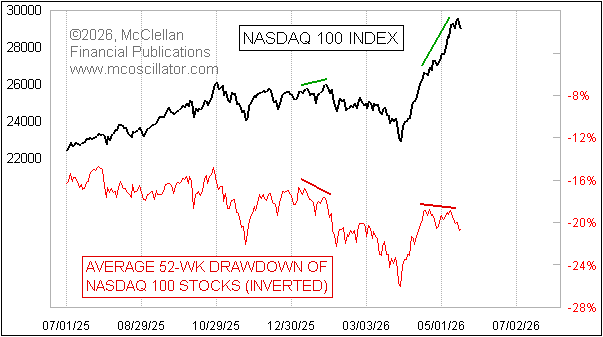
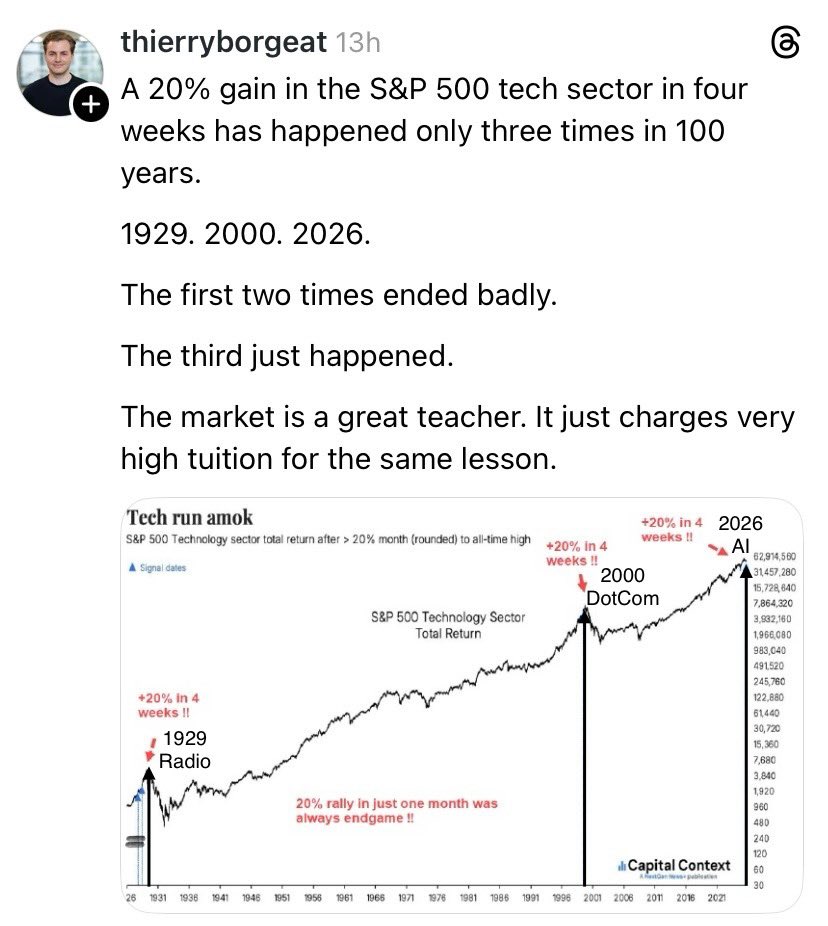
@EdwardGofsky Yes! Very high tuition indeed. Lol. We investors/speculators stay greedy, stupid. Chasing MU, INTC and NVDA here this time. 😊
English
Homo sapiens retweetledi

ONLY TEN STOCKS ARE KEEPING THE ENTIRE U.S. STOCK MARKET FROM A COLLAPSE.
The S&P 500 has rallied nearly 16% since March 30, making it look like the entire market is booming again.
But under the surface, this has become one of the narrowest and most concentrated rallies in decades.
Just 10 stocks drove 69% of the entire move higher. Alphabet alone contributed 15% of the rally. Nvidia added another 10%. Amazon, Broadcom, Intel, Micron, Apple, AMD and Microsoft carried most of the rest. The other 490 companies in the S&P 500 contributed just 31%.
This means the market is not actually moving higher together. A very small group of AI and semiconductor stocks is pushing the entire index upward while most stocks are barely participating.
The equal-weight S&P 500, which removes the influence of megacaps, only gained around 7-8% during the same period. That is less than half the performance of the normal index. At the same time, less than half of all S&P 500 stocks are even trading above their 50-day moving average right now.
The rally itself started after reports that Iran was open to ending the war with the United States in exchange for security guarantees. Oil prices immediately collapsed from above $100, markets exploded higher on short covering, and then AI earnings mania took over.
After that, almost every major tech company raised AI spending projections to levels never seen before.
Microsoft raised expected capex spending to roughly $190 billion.
Alphabet raised capex guidance to $180-190 billion.
Amazon reaffirmed around $200 billion in AI infrastructure spending.
Meta is expected to spend up to $145 billion.
Wall Street is now effectively pricing the entire stock market around one single assumption: that AI spending continues growing at an extreme pace without slowing down.
That is why semiconductor stocks entered a melt-up phase.
Intel is up more than 240% this year.
SanDisk exploded over 550%.
Micron doubled because AI memory demand became so extreme that customers reportedly could only get 50-67% of the chips they needed.
Even Goldman Sachs warned that market breadth has now fallen to one of the narrowest levels since the dot-com bubble era.
The danger is obvious.
When only a handful of stocks are carrying the entire market, the downside risk becomes massive. If AI spending slows, if oil spikes again because the Iran ceasefire fails, or if earnings disappoint even slightly, there is no real market strength underneath to absorb the damage.
Right now the stock market looks strong on the surface.
But underneath, it is being held up by a very small group of stocks and one extremely aggressive AI spending cycle.

English
Homo sapiens retweetledi

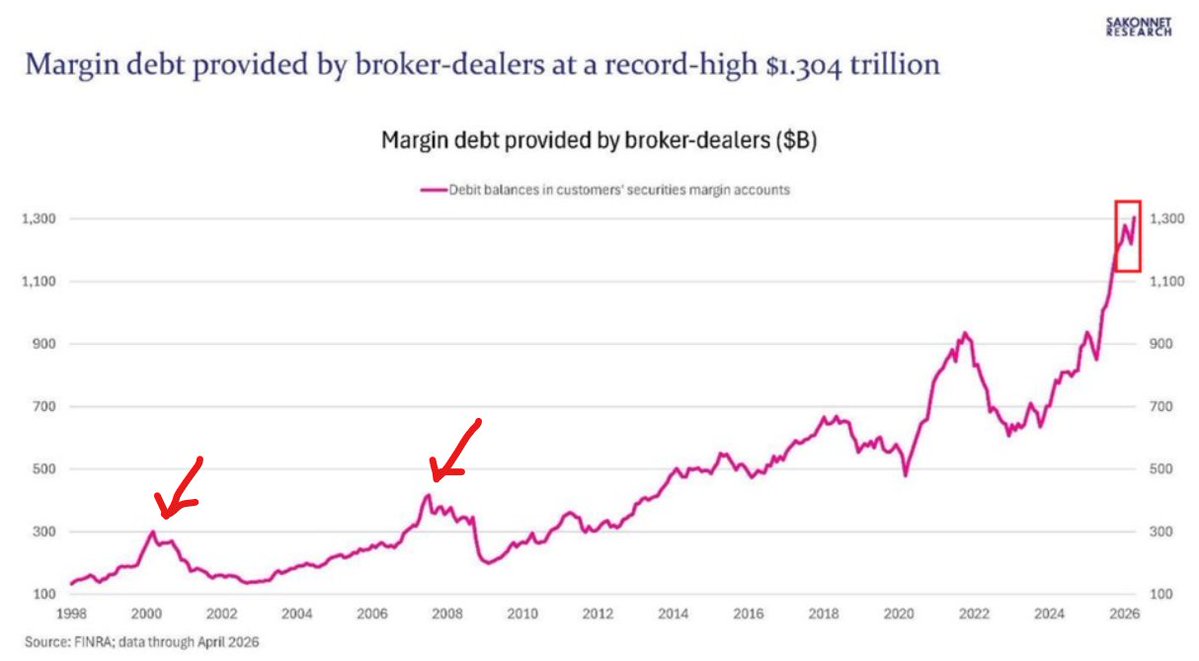
For God’s sake, MARGIN LOANS now make up 5% of our GDP.
This is going to be the largest market collapse of my entire career.
Hedgeye@Hedgeye
🚨 Margin debt as a percentage of real GDP soars over 5%
English