
Sabitlenmiş Tweet
Theo Nash
118 posts

Theo Nash
@IncentiveArch
Equilibrium hunter | Architecting human behavior through game theory | Founder @mergerprotocol
Singularity Katılım Mart 2025
43 Takip Edilen25 Takipçiler
Theo Nash retweetledi

Glad to have made this list.
The market is slowly realizing that consolidation infra is inevitable.
Signal Week (formerly Paris Blockchain Week)@ParisBlockWeek
#StartInBlock 2026 Top 100 Is Here! 1000+ Founders applied, and these are the most promising early-stage startups in Web3, filtered, evaluated, and selected as the 100 best candidates. Get your VIP INVESTOR TICKET to access the DEAL FLOW, pick the 12 finalists, and hear them pitch in Paris at the Louvre. Grab Your Investor Ticket with code: PBWINVESTOR First 10 tickets get 25% off: parisblockchainweek.com/tickets The 12 finalists will be announced to pitch in front of our amazing sponsors and partners @bit2me, @SpectrumNodes, @Cardano_CF, @AdevarLabs, @ai, @yzilabs, @oviohq, @PitchBook, @DraperDragon, @0xProject, @deel, @DraperVC, @Bpifrance, @Taisu_Ventures, @brian_wong, @LBV_VC, @edenblockvc, @cryptocom, @halo__xyz, @50Partners, @Dune, @MCSocialVenture, @CoinMarketCap, @Cointelegraph, @Sony_Innov_Fund, @trgcapi, @strobefund, @BanklessVC, and @Maven11Capital, and jury members @samizb (@draperdragon), @mfelicepace (@Spectrumnodes), @tkstanczak (@nethermind), Cosmin Staicu (@bit2me), and Jessi Brooks (@RibbitCapital). Let's take a look at who made it to the top 100 👇
English
Theo Nash retweetledi

The $40B Graveyard: Why Crypto Has No M&A Infrastructure by @IncentiveArch, Founder of @mergerprotocol
Traditional markets self-organize through M&A - 50% of companies undergo consolidation. Crypto has launched 36M tokens with zero exit infrastructure. This talk explores why crypto's financial system is half-built, the $40B in trapped value, and what the missing primitive looks like architecturally.
Full video below 👇🧵
English
Everyone's posting about AI. Nobody's showing the build.
Starting a build-in-public side project.
Raw unedited recordings of the entire process.
Day 0: the charter and product discovery workflow before a single line of code.
youtube.com/watch?v=L3cPc6…
YouTube
English
Theo Nash retweetledi
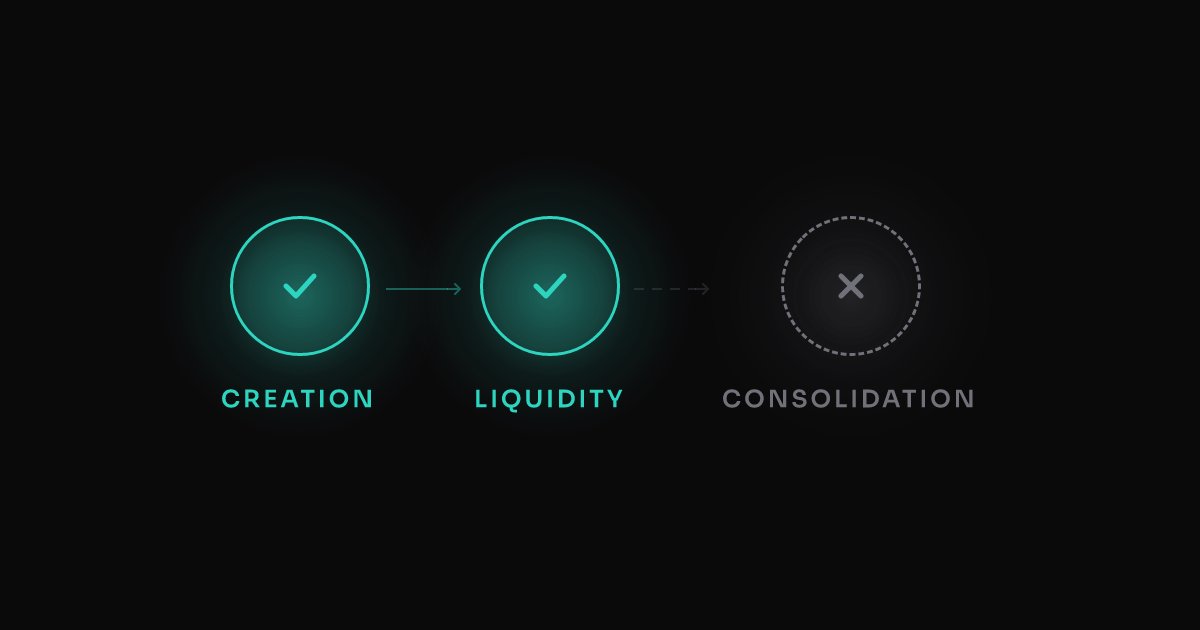
Crypto has primitives for creation (ERC-20) and liquidity (AMMs).
But there's no primitive for consolidation. That's not an oversight. It's a $40B design gap.
Here's why token mergers are inevitable infrastructure. 🧵
English

For anyone actively building with @AnthropicAI's Claude Code and actively using subagents...make them collaborative with my communication protocol
You've probably realized subagents are stateless and have ZERO recall. This makes full agentic workflows a nightmare - repeated context construction, missing historical context, and no cross-collaboration.
You spend thousands of tokens reconstructing context on each new invocation. Subagents have no clue about other agent's work.
Check out my tool which is a Slack-like communication protocol where subagents can leave messages for other agents (and even themselves) to make context construction consistent across sessions and invocations.
npmjs.com/package/claude…
English
@eros_protocol Native upgradeability is deterministic mutability in practice—love this! My piece explores why it's the future beyond dogma. Congrats on the reveal!
x.com/IncentiveArch/…
Theo Nash@IncentiveArch
1/6 Every major DeFi protocol uses upgradeable contracts. Everyone knows it. Nobody talks about it. We worship immutability while secretly building workarounds because we know it doesn't work. Time to admit the truth 🧵
English

Introducing $EROS: The First EVM Blockchain with Upgradeable Smart Contracts
We are excited to announce EROS, a revolutionary Layer 1 blockchain that fundamentally changes how smart contracts work.
After months of development in stealth mode, we're ready to share our vision with the blockchain community.
The Problem
Smart contracts are immutable by design. While this brings security benefits, it creates significant challenges for developers and projects:
- A typo in a comment requires complete contract redeployment
- Domain changes in metadata force migration of all users
- Bug fixes mean abandoning the original contract address
- Feature additions require complex proxy patterns
- Security vulnerabilities cannot be patched in place
This immutability has led to billions of dollars in locked value, countless hours wasted on migrations, and broken integrations across the ecosystem.
Projects are forced to choose between security and flexibility, when they should have both.
The EROS Solution
EROS introduces native upgradeability at the protocol level, enabling smart contracts to evolve while maintaining their address and state.
This isn't achieved through proxy patterns or workarounds. It's built into the core of the blockchain.
Key Features:
- Native Upgradeability: Contracts can be upgraded without changing their address or losing state
- Full EVM Compatibility: Deploy existing Ethereum contracts with zero modifications
- Unmatched Performance: Sub-second finality with massive throughput
- Developer-First Design: All existing tools work seamlessly - Hardhat, Remix, Web3.js, ethers.js
- Solidity Support: Write contracts in the language you already know
New Website: eros.tools

English
@101Blockchains Spot on—proxies show we're already subverting immutability for practicality. My article dives into deterministic mutability as the honest evolution.
@supermassivetheo/the-immutability-trap-why-blockchains-sacred-cow-is-holding-us-back-69853f919205" target="_blank" rel="nofollow noopener">medium.com/@supermassivet…
English

Upgradeable Smart Contracts: Breaking the Immutability Myth? 🎯
Smart contracts are meant to be immutable — but what if they could evolve? 🤔
Discover how proxy patterns enable safer upgradeable contracts.
👉 101blockchains.com/upgradeable-sm…
#Web3 #SmartContracts #BlockchainDev #DeFi

English
@ChanniGreenwall Absolutely—it's why I argue for deterministic mutability over blind immutability.
x.com/IncentiveArch/…
Theo Nash@IncentiveArch
1/6 Every major DeFi protocol uses upgradeable contracts. Everyone knows it. Nobody talks about it. We worship immutability while secretly building workarounds because we know it doesn't work. Time to admit the truth 🧵
English

Smart contract immutability is a double-edged sword.
Every deployed contract with a flaw is a permanent target.
Employ rigorous pre-launch testing and consider upgradable patterns for critical financial logic.
English
@0xfrigg @anoma This ephemeral approach is deterministic mutability in action—rules for change without eternal rigidity. My piece on the immutability trap builds on this.
x.com/IncentiveArch/…
Theo Nash@IncentiveArch
1/6 Every major DeFi protocol uses upgradeable contracts. Everyone knows it. Nobody talks about it. We worship immutability while secretly building workarounds because we know it doesn't work. Time to admit the truth 🧵
English

After digging into @anoma ’s model of ephemeral execution, I genuinely think this is one of the most overlooked breakthroughs in smart contract design.
Here’s how it flips the whole idea of dApps on its head and why I’m so bullish on it
Stateless Apps and Ephemeral Contracts in Anoma
Most dApps today are built like giant on-chain machines:
→ You deploy the contract
→ It sits on chain forever
→ It stores state, exposes logic, costs gas, and leaks info
Every update means a redeploy, a new audit, a bigger attack surface.
Heavy, slow, and inflexible.
Anoma changes all of that with ephemeral execution.
There are no persistent smart contracts unless you want them.
App logic can exist temporarily used once, verified, and forgotten but still:
→ Private
→ Verifiable
→ Fully composable
How it works:
You don’t deploy a contract.
Instead, you submit an intent describing what you want, and you attach:
→ The logic to validate the action
→ Optional ZK proofs (via Taiga)
→ Conditions defined as predicates (AppVPs)
This logic is either executed off-chain or by a solver.
Once validated, it gets settled no contract remains.
This shifts us from “apps with contracts” to “apps with logic that appears when needed.”
It’s stateless and ephemeral.
Instead of updating some big global machine, you just define the conditions needed for an interaction.
And then it’s gone.
Why does this matter?
→ No deployment costs
→ No permanent logic exposed on chain
→ No leftover attack surface
→ Logic can be private by default
→ Lower gas since there’s no storage
The whole app can live inside the intent.
Ferveo makes it even more powerful:
→ Ephemeral intents are encrypted in the mempool
→ No one can frontrun or reverse engineer your logic
→ Once consensus is reached, decryption happens and it executes
Perfect for use cases like auctions, grants, and sealed bids.
Let’s talk real use cases:
→ Flash auctions where logic exists for one block
→ Temporary DAOs spun up for one vote or mission
→ Sealed-bid systems where bids are private, and the logic dies after
→ Flash loan contracts without the flash loan contract
→ P2P deals where coordination logic vanishes after match
Even crazier?
This ephemeral architecture plugs directly into everything else in Anoma:
→ AppVPs enforce logic without contracts
→ Solvers handle execution and prove it happened correctly
→ Chimera lets this work cross-chain
→ Taiga keeps it all verifiable
→ Ferveo keeps it all private
This is the opposite of the monolithic dApp model.
You don’t build a huge on-chain machine.
You build one time logic, enforce it with predicates, prove it in ZK, and move on.
No bloat. No storage. No exposure.
Just logic that lives for one purpose and then disappears.
We’ve spent a decade optimizing for gas.
This is bigger than that.
It’s a complete shift in how we think about applications in Web3 toward event-driven coordination, privacy, and true minimalism.
Anoma makes that real.
Let’s build.

English
@gizmocloud_ark Love the stability angle, but what about the billions lost to unpatchable bugs? Deterministic mutability keeps the trust without the paralysis.
x.com/IncentiveArch/…
Theo Nash@IncentiveArch
1/6 Every major DeFi protocol uses upgradeable contracts. Everyone knows it. Nobody talks about it. We worship immutability while secretly building workarounds because we know it doesn't work. Time to admit the truth 🧵
English
@RedbellyNetwork @bankless This debate nails why immutability at the logic layer is a trap—check my thread on deterministic mutability as the fix.
x.com/IncentiveArch/…
Theo Nash@IncentiveArch
1/6 Every major DeFi protocol uses upgradeable contracts. Everyone knows it. Nobody talks about it. We worship immutability while secretly building workarounds because we know it doesn't work. Time to admit the truth 🧵
English

FROM WALLED GARDENS TO OPEN CAPITAL MARKETS
The recent @bankless debate (between 2 crypto professors) on Ethereum’s readiness for Real World Assets (RWAs) asked a vital question:
👉 Is immutability a feature… or a bug?
Austin argued that for RWAs like stablecoins, tokenised equities or houses, “code is law” becomes a problem. Real-world assets require responsiveness to regulation, legal frameworks, and the messy reality of errors or hacks.
Omid countered that immutability is precisely what gives institutions trust: neutrality, predictability, and protection from political interference. In his words, a blockchain that bends becomes “just TradFi.”
Both perspectives are worth taking seriously. RWAs will bring trillions on-chain, and the rails we build must balance neutrality, resilience, and legal interoperability.
This is where the term “OPEN CAPITAL MARKETS” comes in. To move beyond TradFi’s fragmented walled gardens, we need infrastructure that is:
1/ COMPLIANT → responsive to regulation and real-world needs
2/ COMPOSABLE → enabling innovation through open access and integration
3/ ACCESSIBLE → connecting global institutions, builders, and communities
At Redbelly Network, we're purpose-built for this future: not a private club, but a foundation where the next era of finance can compound and interconnect.
The Bankless debate highlighted the challenge. We think Open Capital Markets is the answer.
Check out the podcast here: youtube.com/watch?v=m-h-Pe…

YouTube
English
6/6 The future of blockchain isn't immutable.
But the rules for how it changes can be.
We're already living this (upgrades, governance, reorgs). Time to stop pretending otherwise.
Full breakdown: @supermassivetheo/the-immutability-trap-why-blockchains-sacred-cow-is-holding-us-back-69853f919205" target="_blank" rel="nofollow noopener">medium.com/@supermassivet…
English
5/6 Example: Token mergers are impossible in crypto but happen daily in TradFi.
$5 trillion market. 50% of companies merge.
In blockchain? Dead tokens just die. No consolidation. No absorption. Value evaporates because immutability forbids becoming something else. Zombies.
English
This is the challenge that consumes me.
Not building faster blockchains or more complex financial products, but solving the fundamental economic game that determines who actually controls these systems.
Because without economic decentralization, technical decentralization is an illusion.
English
The solution exists in game theory, not governance rules.
We need distribution mechanisms where:
- More tokens = exponentially higher costs
- Large positions = longer commitment periods
- Influence scales sub-linearly with capital
Making fairness the equilibrium state.
English
Crypto set out to decentralize control.
But a system is only as decentralized as its *most* centralized component.
We've obsessed over decentralizing technology while ignoring the centralization of economic power.
This oversight threatens everything we're building.
🧵
English