IntelBull

695 posts

IntelBull banner
IntelBull

IntelBull

@IntelBull_

I invest in Tech Early in NVIDIA and Tesla -- bought it way before it was cool. Firm Intel bull—betting big as Lip‑Bu Tan steers Intel’s comeback 🚀

Katılım Kasım 2025
72 Takip Edilen389 Takipçiler
Sabitlenmiş Tweet
IntelBull
IntelBull@IntelBull_·
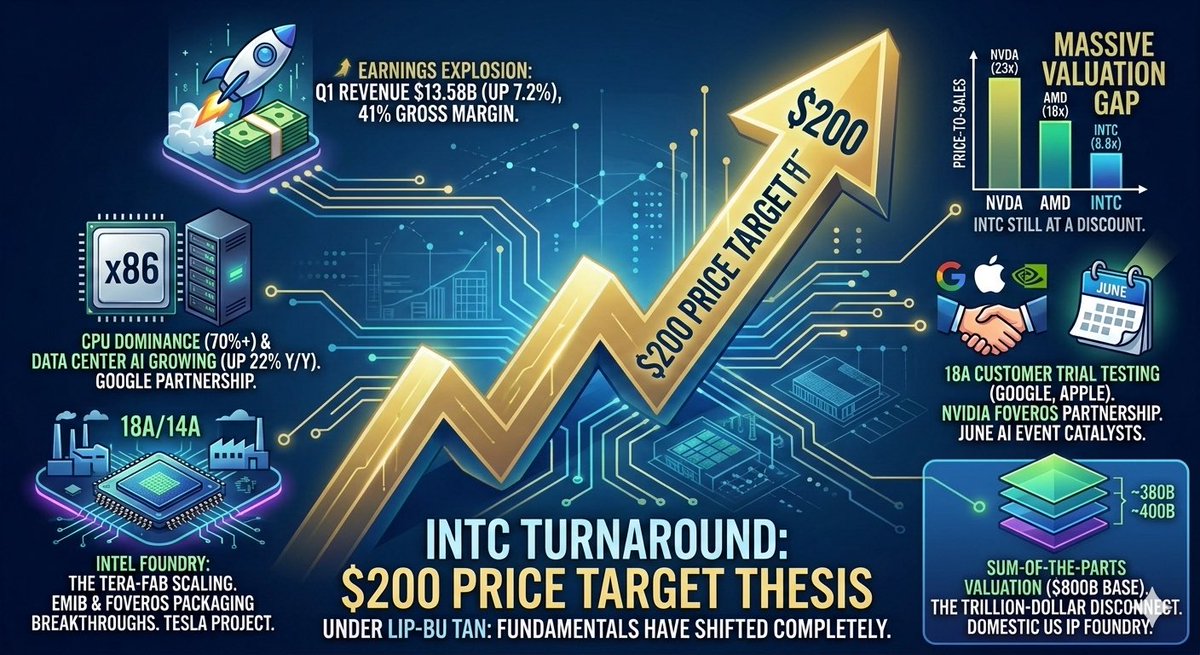
People often ask me if @intel is at a good entry point right now. Family and friends now realizing too late what I have been telling them for months… This is what I told them: if you have a 2–5 year time horizon, Intel may be the best risk-reward opportunity in the semiconductor space! Intel $INTC is one of the most undervalued large-cap semiconductor companies today. While the market continues to favor pure-play chip designers, Intel’s asset base and multi-year turnaround are still largely being discounted. This was due to 18a and foundry dragging the numbers. But now that 18a is roaring success with panther lake the story will change fast. It will become a foundry premium… Below is a factual breakdown of why Intel’s setup for 2026–2027 looks compelling. 1. Valuation Gap vs. Peers Intel trades at a much lower revenue multiple than comparable semiconductor companies. • Intel Price-to-Sales: ~3.8x • Peers: AMD and NVIDIA trade between ~8x and over 30x The market is valuing Intel like a slow-growth hardware company, despite the fact that it is the only Western company that both designs and manufactures leading-edge chips at scale. Made in America 🇺🇸 alone will have a premium because of Trump. The market is ignoring the fact that Trump policies will have an impact on America for decades… 2. Earnings Power Shift With a current market capitalization of approximately $200 billion, Intel’s valuation looks increasingly attractive when viewed against projected earnings. • 2026 projection: ~$10 billion in net profit • 2027 projection: ~$21 billion in net profit At 2027 earnings, Intel would trade at roughly 10x forward earnings, a level that is unheard of in the semi-sector. 3. Sum-of-the-Parts Valuation Several analyst models suggest Intel’s individual business segments are worth more than the current market value of the entire company. •Product business: ~$340B (valued at ~20x NOPAT) •Foundry (manufacturing): ~$360B (based on ~3x book value) •Non-core assets: ~$13.5B (Mobileye, Altera, IMS) Implied total value: ~$710 billion, or roughly $157 per share. 4. Foundry as a Strategic Asset Intel Foundry is transitioning from a financial drag to a strategic advantage. •Revenue outlook: External foundry revenue is expected to become meaningful by 2027 as the 18A-P process node reaches high-volume production •Strategic importance: Intel is the only U.S.-based alternative to TSMC. Early partnerships — including reported interest from large AI chip designers — support the foundry’s long-term relevance. Intel currently trades at a price-to-book ratio of around 1.6–2.0, which is dramatically lower than peers like Nvidia (≈37.8) and AMD (≈5.6), as well as the broader semiconductor industry average that hovers near 8–10. This stark valuation gap highlights how Intel is priced cheaply relative to competitors, suggesting the market assigns far less premium to its assets compared to rivals despite its scale and strategic importance. In conclusion, I believe this is a strong entry point, as I currently estimate Intel’s fair value at $550 billion. Wall Street has also been waiting for Intel to release its 18A process before fully committing. With that catalyst now in place, let the bull run begin.
IntelBull tweet media
English
9
39
348
27.4K
IntelBull
IntelBull@IntelBull_·
Jensen has a fiduciary duty to his shareholders to diversify, yet he chooses not to. At this point, there is absolutely no excuse for why he still hasn’t committed a significant allocation to Intel. If chips are the new oil and chip production can be located anywhere in world, why isn’t he doing more? This is the question the us gov should look at quickly— before the us is dragged into another conflict over geopolitics
English
0
0
1
24
Alex
Alex@Alex_Intel_·
Jensen about bringing chip manufacturing plants to the US "Let's demonstrate restraint...Let's not press or push unnecessarily" Uh ya we do need do press and push... Only 3 TSMC Fabs are going to be in volume by 2030 (less than 10% of volume)
The All-In Podcast@theallinpod

🚨MAJOR INTERVIEW: Jensen Huang joins the Besties! The @nvidia CEO joins to discuss: -- Nvidia's future, roadmap to $1T revenue -- Physical AI's $50T market -- Rise of the agent, OpenClaw's inflection moment -- Inference explosion, Groq deal -- AI PR Crisis, Anthropic's comms mistakes -- Token allocation for employees ++ much more! (0:00) Jensen Huang joins the show! (0:26) Acquiring Groq and the inference explosion (8:53) Decision making at the world's most valuable company (10:47) Physical AI's $50T market, OpenClaw's future, the new operating system for modern AI computing (16:38) AI's PR crisis, refuting doomer narratives, Anthropic's comms mistakes (20:48) Revenue capacity, token allocation for employees, Karpathy's autoresearch, agentic future (30:50) Open source, global diffusion, Iran/Taiwan supply chain impact (39:45) Self-driving platform, facing competition from active customers, responding to growth slowdown predictions (47:32) Datacenters in space, AI healthcare, Robotics (56:10) OpenAI/Anthropic revenue potential, how to build an AI moat (59:04) Advice to young people on excelling in the AI era

English
3
0
11
2.6K
IntelBull
IntelBull@IntelBull_·
Does anyone know if Intel Foundry Direct Connect still taking place? I can’t find it listed among the upcoming events on Intel’s website. @intel @asheaw $INTC
IntelBull tweet media
English
7
0
17
1.7K
IntelBull retweetledi
Jukan
Jukan@jukan05·
Intel to Raise PC CPU Prices by 10%, Adding to PC Manufacturers’ Cost Burden Intel plans to raise prices on its PC central processing units (CPUs) by 10%. With profitability already under pressure from soaring memory semiconductor prices, the upcoming increase in CPU prices — another core component — is expected to further weigh on PC manufacturers’ production costs. According to industry sources on the 19th, Intel has notified major customers that it intends to raise PC CPU prices by the end of this month. The price hike is said to cover most of the key products across Intel’s diverse CPU lineup. The move is seen as Intel’s effort to protect margins amid a supply-demand imbalance, as surging demand for AI data center semiconductors has reduced the supply available for consumer products. The CPU, which serves as the brain of a PC and determines processing speed and performance, is a critical component. Intel holds approximately 70% of the PC CPU market. While AMD and Qualcomm are also expanding their PC CPU supply, Intel’s dominance remains overwhelming. Against this backdrop, Intel’s price hike is particularly damaging to PC manufacturers, as rising production costs will sharply deteriorate their profitability. Memory prices — another essential PC component alongside CPUs — are also seeing unprecedented surges, driven by memory supply shortages stemming from expanded AI infrastructure investment. According to market research firm Counterpoint Research, memory prices rose by as much as 180% quarter-over-quarter in Q1. PC manufacturers are now on high alert as prices for essential components spike. An industry official noted, “The biggest concern for manufacturers right now is the rapidly rising cost of components. There are fears that if Intel CPU prices rise on top of everything else, operating profits will fall sharply and companies will struggle to stay afloat.” Major PC makers are responding to the crisis by diversifying their supply chains and increasing the proportion of higher-value AI PCs in their product mix — a strategy aimed at defending profitability through greater sales of premium products. However, since memory prices are expected to remain elevated through next year, PC manufacturers’ difficulties are likely to deepen further. Rising component costs are also expected to feed through into higher PC retail prices, increasing the burden on consumers. Separately, market research firm TrendForce projected that if memory and CPU prices rise simultaneously, the combined share of these two components in notebook BOM (bill of materials) costs could reach as high as 58%. It added that memory price increases alone could push retail prices for standard laptops up by more than 30%, and that with the additional CPU price hike, total price increases could approach 40%.​​​​​​​​​​​​​​​​ $INTC
English
8
27
194
52K
XCorpHub
XCorpHub@XCorpHub·
Elon’s Photonic Escape Hatch: Sidestepping ASML’s EUV Monopoly with Light-Speed Thinking🔥 Elon Musk doesn’t fight monopolies head-on — he changes the game entirely. While the semiconductor world obsesses over ASML’s $400 million EUV machines and sub-2nm shrinks for Dojo, AI5, and Optimus chips, Elon is already hiring the talent to bypass the entire bottleneck. SpaceX (deeply intertwined with xAI and Tesla post-merger) has been quietly posting senior Silicon Photonics Design Engineer roles since February 2026. The job: build custom Photonic Integrated Circuits (PICs) that move data with light instead of electrons. Why? 10–100× higher bandwidth, drastically lower power, almost zero heat — perfect for orbital AI data centers, Starlink satellites, and massive terrestrial clusters. Here’s the first-principles genius: traditional chips are trapped in EUV’s physics prison because shrinking transistors demands extreme ultraviolet lasers, tin plasma, and flawless mirrors. Photonics flips the script. Optical interconnects (the highways between chiplets, cores, or entire racks) don’t need bleeding-edge nodes. Mature 7nm/5nm or even older silicon works beautifully for waveguides, modulators, and photodetectors. You still use some conventional transistors for logic, but the data movement — the real power hog in AI training/inference — runs on light. Result? You get supercomputer performance without queuing for ASML’s High-NA machines or paying the Dutch tax. For Tesla’s Terafab? Imagine this: • Build core AI dies on readily available DUV nodes (no EUV monopoly). • Connect everything with in-house photonic links designed by the same team building space data centers. • Stack chiplets vertically (Tesla’s packaging expertise + Optimus automation). • Suddenly Terafab scales to hundreds of billions of chips without waiting years for EUV slots. Even better: inference-heavy workloads for FSD and Optimus are photonics’ sweet spot. Light-based computing (or hybrid photonic-analog designs) slashes energy use so hard that “older” silicon suddenly feels like next-gen. Add xAI software optimization and Neuralink-inspired brain-like architectures, and the EUV dependency shrinks to near zero. This is pure Elon: vertical integration on steroids. Don’t copy ASML’s 30-year, trillion-dollar nightmare. Build the interconnect layer yourself, use light as the new electron, and let the physics monopoly wither. China is already pushing silicon photonics for the same reason — to escape EUV sanctions. Elon is just doing it faster, bolder, and with rockets attached. The hiring posts are live. The orbital data-center vision is public. The Terafab is coming. While the industry kneels at ASML’s altar, Elon’s photonic army is already marching around it. Light wins. Monopoly over. Game changed. 🚀
XCorpHub tweet mediaXCorpHub tweet media
English
57
220
906
56.7K
French Embassy UK🇫🇷🇪🇺
President @EmmanuelMacron announced France’s new aircraft carrier will be named France Libre – a tribute to the Free French Forces, created in London in 1940 by Charles de Gaulle and recognised by Winston Churchill. A symbol of our enduring bond. 🇫🇷🇬🇧
French Embassy UK🇫🇷🇪🇺 tweet mediaFrench Embassy UK🇫🇷🇪🇺 tweet media
English
53
319
1.9K
49.8K
felix
felix@felix39990211·
@IntelBull_ @LipBuTan1 @intel @nvidia Nvda was 10 years early to cuda. They have no obligation to make it open source. Just like Apple and Microsoft and the Coca Cola formula
English
1
0
0
48
IntelBull
IntelBull@IntelBull_·
.@LipBuTan1 @intel @nvidia We’ve effectively given up 10% to the U.S. government, along with additional dilution tied to $NVDA. The obvious question is: what are we actually getting in return for these concessions? $INTC likely would have recovered regardless, especially given the ongoing CPU supply constraints. So it’s fair to ask whether these trade-offs were truly necessary? Many investors are also deeply disappointed with Nvidia’s role as a major Intel shareholder as we are still not seeing the value. At GTC, Intel wasn’t mentioned even once—this raises serious concerns about alignment and strategic intent. On top of that, why isn’t Nvidia utilizing Intel Foundry Services yet? Nvidia already controls roughly 90% of the AI stack. With that level of dominance, they should be doing more to avoid potential monopoly scrutiny, not reinforcing it. There’s also a broader strategic issue here: Nvidia should be prioritizing partnerships with U.S.-based firms rather than remaining so heavily dependent on Taiwan. Diversification isn’t just good optics—it’s critical for long-term resilience and geopolitical risk management. I understand this is slow but we need more vision and clarity. If it was me I would bring Nvidia to court over the monopoly they are constructing
English
7
2
47
4.5K
IntelBull
IntelBull@IntelBull_·
@felix39990211 @LipBuTan1 @intel @nvidia You can’t be serious… just the overhead on the compatibility layer not only talking about all the software that needs to be rewritten to run on another architecture doesn’t compare to native
English
1
0
2
40
snapshot
snapshot@solitude12133·
@IntelBull_ @LipBuTan1 @intel @nvidia Maybe Intel needs to make a good product rather than asking everyone to rescue them. With Intel's work culture and middle mgmt, the company is far less competitive than its peers. That's why they lost to TSMC in fabs, are losing share to AMD in CPUs, and have no chance in AI
English
2
0
1
190
felix
felix@felix39990211·
@IntelBull_ @LipBuTan1 @intel @nvidia No it isn’t. Their ecosystem, unlike Apple, doesn’t keep competitors out. There are plenty of rapidly growing competitors. They are just not as good. They pay their suppliers well, unlike Walmart, and the suppliers are free to expand and supply the competition
English
1
0
0
50
IntelBull
IntelBull@IntelBull_·
@felix39990211 @LipBuTan1 @intel @nvidia Monopoly laws are complicated you don’t have to undercut your competition necessarily for it to count. Ecosystem that keeps competitors out and power over suppliers plus a 90% market share is enough
English
2
0
2
142
IntelBull
IntelBull@IntelBull_·
@VeeEyeEll Oh shit thanks really didn’t know. You are a genius
English
1
0
1
51
VIL
VIL@VeeEyeEll·
@IntelBull_ Maybe they have so much market share because they make the best product
English
1
0
0
54
IntelBull
IntelBull@IntelBull_·
GTC was a disappointment and a missed chance to address a real issue: the extent to which $NVDA already dominates the AI compute stack. Nvidia’s position in the AI GPU market is overwhelming, it accounts for roughly 80–90% of the data‑center GPU market, and that dominance gives it immense leverage across the broader AI infrastructure ecosystem. What’s more concerning is Nvidia’s outsized dependence on Taiwan’s semiconductor industry, particularly TSMC, for advanced manufacturing. Over 90% of the world’s leading‑edge chips are still made in Taiwan, and TSMC’s facilities in Taiwan produce essentially all of Nvidia’s top‑tier AI accelerators. A significant disruption there, whether through geopolitical tension or conflict — would have catastrophic implications for the global tech supply chain and economy. U.S. officials have even warned that Taiwan is a “single point of failure” for critical chips. This dynamic isn’t just about supply risk — it also means Nvidia can effectively set terms in the AI hardware market because most of the cutting‑edge capacity it needs resides in one geopolitical hotspot. Regulators should take a far closer look at $NVDA market power and its long‑term implications. Its dominance in AI GPUs, ecosystem lock‑in (such as CUDA), and strategic position in global chip supply chains give it de facto control across multiple verticals — from training to inference to infrastructure — which raises reasonable competition and national security questions. The @realDonaldTrump administration and global regulators shouldn’t wait for a crisis to start paying attention to these structural risks. They need to diversify now away from Taiwan to us fabs like $INTC It’s now or never 2027 is 7 months away. Why are they all sleeping at wheel
English
1
1
14
1.1K
IntelBull
IntelBull@IntelBull_·
Well then, let’s take them to court for what looks like a blatant monopoly. They control roughly 90% of the AI GPU market, there is no doubt they are a monopoly. To be honest, if they continue down this path, all the regulators will start looking at Nvidia. Jensen Huang is not doing anything about the company’s reliance on Taiwan. With China saying they could move on Taiwan, this could drag us into a WW3. I know he may not care because his parents are from Taiwan, but who wants to go to war over AI GPUs? Pete Hegseth said that in all the Pentagon’s war game simulations involving a conflict with China, they lose every time. China is serious about Taiwan, and the situation is even more precarious due to the Iran conflict. You have the two main CEOs, AMD and Nvidia—who are cousins—and they don’t seem to care about the risk of the U.S. being drawn into a war over Taiwan for AI GPUs. They have done nothing to reduce their reliance on TSMC because they don’t want to use Intel. Are these people serious?? They really think the US will go to war for them Make that make sense. Even the CIA warned that China could move on Taiwan as soon as next year. What are these people doing? So many times the have been warned and they are doing nothing. All experts in the field. China warned it so many times. The us internal defense are all saying the same things and yet nothing changes. It’s not difficult they need to secure some capacity with Intel now they don’t have time to play stupid $AMD $NVDA $INTC
English
0
0
2
284
John Wix
John Wix@JimmyButlerCap·
@IntelBull_ @LipBuTan1 @intel @nvidia $NVDA used the 5B investment to lobby US on H200 exports to China. Now that that’s underway Jensen Huang could care less about $INTC. And in fact needs to take market share from Intel/AMD to justify the 4T MC. At least that’s how it seems
English
1
0
2
530
IntelBull retweetledi
IntelBull
IntelBull@IntelBull_·
Fast-forward me to the end of 2026 already. I’m done watching this market go sideways. Just wake me up when $INTC is trading $100+ per share.
English
4
4
48
5.5K