
Practical Patriot 🇺🇸

9.3K posts

Practical Patriot 🇺🇸 banner
Practical Patriot 🇺🇸

Practical Patriot 🇺🇸

@InternetCPA

Practical healthcare reform. Follow the money. Fix incentives. Site-neutral payments, Medicare-based price discipline, real competition.

Katılım Ekim 2015
1.3K Takip Edilen641 Takipçiler
Practical Patriot 🇺🇸
@JoeCarloLaw Tennessee is a step. ERISA is the wall. You can pass all the state PBM laws you want, but if self-funded employer plans are still shielded, the biggest part of the commercial market stays rigged. State reform creates pressure. Federal reform changes the game.
English
1
0
2
49
Joe Carlo
Joe Carlo@JoeCarloLaw·
Almost every celebratory "state reined in the shadowy PBM middlemen" article skips the same fact that no state law can touch ERISA-covered plans, which is most of the commercial market. State legislation is progress, but ERISA severely handicaps what it can actually accomplish.
English
4
4
13
603
Practical Patriot 🇺🇸
Drop Medicare to 60, then 55, then 50. Let people choose it. Let insurers compete. Then pass Break Up Big Medicine so the same corporate parent cannot own the insurer, PBM, and provider stack. One reform gives people coverage. The other strips out the rigging. If private insurance is really better, it should be able to win without owning the referee.
English
1
0
1
124
Mark Cuban
Mark Cuban@mcuban·
Single payer COULD cut cost and improve care but there are 2 fundamental issues. 1. All plans proposed have placed the Sec of HHS in charge of the program. You can't have a political appointee in that position and it's hard to de-politiicize HC in this country 2. They assume that they can get providers and specialists to accept whatever rates they set. You are talking about organizations that in most cases, don't even know their costs. Why ? They don't want to know their costs. For lots of reasons to long to dig into here Proponents of M4A have to first get hospitals to the point where they can define all their costs and do a Bill of Materials for procedures. You can't negotiate a price for all Americans if you don't know what your costs are It's Shark Tank 101. So we get a stalemate. Politicians don't do the work needed. Hospitals and providers avoid the work needed Other countries started on their path to universal care decades and decades ago. When healthcare was much simpler technically and fiscally. If senators won't support the Break Up Big Medicine Bill or anything comparable , there is no chance of getting to single payer. Our politicians don't have the backbone to do what is needed. You can call out all but Hawley and warren. No one else has uttered a syllable in support
Berniebabe2016☮️🟧@berniebabe2016

@mcuban @IngGuthrie #MedicareForAll would resolve that issue. Healthcare should not be connected to employment.

English
272
219
1.2K
286.2K
Practical Patriot 🇺🇸
Insurers sell coverage with deductibles people cannot afford, so hospitals mutate into lenders, collectors, and fee maximizers to get paid. Then the bureaucracy explodes and the patient gets crushed in the middle. This is not a functioning market.
Mark Cuban@mcuban

The are a function of health insurance plans. The insurance companies create plans with deductibles that most people can’t afford. So to get to the insurance money from their plan, they will loan the patient money to cover their deductible. That turns the hospital into a sub prime lender. Then the insurer will under pay, late pay and claw back in the contract. Costing the hospital more cash. And costing them in administrative costs even more Then the insurer will delay approvals and deny care, earning interest on the premiums. So then the hospitals. Non profit or not, have to compensate for the issue with insurance companies. So they create ridiculous shit like facilities fees, abuse 340b programs , abuse site neutrality and more. And of course non profits don’t pay taxes And then the biggest provider systems will say they can’t make money on Medicare. Which is a function of them spending like drunken sailors on everything they can. From buildings to consultants. There are more administrators than doctors and in aggregate they make more. It makes no sense that hospitals spend so much money on consultants. It’s a waste. It’s like them want them to give the CEO cover , so they can try to buy more hospitals which leads to more pay for the ceo Break em all up

English
0
0
0
24
Practical Patriot 🇺🇸
Stark has asymmetric friction. Agree. But site-neutral payment matters more because that is where the money is. If hospitals get paid more for the same service, they will keep buying practices no matter how many Stark tweaks you pass. End the payment distortion, then modernize Stark so independent doctors can build without turning referrals into commission checks.
English
0
0
0
30
Adam Bruggeman, MD
Adam Bruggeman, MD@DrBruggeman·
“I didn’t write those penalties.” - Pete Stark The Stark Law prohibits a physician from referring patients to an entity in which they have a financial interest. That sounds neutral but it isn’t. A hospital-employed orthopedic surgeon who refers every post-operative patient to the hospital’s owned SNF, physical therapy, imaging center, and home health agency has a financial interest in every one of those referrals. His salary, his productivity bonus, and his continued employment depend on staying within the system. None of that triggers Stark. The bona-fide employment exception covers it entirely. An independent orthopedic surgeon who owns an MRI with two partners? Well, they would have to go through a full stark analysis and legal review with complex written arrangements and ongoing compliance infrastructure. One technical violation of Stark and the False Claims Act exposure is existential. These scenarios show the same financial conflict with radically different legal treatment. The consequences for patients are hard to ignore. A recent NORC survey found that 61% of employed physicians have moderate or no autonomy to make referrals outside their system, and nearly half said they adjust treatment options based on organizational incentives. Hospital employment doesn’t eliminate the financial conflict of the referral relationship. It just hides it inside a compensation structure Stark never touches. Marc Greenberg, MD, an orthopedic surgeon in Baltimore, put it plainly in Becker’s this week: “We’ve created a system where for-profit entities can have healthcare ownership. But the people who took an oath to serve the patient — who’ve shown a commitment to caring — can’t.” There is no federal prohibition on hospitals requiring employed physicians to refer within the system. No law prevents health systems from structuring compensation, call coverage, or scheduling to steer referrals to owned facilities. No equivalent of Stark governs the institutional referral relationship at all. Congressman Stark was trying to protect patients from corrupted referrals. What his law produced was a system where the most powerful referral relationships in American healthcare are completely unregulated and the physicians most accountable to patients are the ones most restricted.
Adam Bruggeman, MD tweet media
English
7
34
75
3.8K
Practical Patriot 🇺🇸
Yes, expose hidden ownership everywhere. Funny how transparency suddenly becomes “complicated” whenever the profit stream might become visible. Medicine is different because the person steering the transaction is also the person the patient is supposed to trust. Let doctors build, let doctors compete, let doctors own hospitals. Fine. Just do not turn clinical judgment into a commission structure. Full ownership disclosure, site-neutral payment, zero pay tied to referral volume, that is a market; the rest is monetized trust.
English
1
0
0
14
Justin Albright
Justin Albright@jalbright22·
@InternetCPA @DrBruggeman Why stop at medicine? Try full ownership transparency, site-neutral pricing, and referral scrutiny in law, accounting, title/escrow, auto sales/financing, and real estate. See how fast the “it’s complicated” crowd shows up.
English
1
0
0
22
Adam Bruggeman, MD
Adam Bruggeman, MD@DrBruggeman·
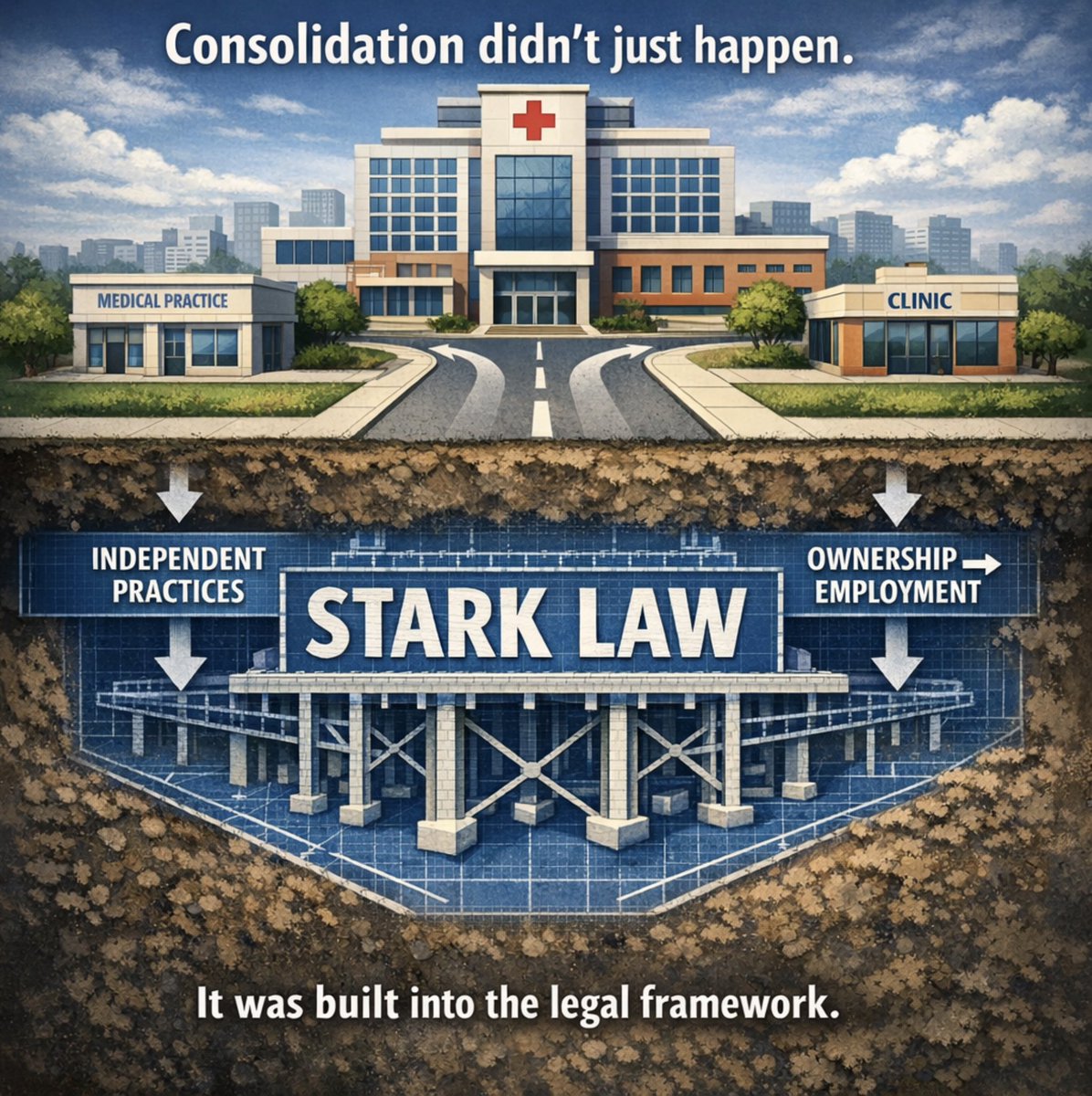
“I would like to just go back to the old law.” - Pete Stark When I talk about hospital consolidation, I typically blame market forces. Economies of scale, thin margins, and the complexity of modern healthcare all weigh heavily. I rarely mention the federal law that made independent physician ownership structurally illegal, but it is important to include. Stark created a legal environment where the only compliant way to build integrated referral relationships was through employment or complex written arrangements requiring teams of healthcare attorneys to maintain. Independent physicians who wanted to own ancillary facilities or build integrated care models faced Stark liability at every turn. Hospital systems faced none of that friction. The result was predictable. The practice model Stark was supposedly neutral toward was systematically disadvantaged while the practice model it left untouched captured everything. Independent physician ownership gave way to large employed systems. In 1983, more than 75% of physicians were independent. Today that number is below 25% and falling. Stark didn’t cause all of that but it built the legal architecture that made consolidation the path of least resistance and independent ownership the path of maximum legal exposure. Patients pay the price. Hospital-employed physicians practice in the most expensive care settings in the system. Every referral to a hospital-owned facility carries a facility fee that an independent practice cannot charge. While site-neutral payment reform is the demand-side fix for this problem, Stark modernization is a potential supply-side fix. You cannot solve consolidation without first addressing laws that incentivized it.
Adam Bruggeman, MD tweet media
English
13
23
66
6.1K
Dylan
Dylan@BigBlueDylan·
There’s about to be a former 4⭐️ and top 20’ prospect in 2025’s class hit the transfer Portal, that averaged over 16 Points a game. Gonna be a lot of interest in this kid.
English
8
1
293
93.3K
Practical Patriot 🇺🇸 retweetledi
Practical Patriot 🇺🇸
Stark did not protect independent medicine. It helped box out independent doctors while hospital systems turned ownership into a billing weapon. But full repeal is not reform. Let doctors own hospitals and facilities, require full ownership and pricing transparency, ban compensation tied to referral volume, and enforce site-neutral payment. The goal is competition, not a new class of medically licensed toll collectors.
English
1
1
1
81
Practical Patriot 🇺🇸 retweetledi
Magyar Péter (Ne féljetek)
Üzenet a magyar nemzetnek. Az Orbán-gate egy puccs a szabad Magyarország ellen. Orbán Viktorék nemcsak a legerősebb magyar pártra támadtak rá illegális rendőri és titkosszolgálati eszközökkel, hanem a saját hazájukra is. 19 nap múlva sok millióan véget vetünk a modernkori magyar kommunizmusnak. Leváltjuk a pedofilvédő, a Nemzeti Bankot és a honfitársaikat kirabló maffiózókat, akik elárulták a saját hazájukat, azokat, akik bábállammá tennék ezt a csodaszép országot, akik kockáztatják helyünket Európában, akiknek semmi sem drága. 19 nap van hátra. Készüljetek!
Magyar
390
1.4K
4.2K
116.4K
Practical Patriot 🇺🇸
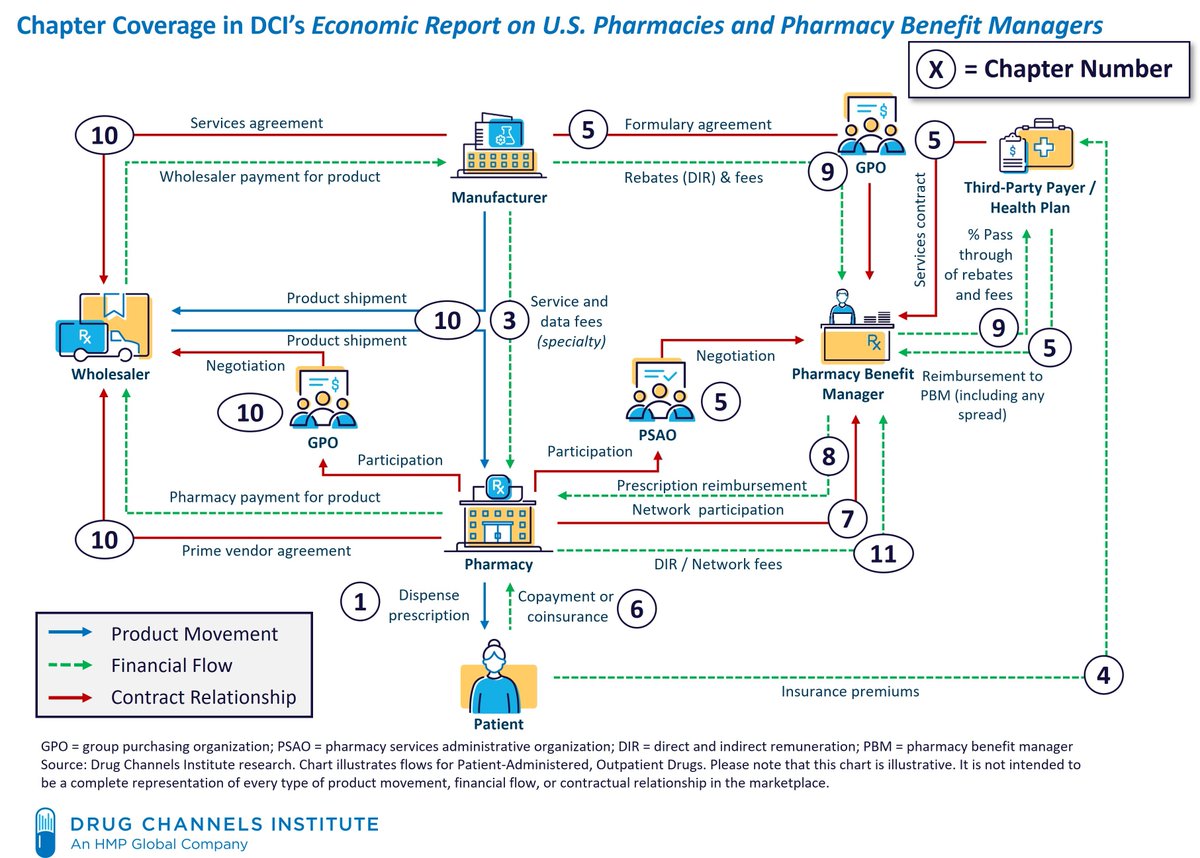
The drug takes a straight line. The money does not. That is the scandal. This chart shows a system where PBMs and health plans sit in the center of a maze of rebates, fees, spreads, and contract layers while the pharmacy that actually serves the patient gets squeezed. When money moves in more directions than the medicine, the market is built for extraction, not care.
Practical Patriot 🇺🇸 tweet media
English
0
0
0
24
Practical Patriot 🇺🇸 retweetledi
Mark Cuban
Mark Cuban@mcuban·
I don’t think people realize how much healthcare costs are driving big companies to fire and not hire. It costs them $30k per family, per year for premiums and care. Most of that goes to the massive, vertically integrated insurance companies that send weekly bills that no one reviews in details. And it doesn’t include the company overhead to deal with it all. It’s usually the 2nd largest expense after payroll. Which is insane It’s far easier to blame AI than it is to blame Healthcare costs. Want to increase jobs, wages and improve affordability for every American ? Break up the biggest insurance companies. Make divest non insurance companies. They don’t need thousands of subsidiaries. That’s how they game and abuse the system and increase costs for all of us. Call your senator and tell them to support the BreakUp Big Medicine Bill by @HawleyMO and @SenWarren.
English
1.5K
4K
26.9K
1.8M
Practical Patriot 🇺🇸
@SteveDu56581507 @DrBruggeman Patients don’t have clean prices, equal information, or real shopping power when a doctor, hospital, or insurer steers care. That is exactly why ownership plus referral control is different here. I’m not arguing against ownership. I’m arguing against monetized steering.
English
0
0
0
25
Steve Dunlap
Steve Dunlap@SteveDu56581507·
@InternetCPA @DrBruggeman Ok, so then let's disallow lawyers and accountants from owning their firms and making money on junior partners. Disallow mechanics owning their garage. Chef owns the restaurant? Forget it! No credit cards for airlines.
English
1
0
0
26
Adam Bruggeman, MD
Adam Bruggeman, MD@DrBruggeman·
The Law That Was Supposed to Stop Fraud But Instead Created It In 1989, Pete Stark identified what he thought was a real problem. Physicians were referring patients to facilities or entities they owned with no checks and balances. Whether or not he was wrong in his assessment, the solution ended up worse than the problem it resolved. In 2007, Stark himself wrote that his law had done more harm than good. In 2016 his words were entered in the Senate Finance record stating “It gave every shyster and promoter a loophole. We now have to keep rewriting the laws like the tax code.” Stark laws closed one loophole and opened a bigger one. Before their implementation, a physician faced medical board action, malpractice exposure, and professional sanction for any questionable or unethical behaviors. Those mechanisms still exist today. Hospital systems, private equity firms, and corporate administrators have no medical boards or professional sanctions while largely avoiding malpractice concerns. The CFO building a facility fee structure that drives unnecessary utilization will not face a licensing board. The executive steering referrals to their own physicians, imaging, physical therapy, or hospitals will not be put in front of an ethics board. Instead they will be celebrated and promoted. Stark laws didn’t create a cleaner system. They created the same financially-conflicted referral relationship with more layers, larger actors, and less accountability at every step. The Department of Justice has recovered over $35 billion under the False Claims Act since 1986, dominated by hospital and health system conduct. Medicare Advantage overpayment to insurers runs an estimated $80 billion annually. None of these are a physician self-referral problem. When the Stark laws passed, Medicare managed care covered 3% of beneficiaries and prospective prior authorization barely existed. Today Medicare Advantage covers more than 50% of beneficiaries and processes over 50 million prior authorization requests annually. The checks and balances that Stark was designed to substitute for now exist in nearly every medical setting. The law hasn’t changed but the healthcare system it governs barely resembles 1989. This week: what Stark modernization actually needs to look like, why the physician-hospital double standard is indefensible, and what a concrete legislative framework for independent practices looks like today.
Adam Bruggeman, MD tweet media
English
13
48
139
11.3K
Practical Patriot 🇺🇸 retweetledi
Aaron Rupar
Aaron Rupar@atrupar·
NewsNation has footage of the deadly plane-fire truck accident last night at LaGuardia
English
44
132
634
97K
Matt Jones
Matt Jones@KySportsRadio·
Will always love Demarcus Cousins. And I would listen to him (and most people) over me when it comes to basketball as well Go Cats
English
72
24
1.8K
125.9K
Practical Patriot 🇺🇸 retweetledi
Astraia Intel
Astraia Intel@astraiaintel·
Simply INCREDIBLE scenes coming out of the Žalgiris - Rytas basketball match, as the fans of both teams United to chant “Slava Ukraine” in a show of solidarity. I don’t think I have ever seen anything like this before in my life 🇱🇹❤️🇺🇦
English
110
1.9K
8.9K
154.4K
Glenn Kirschner
Glenn Kirschner@glennkirschner2·
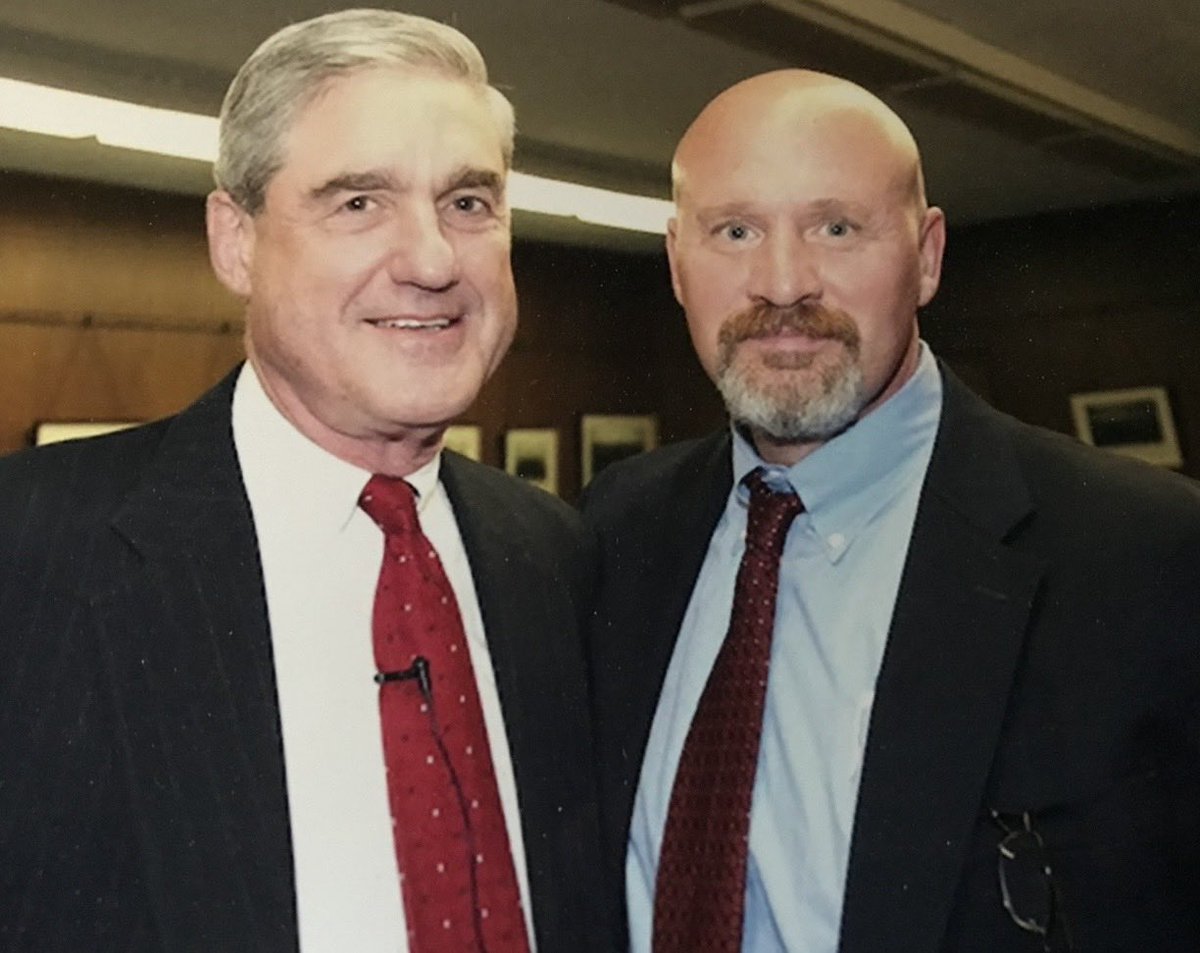
Bob Mueller was the single best leader and supervisor for whom I ever had the honor to work. I will forever stand on his shoulders. May he rest in peace.
Glenn Kirschner tweet media
English
1.3K
3.1K
17.8K
138.5K
Practical Patriot 🇺🇸 retweetledi
Ivory Hecker
Ivory Hecker@IvoryHecker·
UPDATE: Hospitals are now required by law to post their prices online. This was meant to stop the practice of patients getting blindsided with surprise mega-bills, aka predatory billing. At a hearing this week in Congress, witness Elizabeth Mitchell said only 69% of hospitals are complying with that law, and the price info they do put out “is increasingly unusable.” An investigation of hospital price variation showed it’s common for a hospital to charge one patient one thing and charge another patient 10 times more for the same procedure. Here’s that report: static1.squarespace.com/static/60065b8… Price transparency advocates are pushing people to call or write their elected officials to demand that the law be enforced. Have you ever been price gouged by a hospital? Let me know your thoughts!👇🏼 #hospitalfacts #partner
English
50
357
2K
81.3K
Practical Patriot 🇺🇸 retweetledi
Harshi Peiris, Ph.D.
Harshi Peiris, Ph.D.@Neuroscope_mp·
🚨 BREAKING: German researchers treated 15 severe lupus patients with CAR-T therapy. All 15 went into complete remission. Many stopped ALL medication. Now a larger trial just confirmed it — across 3 autoimmune diseases. This might be the biggest shift in autoimmune medicine in decades. 🧵
English
127
1.7K
6.3K
404.1K