Ash

14.5K posts

Ash banner
Ash

Ash

@JBling5

Business Intelligence, Stocks/Options Trader. Disclaimer: My tweets are not recommendations to buy or sell any securities

ohh hi hoe Katılım Eylül 2009
119 Takip Edilen459 Takipçiler
Ash retweetledi
*Walter Bloomberg
*Walter Bloomberg@DeItaone·
$QCOM - CHINA COMMERCE MINISTER MET WITH QUALCOMM CEO - STATEMENT
English
20
18
142
57.7K
Ash retweetledi
Jason
Jason@3PeaksTrading·
$NVDA going to explode after earnings even more isn't it? Today also 5500 August $280 calls bought at $8.70 offers and large buys of 8500 August $300 calls at $5.40 offer sweeps, wild demand
English
2
6
80
6.2K
Ash retweetledi
Garry Tan
Garry Tan@garrytan·
The politicians think this is about blocking big tech when actually they are going to strangle little tech while also destroying jobs and American competitiveness at the global level It’s all so knee jerk and shortsighted texastribune.org/2026/05/12/tex…
English
339
356
4.1K
363.9K
Ash retweetledi
Flow God
Flow God@FL0WG0D·
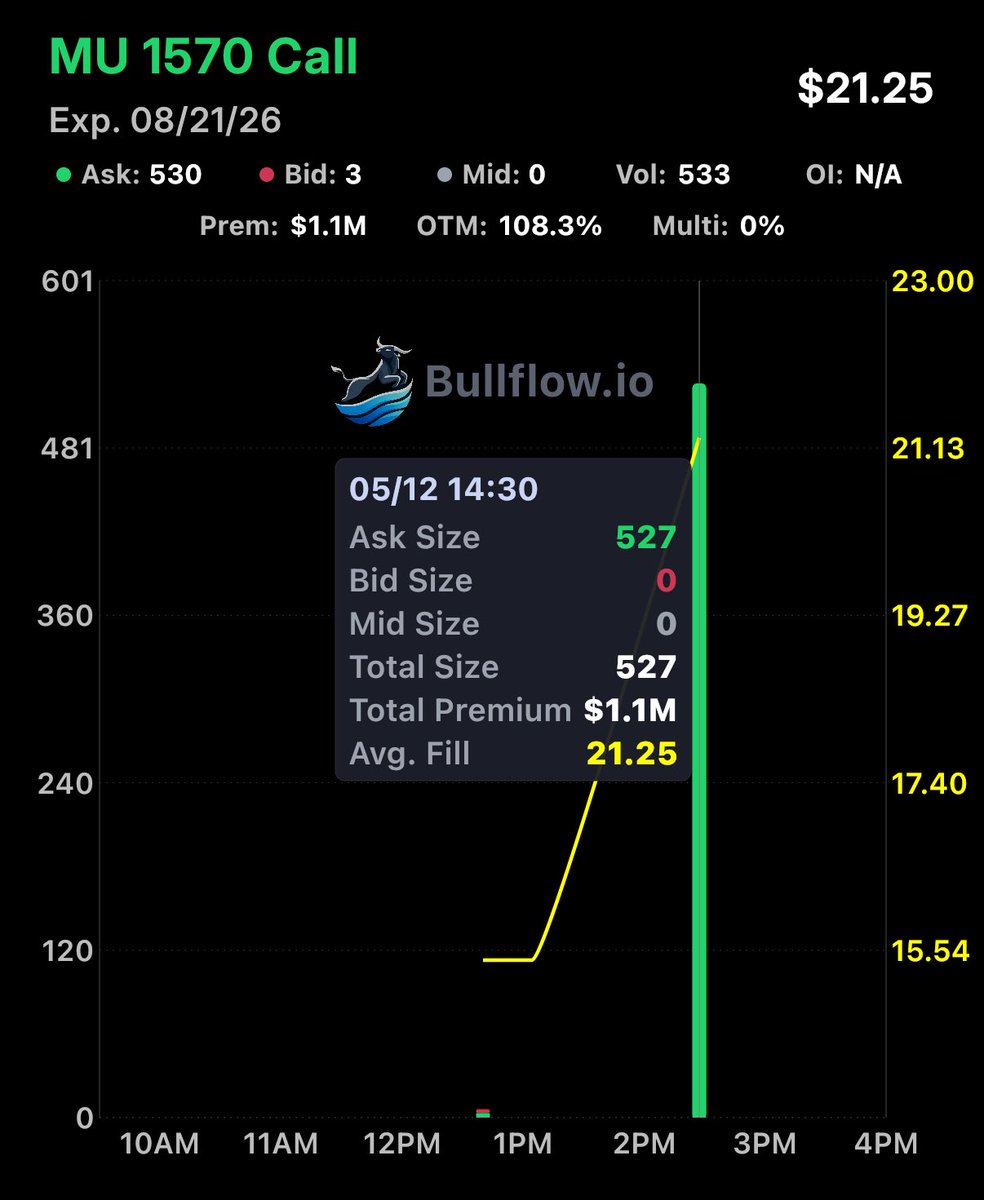
$1.1 million into these $MU calls. 100% OTM
Flow God tweet media
English
42
56
907
171.5K
Ash retweetledi
Aikido Security
Aikido Security@AikidoSecurity·
Update 5:05 PT: The attack has now expanded well beyond @TanStack and @Mistral. 373 malicious package-version entries across 169 npm package names, including @uipath, @squawk, @tallyui, @beproduct, and more. The malware propagates by stealing your CI credentials and using them to publish new compromised versions. Full IOCs, affected package list, and detection steps: aikido.dev/blog/mini-shai…
Aikido Security@AikidoSecurity

🚨 Update: @mistralai npm packages are now confirmed compromised as part of the ongoing Mini Shai Hulud attack. Affected versions: @mistralai/mistralai 2.2.2, 2.2.3, 2.2.4@mistralai/mistralai-azure 1.7.1, 1.7.2, 1.7.3@mistralai/mistralai-gcp 1.7.1, 1.7.2, 1.7.3If you use the Mistral SDK in any CI pipeline, treat your environment as compromised. Rotate npm tokens, GitHub PATs, and cloud credentials immediately.


English
76
492
2.6K
2.4M
Ash retweetledi
TFL
TFL@TFLabofficial·
The biggest mistake killing your PnL isn’t your entries… It’s what you do after you’re right. Cutting trades too early is one of the most common issues traders face. And the reason this happens is more a matter of your psychology, not intellect. You exit trades early because… You’re staring at your PnL when you should be watching key levels and market structure. You are thinking about the last trade you lost instead of looking at each trade independently. You don’t trust yourself. So how do you stop yourself from missing out on the big runners? 1 - Have a plan going into each trade and follow it. Take partial profits at 1-2R and play with profits (this helps you stay calm, knowing your trade is already profitable). 2 - Use trailing stops based on market levels or moving averages. Avoid using your PnL as a guide as it will cloud your judgement. 3 - Avoid oversizing. Arguably the biggest issue traders routinely struggle with is oversizing. A good rule of thumb is if you’re nervous in a trade, you sized too large. You should be able to sleep at night with any trade you have. If you can’t, it’s a sign to take some risk off. That said, everyone needs to develop a system that works for them. This requires doing some journaling and understanding the trades where you do the best versus the ones that hurt you the most. Over time, you learn what your edge is so that you can exploit it. Don’t let impatience get in the way of profitability. Trades are like trains, there is always another one just around the corner. (Unless you ride SEPTA in Philly, then you may be waiting awhile).
English
0
4
13
297
Ash retweetledi
Jason
Jason@3PeaksTrading·
Often get early week shakeouts in monthly OPEX week so likely just a normal retracement within positive gamma zone that sets up a new leg higher into NVDA report next week which remains the top event upcoming to the AI trade. Just the past weeks VIX rise is a good reminder to not be over your ski's leverage wise.
English
0
2
55
4.4K
Ash retweetledi
Deedy
Deedy@deedydas·
Billionaire Michael Milken joked “if a US company replaces the US-born CEO with a CEO born in India, I buy the stock” But he reveals he hasn’t backtested the idea. So we did. In the last 15yrs, that would’ve 50x’d your money: 7.5x more $$ and >2x IRR vs S&P500: 30% vs 14%!
English
557
1.7K
15.2K
3.6M
Ash retweetledi
*Walter Bloomberg
*Walter Bloomberg@DeItaone·
FRENCH HEALTH MINISTER THERE ARE STILL THINGS WE DO NOT KNOW ABOUT THE HANTAVIRUS, WE DO NOT KNOW IF IT HAS MUTATED
English
84
54
542
93.5K
Ash retweetledi
Jim Fan
Jim Fan@DrJimFan·
I promise this will be the best 20 min you spend today! Robotics: Endgame, the sequel to my last year's Sequoia AI Ascent talk, "Physical Turing Test". I laid out the roadmap for solving Physical AGI as a simple parallel to the LLM success story. Be a good scientist, copy homework ;) And stay till the end, more easter eggs and predictions for your polymarket! 00:30 DGX-1 origin story at OpenAI, I was there in 2016 signing with Jensen and Elon. Heading to the Computer History Museum! 01:42 The Great Parallel 03:31 Robotics, the Endgame 03:39 Why VLAs fall short 04:32 Video world models as the 2nd pretraining paradigm 06:09 World Action Models (WAM) 07:46 Strategies for robot data collection and the FSD equivalent to physical data flywheel for robot manipulation 11:06 EgoScale and the Dexterity Scaling Law we discovered recently 14:00 Physical RL: bridging the last mile 15:39 DreamDojo: an end-to-end neural physics engine for scaling RL in silico 17:00 Civilizational Technology Tree and my predictions for the near future. Spoiler: it's closer than you think. Thanks to my friends at Sequoia for inviting me back to AI Ascent this year! I had a blast! Last year's talk is attached in the thread if you missed it.
English
134
516
3.2K
464.8K
Ash retweetledi
Alma.Trk
Alma.Trk@alma271828·
THE BIGGEST MISTAKES OF RETAIL TRADERS ▫️Bayesian thinking Amateurs believe a trader should act like a politician: taking a stance and sticking to it through thick and thin. If they change their mind, it is viewed as "embarrassing" in the eyes of the crowd. Professionals, however, are always Bayesian thinkers. If the facts, the charts, or the economic data change, you must also change your position immediately, rationally, and without emotion. You either learn and accept this, or you are going to crash and burn very badly. Financial markets—much like the weather—are non-linear, chaotic systems where the "butterfly effect" prevails. The market is a dynamic, constantly evolving open system where new information and external forces flow in minute by minute. Some argue that the market is fractal. But this is not entirely true; it only appears to be fractal. On minute and second charts, the vast majority of price action is driven not by fundamental changes in value, but by liquidity hunting, the skirmishes of high-frequency trading algorithms, and order book dynamics. Therefore, the signal-to-noise ratio is at its absolute worst on very low timeframes. This is why so-called "Cognitive Flexibility" (based on Professor Tetlock's work) is indispensable. Trading is not chess, where we can see all the pieces on the board; it is poker. As the cards are dealt (as new data arrives), probabilities must be constantly recalculated. We weigh the odds: "What cards do the others hold? Should I fold my hand before the weekend, or stay in the game?" The analogy of blackjack and card counting also applies: we only place large bets when the deck favors us (this is called a "hot deck"); otherwise, we minimize our risk. This game is simply not for those who cannot tolerate uncertainty. This is exactly why a high win rate (strike rate) is not important at all. A trader can have a win rate of merely 15% and still make a fortune. How? By keeping their losses as tiny, insignificant "tests" (just "dipping their toes in the water" to gather information), but when they catch a massive trend within that 15%, they make a killing. A counterexample is Al Brooks, who scalps tiny price movements with 20 trades a day. He has an exceptionally high win rate, but his return per trade is very small. This is the hardest concept for retail traders to grasp, because intuitively, the untrained mind fundamentally assumes a symmetrical Gaussian distribution. Market returns, however, follow power-law and fat-tailed distributions (see the research of Mandelbrot and Taleb). This means that the overwhelming majority of market returns are generated by a few rare, extreme-magnitude moves. The most successful trend-following funds (CTAs), for instance, deliberately operate with low (30-40%) win rates, but they strictly cut their losses and let their portfolio-saving, massive winners run. This is called positive asymmetry. This is what I constantly emphasize to my followers as well, providing calculation methods for it. (Incidentally, this is also a central issue in machine learning, known as the Multi-Armed Bandit problem). The large institutional players trade by mapping out market possibilities and probabilities (how many paths lead to each outcome, thereby allowing those options to be weighted), as well as identifying the precursors to each outcome (which levels will confirm or invalidate the fulfillment of a scenario). They then execute micro-trades if they see momentum shifting toward one outcome or another. If they lose, they lose a little. But if the bet pays off, they scale up the position. Size up the winner, cut the loser. To this approach, I can also attach expected dynamics using speed profile and vanna profile analysis, since options positioning data is essentially a simultaneous bet on both the spot price and volatility. Therefore, you must let go of the ego-driven need to "always be right." In a random system, you cannot truly be right, because it does not operate by the strict rules of logic. On the very rare occasions it does, it usually stems from the interpretation of external information. Thus, you are neither right nor wrong in the market; you simply either catch the move or you don't. The other crucial point is that you must trade the distribution, not your fantasy. The market is not a deterministic system, despite how much many people seek and desire it to be. Do not look for certainty in a stochastic system. The only thing that will keep you afloat is a well-planned, rational, and consistent systematic approach backed by self-discipline. An analyst's job, competence, and quality typically boil down to how accurately they map out these possibilities, dynamics, and probabilities. But since we operate in a randomized, non-symmetrical system with an ever-changing distribution, an analyst's performance will inherently fluctuate as well. Based on my own backtests, my expected dynamics and level-bound dynamics were accurate 58-62% of the time, while my geopolitical forecasts hit a 73% accuracy rate... SOME PRACTICAL TIPS ▫️Using the Volume Profile is crucial. Price is always king. Volume is a secondary, supplementary tool that, by itself, never provides a buy or sell signal. Its sole purpose is to confirm (or question) the price action by placing it into context. I always emphasize the importance of the first 20-30 minutes. If the volume in the first half-hour is exceptionally high, it signals a trend day. In this scenario, the market gets a green light: institutions are present, breakouts can be traded confidently, and there is a high probability that the price will close near the extremes of the daily range (in the bottom/top 10-15%). Conversely, if volume is low, the market will only chop sideways and be driven by daily options flows (gamma profile). During these times, most breakouts will be fakeouts, and the focus should shift to trading inward from the edges of the range—i.e., mean reversion trading. This is further confirmed by checking the type of iron fly profile the market adopts, short or long. One is a bet on momentum, while the other is a bet on ranging. When the price breaks through a clear support or resistance level (confirmed by at least two prior touches), volume must spike dramatically. The real trick is that the first minor pullback following the breakout must occur on very low volume, and the price must not retrace below 62% of the breakout candle. This is the perfect trend-continuation entry. Once a trend is successfully caught, I usually trail my stop-loss order just below the low of the last high-volume candle (in the case of a long position). The logic is that this is where the large institutions stepped in; if they allow the price to drop below this level, the "big boys" are no longer defending the market, meaning I have no business being there either. If a massive volume spike suddenly appears at the very end of a long, extended trend, far away from support levels, it is a sign of exhaustion. It represents the FOMO panic of latecomer amateurs and a few artificially induced capitulations. This is not an entry signal; it is the absolute best exit point. If you were in the trade up to this point, this is where you lock in profits, because it is almost always followed by a violent snapback (reversal). Similarly, if volume diverges while the price is testing resistance, it indicates exhaustion, which can also be confirmed with RSI and MACD, as they trigger algorithmic reactions. If the market tests a level (even after a drop) and suddenly reverses with extreme volume in the opposite direction, it signals that the dynamics of the previous trend have been invalidated. Daily VWMA, VWAP, and AVWAP levels are incredibly important, as are the Initial Balance and Value Area levels on a TPO chart. Here, according to Steidlmayer, when price opens outside the previous day's Value Area and then re-enters and is accepted (spending 2+ TPO periods inside the VA) back inside, there is an 80% statistical probability that price will travel to the opposite side of the Value Area. In my own analysis, I always examine what dynamics and realized volatility expectations traders are assigning to specific zones via the options market. Deviations from these expectations, or the actualization of the anticipated dynamics, provide a massive informational edge and help map out the distribution much more accurately, thus reducing the number of micro-trades required. Anyone who followed my live intraday momentum signals last year and the year before knows exactly what I am talking about. An additional pro tip: it is highly recommended to apply a very slow 150-200 period Bollinger Band directly to the volume bars, plotting the 3, 3.5, 4, 4.5, and 5 SD levels. Personally, I also like to adjust the SD levels using the Cornish-Fisher expansion based on the skewness of the volume's own distribution, a technique I demonstrated in my educational post on mean reversion trading. (This is because Standard Deviation is inherently based on a Gaussian distribution). This helps immensely in judging whether a volume move is genuinely statistically significant or not. One more advanced trick: I monitor the standard deviation of the deviations from the volume's moving average. This is even more precise, because here I am comparing the magnitude of the deviations from the mean. A specific volume spike might look high to the naked eye, or even in terms of simple standard deviation, but it might not actually be statistically unusual. I consider services like order book depth, footprint charts, market delta, etc., to be completely useless, as the overwhelming majority of market volume is executed by algorithms. Large funds operate using "Iceberg" orders and VWAP time-slicing. They intentionally mask their true intentions in the order book, meaning you will always just be chasing micro-noise. Furthermore, it provides absolutely no actionable forward-looking edge. The only thing that is truly predictive is options positioning, but even there, I don't care about the daily intraday noise; I am solely interested in the pre-open data. That data reveals true market sentiment—i.e., what traders actually think about the underlying market structure. @OptionsDepth The rest is just smoke and mirrors and pseudo-intellectual overcomplication.
Alma.Trk tweet media
Alma.Trk@alma271828

Stop trying to predict tops you'll burn yourself... When the market was below 6400, I called the bottom. I marked a certain pivot that tells us whether there will be another downside retest or not. I personally expected one, but I also said that if that level is solidly broken, the $SPX will go above 7k. Then two weeks ago, when the market was at 7086, I indicated that 7200-7300 would come before any kind of pullback. Not a trend change, but a pullback. I did this in a free post. Yes, there are many gaps below the price level; it is unstable, right-tailish, and very overvalued. But since April, this market hasn't been about valuation—nor even since 2016 for that matter. Rather, it is headline-driven. That is why they are lying that the war is over, to moderate sentiment and squeeze out downside long vol trades, reducing short-term tail risk, because a pullback might come next week that builds structure. But the inflow remains high. The distribution is bimodal, with a huge right-tail. This is key☝️ However, the economy is in an inflationary spiral. The Iranian war is not over, cyber warfare and local ops are still ongoing; they just dialed back the news coverage so it doesn't disturb risk sentiment. But even if it were over, it wouldn't solve the stagflationary shock it triggered, the effects of which haven't even hit the economy yet. Ships are bypassing Africa, shipping times are very long, insurance premiums are sky-high, there is a lack of proper real-time information, etc.—the market is not pricing these in. By autumn, in Q4 (as I have been writing for months), this will drive up energy prices, the biggest victim of which will be the overvalued AI/tech sector. In addition, core inflation is stuck around 4%, ISM prices are sky-high, and the passing of tariffs/costs onto consumers has drastically accelerated. Since inflation is rising but the central bank is not raising interest rates, real interest rates have collapsed—which practically means 'passive monetary easing.' The bond market is too complacent and is not pricing in the danger. If the Fed doesn't act now, it will later be forced into panicked, harsh (even 200 basis point) tightening. Under Warsh, the Fed might fall behind the curve if it underestimates the second-round effects of strong demand and the energy market shock. 🚩Market liquidity is currently provided by machine algorithms (HFT, Pod shops); true price discovery is missing. When the structural sell-off starts, or the AI narrative disappoints, liquidity will evaporate instantly. ☝️But as I usually write: not now. This is not an immediate thing; rather, it is gradually building into the economy. For now, it is not yet priced in. They are inflating the bubble as long as they can. Citadel doesn't want to sell right now either. As long as possible, they will squeeze everything they can out of this. But there will be a point when AI capex becomes obviously unsustainable, and reality catches up with fantasy. That is why this is a trader's market, not an investor's market. I don't understand this retail top-chasing mentality... one wants to short at all costs, the other is complacently BTD-ing. For a good while now, I have literally been propagating the latter, but only smartly. The market won't go up forever. Trade the structure, not your illusions. And don't try to predict, because in a rigged system, you can't.

English
11
68
398
64.2K
Ash retweetledi
*Tyrone Bloomberg
*Tyrone Bloomberg@crcuitbreaker·
*APPLIED OPTOELECTRONICS, INC. Q1 REVENUE USD 151.1 MILLION VS. IBES ESTIMATE USD 157.1 MILLION *APPLIED OPTOELECTRONICS, INC. Q1 ADJUSTED NET INCOME USD -4.9 MILLION VS. IBES ESTIMATE USD -3.84 MILLION $AAOI via @tradfi
English
0
1
1
1.7K
Ash
Ash@JBling5·
@JonEtrades Thank you for this alert 👍🏼
English
1
0
1
34
Ash retweetledi
RegardedTrader
RegardedTrader@JonEtrades·
$TSLA
RegardedTrader tweet media
QME
7
15
123
19.2K
John Chungus V
John Chungus V@John_Chungus_5·
when the hooker asks you how you're gonna pay
John Chungus V tweet media
English
164
304
8.3K
446.5K
Ash retweetledi
A Man Of Memes
A Man Of Memes@RickyDoggin·
Too Funny 😂🤣😂
English
126
458
6K
479.9K