Jan

132 posts

Jan banner
Jan

Jan

@JDihlmann

Researching 3D Reconstruction & Generation | PhD Student University of Tübingen @CG_Tuebingen & @MPI_IS | Previously @saysomapp

Tübingen, Baden-Württemberg Katılım Nisan 2013
433 Takip Edilen504 Takipçiler
Jan
Jan@JDihlmann·
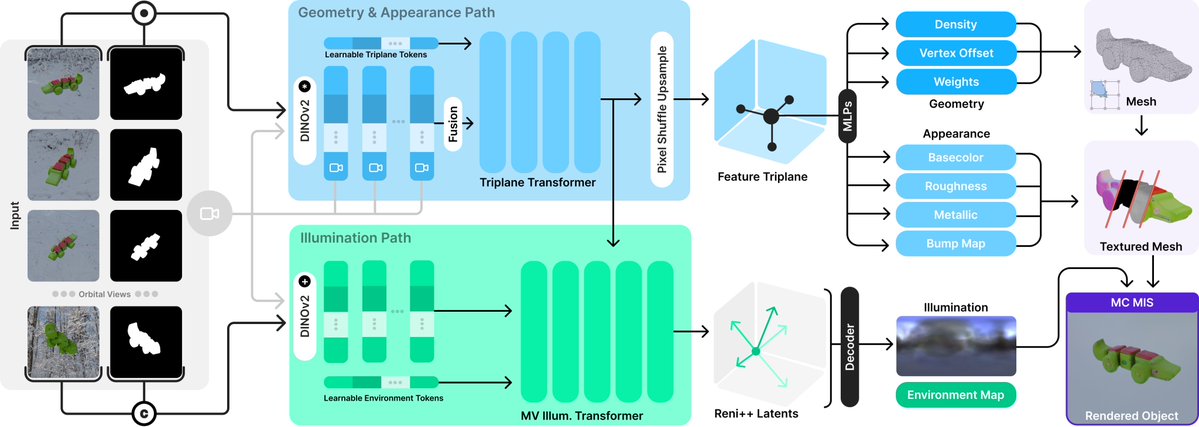
Pipeline: multi-view cross-conditioning -> shared triplane. Two paths: svBRDF materials + RENI++ environment lighting. Trained with differentiable MC + MIS (mixed-domain: synthetic PBR/RGB-only + real UCO3D).
Jan tweet media
English
1
0
0
287
Jan
Jan@JDihlmann·
@humphrey_shi @chen940382 @CVPR @humphrey_shi Another question on this, perhaps something to add in the official instructions: Is this considered an officially published paper? If we opt in, would it still be possible to submit the work to another venue, e.g., ECCV, or would that count as a double submission?
English
1
0
0
1.8K
Humphrey Shi
Humphrey Shi@humphrey_shi·
@chen940382 @CVPR Thanks! We’re finalizing the opt-in flow and logistics now. Official instructions (incl. timing + poster details) will go out to authors soon—please stay tuned.
English
4
1
13
8.2K
Humphrey Shi
Humphrey Shi@humphrey_shi·
Decisions for @CVPR 2026 are out—congratulations to all authors. I’m excited to share a community step forward: the new CVPR Findings Track. Area Chairs recommended 1717 papers for potential inclusion, creating a principled pathway to recognize and share valuable work that may not be the best fit for the main program—while still enabling authors to publish and present through integrated Findings poster sessions. As our field scales, we need not only better models—but better community infrastructure. This effort is led collectively by the Findings organizing team—Bryan Plummer, Kevin Shih, @anand_bhattad, @jccaicedo, @Grigoris_c, @BoqingGo, @liuziwei7, and me. Huge thanks to the CVPR General Chairs, Program Chairs, and especially the Area Chairs for supporting this step forward. Looking forward to seeing many of you at CVPR 2026—across the main program, Findings, and workshops.
Humphrey Shi tweet media
English
5
12
67
33.5K
Jan retweetledi
rsasaki0109
rsasaki0109@rsasaki0109·
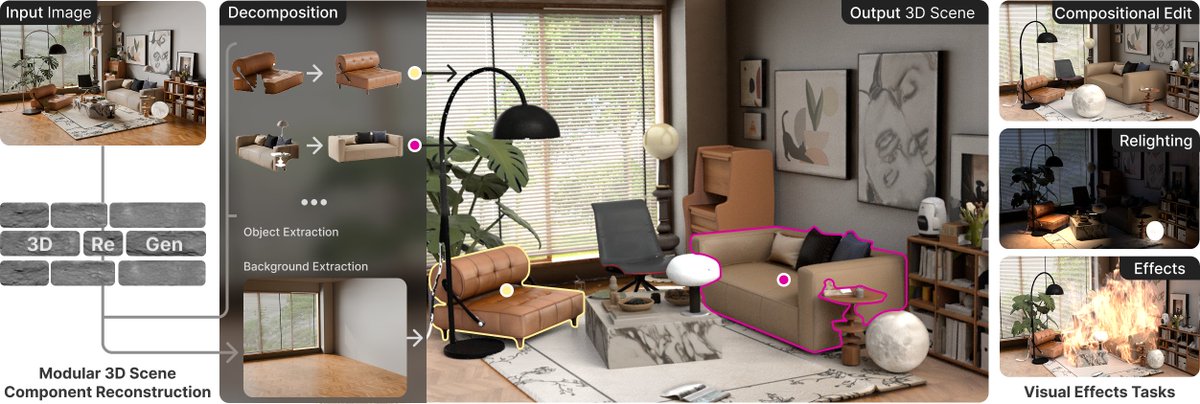
3D-RE-GEN 3D Reconstruction of Indoor Scenes with a Generative Framework github.com/cgtuebingen/3D… We propose single-image 3D scene reconstruction for producing complete, editable scenes from a single photograph. Our method reconstructs individual objects and the surrounding background as textured 3D assets, enabling coherent scene assembly from minimal input. We combine instance segmentation, context-aware generative inpainting, 2D-to-3D asset creation, and constrained optimization to recover physically plausible geometry, materials, and lighting. The resulting scenes preserve correct spatial relationships, lighting consistency, and material fidelity, making them suitable for production-ready workflows.
rsasaki0109 tweet media
English
3
32
278
16.7K
Jan
Jan@JDihlmann·
@PhilipvN @AIatMeta We‘ll release code soon, maybe with a Demo. I‘ll keep you posted.
English
0
0
1
17
Philip vN
Philip vN@PhilipvN·
@JDihlmann @AIatMeta Got an executable or a website version one can play with to take your algo for a test drive?
English
1
0
0
14
Jan
Jan@JDihlmann·
3D-RE-GEN: 3D Reconstruction of Indoor Scenes with a Generative Framework from a single image to a complete, editable 3D scene with individual objects AND a reconstructed background - VFX ready. New work from us @CG_Tuebingen together with my student Tobias Sautter. Links 👇
English
6
40
412
23.1K
Jan
Jan@JDihlmann·
@PhilipvN This is single view right now, sure the VGGT prediction could be improved with MV. But the object gen models don’t allow for MV, if so this would def help … but one bottleneck is our inpainting, this is not easily MVable as it is happening in 2D space.
English
0
0
1
8
Philip vN
Philip vN@PhilipvN·
@JDihlmann Do results get significantly better (accuracy) with every extra image of the scene ingested? What number is the sweet spot? (Comparing with photogrammetry accuracy.)
English
1
0
0
11
Jan
Jan@JDihlmann·
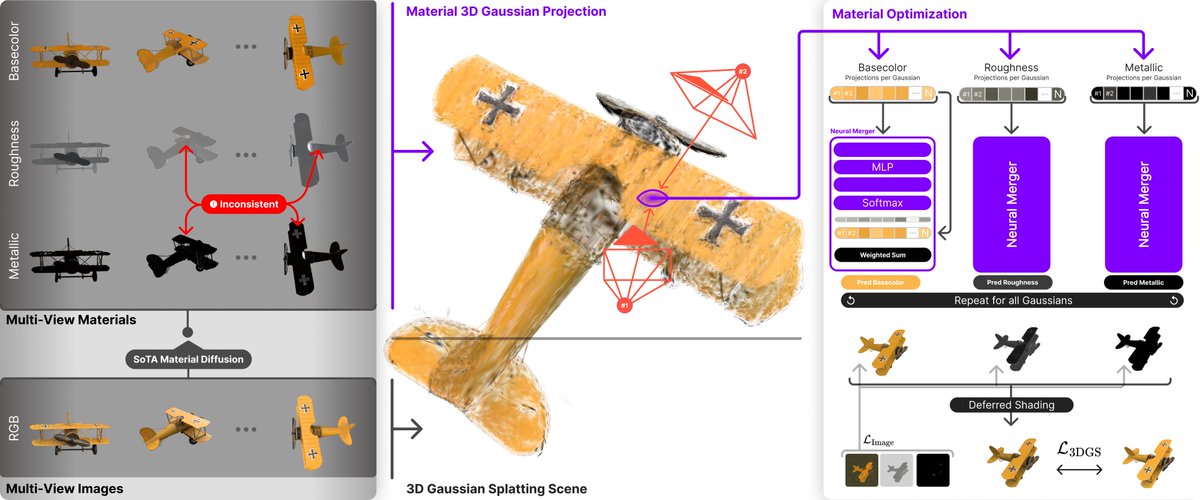
2D diffusion models predict great PBR materials (base color, roughness, metallic) but they're inconsistent across views. MatSpray uses Gaussian ray tracing to lift these predictions into 3D, then our Neural Merger enforces multi-view consistency while preserving diffusion priors.
Jan tweet media
English
0
0
4
296
Jan
Jan@JDihlmann·
MatSpray outperforms state-of-the-art inverse rendering methods in relighting quality, especially for specular and metallic objects. Plus, it's 3.5× faster than IRGS, reconstructing high-quality relightable materials in ~25 minutes per scene.
English
1
0
5
437
Jan
Jan@JDihlmann·
MatSpray: Fusing 2D Material World Knowledge on 3D Geometry Super fast materials for every 3D Gaussian Splatting scene from swappable foundation models. Work together with Philipp Langsteiner @CleanupVessel94 from our @CG_Tuebingen Links 👇
English
4
21
156
14.4K
Jan
Jan@JDihlmann·
We show that we outperform the recent SAM3D by @AIatMeta and deliver ground aligned objects with reconstructed background.
English
1
0
10
653
Jan
Jan@JDihlmann·
We found, that recent image editing models can be prompted with UI interfaces as input images for better performance such as occluded object extraction. We call this Application Querring.
Jan tweet media
English
3
0
6
752