Jack
9.9K posts

Jack
@JEGreen_US
“When a clown moves into a palace, he doesn't become a sultan. The palace becomes a circus.” -- Turkish Proverb
Katılım Temmuz 2011
145 Takip Edilen153 Takipçiler

@DA_Stockman David, don't comment with snarky certitude on a subject you clearly don't know much about.
English


@IsDatEchtZo5 @PeterDClack I can cite a thousand irrelevant facts that do not explain what's actually happening now. Oceans are currently a CO2 sink - they are in-gassing CO2 into their enormous storage capacity. Human-induced CO2 emissions dwarf the ocean sink. Atmospheric CO2 is rising due to us.
English

@JEGreen_US @PeterDClack Ah… Facts are irrelevant. That is your way of doing science?
English

The top 2.5 metres of the world's oceans hold as much heat energy as the entire atmosphere above it.
The oceans are the world's thermal powerhouse and it takes a massive amount of energy to nudge its temperature even a fraction of a degree. It's vast heat capacity is the key.
Once oceans begin to warm or cool they don’t just slow down, they operate on timescales of centuries and millennia. The deep oceans are still responding to changes that happened hundreds of years ago.
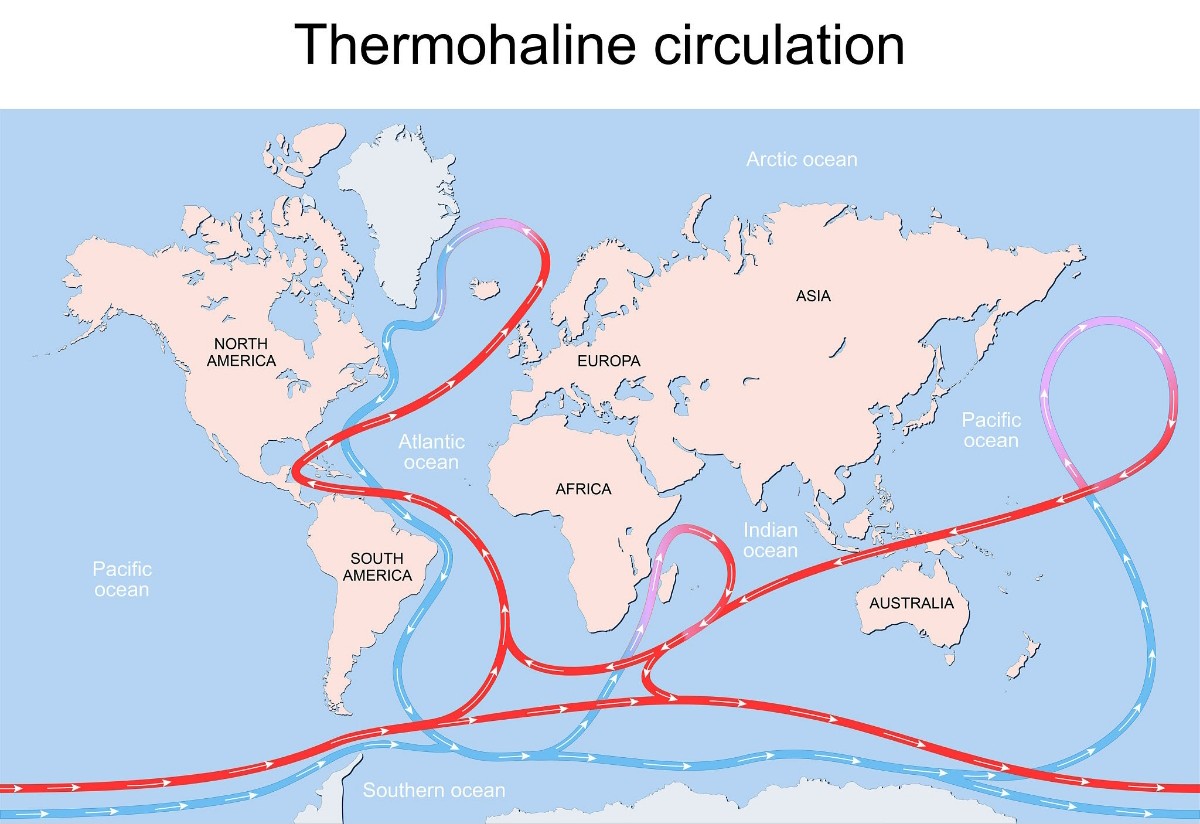
It’s a slow-motion ballet that ignores all modern noise. The key lies in the Thermohaline Circulation - a global conveyor belt that takes a thousand years to complete a single return trip. It means that water currently resurfacing in some parts of the world hasn't seen the atmosphere since the Middle Ages.
The oceans hold 50 times more carbon than the atmosphere and any slight shift in oceanic outgassing or absorption dwarfs all human output. It’s the tail that wags the dog. Understanding this inertia is the ultimate antidote to climate panic.
We're living in a world dominated by water, with its massive, built-in buffer system that has stabilised life for eons.

Bega, New South Wales 🇦🇺 English

@Jimmyking35 13 points in 13 games pretty sure he knows
English

@MiStormChasers While heading north, it's where Birch & Pines begin to significantly populate the forests.
English

Porter Martone of the @NHLFlyers became the fourth skater in NHL history to score the game-winning goal in each of their first two career playoff games, joining Craig Simpson (EDM, 1988), Jaroslav Pouzar (EDM, 1983/84) and Cooney Weiland (BOS, 1929).

English

@PeterDClack Pure nonsense.
> Climate scientists closely examine the role of oceans in climate.
> They use Henry's Law measure ocean/gas exchange - oceans are a CO2 sink.
> Human CO2 emissions are about 4 times the magnitude of net CO2 captured by oceans.
> Ocean CO2 relase is a + feedback.
English

The climate crisis agenda focuses almost entirely on the thin band of air wrapping around the planet, yet it ignores the overwhelming role of the oceans.
This is a fundamental flaw in the climate debate. It treats the atmosphere as a closed loop, placing the blame on carbon dioxide driven by human activity. However, the CO₂ we track in the air is just the visible surface of a massive exchange with the deep sea. This process is driven by Henry’s Law, which dictates that the solubility of gases in liquids is governed by temperature and pressure.
A narrative based solely on the atmosphere ignores the omniscient influence of the oceans. It overlooks the regional climates controlled by landforms, ocean proximity and trade winds. Essentially, the oceans and water vapor—the primary drivers of our climate—were left out of the equation.
By narrowing the focus, the blame was placed squarely on the 'fossil fuels' that provide 81% of the world’s primary power. These energy sources created the modern industrial world. Today, many Western nations face economic decline as they abandon affordable baseload power. Without adequate electricity, human society quickly reverts to medieval conditions.
The United Nations campaign relied on tipping points that failed to appear. The warming shift has been a modest 1.4 degrees over 175 years of expansion. Meanwhile, increased CO₂ concentrations have sparked a global greening phenomenon since the 1980s, as confirmed by NASA satellite data.
The scale of the ocean is the missing link. The top 2.5 meters of the sea contain the heat energy equivalent of the entire atmosphere. When oceans warm, they release CO₂ via outgassing; when they cool, they pull it back in. This makes the oceans the true engine of climate variability.
Consider the physics: water covers 71% of the Earth to an average depth of 2.35 miles. It is 1,000 times denser than air and holds 91% of the planet's retained heat energy. Oceans contains 60 times more carbon than the atmosphere. Even a fractional shift in oceanic temperature can move more CO₂ than all human activity combined. This is called oceanic inertia.
It means 90% of the climate story is written in the abyss—a realm where we have the least data, yet the most profound influence on our collective future.

Bega, New South Wales 🇦🇺 English

@CaptainAdvance1 @PeterDClack I posted the current estimate in another reply ... "... current estimates show oceans being a sink of ~9–11 GtCO2/yr. Human emissions are estimated as ~37–40 GtCO2/yr. As oceans warm, they'll be a + feedback."
English

@JEGreen_US @PeterDClack 'The oceans aren't able to absorb all the carbon we emit' is a better way to word your point, Jack. We emit too much CO2, too fast. Oceans absorb 30% & plants 25%. The other 45% increases the concentration.Clack will object the total in oceans is larger but concentration matters.
English

@Co2isgood4Earth @PeterDClack Yes, please do tell me what happened in 1957. 😜
English

@PeterDClack Note the BBC & similar left media often site the worst or highest since records began but omit in 1957
English

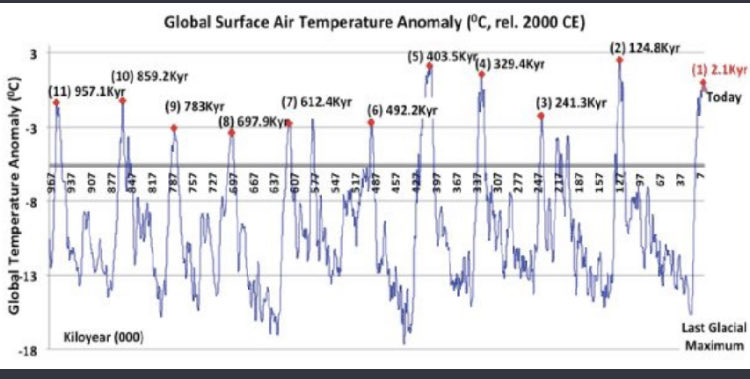
When you look at the spikes on a million-year chart, you see the Milankovitch cycles in action.
Most of the last 100,000 years were spent under massive ice sheets. The Holocene (our current interglacial) is the thin sliver of stability that allowed human civilisation to take root.
Earth’s wobbles and orbital shifts dictated the pace of these great freezes. Looking at those glacial-interglacial spikes, you see the Quaternary period as a long, cold icehouse punctuated by brief, vital spells of warmth.
The current CO₂ fertilisation is a fascinating piece in a planetary puzzle. Its a biological response that often gets lost in broader atmospheric discussion.
The NASA and Nature Climate Change data underscore a specific physiological process: photosynthetic efficiency. As atmospheric CO₂ increases, plants take in the carbon they need while keeping their stomata (pores) partially closed. This reduces water loss through transpiration, which is particularly impactful in the arid and marginal lands.
Visualise a 25-50% increase in greening sweeping across vegetated lands. This fertilisation effect has undoubtedly played a role in the steady climb of global crop production, a tailwind for food security alongside modern farming techniques.
The story of human resilience is strong. We have migrated across land bridges, survived the Younger Dryas, and adapted to radical shifts in local environments for millennia.
It’s a compelling good news story.

Bega, New South Wales 🇦🇺 English

@JEGreen_US You have the second paragraph back to front Jack. Oceans contain 86% of the surface carbon reservoir. The atmosphere has a bit over 1%.
English

@PeterDClack Right. Except when human industrialization enters the picture, sharp elbows flailing, digging up millions of years of sequestered carbon deposits & combusting them into the atmosphere causing a man-made CO2 forcing element that alters the normal natural cycle.
English

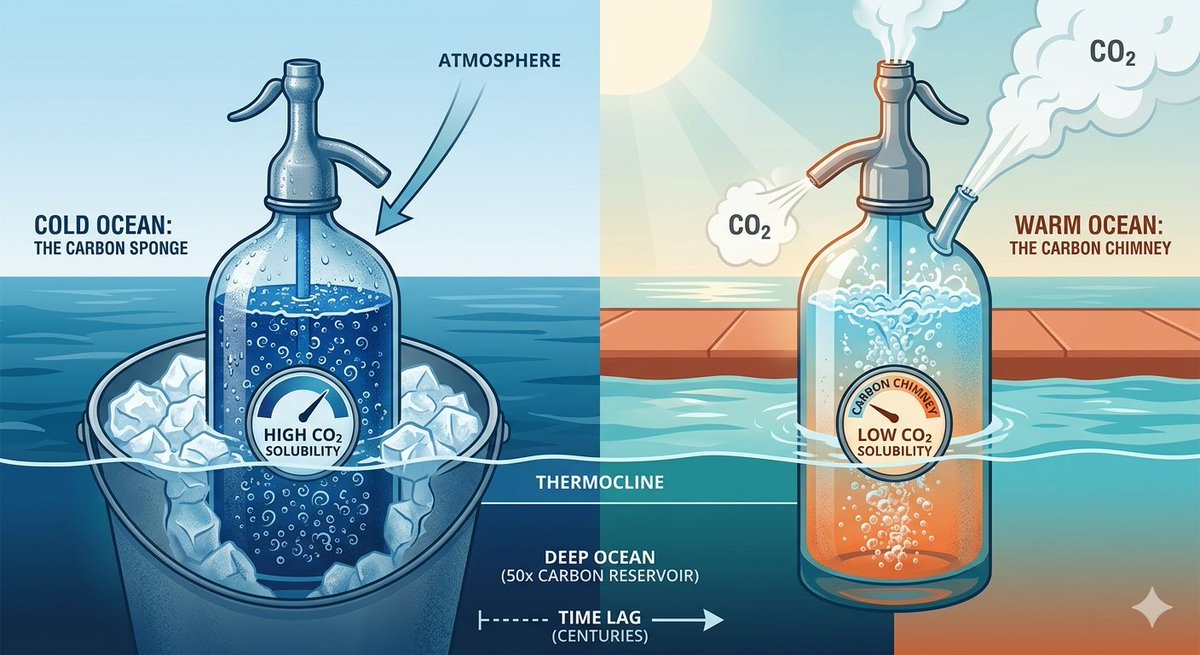
To understand why CO₂ levels rise and fall over millennia, look at a glass of sparkling water.
When it’s cold, it stays fizzy. When it warms up, it goes flat as the CO₂ escapes into the air. The Earth’s oceans work exactly the same way. This is the principle of a solubility pump.
Cold water is a carbon sponge; warm water is a carbon chimney. Because the oceans hold 50 times more carbon than the atmosphere, even a tiny change in sea temperature causes a massive shift in atmospheric CO₂. This explains the time lag seen in ice core data.
Historically, temperature rises first, and CO₂ follows centuries later. Why? Because it takes a long time for the deep, cold thermal flywheel of the ocean to warm up enough to start releasing its stored carbon.
When the oceans finally warm—driven by those million-year Milankovitch cycles—they exhale CO₂. This natural outgassing is a primary driver of the atmospheric shifts we see in the geological record.
It is a biological and physical response to a warming world, not a trigger for a crisis.
The planet is essentially recycling carbon from its massive oceanic reservoir to its parched terrestrial landscapes. It’s a self-regulating system of incredible complexity and beauty.

Bega, New South Wales 🇦🇺 English

@Marie17cf 😂 Delusion does not adequately describe this kind of thinking about a conman who holds zero religious or moral bearing. The English language has no word with the required depth of meaning. Truly sad.
English

They claim to measure human CO₂ with precision, but at its core, the 'crisis' is a computer modelling algorithm fueled by a naive media and institutional groupthink.
The IPCC and UN used every trick in the narrative playbook until the political winds shifted. Now, with the US out of the UNFCCC and the UN facing its largest financing squeeze in history, the 'code red rhetoric has gone quiet.
Turns out, when the money stops flowing, the 'consensus' starts to crumble.
#ClimateNuance #UNReport #EnergyReality"

Bega, New South Wales 🇦🇺 English