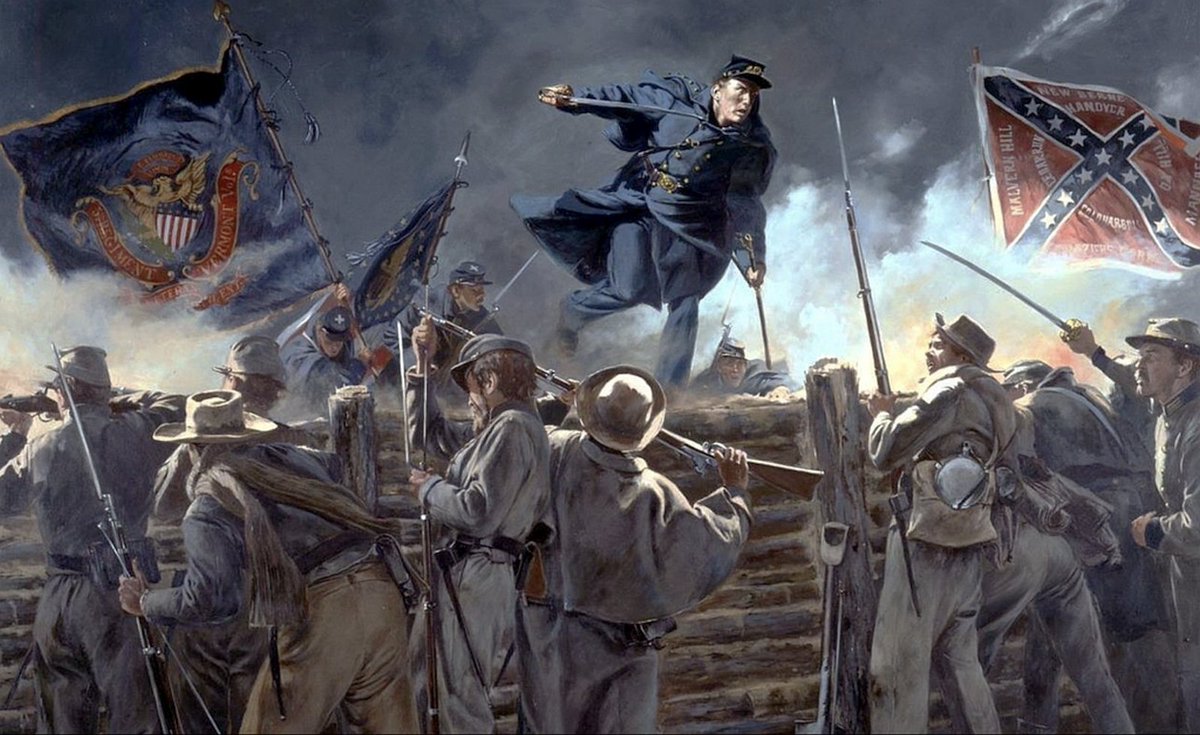
@2ndMississippi Capt. Charles Gould (5th VT) was the first Union soldier over the Confederate parapet on April 2. He jumped in alone, took a bayonet through the face, a saber to the head, and a gunshot. Miraculously, he fought them off and was awarded the Medal of Honor.
The Breaking of the Lines: Petersburg, April 2, 1865
The guns had been at it all night, a steady pounding that rolled across the dark flats south of Petersburg like summer thunder that never moved on, and the men in the trenches — Union and Confederate alike — understood without being told that this was not the ordinary nightly spite work of pickets and battery commanders with nothing better to do. This was preparation. This was the overture. After nine and a half months of siege, of mining and countermining, of trench raids and mortar duels and the slow grinding arithmetic of attrition, Ulysses Grant had found the crack in the wall, and he meant to put his whole weight against it before dawn.
What made it possible was what had happened twelve miles to the southwest the day before, at a crossroads called Five Forks, where Phil Sheridan — all compact fury and profane impatience — had wrecked George Pickett's command so thoroughly that men would call it the Waterloo of the Confederacy, and not without reason. Sheridan's cavalry and Gouverneur Warren's Fifth Corps had driven Pickett's force westward and away from Lee's main army, and in doing so had severed the South Side Railroad, the last direct supply line into Petersburg. Lee, desperate to shore up his right, had pulled three infantry brigades from his already gossamer-thin defensive perimeter and sent them to reinforce Pickett. They arrived too late to matter. The damage was done, and the bill was coming due.
When word of Five Forks reached Grant on the evening of April 1, he saw at once what it meant. The Confederate line, stretched across more than thirty miles of works from the James River to Hatcher's Run, was now stretched past the breaking point — a rubber band pulled one notch beyond its limit, waiting for the snap. Grant feared Lee might abandon the trenches overnight and concentrate against Sheridan's somewhat isolated force before it could be supported. To guard against this he ordered Nelson Miles's division of Andrew Humphreys's Second Corps forward to reinforce Sheridan, then set the rest of the machine in motion. There would be a general bombardment through the night, and at four o'clock in the morning the infantry would go in.
It sounded simple enough in the telegram. The ground told a different story.
Grant wanted the whole line to attack simultaneously — a clenched fist, not a probing finger — but the realities on the ground complicated matters in the way that ground always does. Humphreys and Edward Ord on the left center reported they could not successfully assault with what they had in hand. Godfrey Weitzel, commanding north of the James, could not spare enough men for anything effective. Sheridan and the Fifth Corps were expected to swing wide and cut off any Confederate retreat to the west. That left the center, where only two corps indicated any real chance of success: John Parke's Ninth, facing the formidable works east of Jerusalem Plank Road, and Horatio Wright's Sixth, positioned opposite the Confederate line between Forts Fisher and Welch.
Around four in the afternoon on April 1, Army of the Potomac commander George Meade ordered both corps to prepare for an assault in twelve hours' time. But as the night wore on, Grant's anxiety about a Confederate evacuation sharpened, and a series of changing orders flickered down the chain of command — attack at midnight, no, attack at four, no, wait for further word — creating the kind of confusion that makes staff officers age prematurely and corps commanders grind their teeth in the dark. In the end, the original plan held. Four o'clock. Both corps. Everything they had.
Parke chose the hardest road. His Ninth Corps would go straight at Fort Mahone, the strongest Confederate position in his sector — a squat, ugly earthwork that the men in the trenches had learned to respect the way a man respects a rattlesnake: from a distance. He put Robert Willcox's division on the far left to make a diversionary attack east of Petersburg, near the river, and concentrated Robert Potter and John Hartranft's divisions on either side of Jerusalem Plank Road, using the road itself as a guide in the predawn blackness. There would be no moon to help them. They would go in by feel.
The bombardment opened at four, and Willcox went forward first — the feint, designed to draw Confederate attention upriver while the real blow fell farther south. His men carried portions of the enemy skirmish line near the old crater, that haunted ground, and even seized about 250 yards of the main Confederate works closer to the Appomattox, but there were not enough of them. The defenders drove them back.
The main assault on Fort Mahone jumped off at four-thirty, led by picked men carrying axes to hack through the tangled abatis fronting the Confederate works. Captain Thomas P. Beals, who led one of these forlorn-hope parties, remembered the eerie quiet as they crossed the no-man's-land between the lines: "We reached our picket lines and could then tell about how far we were from those of the enemy. All was quiet in that direction." It did not stay quiet. "Just as we were going over their pits," Beals wrote, "my orderly sergeant, S. L. Kimball, by my side, was shot through the body at that time."
Parke's men took Fort Mahone and three neighboring works in a rush of bayonets and clubbed muskets, but they could not punch through. John Gordon's Second Corps — those lean, hard men who had stormed Fort Stedman just eight days earlier — regrouped in the rear trenches with a speed that spoke of long practice and organized counterattacks that stopped the Ninth Corps cold. To make matters worse, Robert Potter, the veteran Second Division commander, went down severely wounded in the initial assault, and his loss rippled through the command at the worst possible moment. Parke reported the capture of the first line but conceded he could not break through completely. Grant, who had other irons in the fire by then, told him at seven-forty simply to hold what he had.
The Ninth Corps had done its work. It had seized a lodgment, absorbed Confederate reserves, and fixed Gordon's corps in place. But the breakthrough — the real breakthrough, the one that would crack the siege wide open — was happening a mile and a half to the southwest, where Horatio Wright's Sixth Corps was about to drive a stake through the heart of the Petersburg defenses.
Wright had more confidence than Parke, and he had reason for it. His men had already captured the Confederate picket line in his front on March 25, after Gordon's failed assault on Fort Stedman, and they had spent a week studying the ground beyond it with the proprietary interest of men who expected to cross it under fire. Wright intended to give them every advantage he could. He massed all three of his divisions in front of Forts Fisher and Welch and shaped the attack like an arrowhead — strong, narrow, and concentrated, designed to punch clean through the Confederate works before the defenders could shift reserves to meet it.
He spent the night of April 1 positioning his divisions in the dark, a delicate and nerve-grinding business that required moving thousands of men into assault formation within earshot of enemy pickets who had every reason to be alert. By four o'clock his men were ready, crouched in the cold, staring into blackness. Wright waited. He wanted enough light to see the objective, and he would not send them forward blind. Forty minutes passed — forty minutes that must have felt like forty hours to the men in the front rank, who could hear their own breathing and the distant rumble of Parke's bombardment opening on schedule to the east.
At four-forty, the signal came, and the Sixth Corps went forward.
They broke through the enemy picket line almost without resistance, the Confederate videttes melting away in the gray half-light, and then they were into the main works — into the abatis, through the abatis, over the parapet — under a storm of artillery and musketry that cut men down in windows but could not stop the momentum of fourteen thousand soldiers who had been coiled in those trenches since June. They found openings in the defenses and poured through them the way water finds the cracks in a dam, and once through they kept going, some of them so carried away by the rush that they did not stop until they had reached the Boydton Plank Road and the South Side Railroad beyond, where they ripped up track and cut telegraph wires with the elated fury of men who understood exactly what they had just done.
The line was broken. After nine and a half months, it was broken.
South of the breakthrough, the men of the Sixth Corps still had killing work ahead of them. Wright had received no specific instructions from Meade about what to do after achieving a breakthrough — Meade had told him only to be guided by the developing situation, which was the kind of order that either liberated a good commander or paralyzed a mediocre one. Wright was not mediocre. He spent the early-morning hours collecting his scattered brigades — some had pushed all the way to the railroad, others had stopped along the captured works to gather prisoners — and by the time he had seven brigades organized and facing south, he turned them against Henry Heth's division, still holding the Confederate line to the southwest with about sixteen hundred men who now found themselves flanked and, for all practical purposes, doomed.
Confederate Brigadier General McComb swung his brigade to face northwest, anchoring his right on the Boydton Plank Road line, and for a time the Confederates fought with the tenacity of men defending their own backyard. They counterattacked and briefly retook Fort Davis, one of their own captured works, holding it for perhaps twenty minutes before the weight of Wright's numbers rolled over them again. By seven o'clock the Sixth Corps swept Heth's men from their defenses and drove them toward Hatcher's Run. By seven forty-five Heth and what remained of his division were falling back toward Sutherland's Station, five miles to the west. As Cooke's brigade pulled out, Brigadier General Thomas M. Harris's Federal brigade charged a section of the retreating line northeast of Hatcher's Run and scooped up two guns, three battle flags, and thirty officers and men — the debris of a collapsing army.
In the confusion of that morning, while Federal skirmishers probed into the shattered rear of the Boydton Plank Road line, a Confederate lieutenant general rode into the chaos and did not ride out. Ambrose Powell Hill, commanding the Third Corps, had tried to cut through the broken ground to rejoin the bulk of his command. He encountered two Federal skirmishers in a thicket. There was a brief, sharp exchange of fire. Hill fell dead from his horse.
He was fifty-nine days short of his fortieth birthday, and he had been in bad health for most of the war — a thin, intense man who fought best when he fought on instinct and who had saved Lee's army at Antietam by arriving on the field at the last possible moment, his men still in their road column. Now he was gone, killed in the war's last week, and his death was one more weight on a scale that had already tipped past recovery.
Robert E. Lee could read that scale as well as anyone alive. By mid-morning his army was scattered into five distinct fragments: Longstreet and Ewell north of the James, Mahone on the Bermuda Hundred front, Gordon holding east and southeast of Petersburg with remnants of Hill's corps that had been cut off during the breakthrough, the wreckage of the Third and Fourth Corps west of the gap, and Pickett's battered force — which had crossed the Appomattox after the catastrophe at Five Forks — somewhere to the northwest. It was no longer an army in any operational sense. It was a collection of pieces, and the man whose job it was to sweep them off the board was closing in from three directions.
Lee needed time. During the night he had sent for Charles Field's division from north of the James, but Field had not yet arrived, and the western face of the Dimmock Line — Petersburg's main defensive belt — stood empty and waiting for the men who were supposed to fill it. Lee also pulled Nathaniel Harris's Mississippi brigade from the Bermuda Hundred defenses, a stopgap measure that testified to his desperation. He sent Harris's men — roughly 350 to Fort Gregg, 200 to Fort Whitworth — two small earthworks west of the Dimmock Line, with orders that amounted to a death sentence: hold these forts long enough for Field's division to reach the main works.
Harris's Mississippians understood the arithmetic. Somewhere around fifteen thousand Federal troops — Wright's Sixth Corps and portions of Ord's Army of the James — were bearing down on them from the southwest, and there was nothing behind the two little forts but open ground and the empty Dimmock Line. They had to buy time with the only currency available to them, which was blood.
The attack on Fort Gregg came at approximately one o'clock in the afternoon, led by Robert Foster's and John Turner's divisions of Ord's command. What followed was, by the testimony of men on both sides, among the most savage fighting of the entire war. Brigadier General Foster, whose division led the assault, described it with the controlled precision of a man who had seen a great deal and been shaken by what he had just witnessed: "The fighting on both sides at this point was the most desperate I ever witnessed, being a hand to hand struggle for twenty-five minutes after my troops had reached the parapet." Twenty-five minutes of hand-to-hand combat on and inside a single earthwork — bayonets, rifle butts, pistols fired point-blank, men grappling in the dirt like animals. When it was over, fifty-seven Confederate dead lay inside Fort Gregg. The garrison of 250 officers and men who survived were taken prisoner.
The Federals paid more than seven hundred casualties to overwhelm the two forts — more than the total number of Confederates who had defended them. But Harris had done what Lee asked him to do. By the time Fort Gregg fell, Field's division was filing into the Dimmock Line, and the last door to Petersburg was shut for the day.
It would not matter for long.
Five miles to the west, the war's unfinished arithmetic was being settled at Sutherland's Station on the South Side Railroad. Heth had ordered the remnants of his shattered command to reassemble there after being driven from the Boydton Plank Road line, but Heth himself had ridden east to take command of the Third Corps after Hill's death, leaving Brigadier General John Cooke in charge of four battered brigades that had already been whipped once that morning.
Nelson Miles found them there by late morning. A confusion of orders between Sheridan and Humphreys over who controlled Miles's division had left him without support — Humphreys's other two divisions were nowhere in reach — but Miles was not a man who waited for conditions to improve. He was twenty-five years old, hungry for a fight, and disinclined to let a beaten enemy catch its breath. He attacked three times during the day, each time repulsed, each time coming back.
The third time, he found the answer. Instead of hitting Cooke head-on, Miles slipped a brigade — Brevet Brigadier General Ramsey's Fourth — around the Confederate right flank, moving them through a ravine and into a belt of woods where they formed unseen. At two forty-five in the afternoon, Ramsey's men burst from the tree line at the double-quick with a cheer that carried across the field, struck the Confederate flank, and swept down the inside of the breastworks like a river breaking through a levee. The position dissolved. Miles took six hundred prisoners, a battle flag, and two guns, and what was left of Cooke's command fled westward in fragments.
By nightfall it was finished. The Petersburg lines that had held since June of 1864 — the works that had consumed more Federal assaults, more mining operations, more lives than any position in the war — were in Union hands or about to be abandoned. The day's fighting had cost Grant roughly 3,300 casualties. Lee had lost more than 6,500, most of them prisoners — men who would never rejoin an army that could no longer afford to lose a single musket.
Lee ordered the evacuation of both Petersburg and Richmond that night. The army would move west, toward Amelia Court House, where supplies were supposed to be waiting. Grant, who had spent nine and a half months tightening the coil, set his columns in pursuit on the morning of April 3, and the Appomattox Campaign began — the last campaign, as it turned out, though neither side knew it yet.
Grant had done what none of his predecessors had managed: he had kept his eyes fixed on the main thing. When Lee sent Jubal Early's corps to the Shenandoah Valley, Grant did not chase it. He sent Sheridan to deal with Early and kept the pressure on Petersburg, day after day, month after month, extending his lines, stretching Lee's, forcing the Confederates to defend more ground with fewer men until the mathematics became impossible. The best previous chances to take the city — June 15–16, the Crater on July 30, the fighting at New Market Heights on September 29 — had all come up short, each time because Lee's soldiers found a way to plug the gap. By the spring of 1865, there were not enough of them left to plug anything. Desertion was hollowing the army faster than disease and combat combined, and Lee knew it, and Grant knew that Lee knew it, and on April 2 the knowing became fact.
One week later, on Palm Sunday, April 9, Lee surrendered the Army of Northern Virginia at a modest brick house in the village of Appomattox Court House. The guns had been talking for four years. Now, at last, they fell silent — and the silence, for those who had lived through the noise, was the strangest sound of all.
[Author's Note: Please also see the separate post on the capture of the 2nd Mississippi during the Breakthrough on April 2, 1865.]
Graphics: 1) Federal VI Corps punches through the thin Confederate line; 2) A Don Troiani painting of Union Army Captain Charles Gould (5th Vermont) storming the Confederate earthworks near Petersburg, Virginia (awarded Medal of Honor); 3) Post-breakthrough - Sutherland Station
Following the death of Jefferson Davis, his former slaves sent a letter to Varina, his widow:
BRIERFIELD, MISS., January 12, 1890.
TO MRS. JEFFERSON DAVIS, Beauvoir, Miss.
We, the old servants and tenants of our beloved master, Honorable Jefferson Davis, have cause to mingle our tears over his death, who was always so kind and thoughtful of our peace and happiness. We extend to you our humble sympathy. Respectfully, your old tenants and servants,
NED GATOR, TOM MCKINNEY, GRANT MCKINNEY, MARY PENDLETON, MARY ARCHER, ELIJA MARTIN, WILLIAM NERVIS, ISABEL KITCHENS, TEDDY EVERSON, HENRY GARLAND, LAURA NICK, WILLIAM GREEN, GUS WILLIAMS, and others.
A Fallen Hero
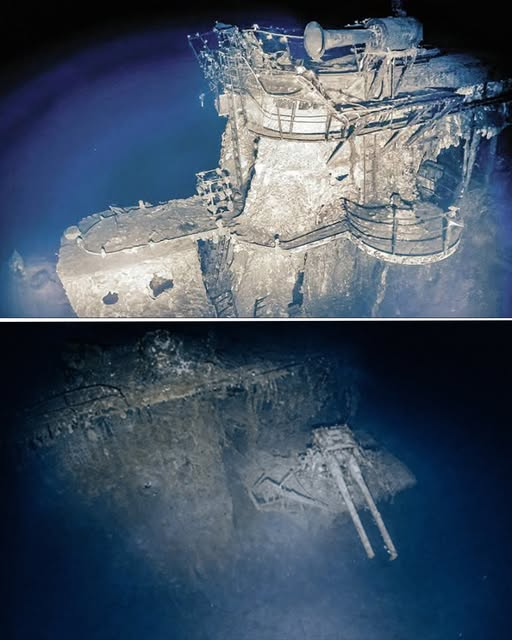
A May 1998 expedition led by Robert Ballard (Discoverer of the Titanic) finds the wreck of the aircraft carrier USS Yorktown (CV-5) on the Pacific Ocean floor near Midway Atoll at a depth of 5,000 meters.
She's resting in peace...
@ColeVonColeIII I need to read that. The only book I've read about the French experience was "The Angel of Dien Bien Phu."
She was considered a hero and was celebrated here and toured America under Eisenhower.
@JLS1861 Yes, it’s a thorough account of Dien Bien Phu. Excellent. The author, Bernard Fall, was a war reporter in Vietnam who was eventually killed there in the 60s, can’t recall the year. I highly recommend it. Well researched with some amazing photos.