Jared Simons

4K posts

Jared Simons banner
Jared Simons

Jared Simons

@JS_PorterandCo

Equity Analyst at @Porter_and_Co. Fintech. Energy. Distressed Debt. “Brilliant thinking is rare, but courage is in even shorter supply than genius.”

Katılım Haziran 2009
514 Takip Edilen3K Takipçiler
Jared Simons retweetledi
a16z
a16z@a16z·
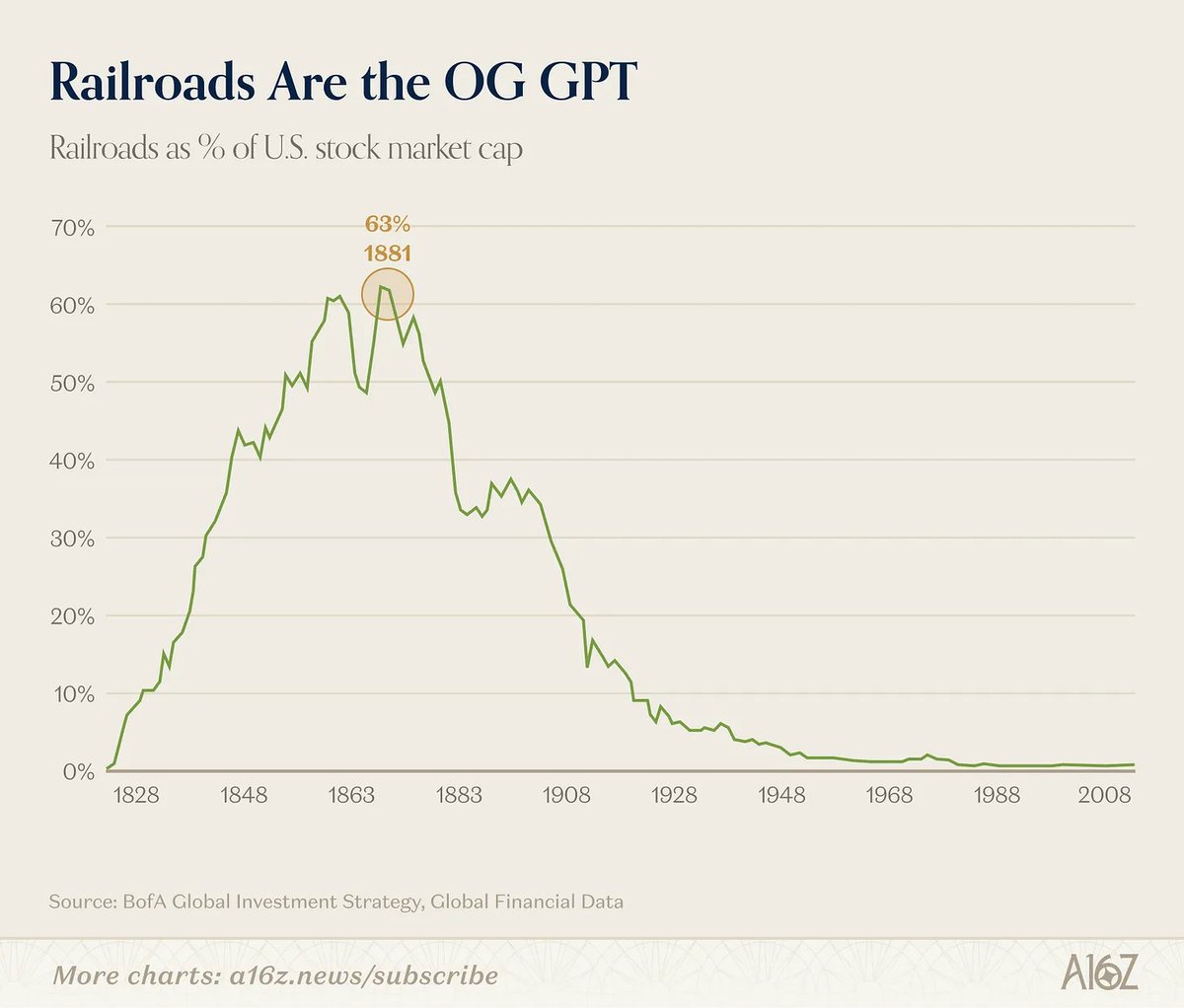
In the industrial era, no sector has ever been quite as big a deal as railroads. More charts: a16z.news/p/charts-of-th…
a16z tweet media
English
45
121
932
329.5K
Jared Simons
Jared Simons@JS_PorterandCo·
The market stops working as a feedback mechanism. This is when capitalism turns to socialism. Hint: it doesn't work.
English
1
0
0
81
Jared Simons
Jared Simons@JS_PorterandCo·
Meanwhile the categories exposed to real competition and price discovery (electronics, software, apparel) have deflated. When you subsidize demand without expanding supply, you get exactly this. When you insulate buyers from prices, providers have no incentive to compete on cost
English
1
0
0
105
Jared Simons retweetledi
James E. Thorne
James E. Thorne@DrJStrategy·
Food for thought. Wall Street still thinks AI is a productivity story. It just became a fragility and trust story, and that shift ties Anthropic’s Mythos, the Clarity Act, and Bitcoin together in a way investors are badly underpricing. Anthropic’s Mythos model did more than showcase clever capabilities. It forced policymakers to acknowledge, in public, that the core software of the financial system is now one well‑aimed AI exploit away from systemic risk. When Scott Bessent and Jerome Powell are in emergency meetings with the heads of Wall Street banks to discuss AI‑driven cyber threats, the conversation has moved beyond sandbox innovation and into the realm of financial stability. The implicit message is clear: the incumbent architecture is not built for an adversarial, model‑driven world. Bessent’s op‑ed arguing that the Clarity Act must pass as a matter of national security is the political counterpart of that realization. If AI can pierce legacy rails, then the United States needs clear, durable rules for digital assets and blockchain infrastructure, not so it can speculate on tokens, but so it can deliberately integrate cryptographic, verifiable, tamper‑resistant rails into the heart of its financial system. Clarity on custody, stablecoins, and blockchain‑based settlement is no longer a regulatory luxury; it is a defence priority. Put together, Mythos, the Bessent–Powell Wall Street meetings, and the Clarity Act op‑ed point in the same direction: the centre of gravity is shifting from “AI will boost earnings” to “AI will test the integrity of our money pipes.” In that world, open, auditable, cryptographic infrastructure stops being a fringe experiment and starts looking like the logical upgrade path. Public blockchains, and Bitcoin in particular, offer precisely the properties an AI‑exposed system now needs: transparent rules, global replication, adversarial testing at scale, and settlement that does not depend on a single compromised database or trusted intermediary. The connection investors are missing is that the AI shock and the regulatory turn are not separate stories. Mythos revealed how fragile the old code base is; Bessent’s call to pass the Clarity Act is an attempt to give the US a legal framework to adopt stronger, blockchain‑based rails; and the emergency meetings between Fed, Treasury, and Wall Street are the first visible signs that the establishment knows it cannot patch its way through this era with 1980s technology. When AI flips from a productivity narrative to a fragility and trust narrative, Bitcoin and blockchains stop competing with Wall Street, and start becoming the architecture Wall Street is forced to build on.
Bloomberg@business

EXCLUSIVE: Treasury Secretary Scott Bessent and Federal Reserve Chair Jerome Powell summoned Wall Street leaders to an urgent meeting on concerns that the latest AI model from Anthropic will usher in an era of greater cyber risk. bloomberg.com/news/articles/…

English
22
57
296
45.6K
Jared Simons retweetledi
Porter Stansberry
Porter Stansberry@porterstansb·
Let's walk through this together. Every 10% rise in diesel adds 1.5% to consumer prices within a quarter. New York Harbor ultra‑low‑sulfur diesel usually trades somewhere in the $2.25 to $3.25 per gallon range. On March 2nd it was $3.18. On March 20, the price hit $4.71 (+48%). If you own a trucking fleet, your single largest operating cost just went vertical. The only time prices have ever been higher was at the beginning of the Russian-Ukraine war. The price hit $5.33 on May 11, 2022. You might recall what happened to inflation, interest rates, the bond market and the stock market that year. Europe has its own benchmark called ICE Low Sulphur Gasoil. In calm times it trades between $600 and $900 per metric ton. Today, it’s trading over those previous records around $1,400 -- the highest price ever. Asia is telling the same story. Singapore’s 10‑ppm (parts per million) gasoil, the key reference price for diesel in the Pacific basin, is trading at an all-time high near $200 per barrel, up from $90 pre-Iran-war. The “crack spread” is the margin a refinery earns for turning crude into diesel. Think of it as the toll the market pays per barrel to get crude oil converted into usable fuel. Normally the crack spread is $15 to $20 per barrel – not a major factor in energy cost. During the worst of the Russia‑Ukraine shock, diesel cracks rose above $50 per barrel. Today, the crack spread is over $70 per barrel. While it only produces 20% of global crude supplies, the Persian Gulf effectively accounts for more than a third of global diesel supply because its sour crude is the key feedstock for the world's most efficient (and largest) refineries. Additionally, Persian Gulf refining capacity has grown from roughly 8 to about 13 million b/d over the past two decades, with new, highly complex export refineries (Al‑Zour, Jazan, Ruwais, Duqm) designed to run heavy/sour crude and maximize diesel yields. With the Gulf closed, you are effectively removing about a third of the world's flexible export diesel that supplies Europe, Africa, and Asia. If the Straight of Hormuz is closed for a year, you'll see diesel trading over $300 per barrel -- roughly 3x its current price. That pushes CPI over 30%. In a year. You say this is impossible? It's exactly what is happening right now. Pakistan -- a nation of 250 million people and nuclear power -- is eight days from running out of diesel. So, where would interest rates go if the CPI was 10%+ and there’s ongoing war in the Middle East? In that scenario, I do not believe the existing federal debt can be financed without a technical default. One-third of all of the outstanding debt held by the public ($10 trillion) must be refinanced by the end of 2026. The weighted average coupon on this maturing debt is about 2.5%. If it has to be rolled at 8-10%, the incremental interest cost is roughly $500-700 billion per year, on top of the already-$1+ trillion interest bill. Each 100 bps (1% higher rate) adds ~$310 billion annually in interest expense. At 10% across-the-board rates, you're looking at net interest expense approaching $2-2.5 trillion per year. Not "some day." Within 12-18 months. Current federal revenues are $5.6 trillion. If interest alone hits $2+ trillion within 12 months, that's roughly 40% of the budget going to debt service — just the interest! I believe it’s inevitable that the U.S. will default – just as it did in 1933 and in 1971. The only question is when and what will trigger the panic. Soaring diesel prices, an ongoing war in Iran, and rates soaring over 10% would do it. So, for me, if the 10-year cracks 5%... I’m out. The markets will no longer be investable. Thank you for your attention to this matter.
English
23
70
381
35.7K
Jared Simons retweetledi
Financelot
Financelot@FinanceLancelot·
BREAKING: US and Israel have struck Iran's Ardakan yellowcake production plant in Yazd province. No reported radiation leaks.
English
19
96
694
68.5K
Jared Simons
Jared Simons@JS_PorterandCo·
@jbulltard1 It must be Monday morning, just in time for markets to open
English
2
0
6
454
jbulltard
jbulltard@jbulltard1·
He taco’d to save the market
jbulltard tweet media
English
21
7
179
19.2K
Jared Simons retweetledi
Freda Duan
Freda Duan@FredaDuan·
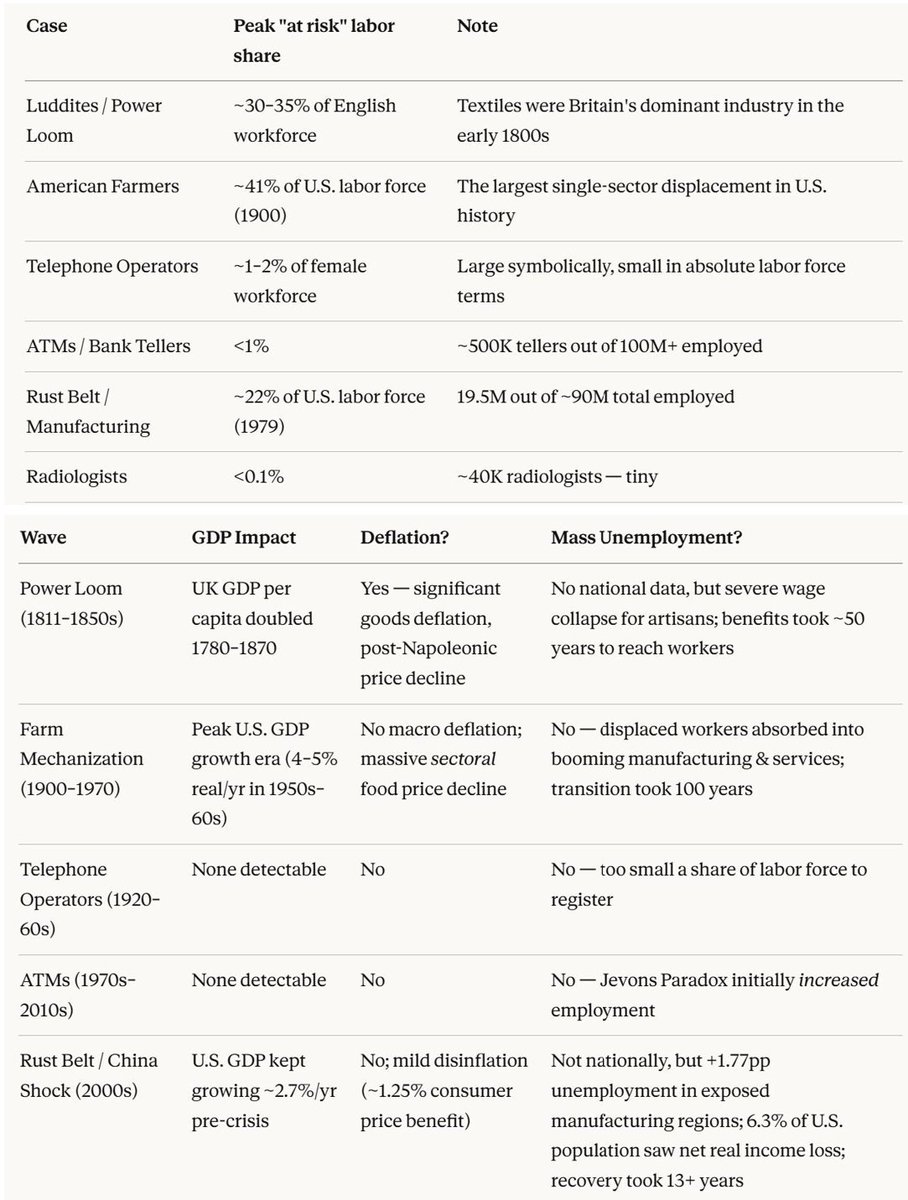
Heard $Druckenmiller on a podcast: "Anybody who believes that(i.e. AI will be very deflationary and it will lead to massive job losses) with conviction suffers from arrogance and not an open mind…every technological revolution since was known to man, it’s been declared, for jobs it’s the end of the world…So let’s say the pessimists are right on AI, it’s possible you get a government response with printing and universal income." That got me intrigued, so I asked $Claude and $GPT to go back through history and review a few cases where societies feared that new technologies or structural shifts would trigger permanent mass unemployment: The Luddites (1811-1850s); American farmers (1800s-1970s); Telephone operators (1920s-1960s); ATMs and bank tellers (1970s-2010s); The Rust Belt (1980s-present); Radiologists and AI (2016-present). Full case study: open.substack.com/pub/robonomics… In none of these cases did we get sustained, economy-wide deflation or permanent mass unemployment. --- What actually feels different this time? Speed. The shift from 41% to 2% of the labor force in agriculture took roughly a century. Telephone operators faded over about 60 years. ATMs played out over roughly 40 years. Even Rust Belt deindustrialization - often seen as shockingly fast - unfolded over 20-30 years. AI could move much faster. --- What happens if AI really does cause deflation or unemployment? The Fed has four main anti-deflation tools: - Cut interest rates - QE - Forward guidance - Coordinate with fiscal stimulus - the 2020 playbook These tools can support aggregate demand. What they cannot do well is determine who benefits. The most likely macro outcome may look something like a Rust Belt at scale: nationally, GDP still grows, unemployment stays moderate, and headline deflation never really shows up. But underneath those aggregates, inequality widens and pain gets concentrated. --- If $Dario is directionally right - say 50% of entry-level white-collar jobs disappear within 1-5 years - the math gets meaningful quickly: - Current unemployed = 168M x 4% = 6.7M - 50% of entry-level white-collar jobs displaced = 5M-7.5M - Unemployment could rise toward roughly 7-9% - Historically, U.S. unemployment has usually ranged between roughly 4% and 10% outside extreme crises. A move from 4% to 7-9% would not be unprecedented - but it would be large enough to reshape politics, wages, and social expectations. --- Long way of saying: I’m trying not to be “arrogant without an open mind.” As $Druckenmiller said: "you just have to always be looking at what other people might not be, and then if you’re prepared for it mentally, you can adjust quickly enough, um, in your portfolio to it as it unrolls." +++ Full analysis: open.substack.com/pub/robonomics…
Freda Duan tweet media
English
28
82
548
100.6K
Jared Simons
Jared Simons@JS_PorterandCo·
Correct. All roads lead to the money printer
English
0
0
0
227
Jared Simons retweetledi
Porter & Company
Porter & Company@Porter_and_Co·
CPI inflation flat… for now. Energy prices have increased 52% year to date, but that surge is not reflected in February’s CPI, which matched January’s modest 2.4% number. With the Middle East conflict likely to keep oil prices high, we may be headed for higher inflation. The parallels to the 1970s are hard to ignore: a supply shock rooted in geopolitical instability, a Fed that’s already been cutting, and consumers who never fully caught up from the last round of price increases.
Porter & Company tweet media
English
0
1
2
405
Jared Simons retweetledi
Marc Andreessen 🇺🇸
My information consumption is now 1/4 X, 1/4 podcast interviews of the smartest practitioners, 1/4 talking to the leading AI models, and 1/4 reading old books. The opportunity cost of anything else is far too high, and rising daily.
English
1.4K
3.9K
35.1K
34.6M
Jared Simons retweetledi
ETF Hearsay by Henry Jim
ETF Hearsay by Henry Jim@ETFhearsay·
New filings: ETFs tracking indices developed by financial research firm Porter & Company Porter & Company Property & Casualty Index ETF | 0.65% Porter & Company Capital Efficiency Index ETF | 0.65% Porter & Company Lindy Effect Index ETF | 0.65% Porter & Company Permanent Portfolio Index ETF | 0.75% Tickers: tba Effective date: May 20, 2026 Porter & Company: members.porterandcompanyresearch.com/research/ Preliminary prospectus: sec.gov/Archives/edgar… @Porter_and_Co @porterstansb @TuttleCapital
ETF Hearsay by Henry Jim tweet media
English
4
5
31
5.5K
Jared Simons
Jared Simons@JS_PorterandCo·
This week on Keeping Up With Trump:
🏴‍☠️@calvinfroedge

I know that most of you are shipping and conflict virgins I myself on the other hand, have traded through a number of these scenarios So let me tell you how this plays out If Trump is going to individually escort tankers through the strait, you're talking about an enormously expensive operation which requires many ships as well as tight air support Even a single inexpensive aerial or naval drone can cause extensive damage to a tanker worth tens or hundreds of millions of dollars. Protecting these ships requires overkill. The Houthis during the Red Sea conflict were able to dramatically reduce the number of ships sailing through. Unlike the Red Sea conflict, where ships could take the longer route around the South Africa, there are few other paths to exporting oil and petrochemical products from the Persian Gulf. The US Navy and Air Force attempted to suppress Houthi interference in Red Sea shipping. In the several years that the Red Sea has been partially blocked, throughput has remained at less than half of pre-conflict levels, with many episodes where throughput dropped to near zero. The houthis were able to score direct hits on many ships. Us soldiers and assets were also lost. And this was not against Iran, this was against the Houthis, who do not have the indigenous weapons platform production that Iran has. The Houthis were completely dependent on their pre-conflict storage of weapons and whatever Iran could smuggle to them. And yet, even this faction in one of the poorest countries on earth was able to dramatically impact global maritime flows. The setup with Iran is exponentially more dangerous. Iran doesn't simply need to attack tankers. And the United States doesn't just need to protect tankers. The United States has to protect all of the upstream energy producing assets that fill those tankers as well. They need to protect the pipelines, the refineries, the petrochemical plants, the storage tanks. And these assets need not only be attacked by drones and missiles. They are easily sabotaged with even a simple wrench. A hand grenade or shoulder-fired weapon at close proximity in exactly the right location can take out an entire oil refinery. Not to mention much more vulnerable assets such as gas production. Thousands of miles of desert pipelines can be sabotaged with a tool as simple as a drill, obtainable from any hardware store. The cost of protecting each cargo coming out of the Persian Gulf may exceed the total value of the cargo. Not to mention that it puts us ships directly within close proximity of Iranian weapons that can destroy them. The US largely abandoned this escort strategy during the Red Sea conflict. In fact, an entire coalition of US and European naval forces along with Gulf States attempted this against the houthis. The campaign was an utter failure and the ultimate conclusion from US military leadership was that it was much better risk reward to focus on suppressing strike capability. Yet after months of airstrikes Red Sea traffic never fully returned. Attacks continued. The Trump administration has expressed its intent in not only protecting these cargos but also in artificially manipulating their prices lower. Trump is working against the laws of physics, sound military doctrine, and fundamental economics. This entire adventure was poorly thought out and calls the entire Islamic world to jihad against America. Trump's attempts to protect the Persian Gulf will result in failure.

English
0
0
0
189
zerohedge
zerohedge@zerohedge·
STRIPE IS CONSIDERING AN ACQUISITION OF ALL OR PARTS OF PAYPAL
English
115
183
3.4K
835.8K
Jared Simons retweetledi
Fredrik Hjelm 🇸🇪
Fredrik Hjelm 🇸🇪@FredrikHjelm4·
Most people who say “AI will replace SaaS” have not replaced a single system in reality. They are vibe coders, solopreneurs, and self-proclaimed experts talking theory. We have done real replacements at Voi, at scale, on a modern tech and data stack, with elite engineering resources. Here is the truth. Critical systems like ERP and CRM are not getting ripped out in established companies. Forget it. You do not replace NetSuite, or Salesforce, lightly. Over years, millions of micro-improvements become embedded in finance, reporting, compliance, and operations. The data is too critical. The operational risk is too high. Net-new companies can go AI-native ERP from day one. Incumbents will not gamble their backbone. Mid- and long-tail SaaS is different. Narrow tools with limited surface area and clear workflows can be replaced. But even there, it is not about writing a prompt and deleting a subscription. You must own lifecycle management: integrations, permissions, data models, edge cases, upgrades, monitoring, and governance. That requires real engineering resources. Saving money on SaaS licenses is a nice headline. It is not the frontier. The frontier is replacing human labor. Cross-functional workflows: reporting, validation, translations, parsing, reconciliation, planning, coordination, and decision support. You do not just swap software. You redesign work. We are now building customized, enterprise-grade software that replaces manual white-collar work, then standardizing the components so evolution and maintenance become automated. The real TAM is not SaaS spend. It is white-collar time spent on tasks computers are better at. That is where this goes.
Johan Roslund@futureinvesting

Lovable går verkligen efter SaaS. Från ett event med Lovables CTO idag. Ska bli intressant att följa… $Lime $Vitec $Upsales

English
32
34
294
106.2K