James Turner

537 posts

James Turner banner
James Turner

James Turner

@JTAuthor

Dr of Philosophy. New article out now in Philosophy of Science: https://t.co/rBm2fBMDMl

Sheffield, England Katılım Aralık 2013
1.3K Takip Edilen484 Takipçiler
Sabitlenmiş Tweet
James Turner
James Turner@JTAuthor·
Does low mood have representational content? If so, what does it represent? Find out in my new paper, recently accepted in Philosophy of Science. philarchive.org/rec/TURWLM
English
0
1
1
416
James Turner
James Turner@JTAuthor·
New article with Fabian Hundertmark, "Moving Past Ahistorical Theories of Function and Malfunctioning”, out now in Biology & Philosophy
English
1
0
0
79
James Turner
James Turner@JTAuthor·
@RealAdamHunt I think the main point of similarity though is that it's a very general framework that encompasses some more specific theories (e.g., social risk theory, disease avoidance/recovery theories). Low mood is a hammer--"Stop, disengage, conserve everything"--not a scalpel
English
0
0
1
9
Adam Hunt
Adam Hunt@RealAdamHunt·
Ha yes I should of course have mentioned our discussion too - I'm sorry, I thought it might be obvious by the episode sequence although I should have mentioned it by name - although I thought your formulation (and Nesse's; and even dans earlier work) was more about unpropitious circumstances and resources? I think that the major difference between that and the more generalist disengaging hypothesis is that it sits much more closely to syme and Hagen on signalling and eliciting social support, rather than primarily being about personal improvements by protecting etx
English
2
0
0
24
Adam Hunt
Adam Hunt@RealAdamHunt·
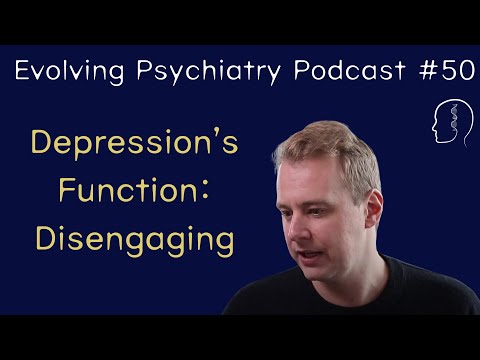
I've recently been fairly convinced that the best evolutionary hypothesis of depression's original function is disengaging from life. But disengaging is almost never the right strategy nowadays.... New podcast episode discussing this just dropped. youtu.be/3F0nF70o5-0?si…
YouTube video
YouTube
English
4
2
12
2.7K
James Turner
James Turner@JTAuthor·
@RealAdamHunt No worries! And yes, there are some subtle differences. At least as I spell it out, it's about reducing resource expenditure. In some cases that would involve signalling help (but probably not all cases). In all cases though, "stop doing things" is roughly the imperative.
English
0
0
1
10
James Turner
James Turner@JTAuthor·
@RealAdamHunt I should add that the idea was originally formulated in Nesse's 2000 paper, and later in his 2019 book. And, as you mention, Dan Nettle also has a similar idea. There are subtle differences between our formulations, but the general idea is very similar. Cool episode as always!
English
1
0
1
17
James Turner
James Turner@JTAuthor·
@RealAdamHunt I would say there's at least one recent paper in the literature that defends (something like) this idea. Mine! I frame it as reducing resource expenditure via (in part) disengagement, and I briefly discuss the idea that it subsumes other theories. pubmed.ncbi.nlm.nih.gov/40420964/
English
1
0
1
23
James Turner retweetledi
Adam Hunt
Adam Hunt@RealAdamHunt·
This summer, August 31st, we are hosting an evolutionary psychiatry debate in Cambridge. Experts discussing whether depression is functional and whether evolutionary perspectives are more important in research or the clinic. Audience participation possible. Join us! buff.ly/daHzwQK
English
1
11
33
2.9K
James Turner
James Turner@JTAuthor·
@Psychistential A recent BMJ article concludes "Exercise is an effective treatment for depression". And their eligibility criteria are "Any randomised trial... for participants meeting clinical cut-offs for major depression". So are people conflating two clinically different things? 1/2
English
1
0
0
42
Cal
Cal@Psychistential·
I'm convinced that the whole exercise being a treatment for depression thing is a conflation between lay-language depression (a bit bluesy, maybe a low period) and genuine depression, which usually need expert assistance.
Dr Brendon Stubbs@BrendonStubbs23

"Wide dissemination of the nonevidence-based claim that exercise is 1.5 times better than other first-line treatments may lead to direct harm to vulnerable patients, who may delay seeking specialist support or stop taking medications/attending therapy” journals.humankinetics.com/view/journals/…

English
7
4
24
2.4K
James Turner
James Turner@JTAuthor·
@JakubZN @eclecticherbal @SameiHuda @dawso007 Again, not a bird expert, but I imagine they are vestigial traits, so have no flight function (but are not DYSfunctional). I.e. in recent evo history they did not enable flight, so there was no effect to select for (but this was nonetheless not detrimental to fitness)
English
1
0
0
37
James Turner
James Turner@JTAuthor·
@eclecticherbal @SameiHuda @JakubZN @dawso007 I talk a bit about them being the same system in my Erkenntnis paper. In brief, massive overlap in neural underpinnings, same defining effects, same types of distal causes. Second question is difficult re low mood. Not sure what you mean by "override".
English
0
0
1
67
Thomas Easley
Thomas Easley@eclecticherbal·
@JTAuthor @SameiHuda @JakubZN @dawso007 This is a stronger framework that i initially thought, but I have more questions: How do we establish depression/mild mood are truly same system? How distinguish original functions from exaptations from dysfunctions? When does environmental mismatch override functional claims?
English
1
0
1
152
Thomas Easley
Thomas Easley@eclecticherbal·
@JTAuthor @SameiHuda @JakubZN @dawso007 Thanks! To clarify -Your SE theory includes not just original selected functions, but also subsequently exaptation, multiple concurrent functions, and functions that may have evolved from what were originally side effects. Is this an accurate characterization of your framework?
English
1
0
0
152
James Turner
James Turner@JTAuthor·
@eclecticherbal @SameiHuda @JakubZN @dawso007 In theory, yes (though I don't know all the details about the evolution of feathers). Most modern SE theories are recent selection theories, so are happy to attribute exapted functions. It is possible, then, that feathers have the function of both flight and insulation.
English
2
0
1
38