Adam Hunt

3.6K posts

Adam Hunt banner
Adam Hunt

Adam Hunt

@RealAdamHunt

Researcher @Cambridge_Uni. PhD in evolutionary psychiatry. Explaining neurodiversity, improving methods & stigma. 'Evolving Psychiatry' podcast host.

Cambridge, England Katılım Şubat 2019
1K Takip Edilen2.5K Takipçiler
Sabitlenmiş Tweet
Adam Hunt
Adam Hunt@RealAdamHunt·
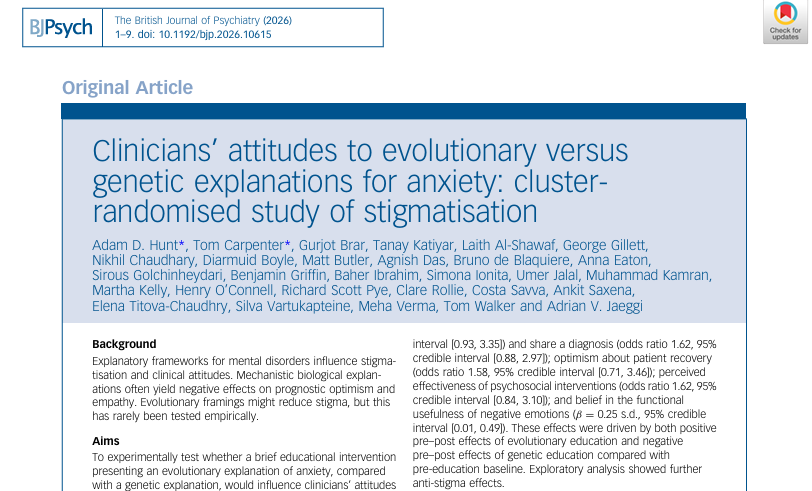
🚨Just published in the British Journal of Psychiatry!🚨 Evolutionary explanations of anxiety rated as 5x more useful for patients and 3x more useful for clinicians than genetic explanations of anxiety! Our paper is the largest RCT of evolutionary explanations to date!
Adam Hunt tweet media
English
16
84
320
26.8K
Adam Hunt
Adam Hunt@RealAdamHunt·
@Evolving_Moloch Yup, I do think that the preservation differences between (very useful and flexible!) organic material vs rocks has wildly biased us here
English
0
0
2
117
Will
Will@Evolving_Moloch·
I think human culture and technology probably did not explode during this period as much as assumed, and there is instead preservation bias in the archaeological record. And relatedly human cultural change cannot be assumed to reflect genetic change—indeed it often does not.
Dwarkesh Patel@dwarkesh_sp

Between 100,000 and 50,000 years ago, human culture and technology exploded. You might expect that this points to a major step-change in human evolution. But David Reich and colleagues looked at the genetic data, and found no significant sweeps in this period at all.

English
10
6
70
5.3K
Adam Hunt retweetledi
Adam Hunt
Adam Hunt@RealAdamHunt·
@Foreman1David @gikkos1 @riad It's two sides of the same story - and that's the interesting thing! Of course, brains are built by genomes which are selected by evolution - yet different focuses do frame the story in a different light. And quite substantially different!
English
0
0
0
60
David
David@Foreman1David·
@RealAdamHunt @gikkos1 @riad Weren’t the answers correlated? Also, I wasn’t a fly on the wall at the lectures but as genomes summarise evolution by natural selection, I don’t understand what is essentially the same theory leading to more positive outcomes under one condition.
English
1
0
0
23
Adam Hunt
Adam Hunt@RealAdamHunt·
@Foreman1David @gikkos1 @riad The one question which might most plausibly have been impacted by that single point would be 'optimism about recovery'. But the others seem much less directly related (e.g. willingness to seek help; usefulness of information)
English
1
0
0
41
David
David@Foreman1David·
@gikkos1 @riad Sorry, but putting a guarded prognosis slide in the genetic but not the evolutionary slide deck biases the results.
English
2
0
3
222
Adam Hunt
Adam Hunt@RealAdamHunt·
@Foreman1David @gikkos1 @riad We had positive results on all 7 pre-registered hypotheses, and an additional 3 items. It would be extremely surprising if a single point in a single slide in the 30 minute presentation is the driver of all the effects? Also we replicated a finding of Schroeder et al. 2023
English
0
0
0
34
Adam Hunt
Adam Hunt@RealAdamHunt·
🚨Just published in the British Journal of Psychiatry!🚨 Evolutionary explanations of anxiety rated as 5x more useful for patients and 3x more useful for clinicians than genetic explanations of anxiety! Our paper is the largest RCT of evolutionary explanations to date!
Adam Hunt tweet media
English
16
84
320
26.8K
Carlos E Alvarez
Carlos E Alvarez@CarlosEAlvare17·
Speaking of anxiety, I teach presentation and feedback skills to PhD students. Despite the class being taught in their final year, the biggest factor in presentation quality is probably the level of anxiety in many students, which is often even greater than the preparation of media and presentation practice. Remarkably, the biggest factor on the overall class vibe is feedback type, tone and amount -- especially the criticism from instructors. The issue of feedback is essentially devising the gentlest way to criticize constructively: open with the presentation strengths, identify specific areas for improvement and suggest how to make the improvement. Even without any harsh or personal criticism, a substantial level of criticism tends to create stress in many students. I think those dynamics align with your study. That's especially true for the idea of hearing strong criticism that would be analogous to a genetic liability that we are unlikely to be able to mitigate. I even see an analogy in the relationship between anxiety and societal authority structures: students vs instructors, and patients vs physicians. Beyond those dynamics, a curious factor is student engagement. The default state is weak or non-engagement except for the small subset of gregarious students. Without preventing it, the natural order seems to be for students to make kind comments and weak critiques, which leaves the stronger criticisms for instructors... eventually arriving on the instructors making up the bulk of the feedback -- which is what makes students the most anxious. Thus, there's a large-effect tradeoff on engagement/stress. And teaching this class is largely an exercise in getting students to give all the necessary feedback (and the instructors are more like facilitators).
English
1
0
1
77
Adam Hunt retweetledi
Vincent-psych
Vincent-psych@VincentPsychSE·
@RealAdamHunt I’ve used evolutionary psychology a lot and yes it’s much more useful. Clients actually feel empowered once they understand the function of these drives.
English
0
1
1
90
Adam Hunt
Adam Hunt@RealAdamHunt·
@Foreman1David @raj_psyc Mayyyybe - but these are UK clinicians with many years of experience in psychiatric training, sessions took about half an hour, most of the content was the actual intervention. We also explicitly framed the questions about the explanatory material rather than the background
English
0
0
0
43
David
David@Foreman1David·
@RealAdamHunt @raj_psyc I understand, but giving the guarded prognosis (which is unaffected by mechanism or theory) in the genetic deck and not the evolutionary deck literally stacks the genetic deck towards a less positive narrative.
English
1
0
0
31
Adam Hunt
Adam Hunt@RealAdamHunt·
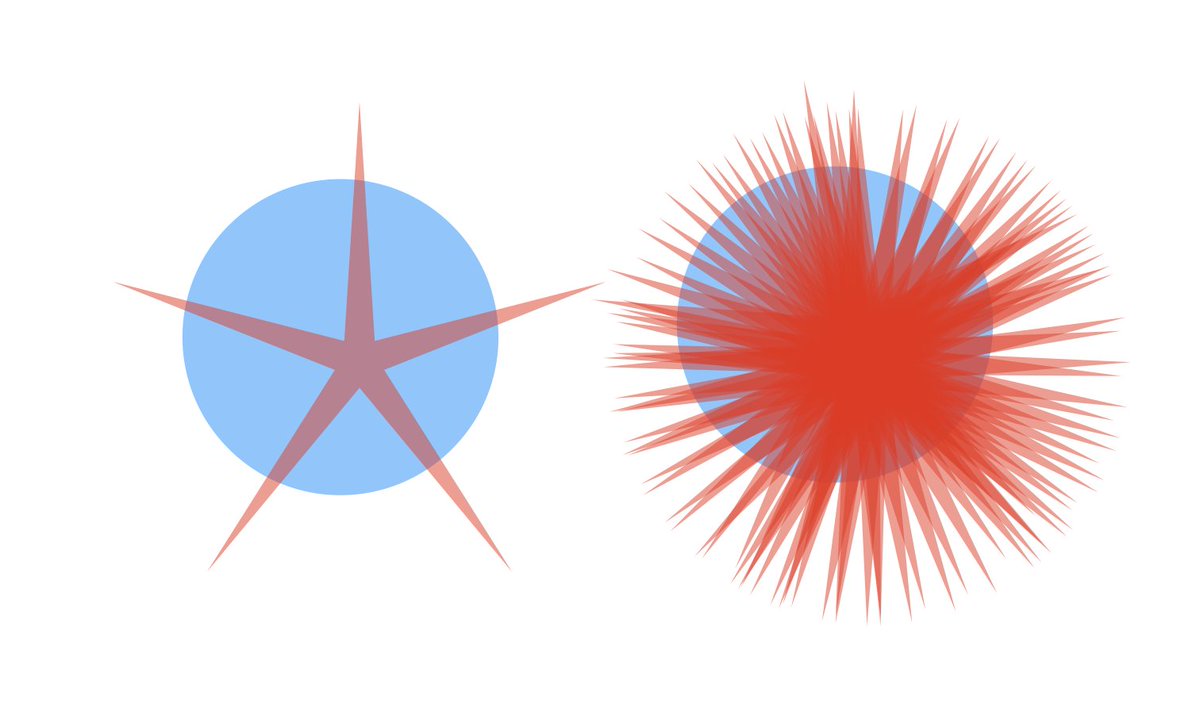
@Foreman1David @raj_psyc The chapter/paper differed in the background information they cited so we couldn't perfectly match these sorts of slides/figures. Like these figures from the evolutionary background arent replicated in the genetic background
Adam Hunt tweet media
English
1
0
0
46
David
David@Foreman1David·
@RealAdamHunt @raj_psyc Thanks, that’s very helpful. I found this slide in the genetics presentation but not the evolutionary one. Could you point me at the evolutionary presentation equivalent of I’ve missed it.
David tweet media
English
1
0
0
40
Adam Hunt
Adam Hunt@RealAdamHunt·
Thanks to all the psychiatrists involved in the study, particularly the educators – and most of all, my co-first author, Tom Carpenter, who was the man on the ground organising sessions in the UK whilst I was in Switzerland!
English
1
0
5
390
Amy Alkon
Amy Alkon@amyalkon·
@RealAdamHunt Am I not finding a link you posted to it? Sound great - would like to read!
English
1
0
0
151
David
David@Foreman1David·
@RealAdamHunt @raj_psyc I couldn’t find the slide decks to open. The usually quoted prognosis of generalised anxiety disorder is still symptomatic at 10 years and 50% relapse after remission. Were prognostic data included in either slide deck, and if so was the same data used?
English
1
0
1
102
Adam Hunt
Adam Hunt@RealAdamHunt·
@krichard121212 The explanations were much more nuanced than that! You can check out the education sessions we used. It's basically as you say - some anxiety is normal, but it can run away from you. I think the nuance here is important, because it encourages us to challenge/channel anxiety
English
0
0
8
214
Richárd
Richárd@krichard121212·
Is it ethical to lie to patients if it makes them feel better? (Yes ofc evolution did play a part in humans developing the capacity to feel anxiety, but anxiety disorders are not a part of normal variation and probably weren't useful in the past either)
Adam Hunt@RealAdamHunt

🚨Just published in the British Journal of Psychiatry!🚨 Evolutionary explanations of anxiety rated as 5x more useful for patients and 3x more useful for clinicians than genetic explanations of anxiety! Our paper is the largest RCT of evolutionary explanations to date!

English
3
1
15
1.8K
Adam Hunt
Adam Hunt@RealAdamHunt·
@Castalia1981 I think both! (And we do find that in the data - most of the measures were conducted pre and post) (Although not the usefulness question)
English
0
0
1
71
Agnes Ayton 💙
Agnes Ayton 💙@AgnesAyton·
@RealAdamHunt Really helpful work. 👏🏻👏🏻👏🏻 My clinical practice is fundamentally informed by evolutionary theory - but rarely been brave enough to articulate it - I’ve had my fair share of controversies for challenging the status quo
English
1
1
1
125
Adam Hunt
Adam Hunt@RealAdamHunt·
@AgnesAyton Thanks for your work! The anecdotes from psychiatrists about the impact are what inspired this research: we need to show empirically how this perspective matters! Hopefully this is only the beginning...
English
0
0
0
31