
Johnny V. Neumann retweetledi
Johnny V. Neumann
328 posts


Johnny V. Neumann
@JancsiNeumann
only close friends can call me John. for professional inquiries contact: @witten271
Berkeley, CA Katılım Ocak 2018
642 Takip Edilen61 Takipçiler


This is a very bad take that would not be endorsed by any mainstream academic economist. It would seriously impede the development of large firms, which likely play a central role in productivity growth and helping low-income countries reduce poverty @RadishHarmers
Sridhar Ramesh@RadishHarmers
It doesn't matter if you're a moral person. You still don't deserve to be a billionaire. No individual deserves so much more unilateral power than others, which is harmful to society, and nothing useful is lost in incentive difference between $10 million or so and billionaire.
English
@Benthamsbulldog @dpecchia @TheLaurenChen presumably they meant that animals aren’t moral subjects, not that animals aren’t moral patients
English

@dpecchia @TheLaurenChen Do you think it's okay to torture cats for fun on this ground, assuming doing so doesn't harm any humans?
English

Why are dogs and cats allowed to eat beef but not me?
Boşuna Tıklama@bosunatiklama
Billie Eilish: "Hem hayvanları sevip hem de et yiyemezsiniz."
English
English
Johnny V. Neumann retweetledi
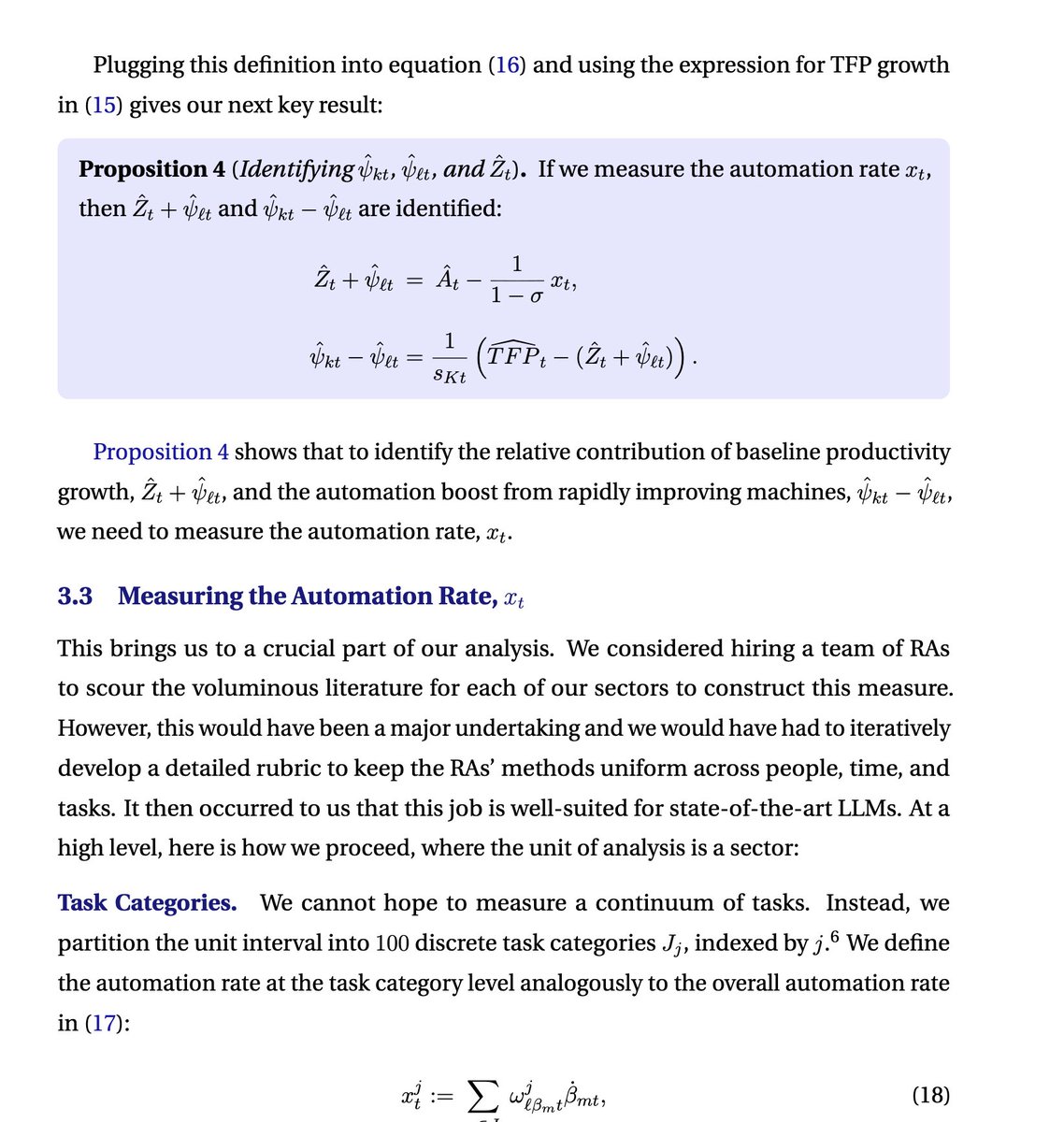
@joshgans @ChadJonesEcon Why not also put a box around it? Just like a calculus textbook... And every item in the text can be labeled in numbered boldface as "theorem" "proof" "remark" "observation" "sentence" "joke" "conclusion", for clarity.
English

It looks like @ChadJonesEcon is upping the game on paper formatting with propositions shaded. It is a good move. I think I'll copy it.
English
@jessi_cata What are your thoughts on first-person realism, in particular, List's first-personal argument against physicalism (philpapers.org/archive/LISTFA…)?
English

"We do not have to derive a first-person perspective from an objective third-person view. It is the opposite: Any account is perspectival because knowledge is always embodied. Scientific knowledge is ultimately first-personal." -- Carlo Rovelli
Earl K. Miller@MillerLabMIT
There Is No Hard Problem of Consciousness noemamag.com/there-is-no-ha… #neuroscience
English
@jessi_cata What are your thoughts on accepting non-relationalism and non-fragmentation, and instead giving up the one world assumption (replacing a single objective world with multiple first-personally centered worlds)? (As sketched here: arxiv.org/pdf/2604.14234)
English
Johnny V. Neumann retweetledi

Ever since I was a small boy I knew I wanted to apologise for my delayed reply
English
David Albert on a rival philosophical view
Bob Golen@BobGolen
Just found the absolute worst page in the dictionary. What I saw was disgraceful, disgusting, dishonest and disingenuous.
English
@morallawwithin what if your diet is determined only by what minimizes animal suffering, but you eat beef (since you believe it reduces wild insect suffering and thus animal suffering overall)?
English

Johnny V. Neumann retweetledi


Lord give me the confidence of a philosopher who’s read zero physics.
Alex Strasser@AStrasser116
Lord give me the confidence of a physicist who's read 0 philosophy
English
the point above was more that, fixing p(survive), the total contractible amount conditional on survival, i.e., how much I can credibly stake in an end-of-the-world bet, can be quite a lot larger than just my seizable wealth conditional on survival (which could be quite small if I just spent all the pre-paid money).
e.g., conditional on surviving AGI-transition, we might have radically extended life-spans and the community can enforce very costly social sanctions if I don't pay out the bet.
English
@almostlikethat @ohabryka @bryan_caplan interesting, yeah it gets more complicated if the interventions i'm funding with the borrowed money meaningfully changes p(survive), and thus probability of repayment.
English
I keep telling you, you CAN bet on the end of the world!
The optimist pre-pays the pessimist, it's as simple as that.
betonit.ai/p/another-end-…
English
QAM

@selectsand @So8res @bryan_caplan I feel like there's a "structural debt vs money printers" governance idea floating somewhere around here?
Going DEEP into hock to buy entire governments and fix their AGI policy might "work"?
But look at the books in the HAPPY aftermath? It feels... "Myerson-Satterthwaite-y"?
English
Why aren't AI doomsters going into massive debt, so they can enjoy life before the world ends (and before the debt comes due)?
English
But Bryan is offering you an opportunity to borrow massively. Suppose linear utility in money for simplicity. You get $1 today and you have to pay back $10 in a year, but you find that acceptable since you think it's only 5% we survive til then. The prospect of having to work extra hard to earn $10 supposing we are alive is worth it now since you currently find it unlikely. Is your objection that enforcing payment in the future will be hard?
English

I can’t “borrow massively” because the only way I could pay you back is if I don’t spend massively. I can only borrow a bit against my future income, and there isn’t really any way to establish creditworthiness even for that without providing collateral, in which case I am better off just selling the collateral instead of taking a loan from you.
English
What’s confusing about this? It’s just a loan with an interest rate that is acceptable to both of you given your differing beliefs about chance you need to repay. Enforcing payment if the world doesn’t end by date T seems analogous to the usual problem of enforcing payment if you side of the bet loses.
English
@bryan_caplan I don't get it. How do I pay you after I spent all the money?
English
@benjamin_hilton @willmacaskill What’s the similarity, beyond the non-uniform weighting of experiences?
English

@willmacaskill The implications of this view are interestingly similar to views where utility is weighted by priors from the universal distribution (e.g. combining UDASSA with an updateless decision theory and a definition of utility)
English

In collaboration with Christian Tarsney, I’ve developed a new theory of population ethics, which I call the Saturation View.
I think that, from a purely intellectual perspective, it’s probably the best idea I’ve ever had. It was certainly great fun to work on.
The motivation is that many views of population ethics, like the total view, suffer from some major problems. Some are already widely discussed:
The Repugnant Conclusion: For any utopian outcome, there’s always another outcome containing an enormous number of barely-positive lives that is better.
Fanaticism: For any guaranteed utopian outcome, there’s always some gamble with a vanishingly small probability of an even better outcome that has higher expected value.
Infinitarian Paralysis: Given that the universe contains an infinite number of both positive and negative lives, no finite or infinite change to the world makes any difference to overall value.
These are pretty bad!
But there’s another less-discussed problem, too:
The Monoculture Problem: Given fixed resources, the best-possible future consists essentially only of qualitatively identical replicas of a small number of lives.
Essentially all extant impartial accounts of population ethics suffer from the monoculture problem. It follows from Pareto and Anonymity alone — you don't need totalism. And perfectly-replicable digital minds mean this is a real issue that future generations will face.
But a monoculture seems far from ideal. Endless galaxies containing nothing but the same blissful experience, repeated and repeated, seem impoverished; like a song with only one note.
The Saturation view deals with all these problems at once, using broadly the same machinery for all of them.
The core idea is that the realisation value of a type of life (or experience) is determined by both the wellbeing of that life, and by how many very similar lives there are in the world. Endlessly creating replicas of the same identical life becomes progressively less valuable, tending to an upper bound. The total value of a world is given by the integral of realisation value over the space of types.
Think of types of life as forming a landscape. Adding different types of life lights up different parts of the landscape. The value of the world is given by how fully illuminated the landscape is.
Why does this help? In brief:
Monoculture: Because there are diminishing returns to increasing wellbeing of very similar types, there’s greater value in having a diversity of lives.
Repugnant Conclusion: The classic path to the Repugnant Conclusion requires trading a utopian world for an enormous population of barely-positive lives. But, on the Saturation view, barely-positive lives can only illuminate a tiny corner of the landscape. The path to the Repugnant Conclusion is blocked.
Fanaticism: Total achievable value is bounded above. That means no tiny-probability gamble can have arbitrarily high expected value.
Infinite ethics: In any infinite universe, the value of a world is finite and well-defined — even if some locations have infinite wellbeing. Unlike other approaches, this does not depend on spatiotemporal structure or choice of ultrafilter.
Separability: Like nearly all non-totalist views, Saturationism is non-separable — background populations can affect how we rank options. But the violations are tame: populations with sufficiently different populations simply add, and at small scales the view behaves just like totalism.
If the Saturation View is right, then the best future isn't the one where we've found the optimal experience and copy-pasted it across the cosmos. The best future is the one where we've gone exploring, and we've fully lit up the landscape of possible experiences.
English
Johnny V. Neumann retweetledi
The whole "you shouldn't vape next to babies on airplanes" ideology is basically a religion.
--Belief in a supreme authority (God/the FAA)
--Strict moral rules that are imposed on everyone (Ten Commandments/"Federal law")
--Threat of punishment for unbelievers (Hell/fines)
English