Jay

4.8K posts

Jay banner
Jay

Jay

@jayendra_jog

Co-Founder @Sei_Labs. Building the world's fastest blockchain. Previously @RobinhoodApp

New York, USA Katılım Ekim 2019
1.5K Takip Edilen26.6K Takipçiler
Sabitlenmiş Tweet
Jay
Jay@jayendra_jog·
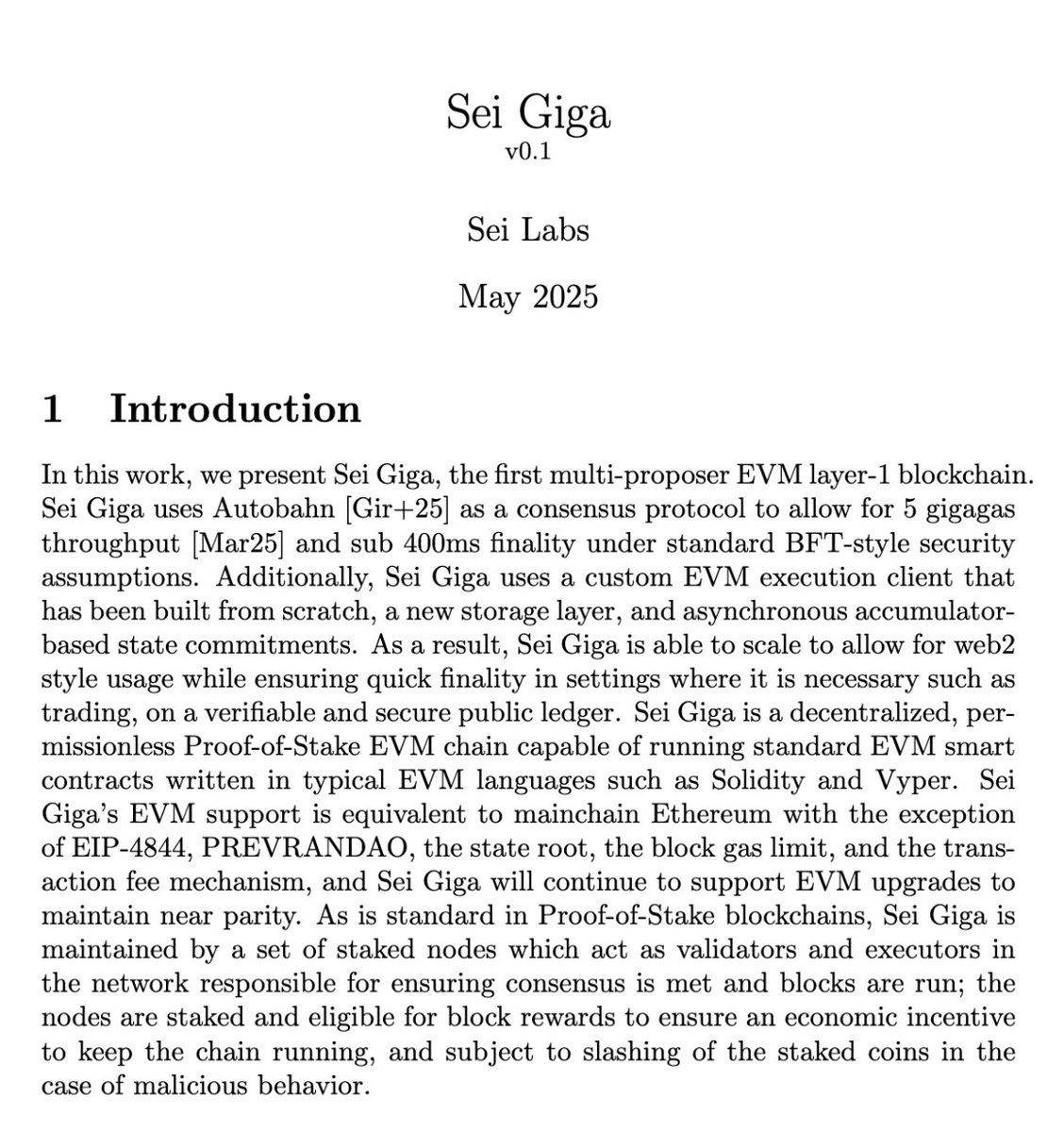
Huge milestone - the Sei Giga Whitepaper is out! Our mission is to scale the EVM, and Sei Giga is the next step towards achieving that vision. Sei Giga is the first multi proposer EVM L1, and uses Autobahn consensus, a new execution client, asynchronous execution, and a reimagined storage layer. This allows Sei to get <400ms finality with 5 gigagas/sec of throughput, all with a decentralized validator set. I'm incredibly proud of the team for this accomplishment, and excited to see these innovations go live on Sei.
Jay tweet media
English
119
93
626
87.9K
Jay
Jay@jayendra_jog·
@zeynep Adoption outside of software will inherently be slower - same thing with the internet in the 90s, where higher tech industries were impacted first
English
0
0
1
174
Jay
Jay@jayendra_jog·
@jonah_b Crypto is in a local minima, AI is close to a local maxima All the tourists are going to AI rn Ironically, this is the best time to double down in crypto
English
1
0
12
267
Jay
Jay@jayendra_jog·
@secparam Both are important, but mythos bugs seem more tractable to solve (need to identify them before attackers) Quantum risk is much more difficult to truly solve (the migration process is extremely cumbersome)
English
0
0
4
224
Ian Miers
Ian Miers@secparam·
You're worried about quantum computers breaking cryptography. You should be worried about classical computers breaking the code. Mythos is more dangerous than a 20 bit quantum computer.
English
10
14
103
6K
Jay
Jay@jayendra_jog·
@udiWertheimer @danrobinson This would still require ancient coins to perform an action - if they don’t, their accounts would still need to be frozen/taken over, no?
English
1
0
0
146
Udi Wertheimer
Udi Wertheimer@udiWertheimer·
@danrobinson @jayendra_jog also, finding some workable solution for ancient coins is probably in the interest of all holders no matter how small, unless they’re looking for an opportunity to buy super cheap coins
English
2
0
4
233
Dan Robinson
Dan Robinson@danrobinson·
Millions of BTC could be vulnerable to quantum computers Bitcoin may someday need to sunset those addresses, but that could force a public migration Today we published a design to let that migration be costless and silent: Public Address-Control Timestamps (PACTs) Link in 🧵
Dan Robinson tweet media
English
58
90
674
117K
Jay
Jay@jayendra_jog·
privacy conversations in crypto usually fail because they skip a more fundamental question: which privacy problems are we actually solving? two completely different requirements get conflated. 1) retail privacy: hide wallet balances and transaction history from analytics tools, data aggregators, etc. 2) institutional privacy: hide order flow and position sizes from mev bots and adversarial traders before execution. these require different protocol-level mechanisms. shielded balances solve the retail problem. confidential execution solves the institutional one. these are different architectures serving different customers. most general-purpose chains have so far only tried to solve one. but the chain that actually wins will prob need both. retail users won't adopt infrastructure that leaves their balances exposed; institutions won't route flow through chains that leak their orders. there's no single privacy feature that completely serves both. the winning implementation will solve for each (either at the protocol level or on top of it) and ship them together
Keone Hon@keoneHD

If you could transact on a blockchain privately, what features what would be the most important for you, and what would you do?

English
3
0
28
1.5K
Jay
Jay@jayendra_jog·
@andyyy iirc most crypto cards are still using traditional rails for sending funds, do you see visa migrating to directly use crypto rails
English
1
0
3
439
Andy
Andy@andyyy·
Visa is absolutely DOMINATING stablecoin payments, specifically for crypto cards. The numbers are actually insane too like, pretty sure it’s somewhere close to 95-98% of crypto-linked cards are powered by Visa. When you combine that with the face that crypto-linked card spending volume has increased 500% since September 24' and is now running at $600 mill/mo, you can see how this is going to be a massive revenue generator for Visa. Naturally I asked their head of stablecoin strategy how big of an opportunity this: He says they are doing BILLIONS/year in revenue from just one stablecoin settlement product and the crypto card product is something they are betting heavily on. He mentioned Rain quite a bit throughout this show as the company powering a lot of these cards as well. Clearly they are thinking deeply about how stablecoins will be integrated as a monetizable product line. Where’s MasterCard or Discover or anyone else in this race???
Andy tweet media
The Rollup@therollupco

What's the actual addressable market for stablecoin payments? Stablecoin Strategy Lead at @Visa, Joshua Moss: In B2B alone, 45T total payment volume, 20% cross-border, 20% of that in high-friction corridors. That's $6 trillion. Today, only 1% of stablecoin volume is payments. The rest is trading. The wedge is barely open.

English
34
15
225
31.3K
Jay
Jay@jayendra_jog·
@sidrmsh fwiw drift was a multisig (not a single signer), but the core point is still true this trend might be the strongest catalyst for immutable smart contracts with no admins
English
1
0
1
138
Sid⚡️
Sid⚡️@sidrmsh·
Hot take: DeFi doesn't have a smart contract security problem. It has a key management problem. April's biggest losses (KelpDAO $292M, Drift $285M, Wasabi $5M) were admin key compromises. No timelocks. No multisig. Write better code all you want. But the ops problem still remains.
English
16
4
81
28.9K
Bramble King
Bramble King@Tudmotu·
@sidrmsh Key management is virtually a solved problem in TradTech. The reason it's not solved in DeFi is because Ethereum refuses to implement the appropriate APIs.
English
1
0
0
49
Jay
Jay@jayendra_jog·
1) do you think bigger context windows will solve this in the long term? presumably, there will be a context size that will solve this problem for most use cases 2) do you see a path where an agent builds a succinct representation of its own knowledge, allowing more efficient queries (i.e. giving suggestions to further investigate in cases like the BigInt one you described)?
English
0
0
3
259
Taelin
Taelin@VictorTaelin·
seriously, working with AI is MISERABLE for one and only one reason: having to re-explain the same thing "oh yeah this new session obviously doesn't know what proper case trees are, so let me explain it for the 5000th time in my life" I'm tired AGENTS.md doesn't solve this because it is impossible to fit the entire domain knowledge without nuking the context - it would be 1m+ tokens worth RAGs don't solve this, the agent won't search unknown unknowns SKILLs don't solve this unless I keep like a collection of 1750 skills with specific cuts of domain knowledge for each possible subset of my domain that I might need in a given chat, but that's a lot of manual work recursive LLMs or whatever don't solve this for the same reason, you can't dump a domain book and expect the AGENT will magically guess that it is supposed to search for a specific bit knowledge. unknown unknowns fine tuning doesn't solve this (OSS models suck and OpenAI / Anthropic gave up on user fine tuning) I honestly think a good product around fine tuning on your domain would be a major hit and an underdog lab should take this opportunity
English
669
181
3.5K
248.4K
Kennan Frost
Kennan Frost@kennandavison·
Skio just sold for $105M cash at close on $8M raised.
English
126
164
1.9K
2.5M
Jay
Jay@jayendra_jog·
@dcfgod Probably listing the token on a solana DEX, seems like a high ROI move for solana eco
English
0
0
2
495
DCF GOD
DCF GOD@dcfgod·
So the entire solana chain is marketing megaeth the eth L2 that’s fast like solana?
English
36
3
193
16.7K
Jay
Jay@jayendra_jog·
@0xPrince Or a state level actor was able to build their own mythos level model
English
0
0
3
214
Prince
Prince@0xPrince·
Something’s off. Either someone got Mythos and is systematically hunting small protocols… or teams are just using this opportunity to rug. Neither is good. Stay alert.
English
5
0
13
1.1K
Jay
Jay@jayendra_jog·
@bread_ @MiniBlocksIO Would be interesting to see real time priority fees + most popular apps by fees
English
1
0
2
247
bread.mega
bread.mega@bread_·
If you want to watch MegaETH hum along during the onchain phase, @MiniBlocksIO has your back:
English
19
8
151
6.9K
Jay
Jay@jayendra_jog·
multi-proposer chains are fundamentally better suited for trading, and Sedna might be the research team's favorite differentiator for Giga
Sei Labs@Sei_Labs

Multi-proposer blockchains are meant to solve the monopoly on transaction inclusion inherent to single-proposer chains. But multi-proposer designs only solve half of it. Censorship resistance keeps proposers from blocking your transaction; it doesn't keep them from reading it and extracting MEV. Why does this matter? Because in the context of trading, MEV creates inefficient price discovery. If blockchain is fundamentally trading infra, bad prices have follow on effects for the lending, prediction, and derivatives markets that consume those prices. Giga will account for this with Sedna, a protocol that splits each transaction into rateless coded symbols and disseminates small bundles of those symbols across multiple proposer lanes, such that no single lane ever holds enough fragments to reconstruct the payload. The result is a design that eliminates the most common forms of MEV (front running, sandwich attacks, etc.) almost entirely. For trading, that means order flow privacy is a property of the protocol. On single-proposer chains, the solutions for common MEV are application-layer workarounds: private mempools, encrypted order flow auctions, etc. These work to varying degrees, but they ask users to trust an additional party (i.e., trade one monopoly for another) or accept added latency. Sedna moves that protection into consensus, tying privacy to the same data layer Giga's consensus already requires for liveness.


English
3
4
50
2.1K
Jay
Jay@jayendra_jog·
@hasufl @preston_vanloon @d_gusakov @ethereum agreed, the fundamental problem right now is that there's not a good reason to chase yield onchain, especially with the perception around the risk profile tied to it
English
0
0
1
28
Dima Gusakov
Dima Gusakov@d_gusakov·
If we cut @ethereum staking issuance, we will likely kill LSTs. Without LSTs, DeFi will shrink to the size of a penny. Without DeFi, @ethereum will lose its main value proposition. Without its value proposition, @ethereum will die. Do we really want to kill @ethereum?
English
41
10
118
84.7K
Jay
Jay@jayendra_jog·
@malleshpai on the flip side, most of the things that completely change society seem to be macro inventions things like the nuclear weapons, internet, crypto, and AI
English
1
0
1
107
Jay
Jay@jayendra_jog·
@toly multi proposer can give censorship resistance, priority pricing that is part of consensus, and application specific sequencing will literally change the game in terms of onchain trading
English
0
0
3
160
Jay
Jay@jayendra_jog·
@binji_x which metrics can you use to measure that? feels like no existing metrics (TVL, volume, DAUs, # transactions) are able to measure that properly
English
0
0
1
106
Jay
Jay@jayendra_jog·
@danrobinson @MrCampbell - in the next 12 months, at least one chain will ship this to mainnet - will result in a completely new market structure and solve some systemic issues (ex. censorship)
English
0
0
1
46
Dan Robinson
Dan Robinson@danrobinson·
@MrCampbell That is one of the holdover Manhattan projects, and I really hope it works
English
1
0
3
347
Dan Robinson
Dan Robinson@danrobinson·
I think the next era of crypto research is going to look like a long steady grind of obvious-in-hindsight improvements, rather than a Manhattan project
English
26
6
194
17.1K