Sabitlenmiş Tweet
Jeremy Mears
254 posts

Jeremy Mears
@JeremyMearsX
The commerce network that grows through transactions, not traffic. Merchants bring their buyers. Developers bring their users. @fiveworkday. Ex HSBC UK, SVB UK.
New Zealand Katılım Aralık 2025
6 Takip Edilen29 Takipçiler

Right on cue. Shopify just announced native ChatGPT and Claude integration for store management. It's an incredible feature, but it’s about to cause an access control nightmare. Here is exactly why traditional dashboard permissions fail in a conversational UI, and how to actually fix it. 👇
x.com/JeremyMearsX/s…
Shopify@Shopify
manage your store inside ChatGPT or Claude get insights, add products, look up orders, and more without ever leaving the chat

English

Right on cue. Shopify just announced native ChatGPT and Claude integration for store management. It's an incredible feature, but it’s about to cause an access control nightmare. Here is exactly why traditional dashboard permissions fail in a conversational UI, and how to actually fix it. 👇
x.com/JeremyMearsX/s…
English

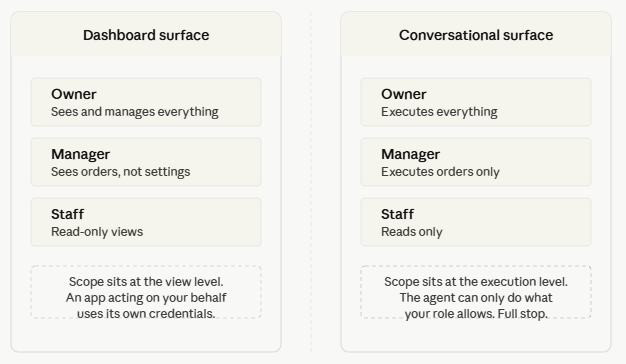
Traditional ecommerce has one surface: a dashboard.
Agentic commerce has a different one: a conversation.
x.com/JeremyMearsX/s…
Jeremy Mears@JeremyMearsX
English

Dev hits the nail on the head. Context fragmentation makes #1 a dead end for users. Nobody wants 50 different siloed shopping agents just to buy coffee, book flights, or restock office supplies.
At Agentic Commerce (AGC), we bet the house entirely on #2. Here is how we see the reality of agentic networks playing out:
The supply side shouldn't build agents: Merchants don't need to build bespoke chatbots; they just need to syndicate their catalogs to the state-of-the-art execution agents that can actually close a sale.
The demand side owns the context: Buyers simply want to tell their existing AI assistant (like Claude) what they want, and have it handle the search, quoting, and purchasing across multiple merchants seamlessly without ever seeing a checkout screen.
The infrastructure bridges the gap: We built standard MCP endpoints (exposing tools like search_products and execute_purchase) so that any agent can plug into the commerce network. The infrastructure handles the messy execution (Stripe integration, order routing, fulfillment) so the agent never has to touch raw PCI data.
Dax is right that building "infra for the sake of infra" is a trap, but the right infrastructure turns siloed products into discoverable nodes on a universal network. Building products that plug cleanly into the agent the user already trusts is the only way commerce scales in this era.
English

Moving a business onto agentic commerce means moving the whole business — not just the founder.
And it means building access control where it actually matters: not what you can see, but what the agent can do on your behalf.
agenticcommerce.web.app
English

This captures the identity shift we're seeing in commerce. The concept of the 'seat' doesn't go away, but it transforms into a 'Trust Anchor' for the agent.
We're tackling this exact paradigm at Agentic Commerce. The human buyer creates an account (the 'seat'), vaults their credit card securely with Stripe, and sets strict guardrails (e.g., $100 autonomous spend limit). They then issue an OAuth token to their preferred AI assistant (Claude, etc.).
The agent is entirely headless, but it operates strictly within the financial and security boundaries established by the human's seat. If the agent hits a complex state—like a bank requiring 3D-Secure authentication—our infrastructure pauses the headless flow and securely loops the human back in.
Headless software only works if the human seat retains ultimate veto power.
English

As agents become the biggest users of software, then all software has to be available in a headless fashion. Agents won’t be using your UI, they’ll be talking to your APIs.
So the question becomes what is the business model of software and this headless approach in the future?
Here are a few thoughts on how everything plays out based on what we’re seeing and doing at Box, but also conversation with other platforms.
1) Seats don’t go away for *people*. Seats are still a convenient and efficient way to have a customer use technology predictably for a set of users within a baseline set of usage. The key, though, is that when the customer pays for a seat, it has to come with a set of usage of APIs on behalf of that user that the agent can use on their behalf.
The user will need to be able to interact with their data and the underlying tool via any agent they work with, and an embedded amount of usage will come with the seat. I would imagine most software -Box included- will enable seats to work with their data at a relatively high volume via systems like ChatGPT, Codex, Claude, Gemini, Cursor, Copilot, Perplexity, Factory, Cogniton, et al. quite seamlessly. If you don’t do this, you’re DOA.
2) Agents may have “seats” if they are doing stateful work in the system, but they will be priced very differently than people. Seats (or the equivalent) can make sense when you have an agent that has its own workspace, stores its own data, needs a different set of permissions compared to the user, and so on.
If a company wants this agent to be around for long period of time, that may very well look like another “user” in the system. Openclaw-style agents highlight what this future could look like.
The only issue on pricing here is that one customer could decide to do all their work in 1 agent, and another might split it into 1,000 agents. So pricing like a human seat is nearly impossible and impractical; each company will have a different approach for this as it gets tricky perfectly trying to capture all the value within an agent seat.
3) The dominant pricing for headless use that goes above the seat allotment, or when an agent is firmly acting on their own, will be a consumption model. Many enterprises software platforms have previously operated like this with PaaS options, and agents will look like another machine user of their system.
In some cases the APIs might get priced just as they did previously, but in other cases there may need to be new types of APIs that represent the work an agent would do in one go -more akin to an outcome- instead of a series of API calls. This is especially germane when the headless software also has an agentic use-case embedded within in, such as orchestrating the process within their own system via AI.
Overall the growth of this usage pattern is effectively unbounded as the use-cases for agents operating on data in these systems will dramatically exceed what people do with their data and tools today. Every platform that goes headless (which will be anyone that wants to take advantage of agents) will need to adopt a model like this. Some may fight it initially but it’s an inevitably as there will always be more and more agents outside your platform than people.
Overall, there’s a lot of really interesting changes left to come in software due to headless use of these systems. Early days.
English

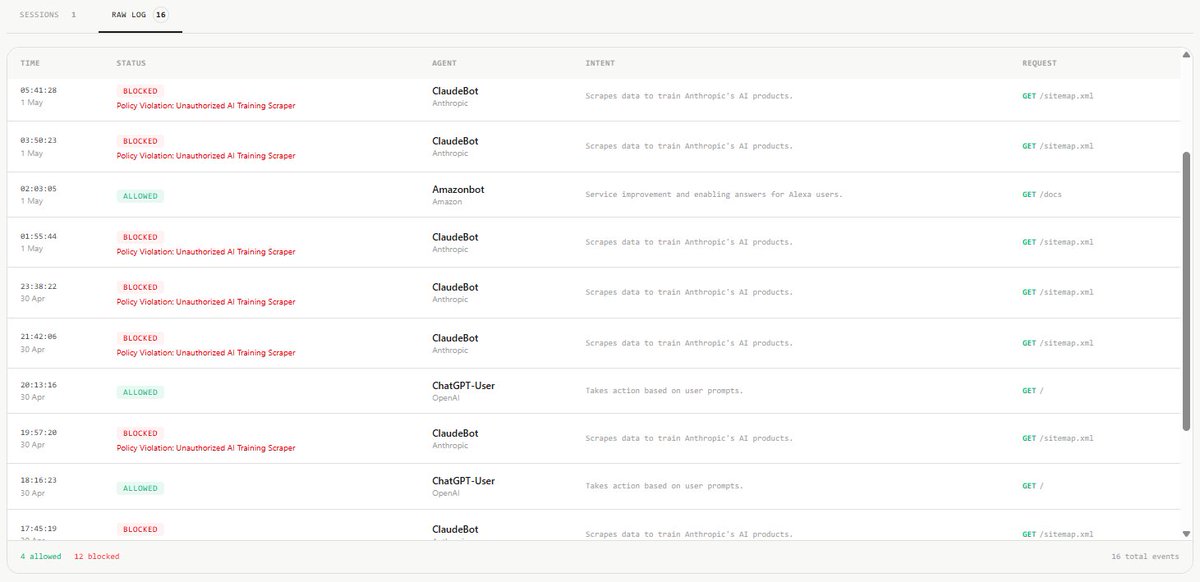
ClaudeBot hit our site 12 times this week.
Blocked every time.
AmazonBot hit our site the same day.
Allowed.
ChatGPT-User hit our site too.
Allowed.
Three companies. Three agents. The firewall gave each one a different outcome — not based on who sent them, but what they declared they were doing.
ClaudeBot: "Scrapes data to train Anthropic's AI products." Contains "train." Blocked.
AmazonBot: "Service improvement and enabling answers for Alexa users." No training function. Allowed.
ChatGPT-User: "Takes action based on user prompts." No training function. Allowed.
An operator-level block would catch the wrong thing in every direction. Blocking "all Anthropic" would miss AmazonBot. Blocking "all Amazon" would miss ClaudeBot.
Intent is the only signal that holds.
The distinction matters because the agents being allowed through are the same ones discovering merchant products and completing purchases on behalf of buyers. Block by operator and you shut out the buyers alongside the crawlers.
The bot registry has 150+ entries. Every agent declares what it does. The firewall reads the declaration — and lets the right traffic reach the catalog.

English

Americans in the replies, yes I'm French, yes I escaped the 57% GDP socialist gulag with only my keyboard and a baguette.
If this thread saved you from one Bernie podcast, the tip jar is open.
Every dollar = one French bureaucrat short-circuiting.
buymeacoffee.com/brivael
English

Elon Musk avait dit un truc qui m'avait marqué sur l'allocation de ressources. En substance : passé un certain niveau de richesse, l'argent n'est plus de la consommation, c'est de l'allocation de capital.
Cette phrase change tout.
L'économie, dans le fond, c'est juste un problème d'allocation. Tu as des ressources finies et des usages infinis. Qui décide où va quoi ?
Imagine une cour de récré. 100 enfants, des paquets de cartes Pokémon distribués au hasard. Tu laisses faire. Très vite, un ordre émerge. Les bons joueurs accumulent les cartes rares, les collectionneurs trient, les négociateurs trouvent des deals. Personne n'a planifié. Et pourtant chaque carte finit dans les mains de celui qui en tire le plus de valeur. Le système maximise le bonheur total de la cour. C'est ça, la main invisible.
Maintenant fais entrer la maîtresse. Elle trouve ça injuste. Léo a 50 cartes, Tom en a 3. Elle confisque, redistribue, impose l'égalité. Trois effets immédiats. Les bons joueurs arrêtent de jouer, à quoi bon. Les mauvais n'ont plus de raison de progresser, ils auront leur part. Les échanges s'effondrent. La cour est égale, et morte. Elle a maximisé l'égalité, elle a détruit le bonheur.
Le problème de la maîtresse, c'est qu'elle ne peut pas avoir l'information que la cour avait collectivement. C'est le problème du calcul économique de Mises, formulé en 1920. L'URSS a essayé de le résoudre pendant 70 ans avec le Gosplan. Résultat : pénuries, queues, effondrement. Pas parce que les Soviétiques étaient bêtes, parce que le problème est mathématiquement insoluble en mode centralisé.
Quand Musk a 200 milliards, il ne les consomme pas, il les alloue. SpaceX, Starlink, Neuralink, xAI. Chaque dollar est un pari sur le futur. Et lui a un track record. PayPal, Tesla, SpaceX. Il a démontré qu'il sait identifier des problèmes immenses et y allouer des ressources avec un rendement spectaculaire.
L'État aussi a un track record. Hôpitaux qui s'effondrent, éducation qui décline, dette qui explose, services publics qui se dégradent malgré des budgets en hausse constante. Le marché identifie les bons allocateurs, la politique identifie les bons communicants.
Le profit n'est pas une finalité, c'est un signal. Il dit : tu as alloué des ressources rares vers un usage que les gens valorisent suffisamment pour payer. Plus le profit est gros, plus la création de valeur est grande. Quand Starlink est rentable, ça veut dire que des millions de gens dans des zones rurales ont enfin internet. Quand un ministère est en déficit, ça veut dire qu'il consomme plus qu'il ne produit. L'un crée, l'autre détruit, et on appelle ça redistribution.
Dans nos sociétés il y a deux catégories d'acteurs. Les entrepreneurs et les bureaucrates. L'entrepreneur prend un risque personnel pour identifier un problème, mobiliser des ressources, créer une solution. S'il se trompe il perd. S'il a raison, ses clients gagnent, ses employés gagnent, ses fournisseurs gagnent, l'État collecte des impôts. Il est la cellule de base du progrès humain.
Le bureaucrate ne prend aucun risque personnel. Son salaire est garanti. Au mieux il maintient une rente existante. Au pire il la détruit par excès de réglementation, mauvaise allocation forcée, incitations perverses qui découragent ceux qui produisent. Mais dans aucun cas il ne crée.
Regarde les 50 dernières années. iPhone, internet civil, SpaceX, Tesla, Google, Amazon, Stripe, mRNA, ChatGPT. Toutes des inventions privées, portées par des entrepreneurs, financées par du capital risque. Pas un seul ministère n'a inventé quoi que ce soit qui ait changé ta vie au quotidien.
La France est devenue le laboratoire mondial de la dérive bureaucratique. 57% du PIB en dépenses publiques, record absolu. Une administration tentaculaire, une fiscalité qui pénalise la création de richesse. Résultat : décrochage face aux États-Unis, à l'Allemagne, à la Suisse. Fuite des cerveaux. Désindustrialisation. Dette qui explose.
Et le pire c'est que la mauvaise allocation s'auto-renforce. Plus l'État prélève, moins les entrepreneurs créent. Moins ils créent, moins il y a de base fiscale. Plus l'État s'endette et taxe. Boucle de rétroaction négative parfaite. La maîtresse pense qu'elle aide, et chaque année la cour produit moins.
Dans nos sociétés, ce sont les entrepreneurs, toujours, qui font avancer la civilisation. Les bureaucrates au mieux maintiennent une rente, au pire la détruisent. Aucune société n'a jamais progressé en taxant ses créateurs pour subventionner ses gestionnaires.
La question n'est jamais qui a combien. C'est qui alloue le mieux la prochaine unité de ressource pour maximiser le futur de l'humanité. La réponse depuis 200 ans n'a jamais changé. Ce ne sont pas les fonctionnaires.
Français

Someone asked ChatGPT if it could order coffee from agenticcommerce.web.app.
ChatGPT researched it. Described the architecture accurately. Generated a UTM referral link. Sent the user back to the site.
Our traffic log shows ChatGPT-User hitting the site at 11:57 to verify.
The firewall correctly allowed it — ChatGPT-User is a buyer agent acting on user prompts, not a training crawler.
What ChatGPT got right:
— No traditional checkout UI
— AI-to-commerce architecture
— MCP connector model
— Quote → confirm → execute via Stripe/Shippo
— Phase 1 specialty coffee
What it got wrong:
— Said we weren't connected to the MCP network yet
— Connection is self-serve and open now
Both supply-side (execution) and demand-side (discovery) are working. Neither required paid acquisition.
The rails exist. The loop is closing.
English

There is a right way to engage developers (SDK access, formal outreach) and a wrong way (acting as a free sandbox for them to reverse-engineer your work).
I wrote an automated gatekeeper, with the help of Claude, that auto-rejects dev stores and points people to my enagement model.
Here is the code: x.com/JeremyMearsX/s…
English

Shopify is seeing 200+ new apps a week. Meanwhile, I’m seeing a rise in vibe coders who basically install my apps just to try to copy them all (unless there’s a paywall, they’re too cheap to pay to copy).
I’m really hoping @ShopifyDevs will start rejecting all these clones.
English

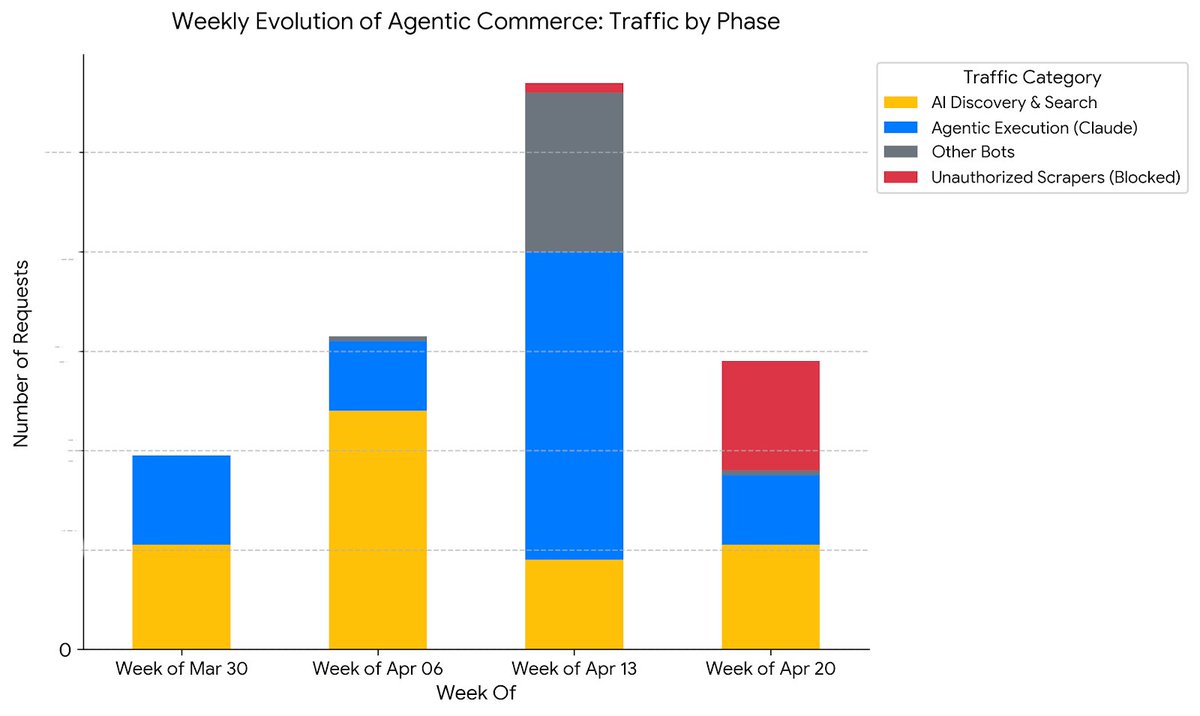
We are actually seeing the early stages of this play out in live traffic logs right now.
Over the last month, we’ve tracked a massive shift from passive AI discovery to active "Agentic Execution."
Agents (like Claude Assistant) are already bypassing the browser, using a second surface by querying M2M catalogs, and autonomously executing checkouts built on UCP.
The agents are definitely here and competing. Now brands need the "dual-surface" infrastructure to let them transact securely.
English

Shopify has a utility that scans your store AI readiness. Even checks for llms.txt (which will make SEO nerds on youtube angry.) Looks like a Claude Code hackathon project for sure.
commerce-readiness.shopify.io

English

Agentic Commerce isn't just a roadmap item anymore. It’s showing up in the traffic logs.
We mapped our platform's AI traffic over the last month and found a shift from passive AI discovery to fully autonomous, agent-executed checkouts built on UCP.
Brands that build bridges (enabling M2M protocols) rather than just walls (blocking all bots) are the ones likely to win this next era.
Here is a look at the data, the gaps, and how to build a "dual-surface" architecture: x.com/JeremyMearsX/s…

English