Joseph Agemy

86 posts

Joseph Agemy banner
Joseph Agemy

Joseph Agemy

@JmAgemy

Katılım Temmuz 2024
255 Takip Edilen10 Takipçiler
Joseph Agemy
Joseph Agemy@JmAgemy·
@Moth3rmomo He misinterprets Matthew 16:18. Gates are defensive structures. Christ’s point is not that Hell is assaulting the Church, but that the kingdom of death cannot withstand the advancing reign of Christ through His Church.
English
0
0
0
119
Momo
Momo@Moth3rmomo·
God bless deacon because I would’ve walked out this is like unintended ragebait
English
23
13
291
13.2K
Chris 8 Limbs ☦️🕵️
Protestant Dilemma: If Orthodoxy is true, Protestantism is false. If Orthodoxy is false, the early Christians were false and Protestanism is false. @ByJimbob point is strong
English
146
92
745
35K
Joseph Agemy
Joseph Agemy@JmAgemy·
Salvation by grace through faith did not begin with the Reformation. Christ Himself said: “Whoever hears My word and believes Him who sent Me has eternal life. He does not come into judgment, but has passed from death to life.” — John 5:24 Paul wrote: “For we hold that one is justified by faith apart from works of the law.” — Romans 3:28 Church Fathers and historical Christian figures who taught themes substantially compatible with salvation by faith apart from works: • Clement of Rome (1st century) “We… are not justified by ourselves… nor by works… but by faith.” • Origen (3rd century) “A man is justified by faith apart from works of the law.” • John Chrysostom (4th century) “Faith is sufficient for salvation.” • Augustine of Hippo (4th–5th century) Strongly taught salvation by grace, human inability apart from grace, and that God “crowns His own gifts in us.” • Anselm of Canterbury (11th century) Emphasized salvation grounded in Christ’s work rather than human merit. • Bernard of Clairvaux (12th century) “It is sufficient for me for all righteousness merely to have Him alone gracious to me.” • John Wycliffe (14th century) Emphasized salvation by grace through faith and the supremacy of Scripture. • Jan Hus (15th century) Preached justification rooted in grace and faith before Luther. Christ and the Apostles consistently pointed to the Word of God as the supreme authority. Christ said: “Man shall not live by bread alone, but by every word that proceeds from the mouth of God.” — Matthew 4:4 “And why do you break the commandment of God for the sake of your tradition?” — Matthew 15:3 Paul wrote: “All Scripture is breathed out by God and profitable for teaching, for reproof, for correction, and for training in righteousness, that the man of God may be complete.” — 2 Timothy 3:16–17 Church Fathers and historical Christian figures who strongly emphasized the supremacy and sufficiency of Scripture: • Cyril of Jerusalem (4th century) “For concerning the divine and holy mysteries of the Faith, not even a casual statement must be delivered without the Holy Scriptures.” • Athanasius of Alexandria (4th century) “The holy and inspired Scriptures are sufficient of themselves for the preaching of the truth.” • Basil of Caesarea (4th century) “It is a manifest falling from the faith… to reject anything written, or introduce anything not written.” • John Chrysostom (4th century) “Everything in the divine Scriptures is clear and straightforward.” • Augustine of Hippo (4th–5th century) “In the plain teaching of Scripture we find all that concerns our belief and moral conduct.” • Vincent of Lérins (5th century) Frequently appealed to Scripture as the foundational authority while arguing for catholic interpretation. • John Wycliffe (14th century) “Holy Scripture is the highest authority for every believer.” • Jan Hus (15th century) Called Christians to obey Scripture above ecclesiastical corruption and human tradition. The Reformers did not invent reverence for Scripture. What they did was press the question: if Scripture is God-breathed, what authority can stand above it? Have a good day!
English
2
0
1
39
Joseph Agemy
Joseph Agemy@JmAgemy·
History must be read in context. Ignatius is arguing for unity under a bishop who is faithfully preserving apostolic teaching—not for a bishop as an independent source of authority. His whole concern is guarding the Church from heresy, which means the bishop’s authority is assumed to be tied to the apostolic faith. If a bishop departs from that faith, Ignatius gives you no reason to follow him—because the standard is still the apostolic teaching itself.
English
1
0
0
72
Onofre ☦︎
Onofre ☦︎@romero_mau69771·
@JmAgemy @chrislives78 @ByJimbob “Where the bishop appears, there let the multitude be; even as where Jesus Christ is, there is the Catholic Church.” “He who does anything apart from the bishop and presbyters and deacons is not pure in conscience.” St Ignatius of Antioch circa 107 AD
English
1
0
7
91
Joseph Agemy
Joseph Agemy@JmAgemy·
Agreed—the Spirit does not lead into contradictory truth. That is why we must look to the apostolic faith once for all delivered (Jude 1:3). The question is where that faith is normatively preserved. Scripture, as the God-breathed and universally binding record of apostolic teaching (2 Tim. 3:16–17), provides the objective standard by which all claims—whether of churches or traditions—must be tested.
English
1
0
0
20
Joseph Agemy
Joseph Agemy@JmAgemy·
The Establishment Clause of the First Amendment was intended to prevent the federal government from establishing a national church, while also prohibiting it from interfering with the free exercise of religion by the states and their citizens. At the time the First Amendment was written and ratified, nine of the thirteen states had established state churches, and several continued to maintain them for years afterward. The states reserved to themselves the authority to establish a state church if they chose. That was part of the constitutional structure reflected in the First and Tenth Amendments.
English
0
0
0
35
Eric Daugherty
Eric Daugherty@EricLDaugh·
🚨 OMG. Rep. Jamie Raskin (D) just got HUMILIATED by 16-year-old patriot Marco Hunter-Lopez, despite Raskin CONSTANTLY cutting him off during the Sharia Law hearing RASKIN: Jefferson described in the letter to Danbury Baptist— LOPEZ: That's a letter, not a law. RASKIN: So your position is that America is a theocracy?! LOPEZ: You didn't let me finish my original statement. What I am saying is we need to acknowledge— *Raskin does more interrupting* LOPEZ: We do need to acknowledge our Christian heritage in America. RASKIN: You can't impose an establishment of religion on other people. LOPEZ: I didn't suggest that at ALL. RASKIN: Everyone can acknowledge their own heritage. LOPEZ: AMERICAN HERITAGE. RASKIN: ...Muslim heritage? LOPEZ: I'm saying MEMBERS OF CONGRESS need to acknowledge American heritage. *Raskin gets flustered* 🇺🇸🇺🇸🇺🇸
English
1.3K
3K
18.4K
624.2K
Joseph Agemy
Joseph Agemy@JmAgemy·
That claim betrays a basic confusion about American origins. Yes, the Catholic Mass was celebrated in the Spanish settlement of St. Augustine, La Florida. But the United States of America did not grow out of Spanish Catholic settlements, it arose from the English Protestant colonies. The nation that declared independence in 1776 was the outgrowth of English political, legal, and religious traditions. Its framework was shaped by English common law, the legacy of the Magna Carta, and the broader constitutional developments of England, not by the institutions of Catholic Spanish colonialism. While Catholic explorers and missionaries were present earlier in parts of North America, they did not produce the political order that became the United States. The thirteen colonies were English in origin and deeply influenced by Protestant thought emerging from Reformation-era England and Northern Europe. The culture, legal system, and founding ideals of the United States, representative government, the rule of law, and ordered liberty, are unmistakably rooted in that English Protestant inheritance. To blur that distinction is not just imprecise, it fundamentally misunderstands where the United States actually came from.
English
0
0
1
30
Sachin Jose
Sachin Jose@Sachinettiyil·
“The first Christian service on our soil was a Catholic mass.” US Secretary of State Marco Rubio deliveres a powerful speech reminding America of its deep Catholic heritage
English
388
2.9K
17.3K
482.7K
Joseph Agemy
Joseph Agemy@JmAgemy·
Pre-Constantinian and early post-Constantinian writers (1st–early 5th centuries) consistently rejected or showed no awareness of image veneration: Many explicitly opposed images in worship to avoid pagan idolatry: Clement of Alexandria (“Works of art cannot then be sacred and divine”); Tertullian (similitude “interdicted”); Origen (Christians “have rejected all images and statues” and avoid them in worship); Lactantius (“there is no religion wherever there is an image”); Arnobius (“there is nothing divine in images”). • Synod of Elvira (~300–314 AD, 19 bishops): “Pictures are not to be placed in churches, so that they do not become objects of worship and adoration.” • Irenaeus and Hippolytus condemned heretical groups (e.g., Carpocratians) for honoring images of Christ “after the same manner of the Gentiles.” • Eusebius of Caesarea (~263–339 AD) described a statue of Christ (a Gentile custom) but opposed depicting Christ’s human form as breaking the commandment. Epiphanius (~310–403 AD) tore down a church curtain with an image, calling it “contrary to our religion.” • No mainstream leader before ~500 AD advocated veneration in worship. Favorable mentions of art (e.g., for memorials) exist, but none describe cultic acts. Some claimed pro-icon quotes (e.g., a disputed Basil letter) are later forgeries. Pagans sometimes criticized Christians for lacking images (calling them “atheists”), and Christians responded by emphasizing their rejection of such practices. Historians trace sacral image veneration to late antique adaptations of Greco-Roman and imperial customs, not apostolic origins. It was not uniform or “early” in the sense of the 1st–4th/5th centuries. In short, real historical sources (artifacts and texts) indicate the earlier Church used images sparingly for non-cultic purposes and actively distinguished itself from image-honoring practices. Icon veneration was a later development, emerging centuries after the apostolic era.
English
0
0
0
82
DeeDee
DeeDee@KalaDeeDee·
The original church had icons- as that was the praxis of early Christianity- but the current ones are from post iconoclastic period. During iconoclasm crosses were painted over the icons. This can also be seen in the nearby Agia Irini Church. As well as in the beautiful Cathedral inn Thessaloniki.
English
1
0
2
120
Thought Eater☦️
Thought Eater☦️@FROTHSOF·
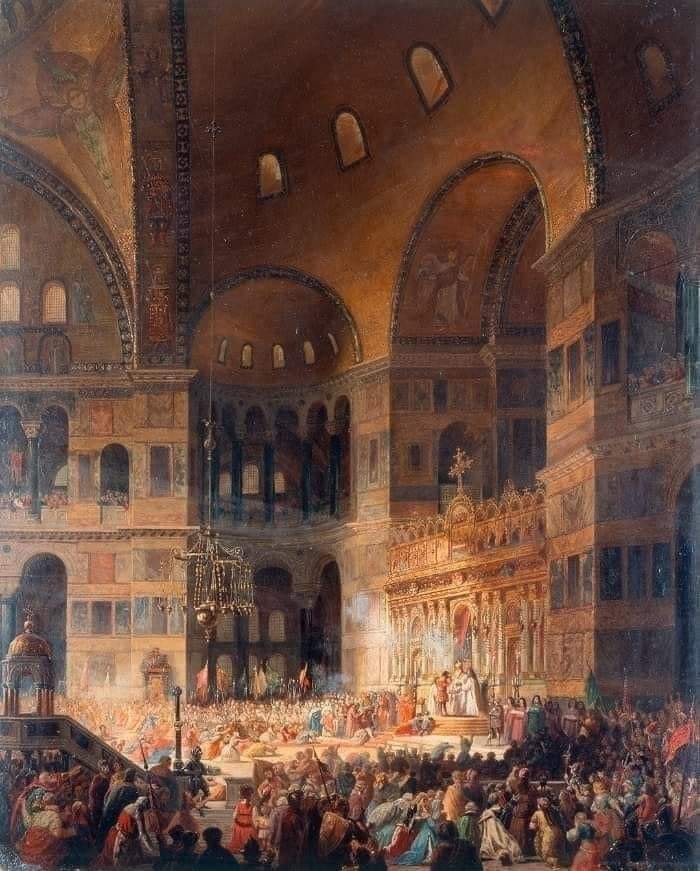
Imagine attending a Divine Liturgy in the Great Church of Constantinople
Thought Eater☦️ tweet media
English
30
162
2K
22.4K
Joseph Agemy
Joseph Agemy@JmAgemy·
@PatriotsTLH @jonharris1989 Yes! Bring on the faith of the female usurper who had her sons’ eyes gouged out — so she can host big, beautiful pictures and kiss them! That's what we have been missing!
English
1
0
0
104
Jon Harris 🌲
Jon Harris 🌲@jonharris1989·
Does this sound right wing or left wing to you? - The Left isn’t a threat. - Transgenderism isn’t a threat. - Islam isn’t a threat. - Iran isn’t a threat. - Israel is a threat. - Trump is a threat. - Bible Belt Southern Christians are a threat.
English
60
18
296
17K
Joseph Agemy
Joseph Agemy@JmAgemy·
Who are my brothers, sisters, and mother? Those who do the will of my Father in heaven. Not those who happen to live close to me. My neighbors may even be my enemies—and Scripture tells us we will have enemies, especially when we pursue righteousness. I will pray for my enemies, but they are not my brothers and sisters. Only in Christ can they become so. You claim to be a learned man of the faith. Do you not know these things?
English
2
0
3
476
Pope Leo XIV
Pope Leo XIV@Pontifex·
#Peace is not something we must invent: it is something we must embrace by accepting our neighbor as a brother or sister. We do not choose our brothers and sisters: we must simply accept one another! We are one family, inhabiting the same home: this wonderful planet that ancient cultures have cared for over millennia. #ApostolicJourney #Cameroon
English
6.7K
14.3K
78.2K
1.3M
Joseph Agemy
Joseph Agemy@JmAgemy·
The word "culture" can be used in two main senses. The first is the literal meaning: the tilling or cultivation of the ground. In the second sense, culture refers to that which grows up organically out of a nation or people through their shared beliefs. In this sense, our hearts and minds are the soil being tilled, and beliefs function as the seeds that are planted. Culture, then, is the fruit of a nation’s beliefs—what it ultimately worships. For nearly two millennia, the culture of Europe and the West has been Christian. The soil was tilled, and the good seeds of the gospel were planted. It was a vineyard established by Christ and His apostles. Over time, however, the hired hands entrusted to protect and cultivate the Lord’s vineyard forgot whose it truly was. They began to re-till the ground and sow different seeds—seeds that are now growing into a new culture, bearing different fruit and manifesting the worship of foreign gods. Yet the Papacy continues to urge their faithful not to fear this transformation. It assures us that the new seeds are compatible, or essentially the same as the old. The echo of the Secularist spirit of the age rings loud within the Vatican. Meanwhile, Europe is already feeling the thorns and thistles of this new planting.
English
0
0
0
49
Jack Posobiec
Jack Posobiec@JackPosobiec·
Pope Leo: “In Europe, fears are present but often generated by people who are against immigration and trying to keep out people who may be from another country, another religion, another race. I would say that we all need to work together."
English
3.5K
374
1.5K
391.4K
Joseph Agemy
Joseph Agemy@JmAgemy·
@theblaze Spoken like a true man after satans own heart. Stir up envy to justify theft. At least two commandments being broken there. A son of lawlessness indeed.
English
0
0
0
330
TheBlaze
TheBlaze@theblaze·
Mamdani: “Findings have shown that the wealth of a median white household in the city is more than $200,000, while that of a black household is less than $20,000. Our commitment now is to act upon these findings.”
English
228
25
80
99.7K
Benonwine
Benonwine@benonwine·
King Charles: I will protect all faiths, not just Christianity "His decision NOT to give us an Easter message, yet give the Muslim community an Eid one, is a profound mistake!" He’s no longer defender of the Faith!
English
441
3.7K
23.4K
228.3K
Michael Knowles
Michael Knowles@michaeljknowles·
A viewer demanded I touch the grass behind me to prove it wasn’t CGI on a green screen.
English
1.6K
2.7K
65.5K
10.3M
Joseph Agemy
Joseph Agemy@JmAgemy·
This is where secular humanism has brought us; it was inevitable. At the heart of secularism is relativism—the denial of absolute truth, maintained with absolute certainty. It is incoherency in bodily form; think of a jellyfish with legs. Without absolutes, there is no real standard by which to judge. This is why Catherine Connolly and those who elected her cannot see the difference between what Saint Patrick brought to Ireland and what Islamists bring today.
English
0
0
0
18
Tommy Robinson 🇬🇧
Tommy Robinson 🇬🇧@TRobinsonNewEra·
President of Ireland, Catherine Connolly, St Patrick's Day speech; "The story of Patrick's life serves as a reminder of the courage of migrants" They're demoralising every aspect of the lives of white people in their own countries. All by design.
English
914
2.2K
15.5K
210.1K