John Stanley
655 posts


@exjon Any historical podcast that interviews Richard Frank, is doing something right.
English

@JohnStanle80352 Absolutely. It served as some great research for my writing. All the little throwaway details about serving on a Gato-class sub. He really knows his stuff and is just a good dude.
English

Bill Toti is THE MAN! Fantastic choice! #SilentService
OSINTdefender@sentdefender
Hung Cao, the Acting U.S. Secretary of the Navy, has announced that William J. Toti, the Former Captain of the Los Angeles-class submarine USS Indianapolis (SSN-697) and Commodore of Submarine Squadron 3, will perform the duties of Undersecretary of the Navy.
English

@kvam95886 @baseballinpix Hunter and Finley.
Finley allowed the owners worst nightmare, a high value player, in his peak years, to become a free agent.
English

@notgaetti Do not forget very early Mets getting aging sluggers, with both Duke Snider and Gil Hodges, both on the 1963 roster.
English

Remember that this is, after all, the team of late-career Willie Mays, Yogi Berra, George Foster, Moises Alou, Rickey Henderson, Gary Sheffield, Bobby Abreu, and so on….
The Mets aren’t just *interested* in aging sluggers with declining bat speed; they’re *addicted* to them.
Robbie Bangers@RobertSportsBet
@notgaetti What interest would the Mets have in an underwhelming, aging slugger with declining bat speed?
English

@TheGascon Where are the sails? Where are the marine sharpshooters?
English

@GMcLean1988 @ESPNMcGee @MartySmithESPN I think your looking at Sampson, of the Old Testament.
He already has the tattoo on his left arm.
English

@ESPNMcGee @MartySmithESPN Rate this guys mullet. Honest opinion
Pittsburgh Steelers@steelers
Gennings Dunker. STEELER.
English

@ReemAmirIbrahim @reason This flies in the history of British outdoor preaching, as done by religious leaders as George Whitefield and John Wesley in the 18th century.
I can only assume he is making people feel “uncomfortable”, due to living his faith, not by any action or word.
English

@johnbryanesq @SamaHoole Agreed. The 17th century English settlers did have abundant wildlife, as a food source. The early “thanksgiving” celebrations were filled with fish and shellfish.
English

Well, Virginia was first and they did it as an organized business venture to obtain profits. And the Virginia Company did own (via a deal with the king, eg, “Jamestown”) and distribute titles to land to wealthy participants slash investors who volunteered. The game situation wasn’t great, particularly because of hostile Indians surrounding them. They ate a lot of oysters and sturgeon. Many wanted to escape back to Britain and were held against their will. They almost starved to death while under siege. Eventually things improved and I’m sure they enjoyed fresh venison, once they survived the first decade or so of struggling to survive.
English

The school textbooks tell you the settlers crossed the Atlantic for religious freedom.
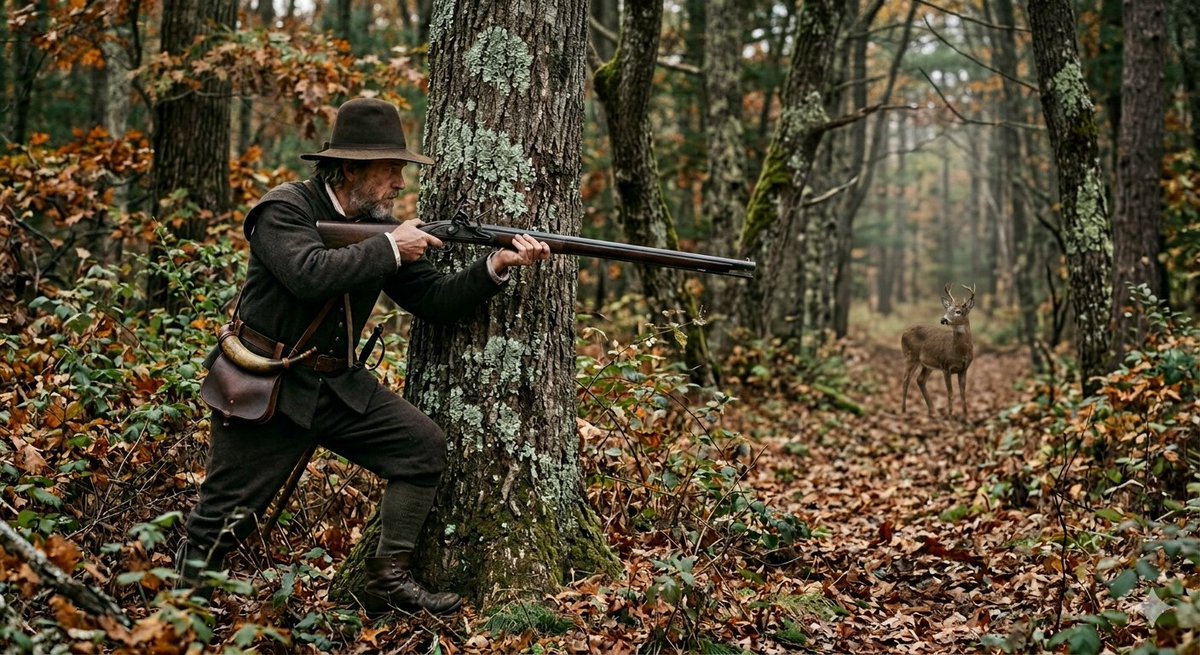
Some of them did, partly. What the textbooks leave out is the thing that sits in the actual letters, in the sailors' accounts, in the merchant pamphlets circulating in English ports from the 1580s onwards: a major reason people came to America was the wild game. Meat you could take. Meat nobody owned. Meat that walked into camp.
For a population legally separated from the animal for five hundred years, this was the whole pitch.
Consider what they were leaving.
A family in a Devon cottage in 1618 eats pottage. Oats, barley, an onion, whatever greens grew near the back door. No meat in it this week. No meat in it last week. There will be meat in it on Christmas Day, God willing, if the chicken is still alive by then. The deer in the forest at the end of the lane have been the king's property under the Forest Laws since 1066. Taking one is a hanging offence. The father has never taken one. His father never took one. The institutional memory of not taking one goes back five hundred and fifty-two years.
Then the stories arrive. From sailors. From ship's captains. From merchants returning through Bristol and Plymouth.
The birds come in flocks that darken the sky for three days. Not an afternoon. Three days. Passenger pigeons in numbers later estimated at three to five billion in a single flock, making a sound early settlers compared to the roar of a river that refused to stop. A man with a net could take five hundred in an afternoon. The king of England had no claim on the sky over Massachusetts.
The rivers, the captains said, ran so thick with salmon that the water appeared to boil. The deer walked into camp, looked at the fire, and were shot. The oysters on the Atlantic shore came the size of dinner plates, piled in reefs you could lean over the side of a boat to harvest. Turkeys weighing thirty pounds stood in clearings with the fearlessness of an animal that had never been hunted by anything on two legs. Bison herds on the plains took four hours to cross a ford.
And nobody, crucially, owned any of it.
The father in Devon lies awake that night thinking about the sky going dark for three days. He is also thinking about religious freedom. Theological persecution was real. The Mayflower passenger list included genuine dissenters. That was part of it. It was not, for most of them, the biggest part.
The biggest part was that the animals in the captain's story belonged to nobody, and the family had been watching animals that belonged to somebody else walk past their cottage for twenty generations.
Between 1620 and 1640, roughly 20,000 people made the crossing. By 1700, 250,000. By 1900, fifty million Europeans had crossed, most of them peasants from cultures where meat had been restricted for centuries, most of them arriving within the first generation at a standard of eating their grandparents would not have believed.
A labourer in Pennsylvania in 1750 was eating more meat per week than an English nobleman had eaten in 1450. An Irish emigrant's grandchild in Boston in 1900, whose great-grandmother had starved in 1847 while Irish cattle were shipped past the coffin ships to English markets, was eating steak on a Tuesday and not thinking about it.
At the centre of the great migration was hunger. Specifically, hunger for meat. Enforced since 1066, reinforced by Enclosure for another four hundred years, reinforced by the quiet understanding that the venison belonged to the lord and the pottage belonged to you.
They crossed an ocean because, finally, you could go somewhere the deer walked into camp and the pigeons blocked out the sun and nobody had a legal claim on any of it.
You could eat like a lord without owing a lord anything.
They crossed an ocean for that.
And having got to it, they did not give it back.

English

@JoshKraushaar @mkhammer There are a few court cases still pending on the amendment.
English

If a genie grants me 3 wishes, I’m using one of them to cure Nick Lodolo’s blister problems forever.
Enquirer@Enquirer
Reds LHP Nick Lodolo to make rehab start Sunday in Dayton cincinnati.com/story/sports/m…
English

@ReemAmirIbrahim @robbysoave The United Kingdom is a continuing warning of why governments must be of limited powers, and constrainted by a written constitution.
English

How can saying "For God so loved the world" land you in court?
This 77-year-old retired pastor is going to court tomorrow for holding a sermon within 100m of a hospital. Read more here 👇
reason.com/2026/04/21/ret…
English

@notgaetti @mikepiazza31 Here is a thought exercise: If a catcher works with very good pitchers, does the catcher gets unfairly less credit?
My example is Javy Lopez years of catching for the Braves.
English

This means a lot to hear
Posada being a one-and-done on his only HOF ballot — given his drawer full of World Series rings and tremendous offensive output among catchers — was a travesty of the highest order.
@mikepiazza31 is the only other catcher with 275 HR and an .840 OPS!
Mark Twitty@Marklen916
@notgaetti You've almost overcome my ingrown belief that all Yankees are overrated, at least where Posada is concerned
English

First - that's not Smokey Yunick. 2nd - that looks like Humpy Wheeler talking to the woodchopper HOFer Glen Wood.
Happy Motorhead@HappyMotorhead
Legendary NASCAR engineer and engine builder Smokey Yunick discussing a Ford 427 SOHC "Cammer" V8 racing engine ~ Cool or Not?
English

@NASCARInsights For historical context, David Pearson won ever single race for Ford Motor-Mercury from August 20, 1972 to May 4th, 1975. Pearson streak being the was a total of 20 wins.
English

@nut_history The power, the grace, and speed, Clemente was a great player.
youtu.be/puK5_DABXS4?si…

YouTube
English

@exjon Giving the crew the H.O.R. diesel engine, as a challenge to overcome?
English