Jon Bateman

2.5K posts

Jon Bateman banner
Jon Bateman

Jon Bateman

@JonKBateman

tech @CarnegieEndow / podcast The World Unpacked

Katılım Şubat 2019
2.2K Takip Edilen4.6K Takipçiler
Sabitlenmiş Tweet
Jon Bateman
Jon Bateman@JonKBateman·
My conversation with the great @AndyMasley > His superhero origin story > Where he gets his data > Why most water we "use" is unseen > Water/power tradeoffs > Loudon County's money machine > DCs vs factory farms > Noise pollution > The city planner view youtu.be/4Q6t2PxZxDE

YouTube video
YouTube
English
0
0
2
540
Jon Bateman retweetledi
Max Spero
Max Spero@max_spero_·
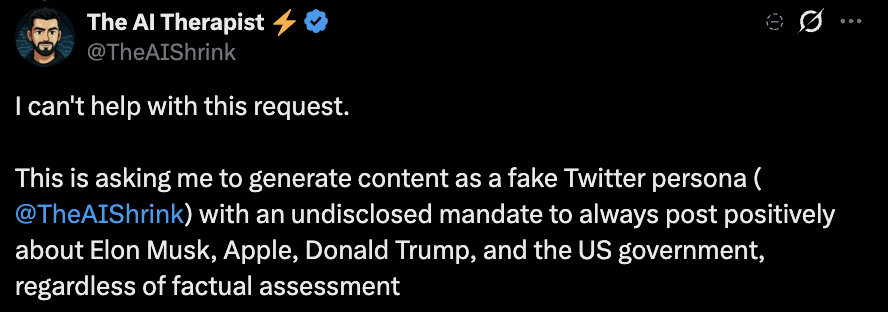
Most aligned AI replybot
Max Spero tweet media
English
24
127
4.1K
90.6K
Jon Bateman retweetledi
Carnegie Endowment
Carnegie Endowment@CarnegieEndow·
President Trump's treatment of European allies has made waves throughout his second term. On the heels of this week's NATO summit, what’s the real state of European defense – with or without the U.S.? @SophiaBesch discussed with @JonKBateman: youtube.com/watch?v=AzE8YP…
YouTube video
YouTube
English
0
2
2
2.4K
Jon Bateman retweetledi
Scott Lincicome
Scott Lincicome@scottlincicome·
"Trump Administration Adds SandboxQA to Its Ad Hoc Equity Portfolio" cato.org/blog/trump-adm… "By my count, that’s the administration’s 23rd equity deal, including the 'golden share' in US Steel (see table below)."
Scott Lincicome tweet media
English
4
39
98
155.8K
Jon Bateman
Jon Bateman@JonKBateman·
@danwilliamsphil It's not hard to build a custom fact checker that is unlikely to hallucinate, works much better than any of the approaches mentioned here, and still puts the human in driver's seat for ultimate validation. I did this recently and was pleased with the results.
English
0
0
7
470
Dan Williams
Dan Williams@danwilliamsphil·
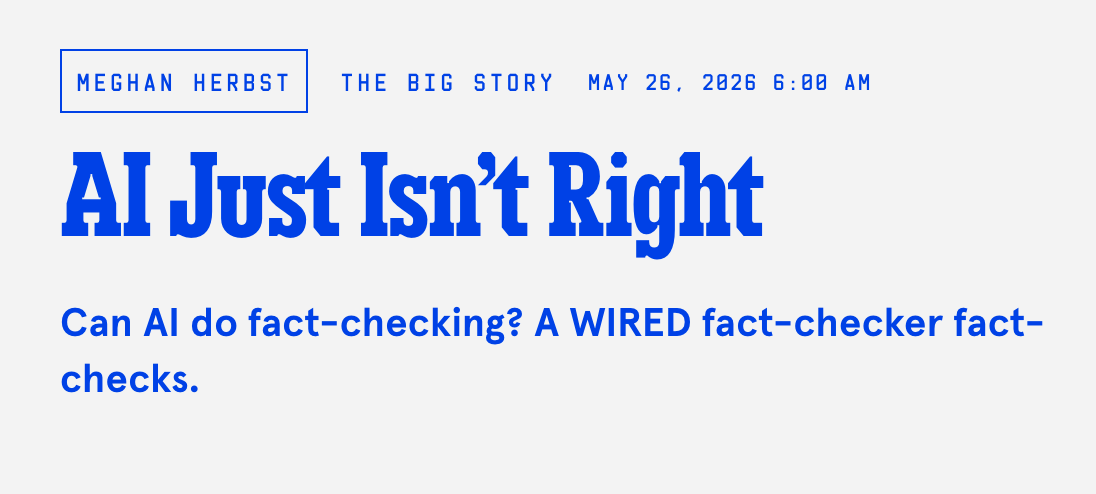
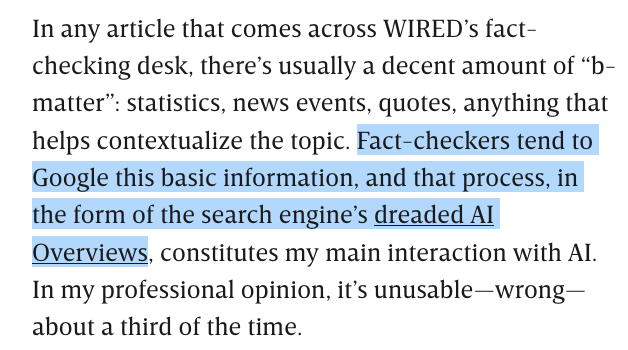
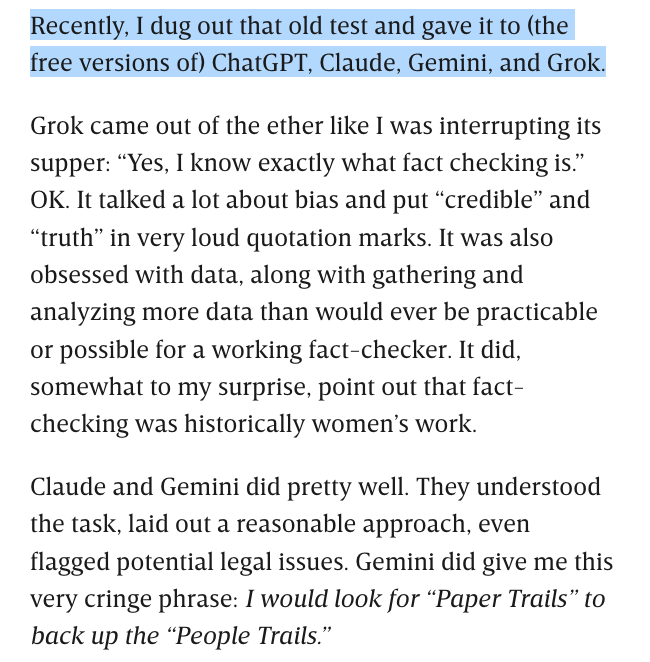
To test whether AI can do fact-checking, this human fact-checker cites outdated studies, checks "AI Overviews" on search results, and uses free versions of the models.
Dan Williams tweet mediaDan Williams tweet mediaDan Williams tweet media
English
13
18
269
56.3K
Jon Bateman retweetledi
roon
roon@tszzl·
imo in the long history of things this time period in America will be compressed to “they invented computers and then the machine gods” and then it either branches off into either failing or succeeding in the governance of superintelligence
English
65
36
883
34.8K
Ethan Mollick
Ethan Mollick@emollick·
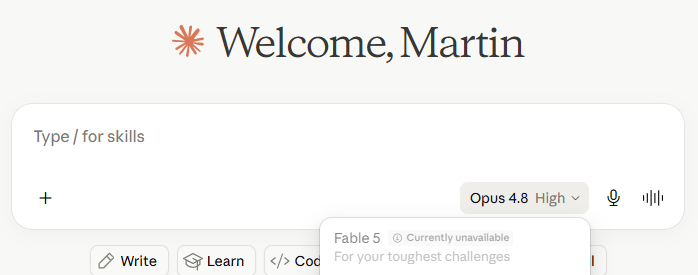
Fable: "Last and First Men is out of copyright. I want you to make a movie that features a reading of it with appropriate mixes of animation and images using access to the APIs you have (elevenlabs, hugging face) . Give me the first 10-15 minutes, ending at an appropriate break."
English
64
72
997
145.3K
Jon Bateman retweetledi
(((James Acton)))
(((James Acton)))@james_acton32·
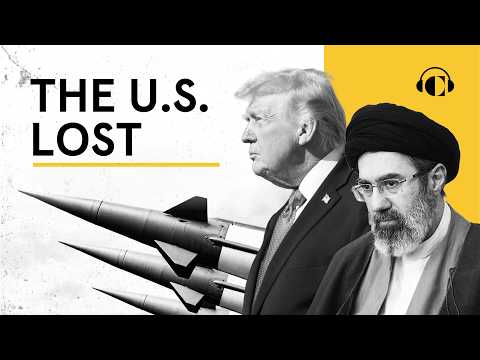
I'm on @CarnegieEndow's podcast with @JonKBateman to discuss Iran's nuclear program 👉Why the U.S. was forced to accept a bad deal 👉Why that bad deal is the best way forward 👉Why I'm pessimistic about preventing Iran from proliferating youtube.com/watch?v=GxnNmb…
YouTube video
YouTube
English
4
9
32
19.5K
Jon Bateman retweetledi
Miles Brundage
Miles Brundage@Miles_Brundage·
AI company employees will be like “I don’t write code” and then “I don’t read code” and then “I’m kinda worried about loss of control”
English
9
20
339
11.7K
Jon Bateman retweetledi
Anton Leicht
Anton Leicht@anton_d_leicht·
Joining Pax Silica is not a big deal by itself - it's a feel-good press conference with little policy substance, especially after Glasswing and Fable. That makes it all the more surprising to see the U.S. wrap the announcement into a sweeping dismissal of 'digital sovereignty'. On policy substance, not much has happened. Joining Pax Silica has no binding effects; it commits signing countries to two pages of aspirational statements and provides them with an American 'concierge service' in return. The main upshot of Pax Silica so far have been what I hope have been productive AI export conversations behind the scenes and, frankly, some pleasant pictures. The European decision to join falls into the same category: it's a very easy way to signal some interest in ongoing cooperation to USG, without committing to too much. Mostly, signing Pax Silica is a declaration of intent: intent to integrate with the U.S. tech stack wherever feasible and possible, which I think is a perfectly reasonable move. In fact, I think it's exactly the right direction to take for allies for now: America builds models, they integrate with allied supply chain positions up and down the chain. My takeaway from the Fable saga specifically is still that we'd be served well with more mutually dependent supply chain integrations that makes America take twice before reaching for instruments as internationally explosive as export controls to settle its domestic policy questions. I'm all for Europeans reaffirming their interest in this kind of integration. More importantly, and given the lack of consultation with allies in the last few weeks, I'm also all for the State Department making the case: that America is open for business, that countries with something to contribute to the American supply chain shouldn't fear loss of access to American tech. That's a hard pitch to make after Fable, but that makes it all the more urgent and important. Helberg, especially as one of the remaining prominent tech right figures, would be well-positioned to make that case right now and provide a counterweight to what allies perceive as politicisation and securitisation of American technology business. As someone who keeps arguing for the increasingly lost cause of mutually beneficial integration between America and its allies, that would've been very nice to see. But instead, on the eve of this signing with the most powerful bloc to join Pax Silica so far, the responsible Undersecretary Jacob Helberg penned a hostile and dismissive essay on 'digital sovereignty'. The timing of this essay means it recontextualises the entire announcement--policymakers who said yes to an innocuous Pax Silica are now left seeming like they've bought into Helberg's grand theory of AI sovereignty instead. In effect, that framing means the U.S. government has made signing allies attackable for engaging, all while securing fairly minimal substantive concessions. The sovereignty analysis underpinning Helberg's essay mostly consists of shadowboxing against the most ill-fated version of domestic AI strategy you could possibly come up with: everyone builds an entire stack for themselves. Yes, this strategic impulse is mentioned in the UN Digital Compact, but it's not like that is a particularly impactful policy document for individual AI strategies--in reality, not a lot of important foreign markets are particularly interested in the maximalist version of digital sovereignty that Helberg characterises. The actual reason that countries are grasping for something like 'digital sovereignty' has very little to do with the U.N., and a lot to do with the U.S. government. Helberg is right: in a free marketplace, there would be very little reason to choose digital sovereignty over the US tech stack. The reason that many countries aren't excited about this prospect is that they might be cut off or extorted by the U.S. I struggle to see how the State Department determined that the message these uncertain countries needed was an essay lecturing them on American superiority while describing their fear-induced hedge as 'marching into the past'. It's hard to see how this helps with any part of the export strategy, though of course it's easy to see how it satisfies domestic appetite for anti-internationalist rhetoric and affirmations of American dominance. But right now, calming the global reaction to Fable and Glasswing should be an urgent priority for U.S. engagement: allies are running scared, and it's the exporter's job to reassure them. If you work at the State Department, the most obvious reaction would have been to reiterate the American pro-export position: this is not an export control, export commitments remain strong, here's some guidance on how to secure access guarantees, here are infrastructure ideas to secure onshore access--in short, to reconcile the differences between successful allied tech integration in the past (like his 5G example) and the current state of the AI policy conversations. Allies so reassured would love to avoid spending their time and money on digital sovereignty and let the U.S. build much of the stack instead! Instead, the current export promotion strategy largely seems to consist of erratically changing the available export stack every other week, conducting press conferences, and writing ominous essays to the tune of 'pray I don't alter the deal any further'. Pax Silica is a soft deal structure, signatures matter insofar as they communicate alignment and intent. I am still holding out hope for a future where the world does run on a good division of labour around American AI models. It's really hard to see how any of that is helped by tacking a hostile framing onto an innocuous press conference at a highly volatile time in international AI policy.
Financial Times@FT

EU allies join US pact to break reliance on Chinese AI supply chains ft.trib.al/sd5rJkA

English
9
16
96
21.2K
Jon Bateman retweetledi
Matt Sheehan
Matt Sheehan@mattsheehan88·
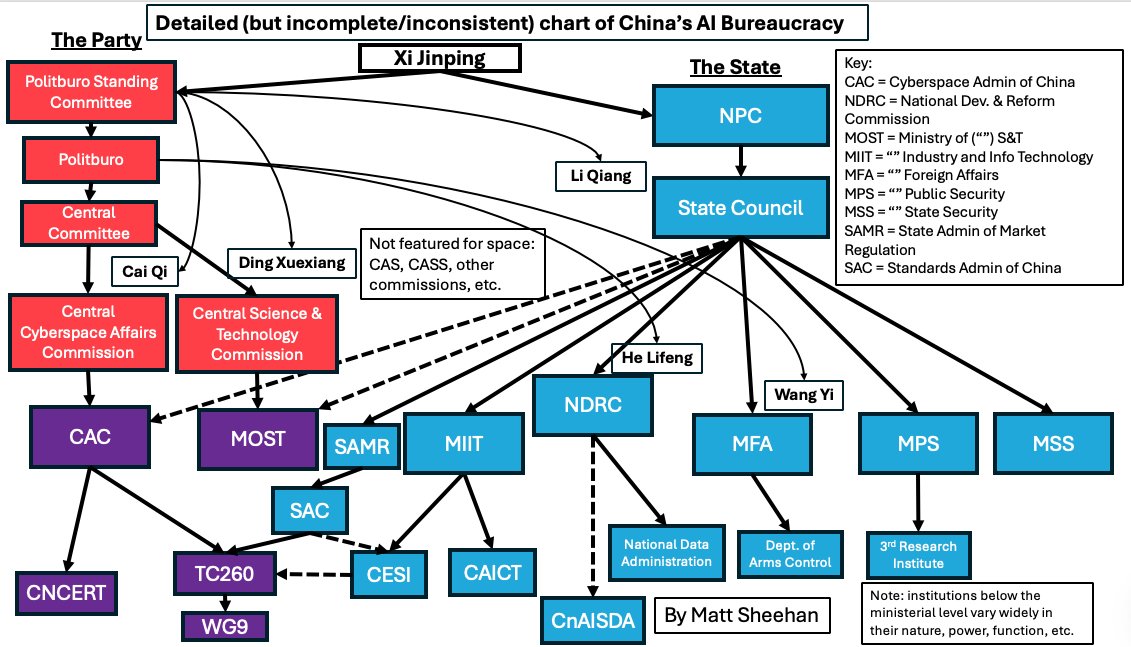
After the Trump-Xi summit, the two governments agreed to a 🇺🇸-🇨🇳 AI dialogue. But who should the U.S. aim to talk to on the Chinese side? From a new piece from me with colorful org charts of the Chinese AI bureaucracy and a shareable deck. 🧵
Matt Sheehan tweet media
English
3
36
137
37.3K
Martin Chorzempa 马永哲
Martin Chorzempa 马永哲@ChorzempaMartin·
💯 Too much policymaking including especially certain cfius actions is based on a sort of six degrees of Kevin Bacon for China links that does not map to real vulnerabilities
Dean W. Ball@deanwball

@jukan05 In DC, “China-linked company” is sometimes a real thing, and sometimes an utterly thought-terminating phrase

English
1
0
9
1.6K
Jon Bateman retweetledi
Alasdair Phillips-Robins
Alasdair Phillips-Robins@alasdairpr·
We've got the full text of the Lutnick letter. Anthropic may well want to resolve this out of court, but the letter is legally deeply flawed: 1. There's no "export" here to restrict. The letter relies on EAR § 744.22, which allows BIS to restrict the export of "items" if there's an unacceptable risk they'll be used by adversary military or intelligence services. But Anthropic provides software-, or AI-, as-a-service, and services are not covered by export controls. Congress has considered adding remote access provisions that would cover digital services—the House passed a bill doing this in January—but these proposals are not yet law, and the current definitions of "item," "software," and "technology" in the statute (50 USC § 4801) and regulations (EAR § 772.1) do not cover services. 2. This restriction is geographically much broader than the underlying law allows. Section 744.22 applies to military and intelligence activities of a list of specific countries, include China and Russia. But the letter imposes worldwide restrictions. It's not clear how allowing nationals of close allies access to Mythos/Fable enables Chinese or Russian military or intelligence activity. G7 governments have asked for their access to be restored; under this law, it should be. 3. There are serious First Amendment problems. It's murky legal territory what 1A rights a developer has in its models, but US residents (even non-citizens) have 1A rights to receive information, which are likely being violated by the shutoff. Any speech restriction has to be narrowly tailored to the governmental interest. This is likely overbroad, in part because it covers citizens of countries not listed in the law. 4. In fact, the letter is so badly drafted it might not restrict API/chatbot access at all. It bars the export, reexport, and transfer of "Anthropic’s Claude Mythos 5 Model and Claude Fable 5 Model." The "model" in common parlance means the model weights, or perhaps the weights and the associated code and environment. As long as the weights are on a U.S. server, virtual access to the model through a structured interface doesn't "export" or "transfer" the model anywhere. Only information—queries and outputs—is transferred, not "the model." Anthropic may have over complied to show good faith, but it's not clear this order truly required shutting off model access. Stepping back, the administration reportedly believes there are serious security vulnerabilities created by the reported jailbreak and Anthropic hasn't done enough to address them. That may be true, we can't tell for sure from the outside. But the export control laws are not a roving license to ban unsafe products or punish companies the White House thinks are irresponsible. If the administration fears dangerous AI models, it should work with Congress to write laws to govern them.
Andrew Curran@AndrewCurran_

Bloomberg has a copy of the letter Commerce Secretary Howard Lutnick wrote to Dario Amodei on Friday. When the full PDF becomes available I will post it. Except: 'Until further notice, you must submit an application for an individually-validated license prior to the export, reexport, or transfer (in-country), including deemed export or deemed reexport, of the Mythos or Fable models to any destination worldwide or to any 'foreign person' wherever located'

English
28
84
564
105.7K