TheJR

5.9K posts

TheJR banner
TheJR

TheJR

@JonathanRenstr3

i like @Theta_Network

Katılım Nisan 2021
218 Takip Edilen674 Takipçiler
TheJR retweetledi
Theta Network
Theta Network@Theta_Network·
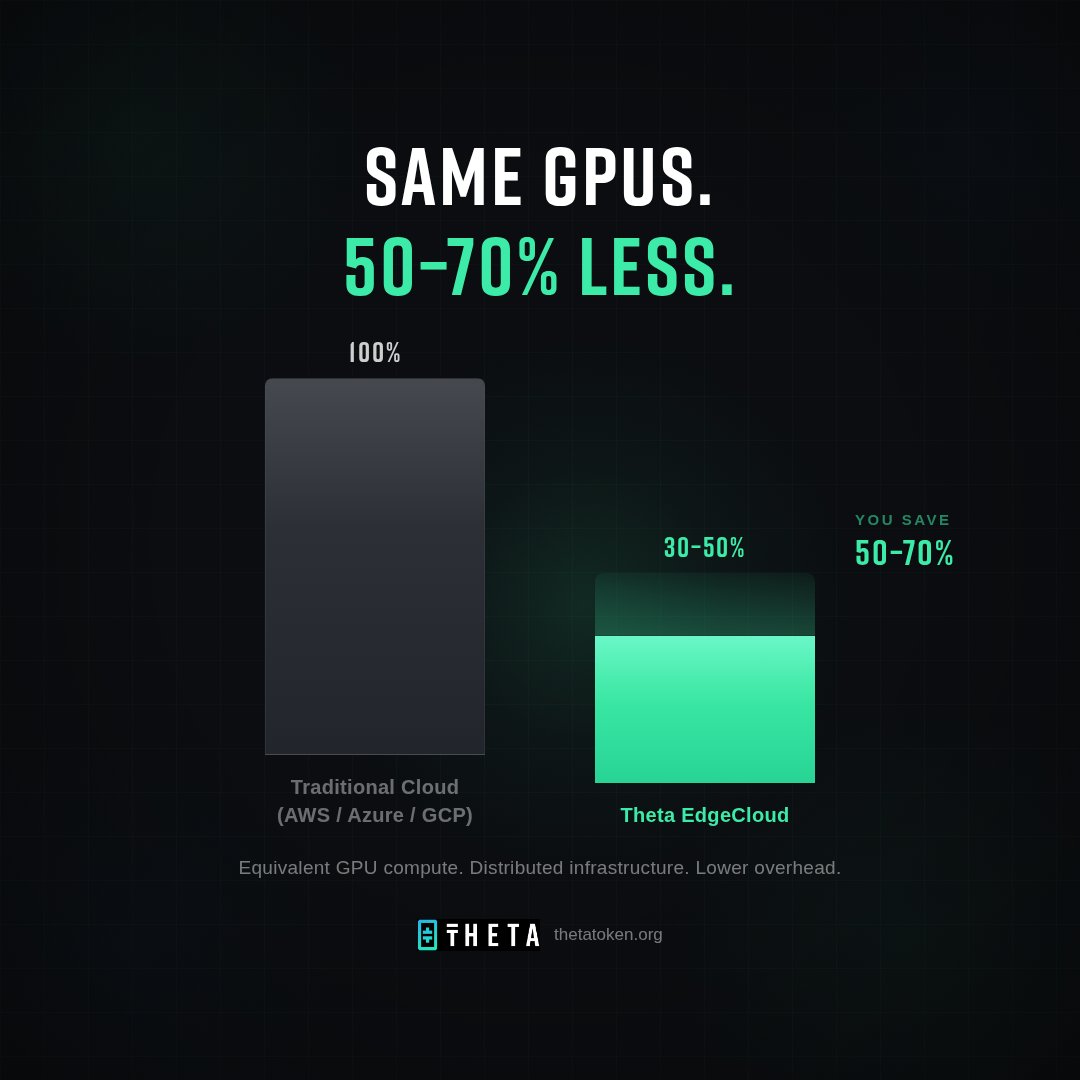
As demand for compute grows, so do the bills from centralized clouds. Theta offers a different model. Distributed infra, 50-70% cheaper GPU compute. Some of the world's leading universities already rely on it for their AI research. Find out more at thetaedgecloud.com
Theta Network tweet media
English
29
128
430
14.1K
TheJR retweetledi
Angel French
Angel French@AnaniBeaumont·
“Getting started with Theta Intelligence is straightforward. If you want a fully managed setup where we handle everything from AI agent configuration to dashboard customization, we offer a white-glove onboarding experience that gets you live quickly.” 🩵 🤖 Whew it’s been a crazyyy month in the theta dimension 🔥
Theta Network@Theta_Network

x.com/i/article/2034…

English
4
10
102
1.9K
TheJR retweetledi
Theta Network
Theta Network@Theta_Network·
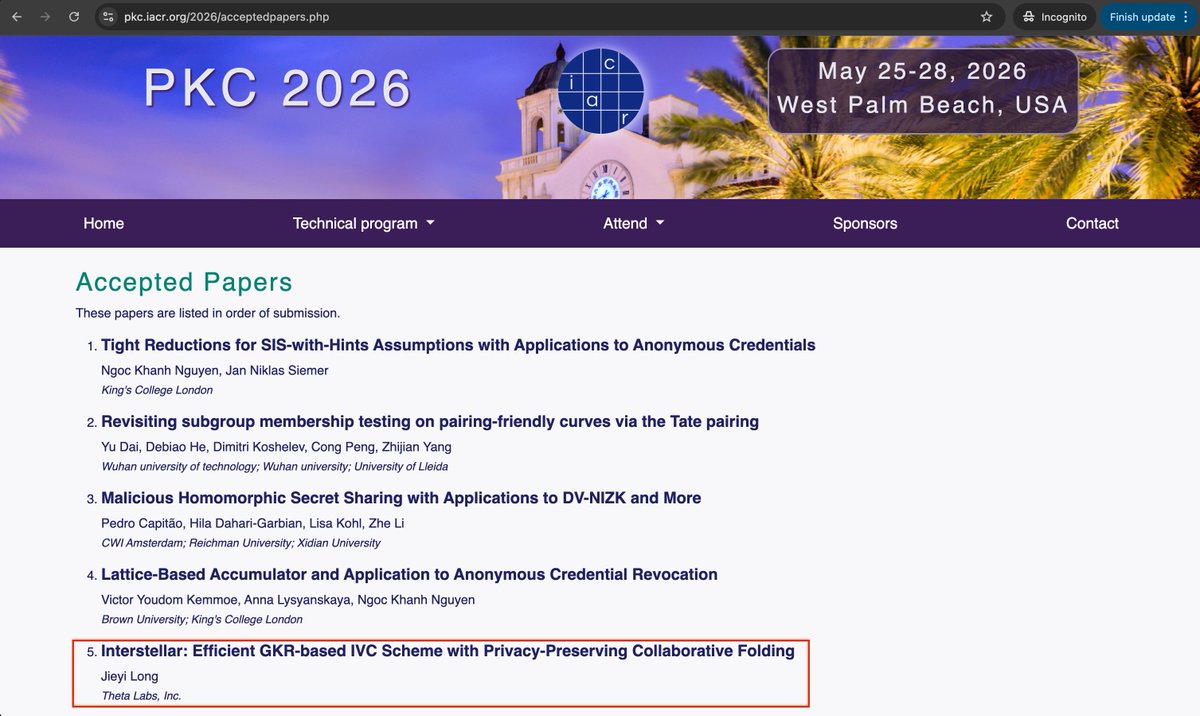
Our CTO has just had his first-authored paper accepted at PKC 2026, one of the top cryptography conferences in the world. The paper introduces Interstellar, a new folding scheme for recursive proofs that significantly cuts prover costs. Huge achievement, Jieyi!
Jieyi Long | Theta Network@jieyilong

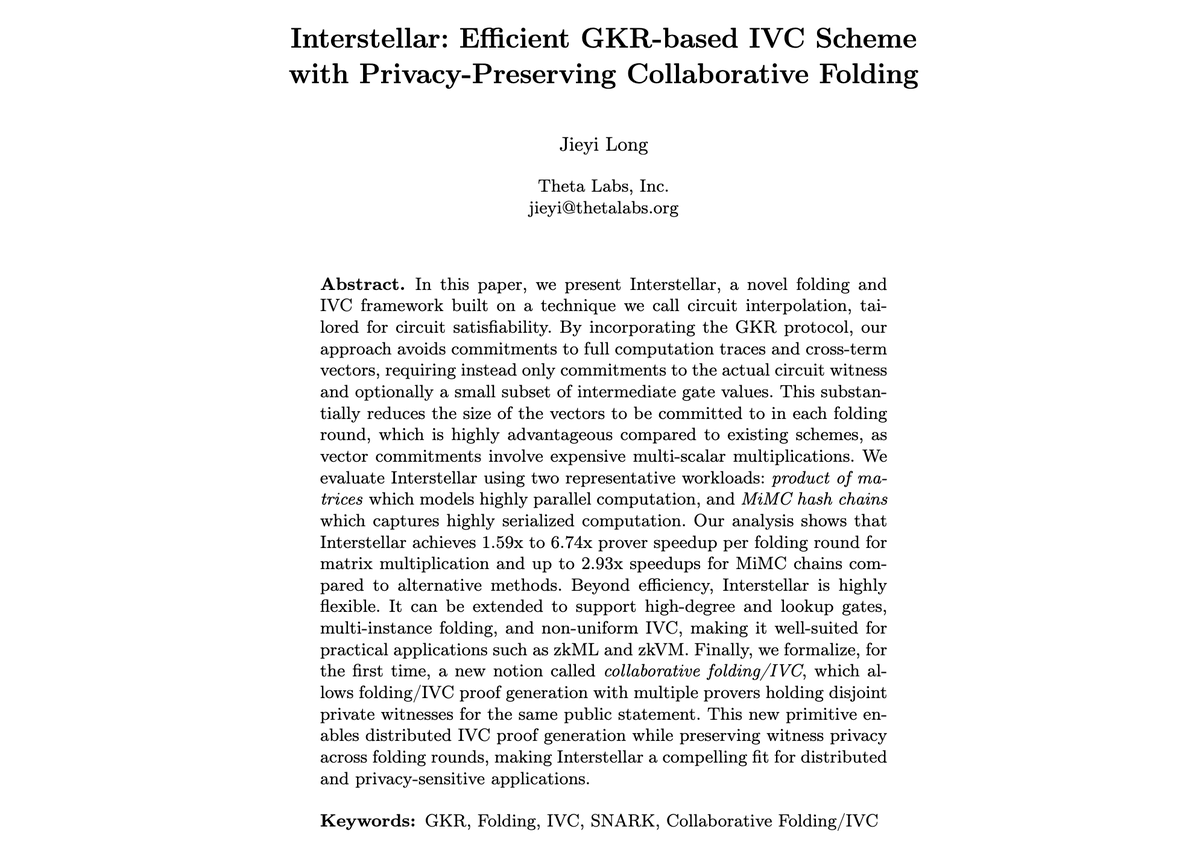
Excited to share that my research work “Interstellar: Efficient GKR-based IVC Scheme with Privacy-Preserving Collaborative Folding” conducted at Theta Labs @Theta_Network has recently been accepted to PKC 2026! PKC (Public-Key Cryptography Conference) is one of the premier cryptography venues organized by the IACR (International Association for Cryptologic Research, iacr.org). IACR conferences represent the gold standard of academic cryptography research, so it’s a big honor to have this work accepted. This is also my first first-authored paper accepted at a major cryptography conference! The paper introduces Interstellar, a new framework for folding schemes and Incrementally Verifiable Computation (IVC) — a key primitive that that has recently attracted significant attention from researchers and is beginning to see widespread adoption in modern recursive zkSNARK systems for scalable blockchains and verifiable computing. Check it out: eprint.iacr.org/2025/1294 Key idea Most modern folding-based IVC systems (Nova, HyperNova, Protostar, etc.) operate on constraint systems and require commitments to the entire execution trace of a circuit. This leads to expensive prover costs dominated by large vector commitments and MSM operations. Interstellar takes a different approach. Instead of committing to the full trace, it works directly with circuit satisfiability and combines a new technique called circuit interpolation and the GKR protocol for circuit verification. This allows the prover to commit only to the actual witness inputs, avoiding commitments to the full computation trace and eliminating cross-term vectors used in many prior folding schemes. Result Because vector commitments are the main cost in folding-based IVC, reducing them yields substantial speedups. Across representative workloads: 1.59× – 6.74× prover speedup per folding round for parallel workloads (e.g., matrix multiplication) up to 2.93× speedup for serialized workloads (e.g., MiMC hash chains) Additional features Interstellar also supports several capabilities needed for real-world zk systems: high-degree gates lookup gates multi-instance folding efficient non-uniform IVC (important for zkVMs and zkML) A new primitive: Collaborative Folding / IVC The paper also introduces a novel cryptography primitive called Collaborative Folding/IVC, which allows multiple provers with disjoint private witnesses to jointly generate recursive proofs without revealing their private inputs. This enables new settings such as: privacy-preserving distributed computation multi-party recursive proof generation federated or cross-organization verifiable computation Why this matters Recursive proof systems are becoming foundational infrastructure for zkVMs, rollups, verifiable AI / zkML, and scalable blockchain verification. Interstellar provides a new design option in the folding-IVC landscape that significantly reduces prover cost while enabling distributed proof generation. If you’re interested in folding schemes, recursive SNARKs, or verifiable computation, I’d love to hear feedback from the cryptography and blockchain community!

English
14
80
395
10.3K
TheJR retweetledi
Jieyi Long | Theta Network
Excited to share that my research work “Interstellar: Efficient GKR-based IVC Scheme with Privacy-Preserving Collaborative Folding” conducted at Theta Labs @Theta_Network has recently been accepted to PKC 2026! PKC (Public-Key Cryptography Conference) is one of the premier cryptography venues organized by the IACR (International Association for Cryptologic Research, iacr.org). IACR conferences represent the gold standard of academic cryptography research, so it’s a big honor to have this work accepted. This is also my first first-authored paper accepted at a major cryptography conference! The paper introduces Interstellar, a new framework for folding schemes and Incrementally Verifiable Computation (IVC) — a key primitive that that has recently attracted significant attention from researchers and is beginning to see widespread adoption in modern recursive zkSNARK systems for scalable blockchains and verifiable computing. Check it out: eprint.iacr.org/2025/1294 Key idea Most modern folding-based IVC systems (Nova, HyperNova, Protostar, etc.) operate on constraint systems and require commitments to the entire execution trace of a circuit. This leads to expensive prover costs dominated by large vector commitments and MSM operations. Interstellar takes a different approach. Instead of committing to the full trace, it works directly with circuit satisfiability and combines a new technique called circuit interpolation and the GKR protocol for circuit verification. This allows the prover to commit only to the actual witness inputs, avoiding commitments to the full computation trace and eliminating cross-term vectors used in many prior folding schemes. Result Because vector commitments are the main cost in folding-based IVC, reducing them yields substantial speedups. Across representative workloads: 1.59× – 6.74× prover speedup per folding round for parallel workloads (e.g., matrix multiplication) up to 2.93× speedup for serialized workloads (e.g., MiMC hash chains) Additional features Interstellar also supports several capabilities needed for real-world zk systems: high-degree gates lookup gates multi-instance folding efficient non-uniform IVC (important for zkVMs and zkML) A new primitive: Collaborative Folding / IVC The paper also introduces a novel cryptography primitive called Collaborative Folding/IVC, which allows multiple provers with disjoint private witnesses to jointly generate recursive proofs without revealing their private inputs. This enables new settings such as: privacy-preserving distributed computation multi-party recursive proof generation federated or cross-organization verifiable computation Why this matters Recursive proof systems are becoming foundational infrastructure for zkVMs, rollups, verifiable AI / zkML, and scalable blockchain verification. Interstellar provides a new design option in the folding-IVC landscape that significantly reduces prover cost while enabling distributed proof generation. If you’re interested in folding schemes, recursive SNARKs, or verifiable computation, I’d love to hear feedback from the cryptography and blockchain community!
Jieyi Long | Theta Network tweet mediaJieyi Long | Theta Network tweet media
English
31
66
299
20.6K
TheJR retweetledi
Theta Network
Theta Network@Theta_Network·
Now a much larger share of EdgeCloud’s community node network can actively serve AI workloads, increasing usable compute capacity by making better use of existing hardware.
English
1
25
200
4.3K
TheJR retweetledi
Theta Network
Theta Network@Theta_Network·
Using techniques like 4-bit quantization for image generation and smart memory management for large language models, these popular AI models now fit on GPUs with 24GB of vRAM. The system also detects each node's hardware at startup and automatically picks the best settings⚙️
English
1
30
169
2.9K
TheJR retweetledi
Theta Network
Theta Network@Theta_Network·
Flux & Llama 3 now run on thousands more community edge nodes across Theta EdgeCloud. The team optimized these models to run on consumer GPUs like the RTX 3090 and 4090, hardware that wouldn't normally have enough memory for this kind of AI workload. 🧵
Theta Network tweet mediaTheta Network tweet media
English
15
86
364
12.2K
TheJR retweetledi
Theta Network
Theta Network@Theta_Network·
We built an analytics layer on top of our AI agents that turns customer conversations into real-time business insights. Leading sports teams like @OM_English and @HoustonRockets are already using it. ⚽🏀 Here's a full demo of Theta Intelligence and how it works. 📺
English
26
83
388
16.9K
TheJR retweetledi
Theta Network
Theta Network@Theta_Network·
The Houston Rockets, Olympique de Marseille and others use Theta's enterprise AI agents for fan engagement, customer service and ticketing deployed without managing any underlying infrastructure themselves. They get actionable, valuable AI business intelligence.
Theta Network tweet media
English
1
25
180
5.3K