Joshua Pantony

33 posts

Joshua Pantony banner
Joshua Pantony

Joshua Pantony

@JoshPantony

The AI engine behind modern investing. @boostedai | 2x founder.

Toronto, Canada Katılım Nisan 2013
80 Takip Edilen8 Takipçiler
Joshua Pantony
Joshua Pantony@JoshPantony·
Continuous learning gets unlocked this year. Calling it now. Today’s models are mostly frozen. The one you use tomorrow is basically the same one you used today. It doesn’t truly learn from working with you. Continuous learning changes the game. An AI that compounds on the job. Builds context over time. Develops judgment. Gets better at your work by actually doing your work. Most people are still debating which model is smartest today. The bigger story is the first one that can genuinely learn tomorrow.
English
0
0
0
35
Joshua Pantony
Joshua Pantony@JoshPantony·
@CryptoMikli I think it’s very likely AI reaches a point where it feels like an extension of cognition. I think the capabilities of that extension will depend on your brain. AI can’t help if you don’t know what to prompt. Stay in school kids.
English
0
0
0
425
Mikli
Mikli@CryptoMikli·
Chris Camillo says AI is accelerating so fast that going to school might not be worth it anymore "One of my kids is 16 years old and he drives himself to school, and one day he slept in and I was so astonished. I was like, how is that even possible? If I would have done that as a kid, the thought of what my parents would have done to me" "But there was a part of me in the back of my head, does it even matter anymore? I'm looking at my kid going to school and I am like, why are you even in school? I know I can't say that to them, but does any of this really matter at all right now? The world is moving so quickly that the stuff you're learning is just too slow"
English
577
355
4.7K
1.5M
Joshua Pantony
Joshua Pantony@JoshPantony·
Everyone’s panicking about AI taking their jobs. That’s cute. Meanwhile people are literally working on autonomous LLM powered weapons getting cheap enough for genocidal regimes to deploy at scale. We’re arguing about résumés while sleepwalking into kill-bot industrialization.
English
1
5
41
16.9K
Joshua Pantony
Joshua Pantony@JoshPantony·
Partnership vs displacement is exactly the right framing. We've been building around this thesis at Boosted.ai from day one — AI that operates as a collaborative teammate inside financial workflows, not a replacement for them. The best enterprises won't choose between humans and agents. They'll build systems where human judgment and AI execution reinforce each other. That's where the durable value lives.
English
0
0
0
30
amit
amit@amitisinvesting·
GOLDMAN: - Anthropic is hosting an event today around "Enterprise Agents Briefing" - Several single name moves on Anthropic mentions...many of which were primary constituents of the AI-At-Risk theme - Early read is market is viewing as more of a PARTNERSHIP vs DISPLACEMENT. maybe some hope for the SaaS names if the market starts to think of this as a connected ecosystem vs commoditized platforms… $CRM $ADBE $NOW $INTU $IGV
English
65
30
537
74.9K
Joshua Pantony
Joshua Pantony@JoshPantony·
The compute demand story is real, but what's underappreciated is what happens after the infrastructure is built. Enterprise adoption of agents doesn't just mean buying GPUs — it means rearchitecting workflows around AI teammates, not AI tools. The firms that treat agents like embedded digital labor (not just a search upgrade) will capture most of the value here.
English
0
0
0
23
unusual_whales
unusual_whales@unusual_whales·
Nvidia, $MVDA, CEO: Enterprise adoption of agents is skyrocketing. Our customers are racing to invest in AI compute: the factories powering the AI industrial revolution and their future growth.
English
52
32
390
77K
Joshua Pantony
Joshua Pantony@JoshPantony·
The real question isn't pricing model — it's moat. If your software sits on commodity data, AI agents eat you alive. But if you own proprietary data and workflows that agents *need* to function, you become more valuable, not less. That's what we're seeing in finance at Boosted.ai — the agent layer actually increases demand for differentiated data.
English
0
0
0
10
Mark Cuban
Mark Cuban@mcuban·
If true and agents work on top of enterprise software, doesn't this eliminate the need for per seat pricing by the software companies ? The coin of the realm for agents and AI in general is tokens. I don't see how enterprise software reconciles this conflict. Particularly when the agent "shops" for the most cost effective path with in an enterprise. I think the enterprise software companies will be able to charge for creating and managing agents and how they engage for companies that can't. But I don't see how the revenues stay where they are. Thoughts ?
zerohedge@zerohedge

"After watching Anthropic's Enterprise Agents briefing event, we have even greater conviction that model providers are unlikely to displace software incumbents and are instead positioning themselves and their agents to be an orchestration layer on top of existing and incumbent systems" - Deutsche Bank

English
270
30
628
484K
Joshua Pantony
Joshua Pantony@JoshPantony·
The compounding effect is the real story: if agents add 2 days of output per week, you're not just 40% more productive — you're on a fundamentally different output curve. The firms that figure this out in the next 18 months won't just outperform. They'll be competing in a different category.
English
0
0
0
73
Joshua Pantony
Joshua Pantony@JoshPantony·
@PeterMcCormack Capitalism will find new bottlenecks around human preference, legal responsibility or trust and the job market will transform around that. Computers caused task level displacement not permanent unemployment. Same will happen here.
English
0
0
0
11
Peter McCormack 🏴‍☠️🇬🇧🇮🇪
So many have no idea how much AI is going to shift the world over the next 18 months. Everyone who uses a screen can be replaced by an AI agent which is smarter, cheaper, faster, works 24/7, and requires no employment benefits. What do you think capitalism does with this?
English
312
50
589
137.8K
Joshua Pantony
Joshua Pantony@JoshPantony·
Photography didn’t eliminate artists. It made mediocre art irrelevant. AI will do the same to software. When software becomes cheap, design and simplicity become everything. Only the best-designed products survive.
English
0
0
0
127
Joshua Pantony
Joshua Pantony@JoshPantony·
@emollick I think the alignment issue is largely a red herring at this point. Models that are aligned to humans are more economically valuable than ones that are not. Therefore all natural selection right now is pushing towards increasingly aligned *and* intelligent AI.
English
0
0
0
25
Ethan Mollick
Ethan Mollick@emollick·
As stories about AI increasingly become stories of either catastrophe or salvation, I worry that people are increasingly discounting the possibility (not certainty!) that we get AGI without a singularity. People are deferring decisions we need to make now. Reminds me of a poem.
Ethan Mollick tweet media
English
39
12
193
18.6K
Joshua Pantony
Joshua Pantony@JoshPantony·
Chess engines beat humans 30 years ago. Grandmasters still sell out arenas. Bank tellers survived ATMs. Doormen survived auto-doors. Human preference for human presence is the most resilient economic signal ever. AI automates manual effort — it won't eliminate the human premium. Jobs will exist forever.
English
0
0
1
177
Citrini
Citrini@citrini·
This is the first article I’ve ever written with the express hope that I am wrong. People discussing the topics raised, becoming more proactive and being aware of the risks inherent to what’s happening in technology is how that happens. I’m glad people are trying to prove or disprove it. It is the first step into realizing that a lot of it has some degree of plausibility, and we should take action earlier rather than later.
Citrini tweet media
Alex Imas@alexolegimas

I formally modeled and worked out what conditions you need for what the essay describes to actually happen. You need fairly implausible conditions on both what happens to investment and preferences. Plus no fiscal policy at all. Here is the essay write up, with all the math in a linked technical note. aleximas.substack.com/p/will-advance…

English
151
82
1.2K
481.3K
Joshua Pantony
Joshua Pantony@JoshPantony·
The next step is AI that builds this without you asking — it already knows your goals, what you find interesting, what form factor you prefer. YouTube doesn't wait for you to search. The intelligence layer will stop waiting for prompts and start shipping personalized software from context alone.
English
0
0
0
12
Andrej Karpathy
Andrej Karpathy@karpathy·
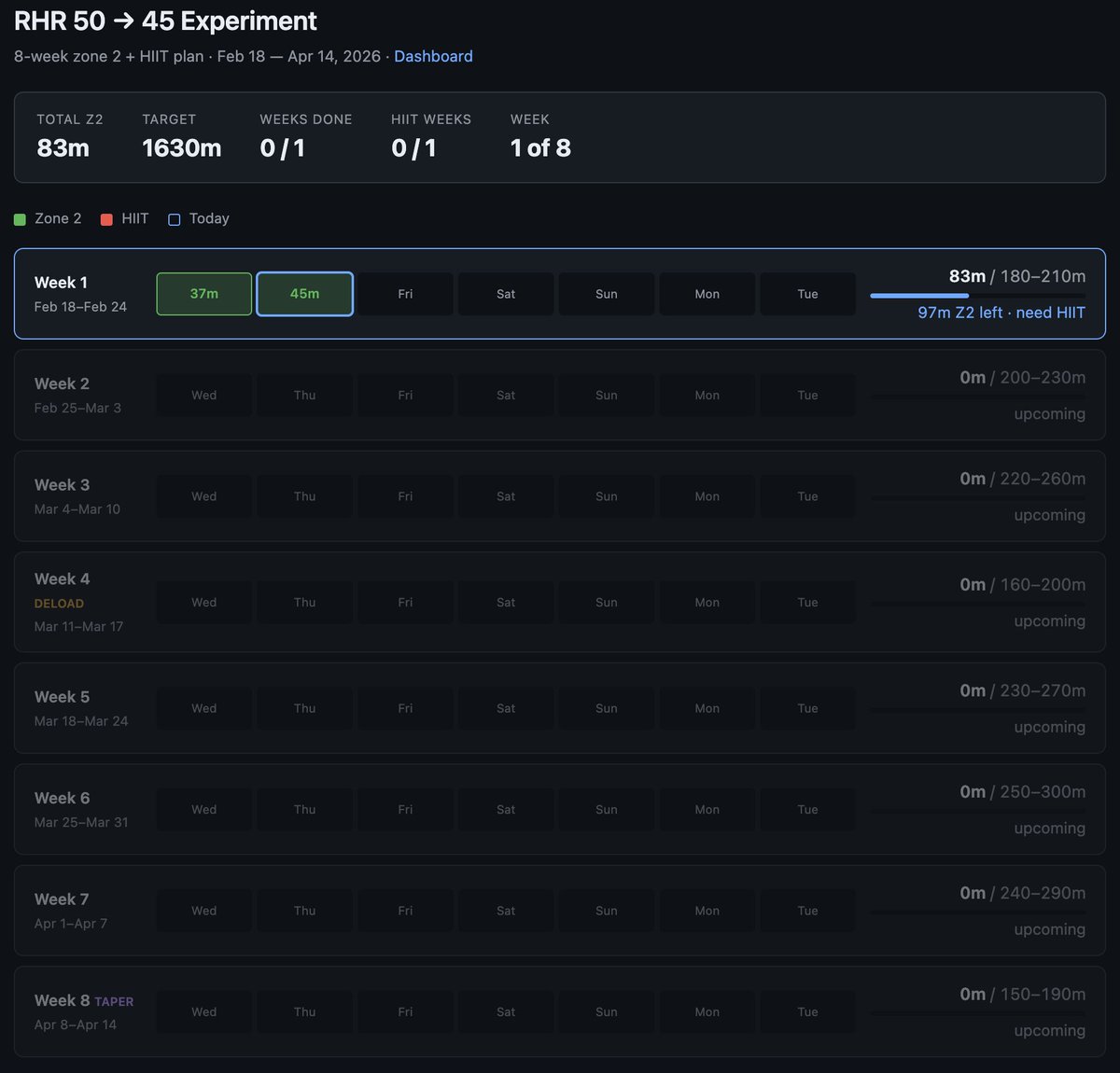
Very interested in what the coming era of highly bespoke software might look like. Example from this morning - I've become a bit loosy goosy with my cardio recently so I decided to do a more srs, regimented experiment to try to lower my Resting Heart Rate from 50 -> 45, over experiment duration of 8 weeks. The primary way to do this is to aspire to a certain sum total minute goals in Zone 2 cardio and 1 HIIT/week. 1 hour later I vibe coded this super custom dashboard for this very specific experiment that shows me how I'm tracking. Claude had to reverse engineer the Woodway treadmill cloud API to pull raw data, process, filter, debug it and create a web UI frontend to track the experiment. It wasn't a fully smooth experience and I had to notice and ask to fix bugs e.g. it screwed up metric vs. imperial system units and it screwed up on the calendar matching up days to dates etc. But I still feel like the overall direction is clear: 1) There will never be (and shouldn't be) a specific app on the app store for this kind of thing. I shouldn't have to look for, download and use some kind of a "Cardio experiment tracker", when this thing is ~300 lines of code that an LLM agent will give you in seconds. The idea of an "app store" of a long tail of discrete set of apps you choose from feels somehow wrong and outdated when LLM agents can improvise the app on the spot and just for you. 2) Second, the industry has to reconfigure into a set of services of sensors and actuators with agent native ergonomics. My Woodway treadmill is a sensor - it turns physical state into digital knowledge. It shouldn't maintain some human-readable frontend and my LLM agent shouldn't have to reverse engineer it, it should be an API/CLI easily usable by my agent. I'm a little bit disappointed (and my timelines are correspondingly slower) with how slowly this progression is happening in the industry overall. 99% of products/services still don't have an AI-native CLI yet. 99% of products/services maintain .html/.css docs like I won't immediately look for how to copy paste the whole thing to my agent to get something done. They give you a list of instructions on a webpage to open this or that url and click here or there to do a thing. In 2026. What am I a computer? You do it. Or have my agent do it. So anyway today I am impressed that this random thing took 1 hour (it would have been ~10 hours 2 years ago). But what excites me more is thinking through how this really should have been 1 minute tops. What has to be in place so that it would be 1 minute? So that I could simply say "Hi can you help me track my cardio over the next 8 weeks", and after a very brief Q&A the app would be up. The AI would already have a lot personal context, it would gather the extra needed data, it would reference and search related skill libraries, and maintain all my little apps/automations. TLDR the "app store" of a set of discrete apps that you choose from is an increasingly outdated concept all by itself. The future are services of AI-native sensors & actuators orchestrated via LLM glue into highly custom, ephemeral apps. It's just not here yet.
Andrej Karpathy tweet media
English
910
1K
12K
2M
Joshua Pantony
Joshua Pantony@JoshPantony·
Markets have always been late to price structural disruption — ask newspaper shareholders in 2005. European equities carry two underpriced risks: the intelligence layer compounds at software speed, not capex speed, and Europe's regulatory drag is measured in years. The moats that matter in AI aren't national — they're contextual. There's no home-field advantage when the field is LLM context.
English
0
0
0
227
tylercowen
tylercowen@tylercowen·
If AI is going to disrupt so many economic matters so quickly, and so chaotically, are you short European equities? They have done well lately. I feel no personal need to short them, to be clear.
English
20
3
190
39.7K
Joshua Pantony
Joshua Pantony@JoshPantony·
@WillManidis Every city council that blocks a data center is setting the terms for who gets to participate in the intelligence economy. The model layer abstracts. The compute layer doesn't. The towns that refused railway stations in the 1850s are still dealing with the consequences.
English
1
0
0
611
Joshua Pantony
Joshua Pantony@JoshPantony·
The positive vision isn't landing because it hasn't materialized at scale yet. But it's real — and it's bigger than job preservation. AI is collapsing the gap between having an idea and executing on it. The person who needed a team of 10 can now operate like one. That's not a displacement story, it's a leverage story. It'll land when people feel it, not when Sam Altman says it.
English
0
0
0
218
Noah Smith 🐇🇺🇸🇺🇦🇹🇼
Yes. Sam Altman has spent the last few years shouting "MY TECHNOLOGY WILL MAKE YOU UNEMPLOYABLE!!!". Sorry, but indefinite techno-optimism is never going to cancel that out. AI people need to tell humanity what a good future looks like.
Alex Imas@alexolegimas

People keep using the word "irrational" when describing the general public's opposition to AI. That word has meaning. Let's start with the colloquial: making consistent decisions against one's best interests given information that one has. What is the current information people have? On the one hand, they have the chatbots. For most people, they are fun and sometimes helpful on the margin. Adoption in consequential contexts has been spotty and surveys show very mixed attitudes in those settings (see 2025 BCG survey). On the other hand, you have the heads of almost every AI company saying that AI will 1) lead to *huge* job losses and 2) potentially much much worse. There is some vague hand waving about curing cancer or going to space, but the main message is "it is coming for your job and your life". Putting the two together, you get exactly what you see in the data: "I like these chatbots, but I do not like AI and I do not want it to get better or expand." This is not a contradiction. The former refers to the current chatbots that people ask random questions, the latter represents the thing that everyone in power tells them will take their jobs. The response in DC and the coasts has been: you don't know what's good for you, move out of the way, you're stupid and irrational. How has that response worked out the last 15 years? If those who see the positives, the huge potential benefits of AI to grow the pie and make life better for all (which includes myself), do not take this political economy into account, I'm afraid that the populist wave of the last decade will look like child's play. A dress rehearsal.


English
63
98
1.6K
100.5K
Joshua Pantony
Joshua Pantony@JoshPantony·
The progression is already visible: First humans ask AI to do work Then AI suggests actions and humans approve. Then AI executes within guardrails. Then it operates independently under defined mandates. Then the AI starts suggesting optimal work for the human to do to achieve a task. Eventually, collaboration becomes so tight it no longer feels like using a tool — it feels like an extension of cognition. Humans remain the source of preference, trust and context. AI becomes the infrastructure for judgment and execution.
English
2
0
18
16.6K
Joshua Pantony
Joshua Pantony@JoshPantony·
9 months ago on Fox Business, I said AI would work like YouTube — it shows up, knows who you are, and automatically finds ways to create value for you: foxbusiness.com/video/63719340… Back on this week: AI is making the cost of producing software approach zero. It's going to become like water: foxbusiness.com/video/63895221… Same thesis, one year later. The intelligence layer is being abstracted away from the software. What you pay for won't be the tool anymore — it's whether the tool knows you.
English
0
0
1
148
Joshua Pantony
Joshua Pantony@JoshPantony·
Respectfully, this misses the bigger shift. In traditional SaaS you find PMF, scale it, optimize it. In AI, capabilities evolve quarterly, customer expectations reset constantly, and new surface areas unlock value that didn't exist last month. Signals of real demand have a short half-life. PMF is no longer a one-time achievement — it's a moving target. And the vast majority of traditional SaaS companies are structurally unable to keep up with that pace. SaaS isn't benefiting from cheaper code. It's getting murdered by it.
English
1
0
1
170
François Chollet
François Chollet@fchollet·
The maximalist form of my thesis is basically this: SaaS is not about code, it is about solving a problem customers have and selling them the solution. Services + sales. If the cost of code goes to *zero*, SaaS will *not* go away. It will *benefit*, since code is a cost center.
English
105
106
1.4K
78.3K
Joshua Pantony
Joshua Pantony@JoshPantony·
@KyleAsay_ Why does it have to be a closed source solution that puts everyone out of business? An open source “OpenClaw 2.0” running the next generation of open source LLM able to write all software for free could also do it. It might just be the case all software is going to lose value.
English
0
0
2
147
Kyle Asay
Kyle Asay@KyleAsay_·
Let me see if I understand: - SaaS companies (who pay AI providers a ton of money) are dead - LLM wrappers and aggregators (who pay AI providers a ton of money) are dead - Companies that don’t embrace AI are dead With every company dead and their employees laid off… Who is left to pay money to Google/Anthropic/OAI/META/Apple? Will those companies and NVIDIA just create their own economy? Something about the business model of “put all of our customers out of business” doesn’t quite jive with me and is another reason why I’m not yet AI-panicked
Kyle Asay tweet media
English
145
54
767
107.1K
Joshua Pantony
Joshua Pantony@JoshPantony·
The weird part is that the fear itself is becoming the disruption. Companies are laying off workers because of AI's *potential*, not its performance — HBR literally just published that headline. Meanwhile the actual labor data barely shows a shift. The AI labs created a narrative so powerful that companies are reorganizing around it before the technology even justifies it. That's not a prediction about AI. It's a prediction about how humans respond to predictions.
English
0
0
1
330
Ethan Mollick
Ethan Mollick@emollick·
The CEOs of the AI labs have spent the last two years ominously discussing massive future job losses even as they continued AI development. As AI becomes more salient outside of the “AI bubble,” workers and policymakers are going to start taking that kind of talk very seriously.
English
54
44
599
46.7K