Julian Reif
1.7K posts

Julian Reif
@JulianReif
Economist at Gies College of Business, University of Illinois | Research Associate, NBER | Follow me on Bluesky @julianreif.bsky.social
Champaign, Illinois Katılım Haziran 2011
582 Takip Edilen2.4K Takipçiler
Sabitlenmiş Tweet

My paper with @TDeryugina @GarthHeutel @davidmolitor and Miller estimating the effect of daily air pollution on health is now forthcoming at AER. Here's a quick recap, including results of a new machine learning exercise with >40 billion observations.
English


@femonomics @crampell @talmonsmith @bencasselman @mattyglesias Many of us are active at Bluesky, including journalists such as @COdendahl
English
Julian Reif retweetledi

Okhmatdyt Children's Hospital in Kyiv. One of the most important CHILDREN’S hospitals not only in Ukraine, but also in Europe. Okhmatdyt has been saving and restoring the health of thousands of children.
Now that the hospital has been damaged by a Russian strike, there are people under the rubble, and the exact number of casualties is still unknown. Right now, everyone is helping to clear the rubble – doctors and ordinary people.
Russia cannot claim ignorance of where its missiles are flying and must be held fully accountable for all its crimes. Against people, against children, against humanity in general. It is very important that the world does not remain silent about this now, and that everyone sees what Russia is and what it is doing.
English

@tyleransom #automating-tables" target="_blank" rel="nofollow noopener">julianreif.com/guide/#automat…
QME

Hi #EconTwitter, what's your favorite way to export regression tables to LaTeX? Bonus points for methods that can handle exporting postestimation output like marginal effects. Code snippets encouraged!
English

@otis_reid @Afinetheorem We try to validate our structural model, calibrated using short-run estimates, by comparing its medium-run predictions to quasi-experimental estimates
julianreif.com/research/reif.…
Todd and Wolpin (2023) have nice discussion on this topic:
aeaweb.org/articles?id=10…
English

What are citations for structural papers that then validate their model in a credible way (eg look at actual outcome from an experiment (but model not trained on same data) or lock model at time t and test on data from T+1)?
Paul Novosad@paulnovosad
I find it so hard to evaluate policy conclusions from structural work. Expert A reaches one conclusion, Expert B says different, both of them have tons of biases, and I presume there are many degrees of freedom in model choice. In the end, it's just an argument by authority.
English

@JulianReif Do you have to say ‘the other place’ or else the X boss man kicks you off or something? I never figured out which other place was gaining market share. Might be different for onc vs Econ though
English

@korenmiklos @toniwhited Are there any online resources for “Reproducible Research from Day 1”?
English

I am not sure what your specific Dropbox sync issues are (I've encountered many over the years!), but two things I do are:
1. Avoid overwriting small files quickly, since Dropbox locks the file during syncing which can kill your script. In these cases, using a tempfile (for Stata) is typically a better option.
2. If there are gargantuan input or intermediate files in the analysis, I store them somewhere outside Dropbox. I have separate folders (`$DATA` and `$TMP`) for those purposes. The downside is that those folders are no longer synced across computers. However, these are usually for analyses that can only be run on a large desktop anyway, so I don't mind. If I'm running on AWS, I omit large intermediate files from the `aws sync` command and keep them stored only in the S3 bucket.
English

@JulianReif Thanks, lots of useful thoughts there! I tend to use Dropbox as well, but I'm struggling with many (over 10k) and few large (over 50 GB) raw input files for synchronization, especially on a laptop. Any advice on dealing with these outside the normal folder structure?
English

Make everything replicable from the start. Lets you catch errors sooner, producing a more error-free analysis, and also will make the AEA replication process smooth
julianreif.com/guide/
Toni Whited@toniwhited
Texting with a colleague at another uni who is mired in the AEA replication process. Wasting > month getting all in order so that some RA can just push one button and get all the data merges right so that the results are perfect to the 3rd decimal place. 1/5
English

@toniwhited Thanks! I use the same structure with big data on AWS, where I find standardization even more imperative. I agree with you that replication standards need flexibility when analysis takes weeks/months to run. That remains to be worked out from what I can tell.
English

@JulianReif Yeah, this stuff is all good, and we should all do that. I do that. Lovely folder structure. :) But! it's also more relevant for small-data reduced-form stuff. Anything that requires babysitting on a cluster or AWS? That's a bigger pain, especially when jobs have time limits.
English

The other place is now open for all, no more invite codes
bsky.social/about/blog/02-…
English

@citizeness Data for my driving and mortality RD paper are available online if you're interested:
github.com/reifjulian/dri…
English

@GaborBekes @ProfDiegoPuga @korenmiklos @larsvil @Stata Given that Stata programs are small in size and (generally) cross-platform, in my opinion it's best to always just store a copy in your replication folder.
English

@GaborBekes @ProfDiegoPuga @korenmiklos @larsvil @Stata If the program is available on Github, you can reference the commit version, which will be stable. However, most Stata programs are not on Github, and if the user deletes the Github repo then the old version becomes unavailable.
English
Julian Reif retweetledi

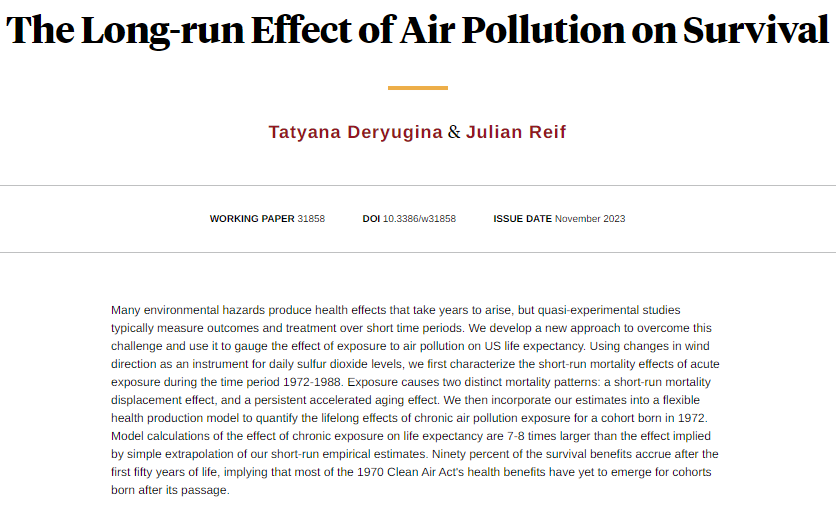
A new method proposes to assess the long-term mortality impacts of air pollution by using short-run quasi-experimental estimates to calibrate a dynamic model of health, from @TDeryugina and @JulianReif nber.org/papers/w31858

English

@JulianReif @TDeryugina Every time I see an acute exposure air pollution paper, I think of how what we *really* want to know is about chronic, long run exposure.
English

New working paper: @TDeryugina and I estimate that a permanent, 10% reduction in air pollution exposure would raise life expectancy by about 1.2 years.
English