Julius Probst, PhD 🌐

17.8K posts

Julius Probst, PhD 🌐 banner
Julius Probst, PhD 🌐

Julius Probst, PhD 🌐

@JuliusProbst

Senior economist @Appcast/Stepstone. PhD @LundUniversity. Stint @ECB. Macro/econ history wonk, blogger, wannabe stoic, chess hobbyist, Scifi nerd. Views my own.

London, England Katılım Kasım 2016
779 Takip Edilen1.5K Takipçiler
Sabitlenmiş Tweet
Julius Probst, PhD 🌐
Julius Probst, PhD 🌐@JuliusProbst·
The business cycle is (mostly) driven by fluctuations in NGDP. Nominal income is nothing more than velocity adjusted money (M*V). It’s the Central Bank’s job to react to changes in M and V and therefore keep NGDP growing on a stable path. This is the most neutral monetary policy
English

8
5
60
0
Julius Probst, PhD 🌐 retweetledi
The Notorious S.E.B.
The Notorious S.E.B.@bigseb31213·
modern monetary theory people don't even talk about MMT anymore, they just look at you like this (postwar rationing was so unpopular that 5% of the UK's entire population emigrated, mostly to Canada, Australia, South Africa, and the US)
The Notorious S.E.B. tweet media
Patricia@PatriciaNPino

Is it a good time to remind people that Britain successfully used price controls during WWII and that this, alongside other price targetting policies, are part of the reason Britain managed to sustain the war for so long?

English
8
43
917
49.4K
Julius Probst, PhD 🌐 retweetledi
Jeremy Horpedahl 🥚📉
"But the data center will only create a few hundred jobs" How many jobs was the vacant lot creating?
English
215
118
2.8K
79.2K
Julius Probst, PhD 🌐
Julius Probst, PhD 🌐@JuliusProbst·
@JeremyWS @pdegrauwe Lol, this is basically irrelevant for the debt burden. interest rate burden UK ~3.6% of GDP, France ~2.5% with roughly similar debt level
English
1
0
0
116
Jeremy
Jeremy@JeremyWS·
@pdegrauwe Hi Paul, that’s not how bonds works. UK pays 0.25% less interest than France does, when adjusting for Ccy… Even interns know how this works… Please do better.
Jeremy tweet media
English
2
1
37
4.2K
Julius Probst, PhD 🌐
Julius Probst, PhD 🌐@JuliusProbst·
@arindube what this fails to mentions is that for several UK regions the minimum wage is much higher than 2/3 because of high interregional inequality. Lots of recruiters, our clients, telling me that the high ceiling + wage compression are a massive problem, career ladder basically dead
English
0
0
0
52
Arin Dube
Arin Dube@arindube·
There is of course a huge body of evidence on the causal inference of minimum wage effects. Here's a repository! economic.github.io/owe/ The problem is some people like to make a correlative claim when it suits their needs, ignoring causal evidence ("UK has 2/3 median MW, and UK is doing terribly! How dare you suggest US should have a similar minimum wage?"). The point is if you apply the same filter but consistently, you have to explain Poland as well. This says nothing about causal effects in either UK (which shrill critics have ignored) or Poland. We have a huge international body of evidence on that! It's a statement about selective use of correlation.
English
2
2
18
3.1K
Arin Dube
Arin Dube@arindube·
Funny, ever since I noted that Poland (like the UK) sets its minimum wage at ~2/3 of the median, and is widely considered a European success story, the shrill, self-assured claims about minimum wages wrecking macro performance have gone a bit quiet.
English
11
15
105
9K
Julius Probst, PhD 🌐
Julius Probst, PhD 🌐@JuliusProbst·
@rcolvile @Starcourse @adamboultonTABB So a few months ago I downloaded the quarterly GDP data for the last 25 years or so, the outperformance of Q1 over the other quarters is not statistically significant at any level. It might just be coincidence.
English
1
1
3
44
Robert Colvile
Robert Colvile@rcolvile·
It will be no consolation at all to Rachel Reeves/Keir Starmer that the ONS has again confirmed that the growth figures pre-Iran were actually starting to look moderately respectable.
English
14
21
423
29.4K
Julius Probst, PhD 🌐
Julius Probst, PhD 🌐@JuliusProbst·
Here is what’s extractive: the government rationing housing, energy, and land. Finance has nothing to do with it. Without finance, you couldn’t get a house or car mortgage, you wouldn’t have credit cards, I couldn’t convert currencies for almost nothing (Wise, Revolut), etc
Patricia@PatriciaNPino

@MrFamilyOffice Not debatable. Finance doesn’t create anything. A small part of it is meant to facilitate capitalist activity. But the vast majority of it * today * is purely extractive. For efficiency, all of it should be as small as possible relative to the rest of the economy.

English
0
0
1
123
Julius Probst, PhD 🌐
Julius Probst, PhD 🌐@JuliusProbst·
@underground_net @DEhnts Moronic! Government spending is going up as the economy is growing over time, what a surprise, just like in every other country in the world with positive GDP growth. The article is talking about the RATIO
English
1
0
2
36
Charles Como
Charles Como@underground_net·
@DEhnts In other words the headline is complete bullshit. They increased government spending each year as your chart shows. (Just spelling it out as people need you to spell everything out for them these days.)
English
1
0
3
367
Julius Probst, PhD 🌐 retweetledi
Adam Ozimek
Adam Ozimek@ModeledBehavior·
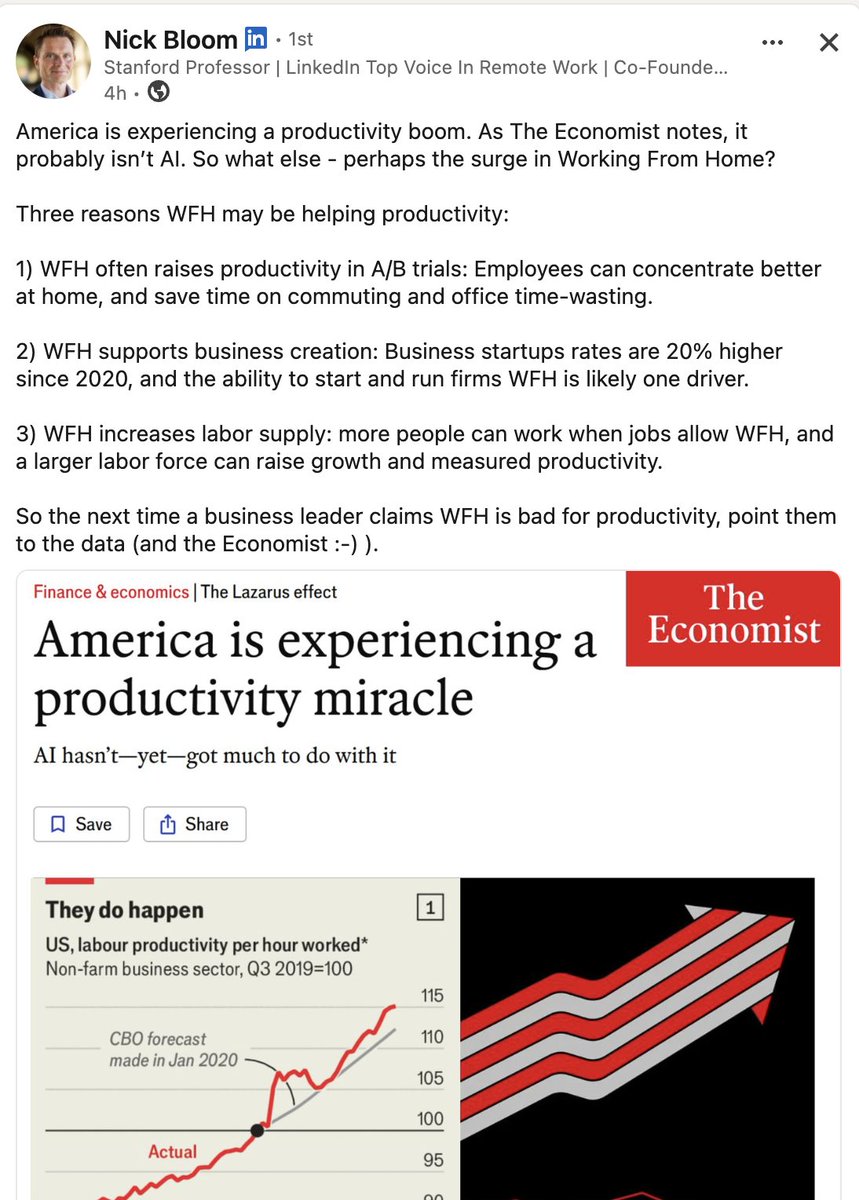
Worth noting @I_Am_NickBloom, probably the leading global expert on remote work, thinks it is boosting aggregate productivity
Adam Ozimek tweet media
English
16
61
271
84.8K
Julius Probst, PhD 🌐 retweetledi
Luis Garicano 🇪🇺🇺🇦
We stopped everything to write an answer (link below) to Paul Krugman's two posts of today (one informal, one with a simple model) arguing that Europe is broadly not falling behind the United States. The change measured by the Draghi report, he argues, is mostly due to growth in the technology industry, which has distorted GDP numbers without actually leading to higher standards of living. We should believe our eyes when we walk around France and walk around Mississippi. Krugman is wrong. The measures he uses understate European stagnation. This matters enormously. Divergence with the United States is the strongest evidence for reform in Europe. 1. The growth numbers Krugman compares the United States, France, and Germany at purchasing power parity in current prices. On that measure, France's and Germany's position relative to America has been roughly constant since 2000. But current price comparisons miss productivity gains in sectors where prices fall. If America produces twice as much software while the price of each unit halves, the value of American software output looks unchanged even though the volume has doubled. Most economists therefore use constant prices, which fix the base-year PPP level and apply each country's real output growth on top of it. American output growth has concentrated in tech, where prices have fallen tremendously as productivity rises. In terms of the volume of things produced, America has pulled away from Europe. 2. Is it all the tech industry? Krugman concedes this tech divergence but says it is not welfare-relevant. The American growth lead is an accounting artefact of measuring more iPhones at base-year prices, not a sign that Americans are actually richer, because Europeans buy the same iPhones at the same world prices. This is not the right way to think about the world today, as an earlier Paul Krugman would have argued. His model assumes tradable goods, interchangeable workers, marginal-cost pricing, and no profits. Each assumption fails. Most of what households buy is non-tradable: housing, healthcare, childcare, education. When American tech firms bid workers from haircutting to coding, American haircut wages rise. Germany has no growing tech sector to do the bidding, so German wages stay flat. Technology is not priced at marginal cost. Apple's margins are around 40 percent. Anthropic's inference margins are at 70 percent. The major platforms enjoy network effects, switching costs, and lock-in that hold prices well above what a competitive market would deliver. A large share of the productivity gains in technology stays as profit. A lot of the value of American technology dominance shows up in equity, not in wages. Apple, Microsoft, Nvidia, Alphabet, Meta, and Amazon together are worth $21 trillion, more than the entire combined stock market value of all European stock markets. Around 60 percent of US equity is held by American households. The median French or Spanish household holds almost no equity. The median employee at Meta, a company with almost 80,000 employees, earned $388,000 in 2025. This advantage is not going to go away. Krugman's own 1991 paper, cited in his Nobel prize, showed that comparative advantage in modern industries is produced by increasing returns to scale, specialized labor markets, supplier networks and the agglomeration of suppliers, workers, and ideas in particular places. Once an industry concentrates somewhere, the concentration is self-reinforcing. Europe is being pushed away from the next round of technology industries (AI!). 3. What about inequality? Another retort is that GDP per capita hides substantial inequality, and so even if America is rich on average, this is mostly due to the super wealthy. But despite the US's high pre-tax income inequality, it also achieves higher median incomes than Europe, in part because of such a high base, and in part because it actually redistributes more than many European countries. The cleanest comparison is median equivalised disposable household income: income after cash taxes and transfers, adjusted for household size and purchasing power. According to the OECD's 2021 numbers, the median American earns 30 percent more than the median Dutchman, about 31 percent more than the median German, and about 52 percent more than the median Frenchman. 4. What about hours worked? Krugman points out that while American GDP per person is higher, most of this is because Americans work more. For this divergence to be an hours worked story, Americans must work more relative to Europeans now than they did in 2000. The opposite has happened. Birinci, Karabarbounis, and See in a 2026 NBER paper show that about half of the American-European hours gap that existed in the 1990s has reversed by the end of the 2010s. Americans work fewer hours per person than they did in 2000, while most Europeans work more. 5. Is America not a bad place to live? Walk around Alabama and France: surely the former cannot be substantially richer than the latter? American cities often have poorer centres and richer suburbs or exurbs. European cities preserve richer and more attractive historic cores. A visit to a city as a tourist in America compared with a city in France will leave one having seen different spots on the income distribution. Americans in Europe go to the nicest and richest European cities. Rather than a walking around test, do a driving around test. Go to the periphery of any modern American city and see a level of new-built material wealth that is extremely uncommon in Europe, with thousands of enormous four- or five-bedroom homes. In the South, in places like Nashville and Austin, drive around the downtowns to see hundreds of luxury apartment buildings springing from the ground. This construction boom is replicated virtually nowhere in Europe today. The other question is generational. Housing often costs more in Europe than in the United States, despite the quality of the housing stock generally being much better. Europe has nice city cores but these are inaccessible to young Europeans. Consider the salaries available to entry-level workers. The starting pay for a London police officer is $57,000. In Washington, DC, $75,000. The entry-level Deloitte consultant job in Madrid pays around €28,000, roughly $33,000 per year. In Charlotte, the entry-level Deloitte job pays $63,000. There are many things to dislike about life in America. But relative to 25 years ago, the gap in material wealth has shifted dramatically in America's favor. siliconcontinent.com/p/european-sta…
English
96
509
2.2K
1M
Julius Probst, PhD 🌐 retweetledi
Andrew Flowers
Andrew Flowers@andrewflowers·
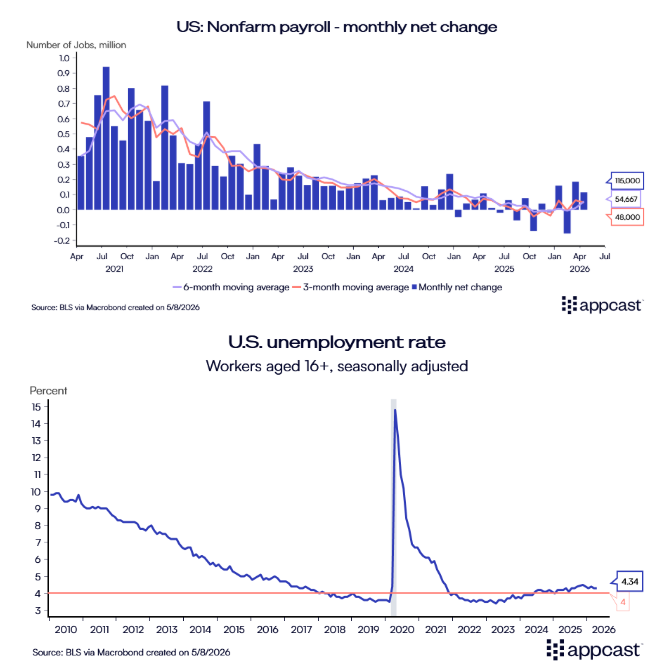
The April jobs report defied labor market skeptics. The expected oil shock effect from the Iran war is not really showing up (yet); plus, tentative signs that job growth may be more broad-based & labor supply isn’t as great of a chokepoint as we thought. With @JuliusProbst...
Andrew Flowers tweet media
English
1
1
1
153
Julius Probst, PhD 🌐
Julius Probst, PhD 🌐@JuliusProbst·
@capjmk @actsmaniac Yeah, regulations have been harsh on the sector. Again, only large Europan champions can successfully compete with US banks, Unicredit would be one of them, Commerzbank alone not so much. I am not a banking expert, all I know is that I hated being a customer of DE banks.They suck
English
1
0
2
133
space cadet 🇪🇺🌐🇩🇪
rumor is the german gov might use the KfW to buy up Commerzbank shares to prevent the complete takeover by UniCredit. complete insanity, the commerzbank is not that important. nor is this political interference good in terms of the european common market and banking union.
English
27
13
284
43.6K
Julius Probst, PhD 🌐
Julius Probst, PhD 🌐@JuliusProbst·
@capjmk @actsmaniac Successfully destroying shareholder value for 2 decades now. It’s not like the lending or deposit base will disappear if unicredit takes over. Can’t stand that shifty hypocrisy from the German government, advocating for European champions but not if somebody else does it to us
English
0
0
15
388