

Atomic Investing
617 posts

Atomic Investing
@Kaizen_Theory
All things related to equity research, decision making, behavioural finance, and investing concepts.
Katılım Aralık 2021
116 Takip Edilen45 Takipçiler

Atomic Investing retweetledi


I finally got around to formalizing my Kelly betting-based method of evaluating time-updating probabilistic forecasts (e.g. in-game win probability, election models, etc.) in a paper.
It is now up on arXiv.
1/
English

Will Thomson of Massif Capital wrote one of the best letters I've read this year.
A must read for metals / mining / commodity investors.
static1.squarespace.com/static/65566a6…
English

I DON’T UNDERSTAND WHY PEOPLE DON’T USE GEMINI FOR STOCKS.
Most traders are looking at charts from 6 months ago.
Gemini analyzes real-time sentiment on X to predict future.
Here are 20 prompts to find the next 10x stock:
English
English

One of the best pieces of writing I’ve read in many years. It was the top featured article by @XCreators in their new campaign, so many of you prob have already seen it. If not, I strongly recommend a read. It has wisdom for personal career & behavior of markets in recent years.
sysls@systematicls
English

She’s reinventing the science of aging.
Meet Julie Clark: the 56-year-old whose biological age clocks in at 36.
She’s outpacing Bryan Johnson, the $2M-a-year biohacker, on a mere $4/day.
Here's her simple anti-aging routine for peak health and lasting longevity: 🧵

English

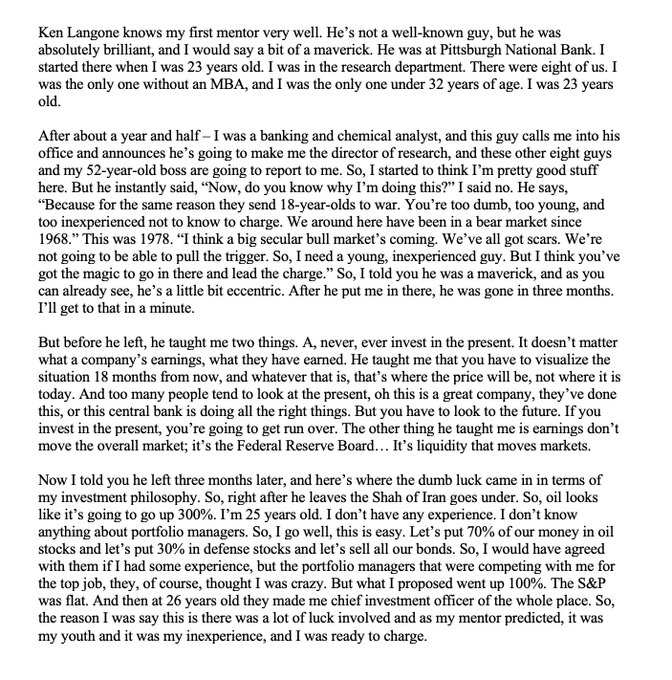

I went through this exact journey myself.
After 13 years climbing the ladder at hedge funds in NYC and ultimately reaching my goal of becoming a portfolio manager, I had a major internal crisis. I had the analytical capabilities to do the job, but my nervous system wasn't wired in a way that aligned with navigating the volatility of the marketplace (and workforce) while also finding internal peace & joy. I worked with a coach, and he asked me "is this what you want to be doing at 50?". I was burned out and no longer found meaning in seeking to generate 300bps of alpha for institutional LPs - the answer was obvious. I knew I needed a change.
I decided to move my family from NYC to Scottsdale, and downshift & reorient my career, while also meaningfully restructuring my personal cost structure.
I thought the peace and joy would flow immediately upon the move...remove the stressor and joy arrives, right? Right?!
WELL, for really the first time in my life, this gray feeling of depression crept in, and it surprised me.
In NYC I was special. I had status, I had an identify. The first thing people ask at a cocktail party in Tribeca is "what do you do?". With pride, I responded "I'm a PM at Citadel". Brokers rolled out the red carpet and "friends" emerged given your perch and your ability to help them. I was infected with mimetic desire and I moved into a beautiful apartment building and was neighbors with Leonardo DiCaprio and Tyra Banks. And it was fun, it was thrilling.
Then, all of a sudden I didn't have that. I was a failed "semi-retired" PM. I looked around me, and I didn't feel special...I felt, for the first time in my life, average. I lived in an average house, drove an average car, and lived an average lifestyle. And it hit me harder than I thought it would.
And I went through it. I struggled for a solid 18 months. I went through the letting go of my ego, the letting go of the identity that I had been so carefully crafting for nearly 20 years.
What did I learn along the way?
I learned that depression is a feature, not a bug. A period of depression, when associated with the letting go of identity, is actually a well-established threshold in the archetypal evolution of male spirituality.
The journey for me kicked off a transition towards a much deeper exploration of the true meaning of life, which I believe is a deeply personal question. For me, this transition point marked a transition towards inner growth as a primary metric of success. Who I can become.
In exploration, I learned that what I was going through was far from unique, but was actually a well-established transition point in a well-lived life.
I stumbled upon Richard Rohr's wonderful book, Falling Upward, and it seemed to explain this journey in wonderful precision.
How the loss of attachment to status and identity is actually a wonderful gift!
I have established this framework as a core part of my personal philosophy of life. And, with some distance from the gray, now look at that period of my life as a wonderful gift. A necessary letting go and reorientation towards more true and more enduring sources of peace, joy & meaning.
So, if you are feeling depressed at the loss of identity. Keep going. It's a sign you are on the right track.


Blueprintsmb@blueprintsmb22
status = identity. get good grades. go to top school. get top banking/consulting job. maybe MBA. pivot to "next" step in corporate/hedge funds/PE, etc. brunches, cocktail parties are spent sharing what is going on at work. in NYC/SF, the first question is "what do you do for work." this was my path the first 2 decades of my career. best thing i ever did for my mental health was leaving the fish bowl of finance and NYC at the same time. spending my day working in a factory and living a less busy life in new jersey has meaningfully reduce my daily stress but i had to basically be okay with "killing" my previous identity before making this pivot. why i probably only did this at 40 vs 30. at 30 i had a way bigger ego and was more competitive. now i just want to be home for dinner and not work on weekends x.com/a_musingcat/st…
English

Stocks with 20%+ ROIC trading below 17x earnings:
1. Adobe $ADBE:
ROIC: 41%
PE: 15x
2. Novo Nordisk $NVO:
ROIC: 53%
PE: 14x
3. lululemon $LULU:
ROIC: 30%
PE: 14x
4. PayPal $PYL:
ROIC: 21%
PE: 12x
5. PepsiCo $PEP
ROIC: 21%
PE: 17x
English

What I learned from Dan Sundheim's rare podcast appearance (didn't even feed this through ChatGPT):
- Buy before research: Initiate position before fully vet an idea (Stan Druckenmiller style)
- Don't hire lateral stock pickers: D1 doesn't hire from other public shops, prefers PE candidates - they have technical skills and no preconception on how to pick stocks, which is a good thing
- Analyst hit rate not as high as he likes: Takes a PE hire 3 years to ramp, but hit rate for hires that add value is lower than he likes at D1, hard to find someone with intuition for making money in stocks
- Very few natural stock pickers: Very few hires exhibit stock talent very early, some take time to ramp on sector knowledge and then thankfully do add value, some just "don't have it"
- You have to love the job: This is not a "close my laptop for the day and forget about it" career path. You are always on.
- Analysts have a mock portfolio: D1 instills portfolio management training into juniors. How their mock portfolio performs at the end of the year impacts their pay. This is likely a heritage instilled in Dan from how Viking Global does, where he was once the CIO.
- Position sizing: have to balance between risk reward (ie. dispersion of future outcome). Businesses currently with good momentum should get more allocation (something Paul Enright has mentioned as well)
- Asymmetry of emotions in public investing: when portfolio is working, he is not euphoric; but the portfolio is not, very stressful because losing money for clients. He was visibly painful talking about the GameStop saga, seems to be genuinely his worst time in career, something he also said in interview with David Rubinstein
- How retail traders changed short selling: have to size positions smaller so can ride it out when it goes up 10x; Short alpha better than before because there are more absolute number of overvalued stocks
- Types of shorts: he doesn't do frauds because too few in large caps. D1 focuses on secular shorts. He is not a fan of cyclical shorts that are currently overearnings (think COVID pull forwards of consumer names like Mattress)
- Risk of M&A for shorting: in his exp, secularly challenged companies almost never get bought (who wants to buy a company slower growing than yours?) but names ceding market share can attract activists which can move the stock up
- U.S. vs European market in spotting turnarounds: U.S. investors quick to see change and multiple expands quickly
- earnings season: Dan wakes up at 3am every day for no reason. During earnings, he will be on the call with the covering junior analysts demanding a quick rundown on what happened on the earnings. If nothing material, might go back to sleep. If material, probably making decision already during the discussion.
- making money on multiple expansion: most of the money is made on multiple expansion, which manifests from market's perception of a business' long-term cash flow generation stability
- why stop investing in China: he is not a fan of Chinese government influencing how capital is allocated and favoring random industries at different periods. Chinese TMT names, despite possibly superior tech to U.S. counterparts, were cautious of consistently beating earnings because stock will go up and will attract government attention. (My take: Which is why despite all the great business successes, Chinese stock market barely went up with the company value creation)
- Advice for aspirant: reading is the way to get ahead in everything and certainly applies to investing. Read a lot of stock pitches and see how the stocks play out, read things on industry and the economy.
John Collison@collision
Dan Sundheim is one of the smartest stock pickers in the public markets. He joins @danielgross and me on Cheeky Pint to discuss their way of analysing businesses, how he makes 95% of the decisions on their $25 billion AUM, waking up at 3am, his career advice for new investors, SpaceX, and how he keeps finding good investments in Europe.
English

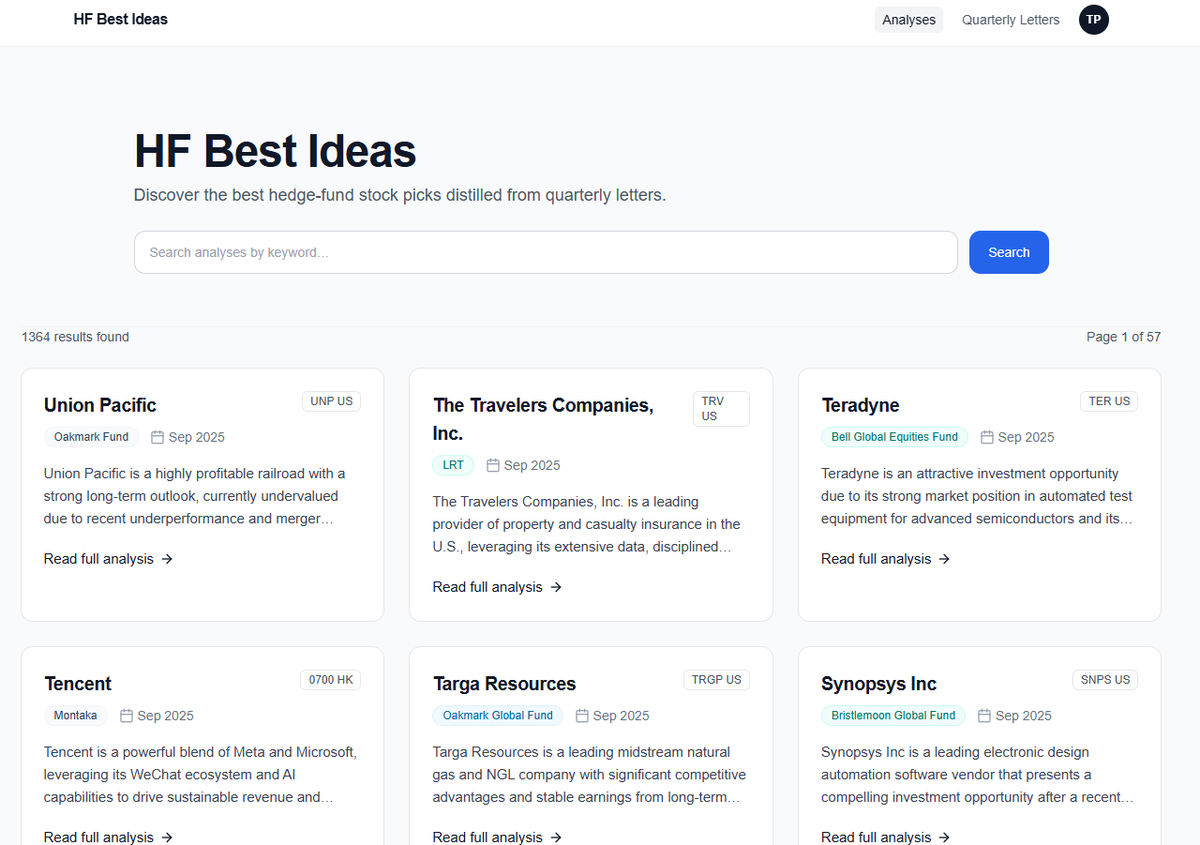
HFBestIdeas.com is now live.
It’s free (for now), you just need to create an account.
Two main features:
1️⃣ Access to 1,000+ quarterly fund letters
2️⃣ Around 500 stock pitches extracted from fund letters each quarter
English
I started recently, on the recommendation of a friend, using Wispr primarily to interact with ChatGPT.
It's a wonderful tool for LLMs because short inputs can be quite vague and not necessarily elicit optimal responses from an LLM. Typing a few paragraphs in can be cognitively more burdensome. But speaking into Wispr for a minute or so, and very deeply exploring what you're trying to complete, I have found to be quite effective and much faster.
It can feel like magic talking into Wispr in ChatGPT for a minute or so, asking ChatGPT to take that rambling and turn it into a prompt and then running that prompt. In almost all use cases that I do this, it's an appreciable improvement over a zero-shot approach.
Personally, I'm hooked. I've started using it to draft emails and even write texts to my wife during the day. I don't know what they did, but it's super accurate relative to past iterations of voice dictation, which were annoying because you'd have to go back and fix all the errors.
No affiliation…just a fan.
Check it out.
Allie K. Miller@alliekmiller
This is absolutely insane and proof that voice is about to transform the workplace. At Wispr, employees use voice hundreds of times a day to multitask across their entire workflow. Here’s one dev using Cursor and Gmail simultaneously, all through WHISPERING, on a $10 mic.
English
Atomic Investing retweetledi

This has always been the problem with the hotel industry & why it's so cyclical.
Christina@cjpraat
Southern Sun $JSESSU - the share price is up 65% since May 2024. But in Cape Town, competitors have more than 40 new hotels in the pipeline. The increased competition in Cape Town, may put pressure on their average Room Rate Growth and result in lower Revenue and EBITDAR.
English

Thread on fundamental L/S analyst "tips and tricks," potential sources of edge & pockets of alpha, sustainable & AI-resistant areas where one can hope to pull dollars out of the mkt...unit economics/modeling, primary rsch, and translating qualitative input to quantitative output.
English




Bill Miller explains how to pitch a stock
Bam, bam , bam

English
AI & EARNINGS SEASON
To me, one of the most compelling frontiers for the deployment of AI in investment research is earnings season.
Earnings season is both "report card" time for a thesis of duration and "super bowl" for high velocity investors looking to monetize their intra-quarter research (surveys, mgmt meetings, channel checks, alt data, read-throughs). The sell-side corporate access complex & the alternative data industry largely thrive due to the importance of earnings season. For the average stock, four earnings print days each year drive ~20% of that stocks idiosyncratic volatility (with elevated idio vol in the run-up and post-earnings period). Getting earnings correct matters a lot. At a multi-manager, a few bad earnings seasons can de-rail your career, which is why anywhere from 30-50% of a MM analysts' motion serves the earnings preparation workflow.
And LLMs have some really compelling fundamental attributes that could make them superb "earnings season co-pilots":
- Distillation & retrieval on a large stack of information
- Native NLP capabilities (a well-defined quant alpha)
- Ability to do immediate pattern recognition at scale
- Ability to train on earnings set ups & alpha pools
- Ability to build expectations, set-up & positioning rubrics and compare internal positioning vs. bar
- One button systematization of earnings risk checklist , to flag risk of "big losers" that I can verify manually
- Instantaneous read through linkages to peers & adaptive bar rubrics
- Tool for triage: as a PM covering ~300 stocks, knowing where to prep & execute matters, "where are the most debated set-ups that are likely to have the most outsized moves in my 300 stock coverage?"
- Objective counter-pitch debate partner to aid in probabilistic thinking, stimulating creative ideas that I may not have thought about
- A future vision of: immediate model update & distillation of press-release, 10-Q (if released), investor deck and sell-side reactions, with a suggested trading range and over/under-reaction signals
Earnings season is also a time of tight bandwidth. The trading desk that was busy from 7am to 6:30pm all of a sudden is busy from 6am to 9pm. There is a LOT of information to go through, particularly as a PM covering many sub-sectors.
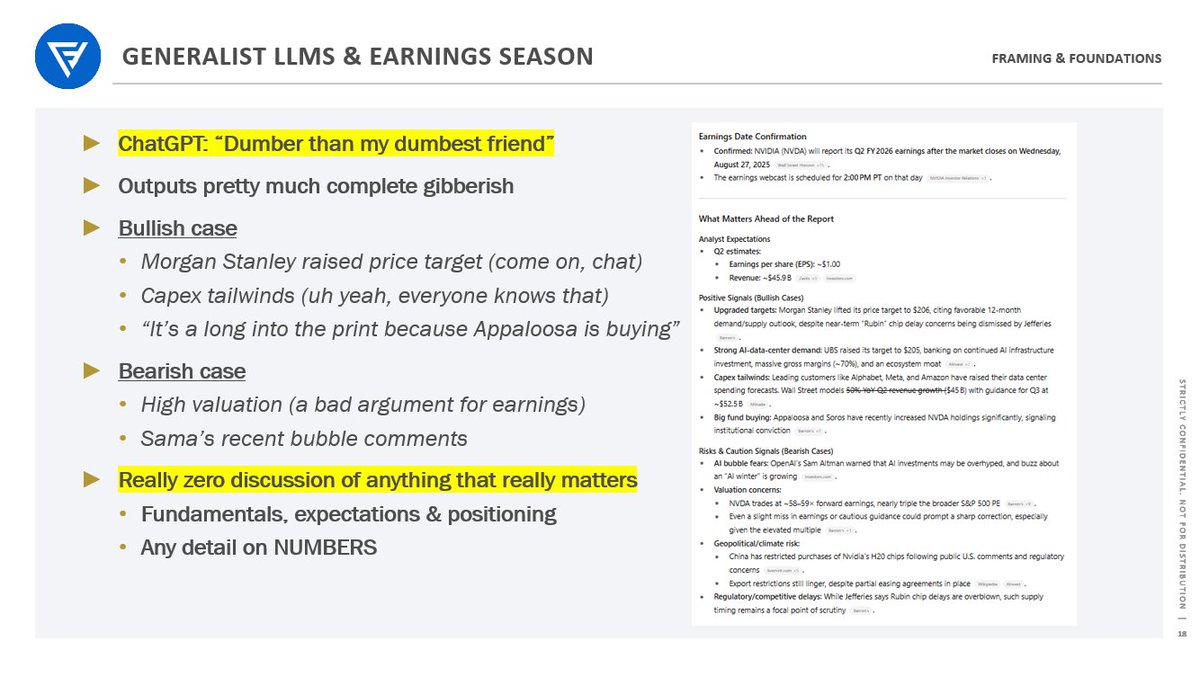
The unfortunate reality, however, is that ChatGPT is "dumber than your dumbest friend" when it comes to earnings season.
I asked ChatGPT 5 to create an earnings preview for NVDA's August 27th earnings release, and it was sort of completely useless gibberish.
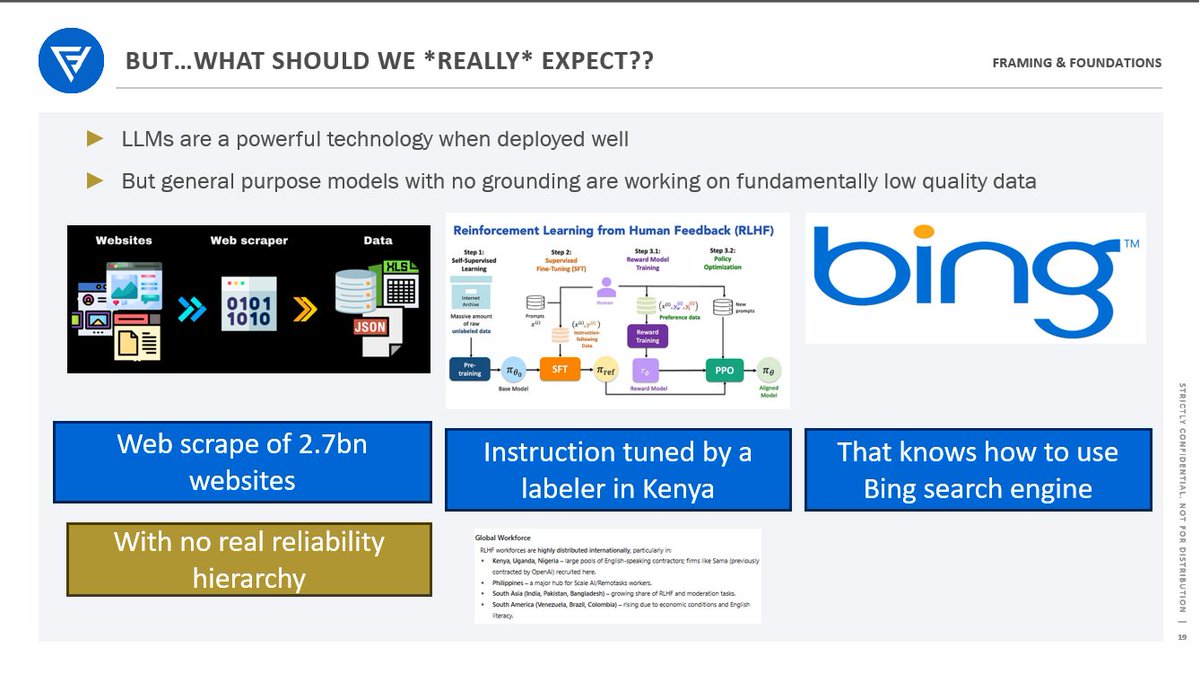
And lately, I've been making the observation that general purpose LLMs like ChatGPT are effectively a giant web-scrape, instruction tuned by labelers (in Kenya, Philippines, Bangladesh, etc.), that know how to use the Bing search engine.
These are not very promising first principles observations for a workflow like earnings season that is so high stakes.
So, are LLMs hopeless for earnings season?
Actually, I don't think so, at all. They just need to be deployed correctly.
I'll give you a few thoughts.
NUMBER ONE: You need to have a data strategy for earnings. I would say the vast majority of critical data & information for the earnings prep process is NOT available via Bing. These are data sets like 13F ownership trends, short interest trends, options implied volatility, and structured base rate history of earning print moves & guidance updates. And some more proprietary data sets like prime broker data.
And ALL that intra-quarter work that was done builds the mosaic of insight. Many funds are still limiting what can be uploaded into LLMs (for good reason). But earnings season co-pilots, in my opinion,
NUMBER TWO: It is necessary to train & prompt LLMs on the earnings season workflows. In the giant web-scrape, LLMs can see many examples of well-written haikus or dad jokes and mimic those examples. That isn't true of well-written earnings previews...they basically don't exist on the open web.
NUMBER THREE: Picking right tool matters. Particularly for high stakes, low latency, hard to verify use cases, such as "this company just cut revenue guidance by 5%", the trade needs to happen quickly. I need a reliable LLM that won't hallucinate that metric, or I'm cooked. To me, finance-tuned co-pilots are likely to be better tools than general purpose LLMs. And if I have to upload 60 documents to NotebookLM across 300 companies, that gets pretty cumbersome pretty fast!
So those are just a few thoughts. I believe with the tools available *today*, hedge funds can deploy AI intelligently into earnings season to drive competitive advantage. But it's not so straightforward.
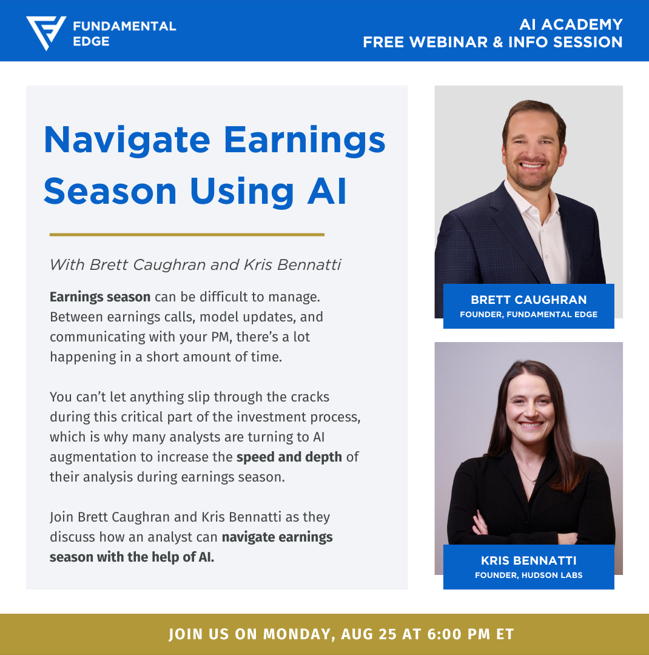
If anything here intrigued you, Fundamental Edge will be doing a live webinar on August 25th at 6pm ET to walk through some more ideas for deploying AI into earnings season.
I will be joined by Kris Bennatti, co-founder of Hudson Labs (who built one of the first finance LLMs in 2019) and co-instructor of the Fundamental Edge AI for Investment Research program.
Will drop the link to register in the replies - FREE for all, will have time for Q&A and YES there will be a replay (posted on our YouTube account)
Brett
English

A 23-page research paper reveals the number 1 method Hedge Funds use to beat the market:
Time Series Momentum
This is how: 🧵

English