Kaleb

534 posts

Kaleb banner
Kaleb

Kaleb

@Kaleb0x

Research & Investing @Polychain

Katılım Mayıs 2022
2.6K Takip Edilen1.2K Takipçiler
Kaleb
Kaleb@Kaleb0x·
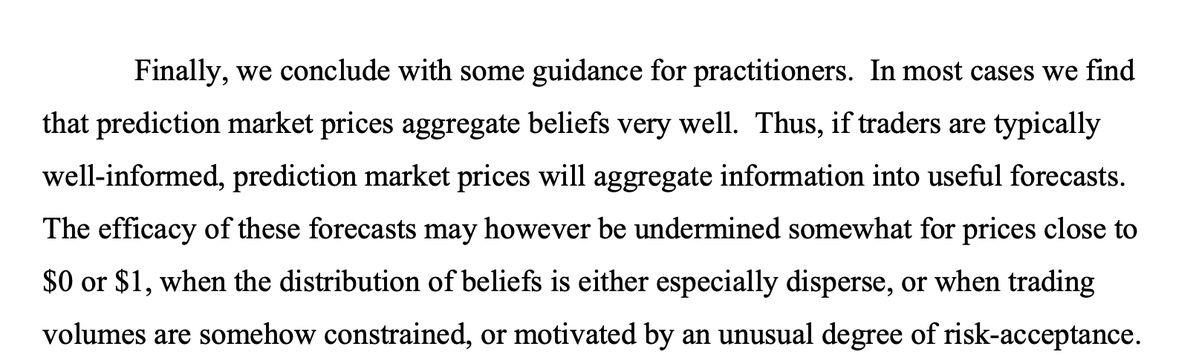
This is a good question, could be worth exploring! Haven't seen much on this or looked into it myself tbh From "Interpreting Prediction Market Prices as Probabilities" paper, they briefly touch on volume as a constraint but no data unfortunately This is prolly the best Dune query I've seen on general accuracy tho dune.com/alexmccullough…
Kaleb tweet media
English
0
0
0
9
Niko
Niko@lngspt·
Has anyone done any research on whether there is a threshold level of both volume and number of positions for how accurate a prediction market (where insider trading is not possible) is? Obviously higher volume = better accuracy, but if I see $1.6m volume on a market like which party will win the senate, how do I know how to weight this? $1.6m feels low.
Niko tweet media
English
1
0
1
62
ElBarto_Crypto
ElBarto_Crypto@ElBarto_Crypto·
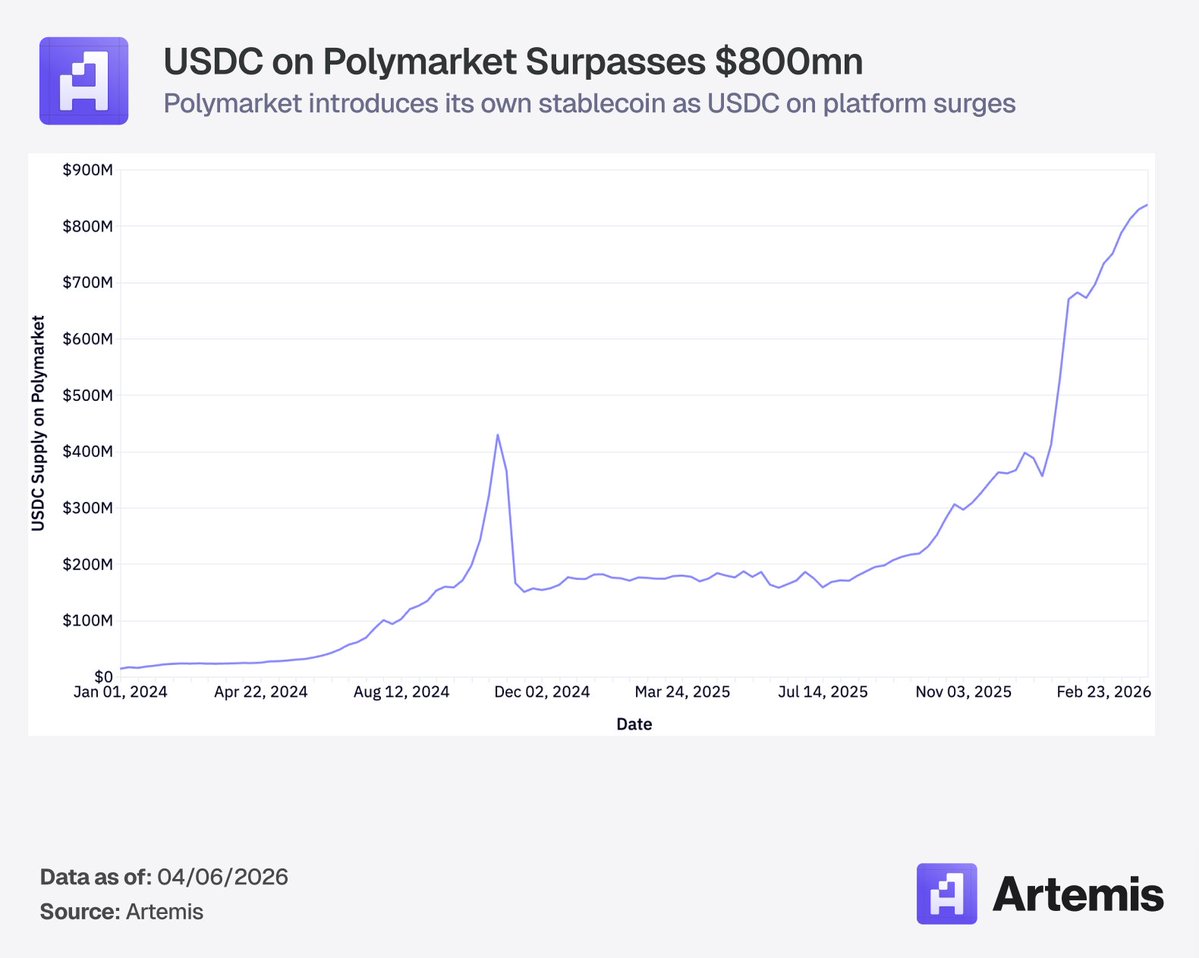
@Kaleb0x @Polymarket We are tracking funds deposited into the Polymarket CTF and also Polymarket accounts that are holding USDC but haven’t made a prediction
English
1
0
1
27
Kaleb
Kaleb@Kaleb0x·
@_kanarazu_ They must have missed the Pump posting
English
0
0
1
123
Toghrul Maharramov 🇺🇦
Toghrul Maharramov 🇺🇦@toghrulmaharram·
Previous week was my last at @fluentxyz. I’m excited to share that I’ll be joining @polychain as a research partner. I’ve always joked that my inability to focus on one thing for prolonged periods makes a fund a perfect place for me and over the past year, I realized I’m ready to take that step. I enjoy digging into different projects and working closely with others to help refine them. I am thrilled to finally get to do that full-time. We've built a lot of cool shit at Fluent and I’m excited to see what’s next for the team and the company.
English
97
3
393
85.2K
Kaleb retweetledi
Neil Chatterjee
Neil Chatterjee@neilc_dawn·
Can’t even begin to explain how awesome it’s been working with the @polychain and @archetypevc teams, and how honored I am to have their support. Every day we’re assembling the bricks of the forever connectivity protocol. Whether it’s raw tech or infrastructure capital formation, DAWN is building the rails for how the world gets connected. Wireless is the final frontier of communications, and we’re building what it takes to hyperscale it so anyone can participate, not just the incumbents. We’re all deploying connectivity infrastructure whether we realize it or not. It’s not just 5G towers or LEO satellites. If you set up a WiFi router at home, you’re deploying infra too. You just don’t equate the two (yet). So to all the builders of connectivity, you're going to ask: - how do I monetize my bandwidth? - how do I move data as fast and cheap as possible? - how do I maximize the value of my infrastructure? - how do I raise to build more infra? - how do I have awesome connectivity throughout my home? The answer to these questions is DAWN. If you're building anything connectivity related, DAWN is the "how." That's the future we are building. Connectivity powered by you. Answer the how, and you stop renting the Internet. You own it.
DAWN@dawninternet

DAWN has raised $13M in Series B funding, led by @polychain This capital accelerates our global expansion, new deployments, and ecosystem partnerships as we continue our mission of scaling decentralized broadband worldwide 🌍


English
54
69
470
37.9K
Kaleb retweetledi
Luis Hauenstein
Luis Hauenstein@luishXYZ·
Liquidity on prediction markets is horrible. The reason: There is little algorithmic market making. It's responsible for 99% of liquidity in the crypto and stock markets, but barely exists for prediction markets. Here are 3 reasons why MMing on Polymarket is a fool's errand: 1. One side of the market certainly goes to zero Prediction markets are binary options that always make the shares of one side of the market ending up worthless. Either YES or NO certainly goes to zero, and here's why that's a problem: A key risk for market makers is inventory risk. If you market make for an asset, it's impossible to not at some point end up with a slight exposure to one side (YES or NO). Market makers always make money if the price of an asset goes sideways. They lose money, when it moves in one direction. To be profitable in the long run, the profit during sideways movements needs to offset the loss during periods of high volatility. The fact that one side is CERTAIN to go to zero makes this much harder. It is even IMPOSSIBLE to market make on prediction markets WITHOUT taking at the same time a directional bet on the outcome of the market. 2. Volatility is instant, causing losses for MMs In prediction markets, an adverse event can hit at any time that moves the price instantly to 0: 1. Market "Who will Trump meet this month?" 2. Trump announces meeting with Putin. 3. Price of YES goes instantly to $1, NO goes to 0. This is not possible in other markets. Bitcoin might dump, but it will not go to zero over night. Having limit orders in the books is therefore much more risky in prediction markets than in TradFi or crypto, because when news hit you might get filled against fast news traders. Everyone who uses prediction markets experienced this already, and it's another factor that makes market making less attractive. 3. Much more insider activity Insider trading makes the problem from above even more extreme: If you have information that is not public, you can "eat the book" (= buy the liquidity that the market maker provides) even BEFORE your insider knowledge becomes public. Like this, the market maker doesn't even have the chance to react. In crypto market making, trading firms pull the liquidity from the books during times of high volatility. This protects them against the risk of being filled one-sided during periods of high volatility and ending up holding the bag (what I mentioned in points 1 and 2). But when insiders are active, this is impossible. This means that EVERY market maker needs to incur a default level of losses that is unavoidable, coming from "smarter money" arbitraging their quotes. In market maker lingo people call this "toxic flow". And due to heavy insider activity, prediction markets are full of it. The effect is that market making on markets with a lot of "toxic flow" becomes overall less profitable. Therefore less people do it. Therefore liquidity gets worse. And that's how we end up with the situation of today, where market making is mostly being done: - by manual traders - who are fine with having directional exposure Now you know. 🙌
Luis Hauenstein tweet media
English
22
12
230
21.7K
Kaleb retweetledi
moon
moon@MoonOverlord·
One qualm with prediction markets is it seems extremely difficult to make any real money in size I think only the top 50 or so traders on Polymarket have made $1M+ Compared to options or perpetual futures you probably have thousands of people who have made $1M+
English
62
6
190
21.1K
Kaleb retweetledi
Dhruv
Dhruv@0xdhruva·
did a quick weekend hack in buenos aires, based on Orbitals AMM by @paradigm built @Uniswap v4 hook implementing the custom spherical AMM curve for efficient stable asset swaps, where the hook acts as a multi-asset pool consolidating liquidity super interesting concept and loved building on it
Dhruv tweet media
English
10
2
142
15.8K
Kaleb
Kaleb@Kaleb0x·
@iouttradeyou Thank you sir! And def agree, lack of liquidity is a huge thing holding back these markets Imo you need to give market makers some kind of structural advantage whether that be cancel-priory ordering or an auction rebate to boost liquidity
English
0
0
1
408
iouttradeyou
iouttradeyou@iouttradeyou·
This is really good stuff. TBH, i think it will be practically impossible for the majority of market makers to get excited about this given the fact that outside of 5 or 10% range in most niche markets in polymarket there is very low liquidity, which is in essence a look at what the liquidity would be like in a leveraged perp market. i.e. If market makers were able to quote for perp prediction markets then prediction markets themselves would already have deeper books.
English
1
0
2
1K
Kaleb
Kaleb@Kaleb0x·
Like all things it totally depends on the market and the data you have. For markets like sports and elections you’re right: when the price is near 0.5 and you get close to the end, volatility and jump risk increase (Gaussian scoring is a decent way to see this for volatility). For longer-duration markets that follow this pattern, financiers might be fine offering leverage early on, then widen or pull their quotes near the end if price is around 0.5. This flexibility is also why you should price in epochs. So for something like “Will Philadelphia win the Super Bowl?”, volatility and jump risk would spike during games (especially near the end of close ones) and is lower / more stable when they’re not playing. But not every market looks like that. Think of a “Will an earthquake happen?” type of market, the underlying risk is uniform over time. In that case the NO price just drifts up to 1 if nothing happens, and the volatility and jump risk are likely constant throughout the entire period.
English
0
0
2
44
oaktoebark
oaktoebark@oaktoebark·
but wouldn’t focusing on longer term markets hedge this a bit? it seems that a college football game would not be safe but predicting the national champion would be a good candidate with the caveat that the jump risk increases considerably as you get closer to the national championship game.
English
1
0
1
51
Kaleb
Kaleb@Kaleb0x·
Hmm well you’d prolly have to design a new / augment existing prediction market platform so that different financiers could compete to fund leverage for traders Besides the transparency, composability, etc benefits of onchain, I’m not sure there are any differences of building the core financier-trader matching engine on vs offchain To my knowledge there aren’t any venues doing this yet. The most promising thing I’ve seen towards leverage on prediction markets is @gondorfi which will enable you to borrow USDC against Polymarket positions but they don’t have any docs yet
English
1
0
2
65
avious
avious@0xAvious·
@Kaleb0x so what's the practical path to achieve onchain leverage then? (assuming the not-immediately-liquidated use case) and whats the offchain alternative right now then?
English
1
0
1
63
Kaleb
Kaleb@Kaleb0x·
Yeah I agree it's all zero sum, and someone has to eat the jump loss, but it's better than the alternative rn which is letting all the value leak to arbitrageurs, and paying unsustainable USDC incentives to boost liquidity Another interesting solution would be cancel-priority ordering to boost liquidity (financiers that provide leverage wouldn't be happy tho because there's no liquidity when they need to exit). The auction idea is just a possible middle ground.
English
1
0
1
169
Matt O'Connor
Matt O'Connor@matty_·
@0xfoobar @Kaleb0x "a block-level auction design could capture news-driven arbitrage and rebate it back to market makers and financiers" But *someone* has to lose on jumps, prediction markets are zero-sum. Regardless, recommend everyone read the full report
English
1
0
1
78
foobar/
foobar/@0xfoobar·
@Kaleb0x Cool math but all hinges on a single failed assumption: that you can accurately estimate jump risk This is the kind of thing where your heuristic parameter estimations will work for a bit, then you'll blow up on a "black swan" (read: something totally normal you didn't model)
English
4
0
13
2.9K
Kaleb
Kaleb@Kaleb0x·
This is cool but it’s not really the leverage you want You’re just moving leverage off of the prediction market and onto BTC/ETH If I borrow against my ETH and buy YES for a market, my PnL on the prediction market would be exactly the same as if I had just sold the ETH and bought the same YES size. The only extra upside is from ETH going up, not from YES being levered
English
0
0
2
36
Kaleb
Kaleb@Kaleb0x·
The issue with only caring about max loss is that you end up charging a fee where the trader’s upside from leverage goes away So you have to care about the chance you can liquidate before resolution, which depends on jump risk In terms of it being insane to underwrite, it really depends on the market. For a sports game, you have a lot of historical data, so it’s likely you can at least get a rough range for what jump arrivals and sizes should look like Same with something like earthquakes (where we have a ton of historical data), so you can reasonably back out a fatal jump probability That being said, you are totally right for other markets. There's not enough info for a market like "Will Trump fire Powell?", you basically have no idea what Trump is going to do, so it probably doesn’t make sense to quote leverage at all The point of the paper isn’t to say that leverage works for these markets and doesn’t work for others however. It just provides a framework for if you can get the microstructure data, here is how you can apply it
English
0
0
2
953
HALKO
HALKO@Halko500k·
@poopmandefi @Kaleb0x You don’t care about a probability of a jump (X), you care about your payoff F(X) and ensure you can absorb it. Furthermore, if the absorption event occurs, you are already ruined, so you don’t really care if the price path rebounds. Absolutely insane to ever underwrite this
English
2
0
2
84