BioAndTrade

2K posts

BioAndTrade

BioAndTrade

@Kapstahoon

Do your own DD. Not a financial advisor. Biotech , Tech, EV and growth, trading

Katılım Ocak 2017
278 Takip Edilen386 Takipçiler
BioAndTrade
BioAndTrade@Kapstahoon·
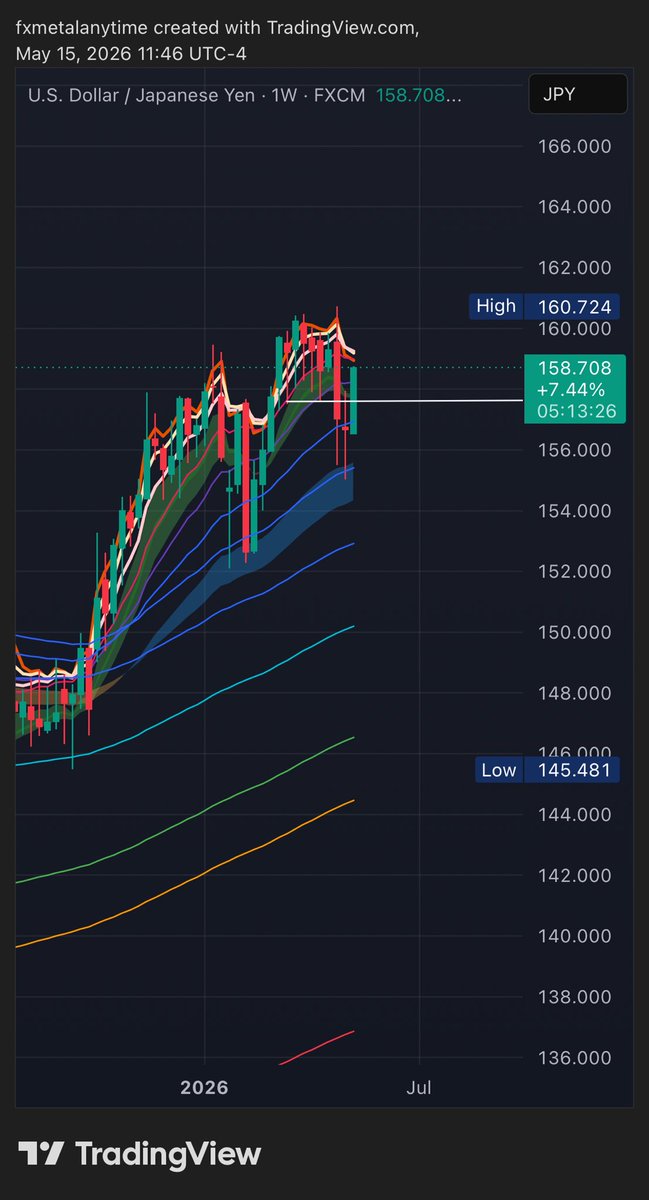
@anytimeFXmetal Could you please explain it why SPX would not go down if USDJPY above 159.2? I am not well versed with the macro and FX so trying to understand.Thanks.
English
0
0
0
61
Rice cooker
Rice cooker@anytimeFXmetal·
You know I have been bearish 5/15 was my time line! I am critical of BOJ, but if Usdjpy can close above 159.20 for the week, dont short $SPX anymore, all eyes on Japanese yen
Rice cooker tweet media
English
2
1
5
1.1K
BioAndTrade
BioAndTrade@Kapstahoon·
@DarioCpx I dont follow oil companies so i dont know the BE price for the oil companies. Do the oil companies disclose break even price or do you need to dig through financial and find yourself? Thank you for the response.
English
0
0
2
216
JustDario
JustDario@DarioCpx·
@Kapstahoon To a different degree is applicable to others, what matters the most is the break even oil price cost of production
English
2
0
3
830
JustDario
JustDario@DarioCpx·
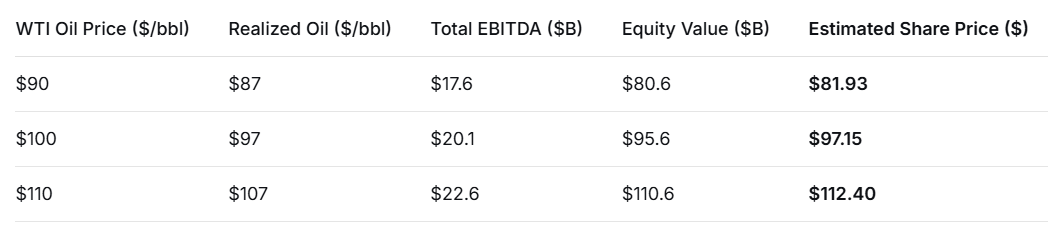
I refreshed the analysis on $OXY and here are the results I got assuming a WTI stable above 90$, 100$ and 110$. I believe that the moment markets realise there has been a permanent structural shift in crude oil, the repricing of oil companies will be big and likely fast
JustDario tweet media
JustDario@DarioCpx

According to my calculations, with an oil price stable above 90$ $OXY P/E drops to ~5.5 from the current ~40 at the current price. Won't be personally shocked to see $OXY pull off a 3x or even 4x in a few months if the current situation shifts from temporary to long-lasting


English
15
20
220
34.6K
BioAndTrade retweetledi
The Fat Pitch
The Fat Pitch@the_fat_pitch·
🚨 STOP CALLING THE OIL MARKET BROKEN 🚨 "Paper" vs. "Physical" Oil - A Short Primer While the oil bears are currently out there taking their victory laps, it is the perfect time to step back and look at the actual plumbing of the market. You have probably heard people scream that the market is "broken" or glitching. Spoiler alert: It isn't. You are just watching the Brent Complex do exactly what it was designed to do. Based on an excellent framework by Morgan Stanley, here is a little—but very comprehensive—primer on how the physical versus paper oil markets actually work, and why your screen price sometimes lags behind reality👇 🧇 The Three Layers of Brent The Brent market isn't just one single price. It is a linked system consisting of three distinct layers, each pricing a different kind of exposure based on time and physical reality.  Layer 1️⃣: Dated Brent (The "I Need It Now" Price) • This is the physical anchor of the entire system.  • It represents the price of a prompt, physical, seaborne barrel of oil in Northwest Europe right now.  • "Dated" means these specific physical cargoes have actual loading dates assigned to them, usually 10 days to a month out.  • When refineries are desperately scrambling for immediate, usable oil to keep operations running, this is the layer that spikes violently.  Layer 2️⃣: Cash BFOE (The "Forward Delivery" Price) • Sitting just below the physical anchor is the forward deliverable cargo market.  • This is where the market takes a step back from immediate, urgent scarcity and looks at forward contractual deliveries.  • Traders here are dealing with generic exposure for a future month.  • It has a path to physical delivery, but some positions are ultimately settled in cash.  Layer 3️⃣: ICE Brent (The "Screen" Price) • This is the liquid, financial layer you usually see on your brokerage app or on financial news.  • It is a standardized, centrally cleared futures contract, meaning traders post margin instead of exchanging the full value of the oil upfront.  • Crucially, open positions here are generally not turned into physical cargo deliveries when the contract expires.  • Instead, they are cash-settled based on an index that is linked to the forward cargo market (Cash BFOE), not the immediate physical barrel ‼️ These three layers capture completely different pricing questions based on immediacy and physical tightness. But how do they talk to each other? Through three highly specific "bridge" instruments 🌉The Three Bridges Bridge 1️⃣: CFDs (Contracts for Difference) The Job: Turning forward cargo prices into forward physical values. • Cash BFOE ➕CFD 🟰 Dated • Think of Cash BFOE as your baseline "forward cargo" price.  • CFDs isolate the exact premium the market places on promptness.  • When refineries are panicking for immediate oil, CFDs can violently spike even if the generic forward cargo market (Cash BFOE) barely moves.  Bridge 2️⃣: EFPs (Exchange of Futures for Physical) The Job: The portal between screen futures and real forward cargoes. • The EFP is the instrument traders use to move exposure between the cleared financial futures contract (ICE Brent) and the forward cash cargo market (Cash BFOE).  • Economically, it represents the basis (the price gap) between these two layers.  • This bridge is literally built into the plumbing of the market: ICE Brent futures are cash-settled at expiry using an index, and that index explicitly uses EFP trades to connect the expiring futures back to the cash cargo market.  • If the EFP widens, it is a live market signal that forward physical cargoes are getting richer relative to paper futures.  Bridge 3️⃣: DFLs (Dated-to-Frontline Swaps) 🧵👇
English
2
11
22
15.5K
BioAndTrade retweetledi
Kevin Simback 🍷
Kevin Simback 🍷@KSimback·
I can now say the best AI supply chain alpha comes from @aleabitoreddit I had my Hermes agent analyze posts from the past 60 days (558 posts) > 22 picks, 21 were up last 30 days > avg 1M performance +63% > best 1M performer +248%
Kevin Simback 🍷 tweet media
English
34
44
819
88.4K
BioAndTrade retweetledi
Ren
Ren@Ren_aramb·
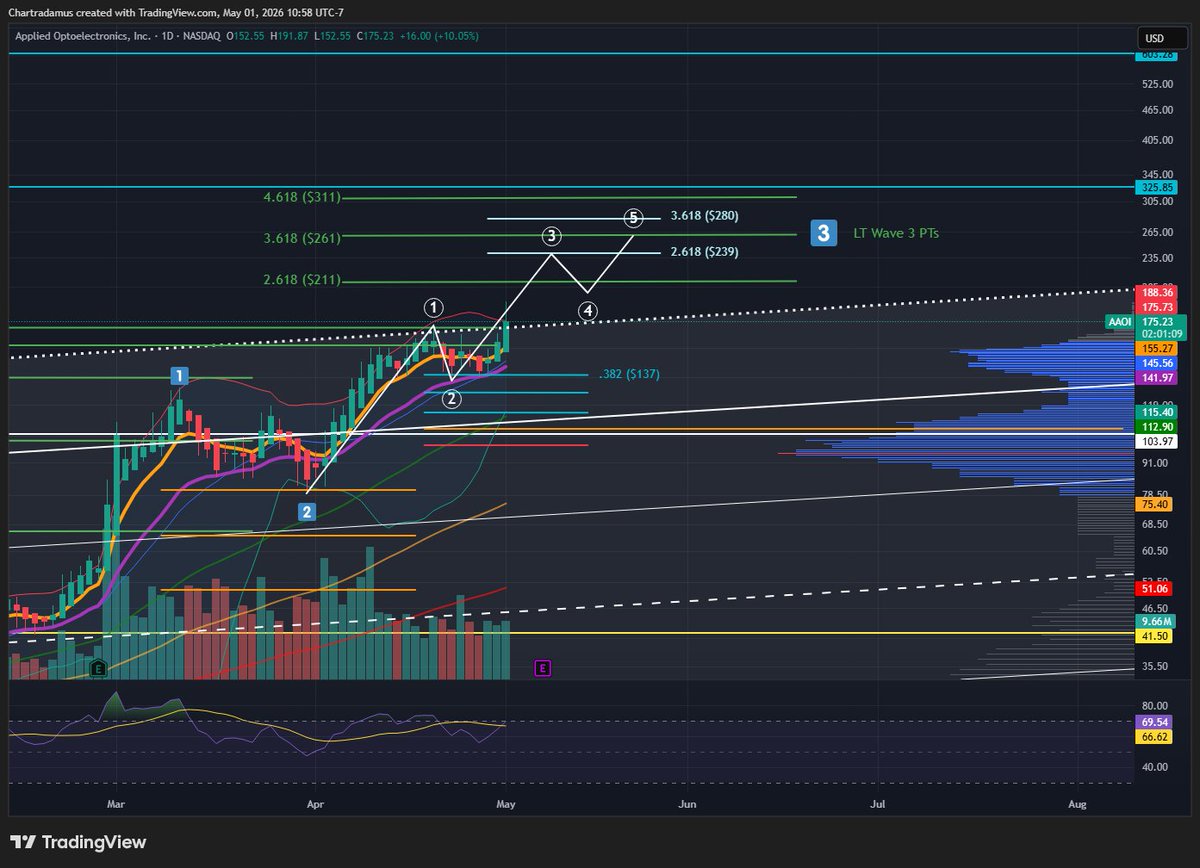
The market sold $AAOI off 11% for missing EPS by two cents (?). I’m buying the dip. The miss was $0.02. The company raised >$200M in equity and deployed $68.7M in CapEx in a single quarter building factories. You have to spend money to make money. This is a company investing ahead of the largest revenue ramp in its history. Q1 delivered record revenue for the fourth consecutive quarter. $151.1M. Up 51% YoY. Up 13% sequentially. Management is explicitly saying demand is not the constraint – capacity is. Their internal demand number is $1.4-1.5B for 2026. They guided to $1.1B because that’s what their factories can physically produce. Q2 guidance: $180-198M. Another 30% sequential step up. Then Q3: management guided 60-80% sequential growth over Q2. Q4 similar to Q3. By mid-2027, $471M per month of data center transceiver revenue – $5.6B annualized from one product category. The capacity ramp: 800G: 138K/month today → 420K/month by Q4 2026 → 550K/month by mid-2027. 1.6T: 10K/month today → 230K/month by Q4 2026 → 380K/month by Q4 2027. ELSFP for CPO: starting Q4 2026 at 5K/month → 400K/month by Q4 2027. Management confirmed an industry-wide InP laser shortage that will “persist and get more acute” with the advent of CPO. This directly validates the $SIVE and $LITE supply chain opportunity. When the CFO of one of the largest transceiver manufacturers in the world says InP laser shortage is getting more acute – that’s primary source confirmation that the external laser market is structurally undersupplied. The compression today is entirely a product mix transition. 400G making way for 800G and 1.6T, both of which carry meaningfully higher margins. Management is calling last quarter’s $200M order announcement “SMALL” compared to what’s to come. Full year 2026 guidance: >$1.1B revenue, >$140M non-GAAP operating income. To be honest, I’m usually the most bullish person in the room but these guys are on something else. They know demand exceeds supply through mid-2027, and they will make the most out of it. Two risks worth naming. Customer concentration (don’t do us a POET) – three customers are 98% of revenue. Management fairy dust sniffing – the company has a historical pattern of promising large ramps and delivering them late. Added to my position on the dip. I’m long $AAOI. (NFA)
Ren tweet media
English
20
32
313
111.3K
BioAndTrade retweetledi
KawzInvests 🦑
KawzInvests 🦑@KawzInvests·
$AAOI Q1 is in. Here's my take after listening to the full call. Q1 came in at the low end at $151.1M, 29.2% gross margin, -$0.07 EPS. Stock got hit on the print. None of that matters. This is a forward-looking story and the ramp doesn't start until Q3. Management raised FY26 from $1B+ to $1.1B+ revenue and $120M+ to $140M+ non-GAAP operating income. Thompson said internal target is $1.2B. Actual customer demand is $1.4-1.5B. They're guiding the only number they can control, their own capacity. The mid-2027 monthly transceiver run rate went from $378M to $471M. That's ~$1.1B in annualized revenue added to the model in one quarter. 1.6T alone in 2027 is a $2B+ business per Thompson. AAOI's TTM revenue is $507M. Q3 guided up 60-80% sequentially. Q4 similar. If Q2 hits the $189M midpoint, Q4 alone exceeds all of FY25. 40%+ gross margin target by Q4. Three 10%+ customers already in Q1 before the 1.6T ramp. Three multi-year CPO/laser agreements in negotiation. Execution risk is still there. They have to procure InP substrates, hit qualification timelines, and stand up new facilities on schedule. If they execute, this is a very solid long. Sold out through mid-2027 with customer demand 30%+ above what they can produce. Added under $140. Full breakdown linked below. $AAOI $LITE $COHR $AEHR $VIAV
KawzInvests 🦑@KawzInvests

$AAOI reports earnings tomorrow and this is what I'm expecting. 2025 revenue was $456M. Management guided $1B+ for 2026 with $120M+ in non-GAAP operating profit. The business is set to more than double in a single year after running $190-250M annually from 2019 through 2024. > Q1 guide is $150-165M vs Street at $157M. CATV running hot, 800G firmware slip from Q4 pushed shipments into Q1, and they beat EPS by 91% last print. Setup favors a beat. > Q2 is what matters. Management has telegraphed it as the first profitable quarter and the start of the 800G/1.6T ramp. Above $185M with positive NG EPS and the move continues. > OFC capacity slide showed 650K combined 800G + 1.6T units/month by Q4 26, 30% above prior guidance. 930K/month by Q4 27. That's a ~$6B annualized run rate from two product lines against a $14B market cap. Full pre-earnings breakdown linked below. $AAOI $LITE $COHR $AEHR $VIAV

English
19
41
411
117.3K
BioAndTrade retweetledi
Michael Sikand 🦑
Michael Sikand 🦑@michaelsikand·
The reason $AAOI is such a volatile stock... These dudes are either lying SO hard or this is the most asymmetric set up in the stock market. Today they said they can go from $150M/quarter to $470M/month in ONE YEAR. Photonics TAM says yes. Mgmt track record does not.
Michael Sikand 🦑 tweet media
English
44
20
485
115.5K
BioAndTrade retweetledi
Beardo
Beardo@BeardoTrader·
The last time the U.S. 10-year broke out to 5%, $SPY dropped 11%. Stocks bottomed three months later, exactly when yields topped.
Beardo tweet media
English
51
74
695
67.8K
BioAndTrade retweetledi
Ch🅰️rtradamus 🔋
Ch🅰️rtradamus 🔋@Chartradamus·
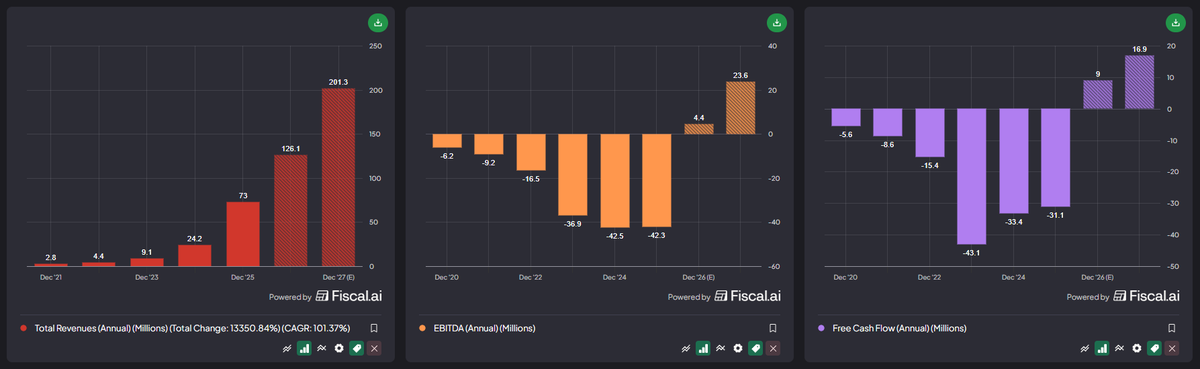
$AMPX Fundamental Deep Dive 🟢 Amprius OVERVIEW Amprius Technologies is a leader in high-energy-density silicon anode lithium-ion batteries, delivering cells with up to 520 Wh/kg (awarded 2026 CES Best of Innovation Award). The importance in this value? These cells outperform graphite-anode cells (260 Wh/kg) by ~2x in terms of energy density, enabling longer range, heavier payloads, and faster charging (0-80% in 6 minutes) without major compromises on cycle life or safety. The core technology uses either SiMaxx (silicon nanowire) or advanced SiCore platforms depending on the use case. This advancement manages the 400% volume expansion that silicon experiences during lithiation, avoiding pulverization issues. This makes Amprius batteries ideal for weight and power sensitive applications. Every little bit counts. Edging out the opponents in gram/watt-hour capabilities and improving the technology year after year opens up incredible doors for the company. Silicon Anode Li-ion Battery Advantages ➯ 2x flight times in drones/eVTOLs ➯ Burst power delivery (maneuvers/takeoff easier) ➯ Military-grade temperature operation and safety At this time, the company is primarily focused on aviation (drones/UAS/UAVs + HAPS). $AMPX expects to further expand into eVTOLs, light EVs (e.g. scooters), robotics, and defense as the business grows. The company operates an R&D/pilot line in California, but relies on a contract manufacturing model that is capital-light with its partners in South Korea and a newly established domestic manufacturing partnership with Nanotech for NDAA compliance. Their business model revolves dominantly around product sales. The Amprius Drones/UAS segment often sees repeat large orders (ex. $15M -> $35M+ Follow-On) from leading Tier 1 UAS manufacturers. Other partners in this segment are Nokia Drone Networks, Airbus AALTO HAPS, AeroVironment aka $AVAV, BAE Systems, and many more proving a strong moat of 500+ customers and diversified proven use cases. This is amplified by the Defense Innovation Unit (DIU) contracts for NDAA compliant drone batteries, deals totaling up to $15M. As for expansionary efforts, there are existing purchase orders for light EV/LEV (2/3 wheelers) worth $10s of millions, and they've been selected by AIBOT for their autonomous eVTOL program. $AMPX holds a ~15% share of the premium aerospace battery segment, with near-monopoly in >450 Wh/kg cells for demanding UAS/HAPS where conventional batteries fall short. Drone demand is surging, and Amprius' cells directly address key limitations for endurance and payload. A critical enabler for military and long-endurance use cases. If this high-energy-density success in UAS can translate to success in robotics over the coming decade, imagine the revenue growth and backlog in store. ----------------------------------- GROWTH OUTLOOK This is the exciting part. $AMPX is a battery company far ahead of others in the theme fundamentally, positioning it as the battery investment with the greatest R/R. A clear leader with a clean balance sheet and strong guidance + backlog + moat. This is clear from the onset of explosive growth over the past year. FY2025 revenue totaled $73M (+202% YoY) with Q4 2025 bringing in $25M (+137% YoY) at 24% gross margins and their initial quarter with positive EBITDA. With this comes a just as strong 2026. Amprius is guiding for ≥$125M FY26 revenue (≥70% growth), narrowing losses and growing margins. Fresh manufacturing ramps w/ Nanotech de-risk scaling. The company has successfully pivoted to commercial scale via SiCore skews while leveraging SiMaxx for premium use cases. This is their inflection point. Expect near triple-digit YoY growth potential over the next couple years, tapering to strong ~50%+ CAGR afterwards due to capacity ramps and market penetration + maturation. All while their balance sheet only becomes more clean and profitability hits 2027 onwards. ----------------------------------- FAIR VALUE ESTIMATE Using an aggregated valuation approach across multiple disciplines of fundamental analysis including... ➯ DCF on revenue/EPS ramps with base terminal assumptions ➯ EV/revenue and EV/EBITDA multiples relative to peers ➯ SOTP considering drone/UAS + eVTOL/robotics upside ➯ Analyst consensus inputs ...my current Fair Value Estimate (FVE) for $AMPX is in the $30-$35/share range over 2026, aligning well with my technical analysis outlook. This reflects 2026 guidance execution ($125M+ revenue, positive EBITDA), backlog conversion, and margin expansion. Catalysts regarding new deals or adoption into defense and premium segments (eVTOLS/Robotics) will aid in easily achieving upper end targets or higher. ----------------------------------- LONG-TERM ESTIMATES Assuming $AMPX consistently meets or exceeds aggressive but achievable growth targets with advancements such as GWh-scale manufacturing ramps, here is a potential path forward valuation-wise. I am using reasonable forward P/E and EV/revenue multiples, factoring in dilution to risk over time and terminal growth. Base Case. EY2026 = $35+ EY2027 = $55+ EY2028 = $80+ EY2029 = $120+ Another high-conviction investment in the years to come for exposure to critical battery innovation in drones, eVTOLs, robotics, and defense. $AMPX technology will only become increasingly essential over the coming years. The company is positioned to take full advantage of the opportunity in these budding sectors from all ends. Risks are the ability to scale and competition, but are not concerning whatsoever at this point. The upcoming earnings will be crucial to gauge their progress.
Ch🅰️rtradamus 🔋 tweet mediaCh🅰️rtradamus 🔋 tweet media
English
2
5
35
11.1K
BioAndTrade
BioAndTrade@Kapstahoon·
@anni_sen Could you please check your DM about substack? Thanks.
English
1
0
1
71
Anni
Anni@anni_sen·
After 4 wks of back-to-back travels going home to San Diego for much needed rest. At CLUBSFO
Anni tweet media
English
3
0
18
2.4K
BioAndTrade retweetledi
The Hormuz Letter
The Hormuz Letter@HormuzLetter·
The "new" proposal Trump just said he received tonight from Iran which he would "soon be reviewing" is the same proposal his administration already rejected on Friday, yet he treats it like a new one and says "can't imagine that it would be acceptable." Per Araghchi, Iran's proposal from Friday demands withdrawal of all US forces from Iran's surroundings, lifting the naval blockade with a new Hormuz mechanism, lifting sanctions, releasing Iran's frozen assets, and paying compensation.
English
28
129
807
80.4K
BioAndTrade retweetledi
Ch🅰️rtradamus 🔋
Ch🅰️rtradamus 🔋@Chartradamus·
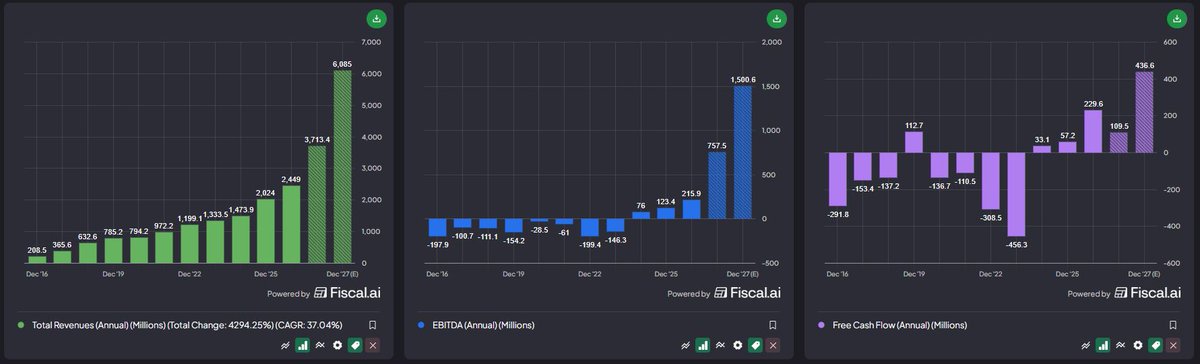
$BE Fundamental Deep Dive 🟢 Bloom Energy OVERVIEW Bloom Energy is a leader in solid oxide fuel cell (SOFC) technology, delivering reliable, clean onsite power solutions primarily for AI data centers/hyperscalers, and critical infrastructure. The core offering, modular SOFC systems, converts natural gas (built for fuel flexibility for future via hydrogen/biogas/RNG) into electricity through an electrochemical process with no combustion. This gives clear advantages over gas turbines from companies such as GE Vernova $GEV. These include... ➯ Faster deployment (months rather than years due to turbine backlogs) ➯ Significantly lower emissions (e.g., 92% lower NOx as shown through Oracle’s Project Jupiter) ➯ Minimal water use ➯Higher power density (~100 MW/acre versus the ~50 MW from turbines) ➯ Quieter operation + superior rapid load-following for spiky AI workloads Partners explicitly choose Bloom in many cases for speed-to-power, permitting ease, and for less backlash from local communities. Major wins include Oracle (up to 2.8 GW, replacing planned turbines), Brookfield ($5B strategic partnership naming Bloom preferred onsite provider), AEP (up to 1 GW), Equinix, and others. Currently, the backlog is huge for $BE so executing on this front is of utmost importance. Bloom is scaling manufacturing toward 2 GW annual capacity by end-2026 (with a path towards 5 GW long-term). The business model blends product sales with high-margin recurring service and Power Purchase Agreements (PPAs), where customers often pay a flat or contracted rate per kWh monthly over 5–20+ years instead of a pure one-time upfront fee. This lowers customer capex while building stable revenue for Bloom. Profitability is inflecting sharply as mix shifts to AI deployments and margins expand (targeting ~34% gross in 2026). FCF is turning positive amid capex for growth. Recent momentum has been explosive. Q1 2026 revenue hit $751 Million (+130% YoY), with the company raising FY2026 guidance to $3.4–$3.8B (~80% YoY growth at midpoint) and non-GAAP EPS to $1.85–$2.25. This surge is powered by AI-driven demand for rapid, behind-the-meter generation that bypasses grid delays. Legislation (ITC eligibility ~30% under IRA frameworks) and public perception around data center environmental impacts (emissions, water, noise, grid strain) strongly favor Bloom long-term versus higher-impact combustion alternatives. I see $BE as a leveraged play on the AI power bottleneck, picks-and-shovels for onsite generation where grid and traditional turbines fall short. With a ~$80B+ market cap, the stock currently trades at a premium, but reflects strong growth expectations that are realistic. ----------------------------------- GROWTH OUTLOOK Under CEO KR Sridhar, Bloom has shifted from steady enterprise deployments to explosive AI/hyperscaler focus. Management projects 2026 as a breakout year and Q1 proves this expectation taking form. Expect further acceleration into 2027+ as capacity ramps and deals convert. Analyst consensus embeds 30–60%+ revenue CAGR with EPS turning strongly profitable and growing ~40%+ annually over the next few years. Revenue could scale from ~$3.5B+ in 2026 toward $9–12B by 2030 in BASE CASE models, with upside from additional GW-scale hyperscaler wins. Key drivers include manufacturing expansion, backlog execution, margin expansion from scale/product mix, SOFC advantages over turbines, and policy tailwinds. Environmental legislation and public backlash against data center impacts (high emissions/water/noise from turbines) position Bloom favorably. Partners highlight sustainability wins, aiding permitting. Risks include execution on ramps, supply chain costs, natural gas pricing, policy shifts, and competition, but demand visibility remains robust. This is still early in the multi-year AI power cycle. Bloom’s PPA/EaaS model and environmental edge will accelerate adoption as their tech makes its mark. Oracle will serve as the proof. ----------------------------------- FAIR VALUE ESTIMATE Using an aggregated valuation approach based on many different disciplines of FA (DCF, Relative Multiples, Analysts, etc.), my current FVE for $BE is in the $200–250/share range near-term, with significant upside as milestones are met QoQ as 2026 rolls on. This FVE reflects current execution and growth, so the stock trades at a premium on AI enthusiasm and expectations of management maintaining outperformance. LONG-TERM ESTIMATES Assuming $BE consistently meets or exceeds aggressive growth targets (capacity ramps, GW deal conversions, margin expansion, environmental tailwinds), here is a potential path forward valuation-wise when using reasonable P/E multiples on expected EPS (Base-Bull Scenarios). EY2026 = $350–500+ EY2027 = $550–750+ EY2028 = $750–1,000+ EY2029 = $950–1,300+ ----------------------------------- All in all, this is a high-conviction investment in the years to come. $BE has multi-year compounding potential and can easily deliver substantial upside from current levels. I remain vested since March lows at a cost basis of $124/share and do not plan to trim/sell the position unless a major market top presents itself. I feel confident in this company as the theme of power delivery for hyperscalers grows and the company is poised to lead the effort through a paradigm shift in method.
Ch🅰️rtradamus 🔋 tweet mediaCh🅰️rtradamus 🔋 tweet mediaCh🅰️rtradamus 🔋 tweet media
English
2
1
27
2.3K
BioAndTrade
BioAndTrade@Kapstahoon·
@Sam_Badawi $BE best solution provider (fast/clean/efficient) is not mentioned here in my opinion.
English
2
0
1
801
Sam Badawi
Sam Badawi@Sam_Badawi·
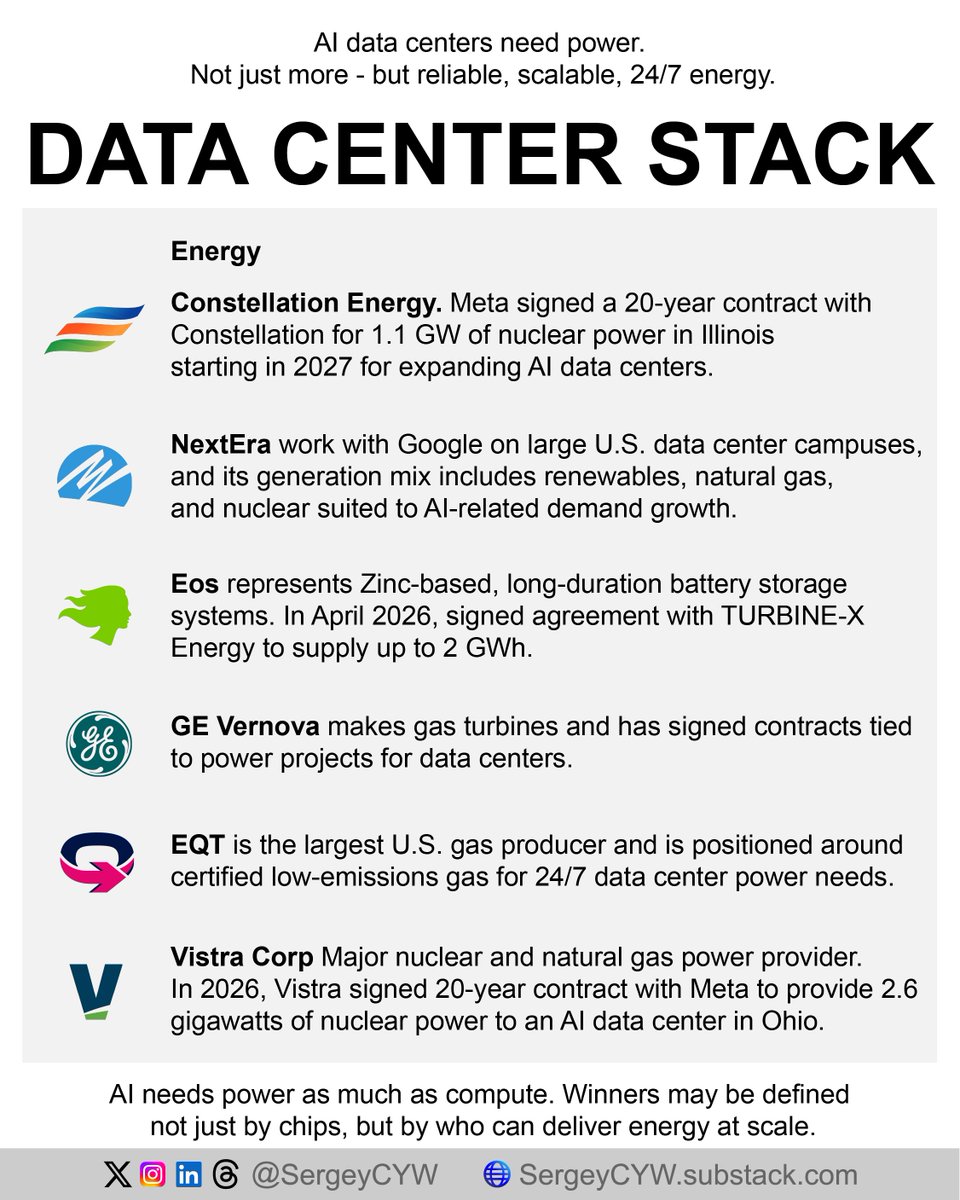
AI data centers don’t just need chips. THEY NEED POWER. $CEG: Meta signed a 20-year agreement for 1.1 GW of nuclear power in Illinois starting in 2027. $VST: Signed a 20-year agreement with Meta to deliver 2.6 GW of nuclear power supporting an AI data center in Ohio. $NEE: Working with Google on large U.S. data center campuses spanning renewables, natural gas, and nuclear generation. $GEV: Manufactures gas turbines and has signed contracts tied directly to data center power infrastructure projects. $EQT: Largest U.S. natural gas producer, positioned to supply certified low-emissions gas for 24/7 data center baseload demand. $EOSE: Zinc-based long-duration battery storage provider. Signed a deal in April 2026 to supply up to 2 GWh to Turbine-X Energy. Credit to @SergeyCYW for the image
Sam Badawi tweet media
English
48
142
836
98K
BioAndTrade
BioAndTrade@Kapstahoon·
$BE bloom energy provides alternative solution which can be deployed faster, clean energy solution. $ORCL just announced that they will use 2.4 GW Bloom’s solid oxide fuel cell replacing gas turbine and diesel generators to power entire datacenter. Bloom last time deployed in less than 60 days.
English
1
0
3
439
Aakash Gupta
Aakash Gupta@aakashgupta·
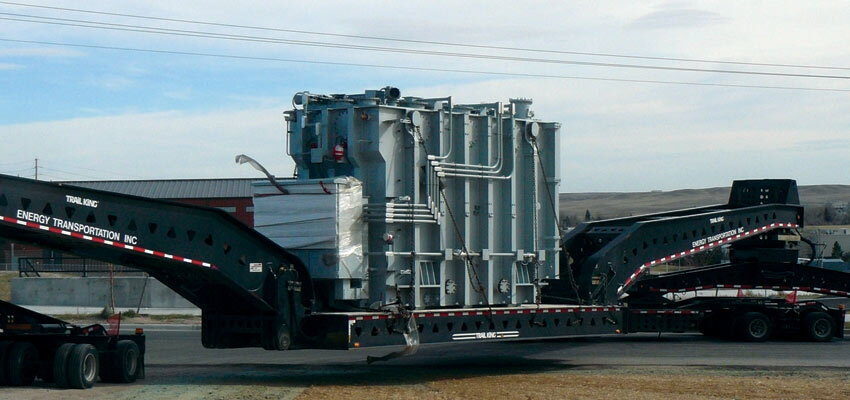
A 5-year backlog on grid transformers just killed half of America's 2026 AI data centers. Sightline Climate tracked 12 GW of 2026 US data center capacity announced across 140 projects. Only 5 GW is actually under construction. 11 GW sits in the "announced" stage with no physical progress despite typical build times of 12-18 months. 25% of those projects haven't disclosed a power strategy at all. That last number is the tell. A quarter of "planned 2026 AI capacity" has no sourced answer to where the electrons come from. Call those projects what they are: vapor capex with a press release attached. Nvidia is shipping. The gating constraint is high-voltage transformers, switchgear, and grid-tie batteries. Pre-2020 lead time on a high-power transformer was 24-30 months. Today it stretches to 5 years. Electrical equipment is under 10% of total data center cost and 100% of the bottleneck. This breaks the standard analyst model. When a hyperscaler announces $50B of capex, the Street treats it as compute coming online in 18 months. If the transformer order wasn't placed in 2022, that money sits as commitment without capacity. You cannot pay for a transformer that doesn't exist yet. The winners under this regime are whoever locked in power purchase agreements and electrical equipment orders 3-4 years ago, before anyone was modeling hundreds of megawatts of inference load. Everyone else is waiting in line behind them. Second order is uglier. Hyperscalers buying $50B of GPUs that sit unpowered depreciate against Nvidia's annual cadence while paying carrying costs on empty data center shells. Every quarter dark is a quarter of compounding waste. The "we're 6 months from running out of compute" panic just became "we're 5 years from running out of transformers." Capital fixes one. Capital cannot manufacture a transformer.
Aakash Gupta tweet mediaAakash Gupta tweet media
Hedgeye@Hedgeye

BREAKING: Half of planned US data center builds have been delayed or canceled

English
65
212
837
237.2K
BioAndTrade retweetledi
Bull Theory
Bull Theory@BullTheoryio·
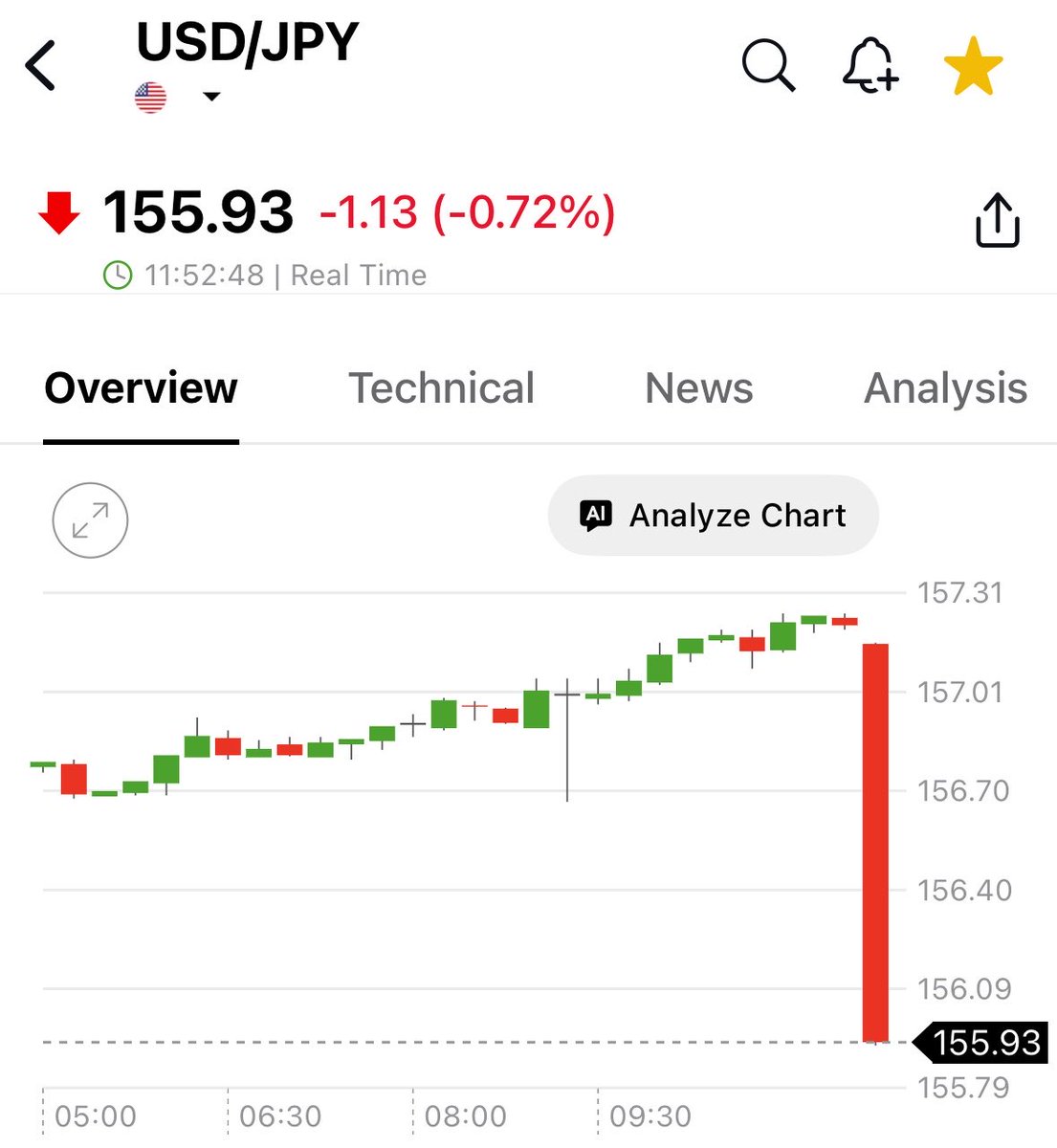
BREAKING: Japan just confirmed a massive Yen-buying intervention. Last time the Bank of Japan sold US dollars to save the Yen, global markets crashed brutally. But this time it is even worse. Today they are dealing with two problems at the same time. Japan's 10 year bond yield is at 2.52%, the highest since 1999. The 5 year bond just hit a record high of 1.88%. The BOJ is defending the yen while its own bond market is selling off hard. In 2024 bonds were stable. Today every dollar they spend buying yen tightens liquidity, and tightening liquidity puts more pressure on bonds already at 27 year high yields. Both problems feed each other and there is no clean way out. Oil is at $120 and Every barrel Japan imports gets more expensive as the yen weakens, which pushes inflation higher, which forces the BOJ toward rate hikes, which slows an economy already being damaged by the US-Iran war. The BOJ raised its inflation forecast this week to 2.8% while simultaneously cutting its GDP growth forecast to just 0.5%. Three of nine board members already voted for a rate hike at the last meeting. The BOJ is being squeezed from both sides, hike rates to defend the yen and you damage an economy already under pressure from the war. Do nothing and the yen keeps weakening and imported inflation keeps rising. In 2024 oil was not a factor. Today it is the core driver of everything. Investors currently hold the largest short yen position since July 2024. Every single one of those positions is now being forced to unwind at the same time. When that happened in 2024 it did not just move the yen, it crashed stocks, crypto, and bond yields simultaneously across every major market. Japan's Finance Minister Katayama told G7 members Japan is watching FX with a "high sense of urgency" and confirmed direct talks with US Treasury Secretary Scott Bessent about the yen. And Kevin Warsh takes over as Fed Chair on May 15. If he signals any lean toward rate cuts, the interest rate gap between the US and Japan narrows and the carry trade that has been driving USD/JPY to 160 unwinds violently on its own, without any BOJ action needed at all. In 2024 the BOJ had one tool and one problem. They spent $62 billion and it worked temporarily. Today they have a weak yen, a bond market at 27 year highs, oil at $120, an active war raising inflation, and a new Fed Chair arriving in two weeks.
Bull Theory tweet mediaBull Theory tweet media
English
84
468
2K
188.8K
BioAndTrade retweetledi
Alphatica
Alphatica@alphaticaio·
SPY OPEN | Thursday April 30 | Last Trading Day of April $711.17. Down 0.06%. All four mega-caps beat. Only one rallied. Apple reports after the close. Composite: +21.8 [Lean Bullish] Last night was the most concentrated earnings event of the year. Here's what happened and what the market did with it. THE EARNINGS: Alphabet: the winner. Revenue $109.9B (+22% YoY), beat by $2.7B. Cloud surged 63% to $20B. Net income up 81%. Stock +6% after hours. Pichai said they're "compute constrained" and can't meet demand. 2027 capex will "significantly increase." The AI story is real at Google. Microsoft: beat but sold. Revenue $82.9B (+18%), Azure +40%, AI business hit $37B annual run rate (+123% YoY). Stock fell ~3% after hours. Cloud grew 29%. The beat wasn't enough. Losing OpenAI exclusivity is weighing on sentiment. Meta: beat but sold harder. Revenue beat, EPS $10.44 (+62% YoY), but Q2 guidance showed flat revenue growth. Stock dropped 5%. Capex raised to $125-145B. The market wanted acceleration and got maintenance. Amazon: mixed. AWS grew but the overall print was soft. Stock fell ~3%. The pattern: four beats, three selloffs. The beat-and-sell theme that started with Tesla last week is now 4 for 5 among mega-caps. The bar for "good enough" is higher than the numbers can clear. WHAT THIS MEANS FOR THE STRUCTURE: The composite improved to +21.8 lean bullish. That might seem counterintuitive after three mega-caps sold off overnight. Here's why: the earnings were priced in. The -$318M accelerator at $710 that threatened to fire all week didn't fire. The worst case was priced and it didn't materialize. The structure relaxed. GEX improved to -$34M total. Nearly flat. A massive improvement from yesterday's -$519M. The event gamma drained out overnight. The market is lighter, freer, and more reactive today. $700 accelerator: -$188M. Still the largest. But it's 1.6% below now, not 0.2% like the $710 accelerator was. The nearest danger moved further away. $715 magnet: +$179M (0.5% above). The magnets above are intact and pulling. Dealers short 100.5M shares. Rebuilt from 87.8M yesterday pre-FOMC. The engine added 13M shares of short delta overnight as the earnings beats stabilized positioning. IV: 17.8%. Down from 19.3% yesterday pre-FOMC. A 1.5-point compression. Vanna at +56.9K is supportive. The vol crush is doing quiet work underneath. Daily flow: +402K shares. Essentially flat. The morning is calm. 73% of premium went to calls. The lean is bullish but the conviction is low. Everyone is digesting. $700 put OI jumped to 340K. Fresh protection built right at the trapdoor. That's 32K more puts than yesterday. The hedging hasn't stopped even as the structure improved. APPLE AFTER THE CLOSE: The last Mag Seven name. Apple is the swing factor. If Apple beats and rallies, it breaks the beat-and-sell pattern and gives the market permission to push to new highs. If Apple beats and sells like the other four, the pattern is confirmed and the market enters May with tech exhaustion. Apple is down 1% YTD while the Nasdaq is up 14% for the month. It's been the laggard. The expectations bar may be lower, which could help. THE MONTH IN CONTEXT: April 2026: SPY went from $655.83 to $711.17. That's +8.4%. The S&P 500's best April since 2020. The Nasdaq's best month since the pandemic. All of it driven by the mechanics we tracked: dealer short delta, put decay, positive gamma, ceasefire dynamics. We published updates every session. Called the 13-day rally. Called the OpEx unwind. Called the ceasefire extension snap-back. Called the $710 accelerator holding through FOMC. The receipts are on the timeline. May starts tomorrow. The ceasefire is open-ended. Hormuz is closed. Warsh takes over the Fed on May 15. The mechanics continue. The bottom line: Four mega-caps beat. Three sold off. The structure absorbed it and improved. The $710 accelerator that dominated this week didn't fire. GEX normalized. The composite is lean bullish. Apple tonight decides whether tech enters May with momentum or fatigue. The beat-and-sell pattern is 4 for 5. Apple breaks it or confirms it. $715 is the magnet. $700 is the trapdoor. Apple is the catalyst. May starts tomorrow. $SPY $QQQ $VIX
Alphatica tweet media
English
0
2
17
1.2K