
Karakandao retweetledi

A British mathematician invented the computer at 24, won the war at 30, was chemically castrated at 40, and was dead at 41.
I went down this rabbit hole expecting a story about science. What I found was the most brutal betrayal in the history of modern technology.
His name was Alan Turing.
In 1936 he was a 24-year-old graduate student at Cambridge working on an obscure logic problem nobody outside academia cared about. The German mathematician David Hilbert had asked whether a single procedure could exist that, given any mathematical statement, would tell you whether it was provable.
Turing answered no. But to prove the answer was no, he first had to define exactly what a procedure was. So he invented an abstract machine to capture the idea.
The paper is called On Computable Numbers. It is 36 pages long. It is the most important paper in the history of computer science.
What he sketched on paper that year is now called a Turing machine. A device that reads instructions off a tape, modifies what it reads, and moves to the next instruction.
Every CPU on Earth is a physical implementation of this idea. Every programming language is a way of writing instructions for one. He proved, on paper, that there could exist a single universal machine capable of simulating any other machine. That single proof is the reason your laptop can run thousands of different programs without being redesigned for each one.
Hardware and software are different things because Turing proved they could be, nine years before there was such a thing as a stored-program computer.
Then the war happened.
In 1939 he was recruited to Bletchley Park, the British codebreaking center where the most secret work of World War II was done. The Germans were using a cipher machine called Enigma to encode every military order moving across Europe. The number of possible Enigma settings was 158 quintillion. The Polish had cracked an earlier version. The new German naval Enigma was considered unbreakable.
Turing led the team that broke it.
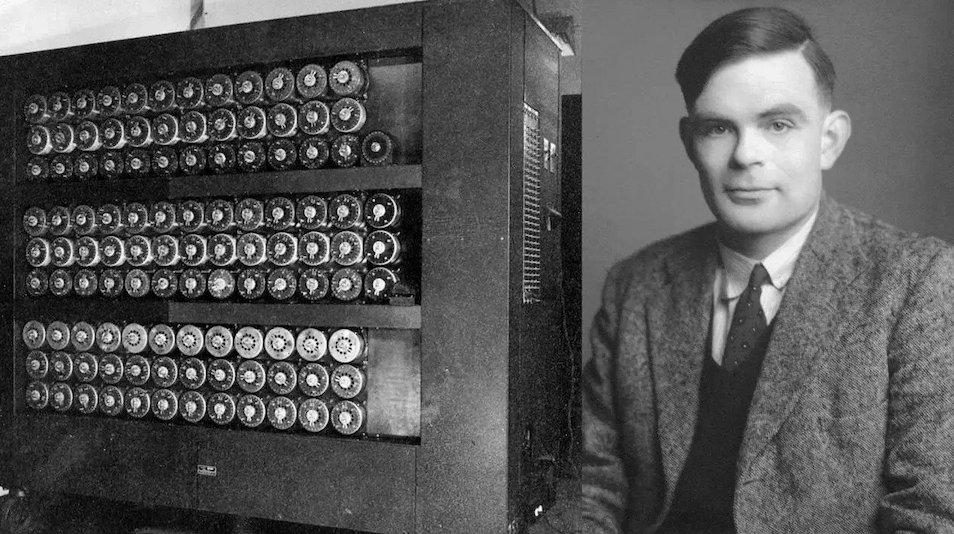
He designed a machine called the Bombe that could systematically eliminate impossible cipher settings until only the correct one remained. By 1943 his team was decrypting roughly 84,000 German messages per month.
The British Admiralty could read U-boat positions in the Atlantic before the U-boats reached them. Historian Sir Harry Hinsley, who served at Bletchley Park and later wrote the official British intelligence history of the war, estimated that the work shortened the war by two to four years. Millions of people who would have died are alive because of what one small team did in a country house outside London.
Almost none of them ever knew his name.
The work was classified for 30 years. Turing went back to civilian life, took a position at the University of Manchester, and in 1950 wrote a second paper that would do for artificial intelligence what his 1936 paper had done for computing.
It is called Computing Machinery and Intelligence. The opening line is famous. "I propose to consider the question, can machines think." Then he did something nobody had ever done with that question. He pointed out that the question itself is meaningless until you define what thinking is, and that nobody can define what thinking is even for humans.
So he proposed replacing it with an operational test. If a machine could hold a conversation indistinguishable from a human conversation, the question of whether the machine "really" thinks becomes a philosophical preference, not a scientific one.
ChatGPT, Claude, Gemini, every large language model in production today, every conversation about AI alignment, every benchmark measuring whether a model has crossed some threshold of capability all of it traces back to the test he proposed in that single 1950 paper.
He defined the entire vocabulary of the field he never lived to see exist.
In 1952 he was arrested.
A young man named Arnold Murray had stayed at his house. Murray's friend later broke in to steal something. Turing reported the burglary to the police. Under questioning, he admitted he had been in a relationship with Murray. Homosexuality was a crime in Britain under the 1885 gross indecency law, the same statute that had been used to imprison Oscar Wilde 57 years earlier.
Turing did not deny what he had done. He told the police it should not be against the law. He was convicted.
The court gave him a choice. Prison, or a year of forced estrogen injections to chemically suppress his sex drive. He chose the injections so he could keep working. The treatment caused weight gain. It gave him breasts. It stripped his security clearance. The country that had used his mind to win the war was now using its laws to destroy the body that mind lived inside.
On the morning of June 8, 1954, his housekeeper found him dead in his home in Wilmslow. He had died the previous day, June 7. He was 41 years old. A half-eaten apple was on the bedside table. The autopsy found cyanide in his system. The inquest ruled it suicide.
Some historians dispute the ruling. Jack Copeland, a leading Turing scholar at the University of Canterbury, has argued that the apple was never tested for cyanide, that Turing was in good spirits in the days before his death, that he had been making plans for the week ahead, and that the cause of death is consistent with accidental inhalation of cyanide vapor from a home electroplating experiment he had been running in his spare bedroom. We will probably never know which version is correct.
What is certain is that he died alone, in a small house outside Manchester, a year after the British government finished injecting hormones into his body, in a country whose existence depended on the work he was no longer allowed to do.
In 2009 the British government issued an official apology. Prime Minister Gordon Brown wrote that the treatment Turing received was "appalling" and that he deserved "much better." In 2013 Queen Elizabeth II granted him a posthumous royal pardon. In 2021 his face was placed on the Bank of England's 50 pound note.
Sixty years. That is how long it took the country that owed him everything to put his face on its money.
The 1936 paper is free online. The 1950 paper is free online. Both have been read by every serious computer scientist who has ever lived. The man who wrote them did not live to see a personal computer, did not live to see the internet, did not live to see a single one of the machines whose architecture he had defined while still in his twenties.
Every algorithm running on every machine on Earth right now traces back to a graduate student who got 41 years on this planet before the country he saved decided they could no longer tolerate the way he loved.
English