K

52.8K posts

K banner
K

K

@KartikSheth

I Am Enough Of An Artist To Draw Freely Upon My Imagination...

ÜT: 18.951912,72.810305 Katılım Mayıs 2009
217 Takip Edilen583 Takipçiler
K retweetledi
Hindutva Knight
Hindutva Knight@HPhobiaWatch·
LGBT March in Delhi ☠️ Must see Delhi Police reaction
English
46
214
1.7K
30.9K
K retweetledi
Raghava Krishna | రాఘవ కృష్ణ
Grateful to the acharya for illuminating the subtler aspects of Dharma. Mindful that we are so mired in SJW by a radical State that acharyas have to take extra burden on themselves. That our education, culture and media do not equip us with our own lens to see ourselves.
Alpakanya@Alpakanya

"Just as a surgeon maintains sterile conditions, a priest maintains ritual purity" - Pandit ji busts the false untouchability propaganda run by seculars to malign Hindus.

English
8
86
296
9.5K
K retweetledi
Comman Man
Comman Man@CommanMan777589·
Make this viral guys! Always double standards!! She is asking some tough questions to the aviation ministry!! At the airport I have removed -Rudraksha from my neck Devi pendant Devi Kavach Devi gudi - a linga Jacket Shoes I stand by every security rule of this country. No questions. My only question -equal rules for everyone. Burqa can hide many things right??
English
210
4.3K
10K
125.3K
K retweetledi
Tathvam-asi
Tathvam-asi@tathvamasi6·
They aren’t allowed in 🕌. But if they must visit our temples, they should have the minimum courtesy to remove their tents and enter. We have our traditions. Take a bath, wear Hindu traditional dresses with a Bindi and come, or don’t come to our temples. This is not acceptable at all. Hindus should confront them. Either make them remove their tents or kick them out. Location: Sringeri, Karnataka.
English
151
1.8K
4.5K
119K
K
K@KartikSheth·
@tehseenp Is it INDIA Alliance or INDI Alliance? Because, as far as I understand, it is the Indian National Development Inclusive Alliance, and INDI Alliance stands for none of the attributes it has adopted in its name.
English
0
0
0
215
Tehseen Poonawalla Official 🇮🇳
Irrespective of whether you are a BJP/NDA SUPPORTER OR A CONGRESS/INDIA ALLIANCE SUPPORTER: can we be explained why Nitish Kumar ji’s pampered nepo baby deserves to be the Health Minister of Bihar?! This special, zero-experience nepo kid who was probably still attempting to play with crayons until yesterday is now suddenly going to “run” the Health Department in Bihar?! And this special child actually tells the media: “Thank you to the people for making JDU win 200 seats in 1925!” This level of nonsense while holding the lives of millions in his soft, privileged- special hands is next-level shameless & a brain-dead, and criminal move. Honestly Bihar’s hospitals are already graveyards & now NDA is handing the keys of the health department to a dynastic toddler who can’t even count seats or years correctly. Frankly this is not just nepotism on steroids, the NDA government is actually playing Russian roulette with public health. Shameless
English
319
315
2.1K
266.9K
K retweetledi
Amish Tripathi
Amish Tripathi@authoramish·
Sanskrit Rock! A project by Trilok Music & me, to present ancient Sanskrit hymns in modern music This one is the Tandav Stotram, composed by Raavan in honour of Lord Shiva The rendition is modern, but the devotion is as deep as the resonance of the universe Hope you like it!
English
156
949
3.9K
241.3K
K retweetledi
Dr Mouth Matters
Dr Mouth Matters@GanKanchi·
MUST READ Unbelievable & SHOCKING INFORMATION. DD Podhigai telecast an interview with Mr P M Nair, (retired IAS officer, who was the Secretary to Dr. Abdul Kalam Sir when he was the President.) I summarise the points he spoke in a voice choked with emotion. Mr Nair authored a book titled "Kalam Effect" 1. Dr Kalam used to receive costly gifts whenever he went abroad as it is customary for many nations to give gifts to the visiting Heads of State. Refusing the gift would become an insult to the nation and an embarrassment for India. So, he received them and on his return, Dr Kalam asked the gifts to be photographed and then catalogued and handed over to the archives. Afterwards, he never even looked at them. He did not take even a pencil from the gifts received when he left Rashtrapathi Bhavan. 2. In 2002, the year Dr Kalam took over, the Ramadan month came in July-August. It was a regular practice for the President to host an iftar party. Dr Kalam asked Mr Nair why he should host a party to people who are already well fed and asked him to find out how much would be the cost. Mr Nair told it would cost around Rs. 22 lakhs. Dr Kalam asked him to donate that amount to a few selected orphanages in the form of food, dresses and blankets. The selection of orphanages was left to a team in Rashtrapathi Bhavan and Dr Kalam had no role in it. After the selection was made, Dr Kalam asked Mr Nair to come inside his room and gave him a cheque for Rs 1 lakh. He said that he was giving some amount from his personal savings and this should not be informed to anyone. Mr Nair was so shocked that he said "Sir, I will go outside and tell everyone . People should know that here is a man who not only donated what he should have spent but he is giving his own money also". Dr Kalam though he was a devout Muslim did not have Iftar parties in the years in which he was the President. 3. Dr Kalam did not like "Yes Sir" type of people. Once when the Chief Justice of India had come and on some point Dr Kalam expressed his view and asked Mr Nair, "Do you agree?" Mr Nair said " No Sir, I do not agree with you". The Chief Justice was shocked and could not believe his ears. It was impossible for a civil servant to disagree with the President and that too so openly. Mr Nair told him that the President would question him afterwards why he disagreed and if the reason was logical 99% he would change his mind. 4. Dr Kalam invited 50 of his relatives to come to Delhi and they all stayed in Rashtrapathi Bhavan. He organised a bus for them to go around the city which was paid for by him. No official car was used. All their stay and food was calculated as per the instructions of Dr Kalam and the bill came to Rs 2 lakhs which he paid. In the history of this country no one has done it. Now, wait for the climax, Dr Kalam's elder brother stayed with him in his room for the entire one week as Dr Kalam wanted his brother to stay with him. When they left, Dr Kalam wanted to pay rent for that room also. Imagine the President of a country paying rent for the room in which he is staying. This was any way not agreed to by the staff who thought the honesty was getting too much to handle!!!. 5. When Kalam Sir was to leave Rashtrapathi Bhavan at the end of his tenure, every staff member went and met him and paid their respects. Mr Nair went to him alone as his wife had fractured her leg and was confined to bed. Dr Kalam asked why his wife did not come. He replied that she was in bed due to an accident. Next day, Mr.Nair saw lot of policemen around his house and asked what had happened. They said that the President of India was coming to visit him in his house. He came and met his wife and chatted for some time. Mr Nair says that no president of any country would visit a civil servant's house and that too on such a simple pretext. I thought I should give the details as many of you may not have seen the telecast and so it may be useful. The younger brother of APJ Abdul Kalam runs an umbrella repairing shop. When Mr. Nair met him during Kalam’s funeral, he touched his feet, in token of respect for both Mr. Nair and Brother. Such information should be widely shared on social media as mainstream media will not show this because it doesn't carry the so-called GB TRP The property left behind by Dr.A.P.J.Abdul Kalam was estimated. _ He owned 6 pants(2 DRDO uniforms) 4 shirts(2 DRDO uniforms) 3 suits (1 western, 2 Indian) 2500 books 1 flat (which he has donated) 1 Padmashri 1 Padmabhushan 1 Bharat Ratna 16 doctorates 1 website 1 twitter account 1 email id He didn't have any TV, AC, car, jewellery, shares, land or bank balance. He had even donated the last 8 years' pension towards the development of his village. He was a real patriot and true Indian India will for ever be grateful to you, sir.
English
99
1K
2.8K
124.6K
K retweetledi
MJ
MJ@MJ_007Club·
Lenskart cannot respect your bindi. Not because they hate you. Because they literally cannot afford to. Let me show you exactly why. Peyush Bansal tweeted: "We are proudly built in Bharat, for Indians." Beautiful line but a Terrible lie. Let's Start with the factory. Lenskart's India plant opened in 2023. Before that, China joint venture. That JV still runs today. Frames, Raw materials, Supply chain. all from China. Indian factory mostly assemble. Now look at who owns this "Bharatiya" company. Peyush Bansal: 10.28% Neha Bansal: 7.74% Amit Chaudhary: 0.98% Sumeet Kapahi: 0.96% All four founders combined: 20%. The remaining 80%? SoftBank: Japan. Temasek: Singapore. ADIA: Abu Dhabi. KKR: New York. Fidelity: Boston. Now here is what nobody tells you. Every foreign investor runs ESG compliance. Before writing a cheque. ESG = Environmental, Social, Governance. A scoring system that has nothing to do with Environment. Built in New York and Amsterdam. It decides who gets capital. Inside ESG lives another animal called DEI - Diversity. Equity, Inclusion. DEI was designed in America. Built on American horrors. Black minorities. Gender wars. LGBTQ rights. Never designed for India. Does not understand India. Here is what DEI scores as "positive": Hijab at work = Positive signal. Turban at work = Positive signal. Here is what DEI marks as risk: Bindi = Majority religion marker. Tilak = Majority religion. Kalawa = Majority religion. In Western DEI logic, the majority is the oppressor. Majority does not need protection. So when Lenskart's HR writes a grooming policy, they are not writing for you. They write for their colonial masters. Because Lenskart is chasing a $10 billion IPO. Does your bindi sit anywhere in that number? Their first customer is not you. Their first customer is SoftBank. Their first customer is ADIA. Their first customer is an ESG agency in Amsterdam. You buy one pair of glasses. They invest $500 million. Do the math on who Lenskart listens to. Now the government. You think they don't know? They know everything. Every ministry understands how foreign capital erases civilizational identity. SEBI approved the DRHP. Not one clause protecting Hindu identity. Because the government also wants the IPO, GST, Tax, Economic headline. Your kalawa / kada is not in that equation. This is not a Lenskart problem. This is every unicorn in India. Swiggy. Zomato. Ola. Meesho. Zepto.... Check their cap tables. Check the ESG reports. Check the grooming policies in their HR folders. Every company 60-80% owned by foreign capital is a branch office of Western values. "Built in Bharat" is a tagline. "For Indians" is a marketing campaign. The policy document tells you who they serve. Your Bindi. Your Kalawa. Your Kada. Your 5,000 years. Irrelevant to billionaires chasing an IPO. But minority appeasement? That scores points in Amsterdam. And we call ourselves an Independent Nation.
English
11
254
587
13.9K
K retweetledi
श्री
श्री@shree_2_2·
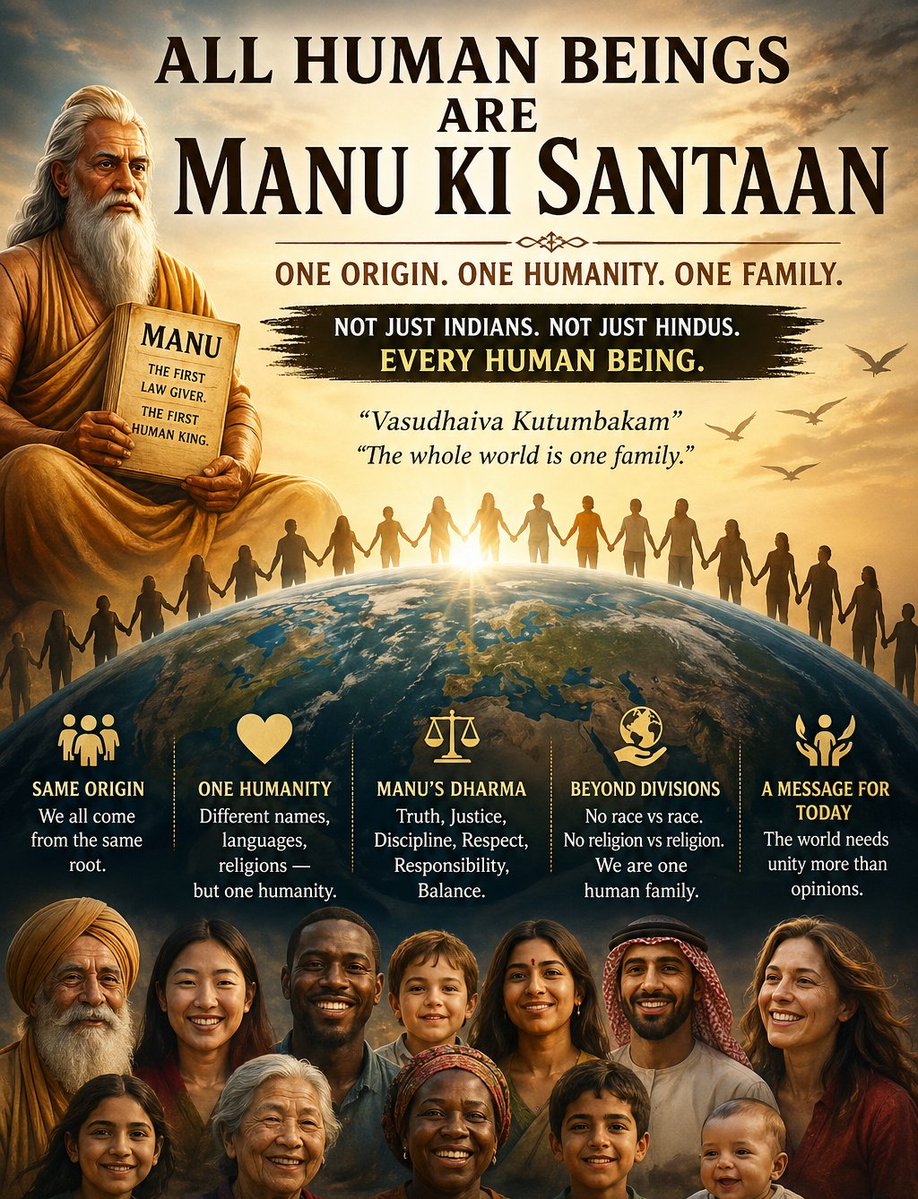
🧵 THREAD: Every Human Being is “Manu ki Santaan” — Not Just Indians. Most people think “Manu ki Santaan” means only Hindus or only Indians. But the truth is much deeper. It’s a civilizational idea about the origin of humanity. Let’s break it down. 🧵👇
श्री tweet media
English
34
162
236
3.9K
K retweetledi
Anand Ranganathan
Anand Ranganathan@ARanganathan72·
Facing an imposing supreme court bench, Senior Advocate @jsaideepak takes us on an incredible journey in constitutional law to bolster his case for overturning Sabarimala judgment. He is fighting ferociously for dharma, armed with nothing but his intellect. Watch, and be amazed:
English
536
11.1K
37.2K
684.5K
K retweetledi
BhikuMhatre
BhikuMhatre@MumbaichaDon·
“Morality isn’t universal. It’s inherited.” From what we eat to how we worship—faith decides. So can State really decide what’s right for everyone?" Striking Argument by Mukul Rohatgi in Sabarimala Case🔥 Modi Sarkar has already submitted that it's not in favour of State Control of Temples.
English
23
585
1.6K
40.3K
K retweetledi
महावीर, ಮಹಾವೀರ, Mahavir
A short film on the fight against love jihad. Watch out, watch out, it is our responsibility to protect our Hindu sisters and brothers. 🚩🙏
English
13
1.5K
2.7K
30.3K
K retweetledi
SANATAN
SANATAN@Eternaldharma_·
Before hanging him, the British broke his teeth with a hammer and pulled out all his nails. His limbs and joints were broken. Surya Sen His last words were: “MY DREAM, A GOLDEN DREAM, THE DREAM OF FREE INDIA” Unfortunately, these are not in our history books.
SANATAN tweet media
English
171
2.8K
6.6K
69.8K
K retweetledi
Paresh Rawal
Paresh Rawal@SirPareshRawal·
WOW !!!
Ihtesham Ali@ihtesham2005

A Soviet psychologist walked into a café in 1927 and watched a waiter do something impossible. He remembered every open order at every table. Perfectly. Without notes. Without effort. Then a table paid their bill. She asked him to repeat the order. He couldn't remember a single item. She spent the next two years figuring out why. What she found is now the operating system underneath every platform fighting for your attention. Her name was Bluma Zeigarnik, and she was a graduate student at the time, sitting with her professor Kurt Lewin, watching the waiters work the room. What caught her attention was something so ordinary that it had been happening in restaurants for centuries without anyone asking why. The waiters could remember every open order with perfect accuracy. Table four wanted the schnitzel with no sauce. Table seven had changed their wine twice. Table twelve owed for three coffees and a dessert. Every detail, held without effort, without notes, without any visible system at all. But the moment a table paid their bill, the information vanished. Completely. Lewin tested it on the spot. He called a waiter back minutes after a table had settled up and asked him to recite the order. The waiter could not do it. Not partially. Not approximately. The information was simply gone. Zeigarnik went back to her lab and spent the next two years turning that observation into one of the most replicated findings in the history of psychology. Here is what she proved, and why it changes how you think about attention, memory, and almost every piece of media you have ever consumed. She gave participants a series of tasks. Some tasks they were allowed to finish. Others were interrupted before completion. Then she tested recall across both groups. The unfinished tasks were remembered at nearly twice the rate of the completed ones. Not slightly better. Nearly twice. The brain was holding the incomplete work in a state of active tension, returning to it, keeping it warm, refusing to file it away. The finished tasks were closed, archived, released. The unfinished ones were still running. She called it the resumption goal. When the brain commits to a task and cannot complete it, it opens a file that stays open until resolution arrives. That open file consumes a portion of your cognitive bandwidth whether you are thinking about it consciously or not. It surfaces in idle moments. It pulls at the edge of your attention during other work. It is the thing you find yourself thinking about in the shower when you were not trying to think about anything at all. This is not a flaw in human cognition. It is a feature. The brain evolved to finish things. An open loop is a signal that something important is unresolved. Keeping that signal active increases the probability that you will return to it and complete it. In an environment where most tasks had real survival stakes, this was an extraordinarily useful mechanism. In the modern world, it is the most exploited vulnerability in human attention. Netflix did not invent the cliffhanger. But it industrialized it in a way no medium before it ever had. When a show ends on an unresolved question, it does not just create curiosity. It opens a file in your brain that stays active until the next episode closes it. The autoplay countdown that begins at 15 seconds is not a convenience feature. It is a precise calculation about how long the average person can tolerate an open loop before the discomfort of not knowing overrides every other intention they had for the evening. One more episode is not a choice. It is your brain doing exactly what it was designed to do: return to what is unfinished. The writers who built Lost, Breaking Bad, and Succession understood this intuitively without ever reading a psychology paper. Every episode ended on an open question. Every season finale answered three things and opened five more. The entire architecture of prestige television is a Zeigarnik machine running at industrial scale. But television is not where this gets dangerous. Every notification on your phone is an open loop. Every unread email is an open loop. Every task you wrote on a list and have not yet crossed off is an open loop. Each one is consuming a small but real portion of your available attention, pulling fractionally at your focus, degrading your capacity to be fully present in whatever you are actually doing right now. TikTok's algorithm does not just serve you content you like. It serves you content that ends one loop and immediately opens another, keeping the resumption system permanently activated so the cost of stopping always feels higher than the cost of continuing. The research on this accumulation effect is striking. Psychologists studying cognitive load have found that unfinished tasks do not sit passively in memory. They actively interrupt. They surface at the wrong moments. They are the reason you are reading something and suddenly remember an email you forgot to send. The brain is not malfunctioning. It is running its resumption system exactly as designed. It is just running it across forty open loops simultaneously, in an environment that generates new ones faster than any human nervous system was built to process. The most important practical implication Zeigarnik's research produced is one that most people use backwards. David Allen built his entire Getting Things Done system on the insight that the only way to close a cognitive open loop is to either complete the task or make a trusted commitment to complete it later. Writing something down in a system you actually trust has the same effect on the brain as finishing it. The file closes. The bandwidth is released. This is why writing a task down feels like relief even before you have done anything about it. You have not solved the problem. You have simply told your brain that the loop is registered and will be returned to, which is enough for the resumption system to stand down. The inverse is equally true and far more destructive. Every task that lives only in your head, unwritten and unscheduled, is an open loop burning cognitive resources around the clock. The mental cost is not proportional to the size of the task. A tiny nagging obligation consumes the same active tension as a major project. Your brain does not discriminate by importance. It discriminates by completion. Zeigarnik published her findings in 1927. The paper sat in academic literature for decades before anyone outside psychology paid attention to it. Then television got good. Then the smartphone arrived. Then the entire attention economy was engineered, largely by people who understood intuitively what she had proven scientifically: an open loop is the most powerful hook available to anyone who wants to hold human attention. Netflix knew it. Instagram knew it. Every designer who ever made a notification badge red instead of grey knew it. The café in Vienna is long gone. The mechanism she discovered there is now the operating system underneath every platform fighting for your time. Every "to be continued." Every unread notification. Every thread that ends with "part 2 tomorrow." All of it is the same waiter, the same unpaid bill, the same brain refusing to let go of what it has not yet finished. Zeigarnik noticed it over coffee in 1927. A century later, it is the most valuable insight in the history of media. And nobody taught it to you in school.

5
35
263
100.7K
K retweetledi
Parijit Khokle
Parijit Khokle@parijit·
Was Ravan really a villain? Do you know how Vishwamitra quietly connect the Ramayan and the Mahabharat? India’s ancient texts are far deeper than the stories we were told. Explore this and a lot more on Bharat Unscripted. Listen now on Apple Podcasts & Spotify
English
114
618
5.6K
3.3M
K retweetledi
Priyanka Chaturvedi🇮🇳
Priyanka Chaturvedi🇮🇳@priyankac19·
Why should India have been on any negotiating table between US and Iran? Don’t get the criticism as it wasn’t our war. And for Pakistan, it is like that tort who for a fee will say it will resolve the crisis- best described by India’s FM in an all party meeting.
English
1.5K
1.8K
13.4K
969.8K