Kathrin Gerpheide

16 posts

Kathrin Gerpheide banner
Kathrin Gerpheide

Kathrin Gerpheide

@KathGerp

PhD neuroscience. Consultant by day Building in AI - Nuroo: Real-time brain state from earbuds 🧠 Based in SF: Open to advice, feedback, and coffee!

San Francisco Katılım Mart 2026
59 Takip Edilen10 Takipçiler
Sabitlenmiş Tweet
Kathrin Gerpheide
Kathrin Gerpheide@KathGerp·
Hi, I'm Kathrin. PhD in neuroscience, work in consulting, build neurotech on the side because apparently I hate free time. Never introduced myself here. So - hi. Always happy to connect, grab coffee in SF, or hear your opinions on what I'm building!

Kathrin Gerpheide tweet media
English
4
0
4
368
Kathrin Gerpheide
Kathrin Gerpheide@KathGerp·
Honest question - why does every wearable measure the body but nothing measures the brain? #WHOOP/ #Oura/ #Apple track recovery, sleep, heart rate, (stress? more or less). But the main organ? Nothing. Stopped waiting for someone to build this. Now on it myself.
English
0
0
2
38
Kathrin Gerpheide
Kathrin Gerpheide@KathGerp·
@LiuTammy140201 Exactly. EEG is finally becoming real-world usable, especially with the new in-ear devices coming to market. The opportunity now is continuous brain-state tracking outside the lab. Building in this space.
English
1
0
1
34
Tammy Liu
Tammy Liu@LiuTammy140201·
The next brain-computer interface might not need a chip in your skull. Sound waves + EEG + metabolic data = non-invasive modulation we’re exploring at QHN. 48h feedback loops instead of 48-week waits. Neuro + metabolic health, one loop. ❤️
Tammy Liu tweet media
English
2
1
4
51
Kathrin Gerpheide
Kathrin Gerpheide@KathGerp·
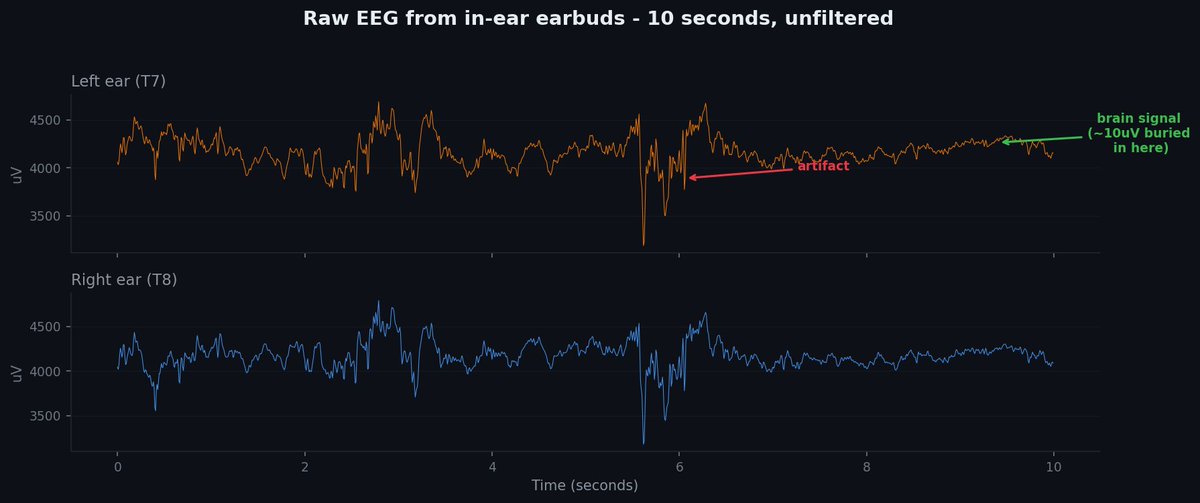
People imagine building neurotech starts with a breakthrough. It started with me staring at raw brain data from earbuds thinking "this is bad." Jaw clenches, eye blinks, loose contacts - the brain signal is buried under noise that's 10x louder. Nobody posts this part.
English
1
0
2
70
Dhaval
Dhaval@dviolite·
@KathGerp earbuds to brain interface is a wilder sentence than anything google announced last week.
English
1
0
1
30
Kathrin Gerpheide
Kathrin Gerpheide@KathGerp·
Hi, I'm Kathrin. PhD in neuroscience, work in consulting, build neurotech on the side because apparently I hate free time. Never introduced myself here. So - hi. Always happy to connect, grab coffee in SF, or hear your opinions on what I'm building!
Kathrin Gerpheide tweet media
English
4
0
4
368
Kathrin Gerpheide
Kathrin Gerpheide@KathGerp·
Day 4: 20 users, 90 pictures / videos to elicit emotions, subjective ratings per session & recorded brain data Key questions: Will brain recordings correlate with subjective ratings? Are people good at reporting emotions? Who is right - subjective ratings or "objective" data?
English
0
1
1
48
Kathrin Gerpheide
Kathrin Gerpheide@KathGerp·
First look at the raw brain data from a wearable EEG It's messy - Jaw tension, eye blinks, bad contact, movements ... In research, this usually gets discarded But in the real world, maybe the “noise” is part of the signal
English
0
1
1
38
Kathrin Gerpheide
Kathrin Gerpheide@KathGerp·
Every adaptive system interacts with a human brain. None of them know what the brain is doing. We're building the missing layer. Real-time cognitive state, from earbuds.
English
0
0
0
17
Kathrin Gerpheide
Kathrin Gerpheide@KathGerp·
Temporal electrodes sit right next to the jaw muscles. Every clench or swallow generates electrical activity. In the exact frequency band (signal range) we need for engagement. This is the single hardest problem in ear-EEG signal processing.
English
0
0
0
15
Kathrin Gerpheide
Kathrin Gerpheide@KathGerp·
Lab EEG uses 32 electrodes, conductive gel, and a technician. We're using 2 sensors inside someone's ear. Everything that works in a lab breaks in this form factor. That's the point.
English
0
0
0
15
Kathrin Gerpheide
Kathrin Gerpheide@KathGerp·
@Berci Curious how they handle signal quality during sleep. Movement, contact, and noise make EEG pretty tricky in real-world conditions.
English
0
0
0
3
Berci Meskó, MD, PhD
When, almost a decade ago, I first used the Muse headband to meditate, I liked the idea, and I had no doubt that the device could deliver what the company said it could, but I had a mixed experience meditating with a headband. Now, after several years, the company came up with a new direction in a new device: the Muse Athena. It tracks brainwaves and oxygen levels to improve mental fitness. In detail, it can help - provide deep sleep insights - find my perfect sleep position - doze off with Sleep Assist via responsive bedtime stories - and allow Deep Sleep Boost, which works through whisper-quiet, brain-synced audio cues  I cannot wait to test it.  What would you like me to definitely check out or pay attention to?
Berci Meskó, MD, PhD tweet media
English
2
0
2
313
Kathrin Gerpheide
Kathrin Gerpheide@KathGerp·
@ritwikpavan Behind-the-ear EEG is a good form factor. The real challenge isn’t sensing - it’s turning that signal into something stable and meaningful across users.
English
0
0
0
5
Ritwik Pavan
Ritwik Pavan@ritwikpavan·
JUST IN: Atlas, a San Francisco–based startup, is building a wearable that helps you understand your mind in real time. • measures brainwave activity to track focus, stress, and energy • worn discreetly behind the ear • turns mental states into actionable insights to improve performance • built after 5 years of R&D and breakthroughs in nanotech sensors • backed by $14M+ from @AcrewCapital, @HOFCapital, @refactor, and others Launching in 2026.
Ritwik Pavan tweet media
English
141
92
1.3K
191.3K
Kathrin Gerpheide
Kathrin Gerpheide@KathGerp·
@MmisterNobody Ear-EEG is legit. But going from raw signals → reliable mental state is the hard problem. Most of the work is normalization, noise handling, and knowing when the signal is wrong.
English
0
0
0
3
Mr. Nobody
Mr. Nobody@MmisterNobody·
Apple has officially patented technology using electroencephalography (EEG) and has successfully implemented it in a prototype version of AirPods, designed to read your mind, control music playback, and monitor your mental health. Can you see where this is going?
English
19
147
250
20.7K
Kathrin Gerpheide
Kathrin Gerpheide@KathGerp·
Two metrics from two ear sensors. Engagement: validated against within-session consistency. Activation: validated against heart rate. Correlation: 0.35 - related but distinct. Engagement drops the same whether someone is bored or overloaded. Activation tells you which.
English
0
1
2
34