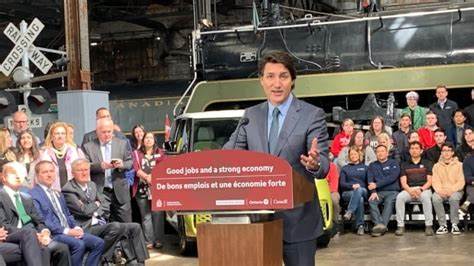


Imagine this: Canada's finance minister, Chrystia Freeland, standing behind a podium at a significant press conference. The room buzzes with anticipation as camera flashes dance across her face, reporters eagerly awaiting her address of the troubling inflation rates surging throughout the nation. As Freeland starts her speech, she attributes the problematic inflation affecting every Canadian's finances to COVID-19 and the Ukraine crisis. It's a claim that might seem plausible to a casual observer, but upon detailed scrutiny, this assertion collapses, much like a house of cards. Before we delve into the present economic situation, let's rewind to the pre-pandemic scenario where two-fifths of our monetary supply didn't exist. This refers to the money creation arising from an expansive monetary policy, in which global central banks, including the Bank of Canada, pumped substantial liquidity into the economy to offset the economic downturn induced by the pandemic. During the COVID-19 crisis, unprecedented fiscal and monetary measures were launched by governments and central banks, such as substantial public spending funded by borrowing and aggressive quantitative easing policies. Consequently, the money supply saw a significant surge. Now, as we navigate out of the pandemic, the economic landscape remains reshaped by these policies. One of the biggest obstacles has been the disruptions in the supply chain, largely caused by the lockdown measures implemented by the Liberal government. Although these were necessary to control the public health crisis, they had a deep economic impact. But the crucial point is this: many companies have adjusted to the new reality. They have restructured their operations, identified new suppliers, and adapted to shifting demand patterns. In essence, businesses have demonstrated remarkable resilience in the face of unprecedented disruption, and supply chains have mostly stabilized. The current inflation isn't the result of supply chain issues, but rather the outcome of other elements, chiefly government overspending and expansive monetary policy. When the government pours significant amounts of money into the economy, with the supply of goods and services remaining fairly constant, the usual outcome is inflation. This is a basic tenet of economics: excessive money chasing a limited supply of goods leads to price increases. With the expanded monetary supply and continued government spending, inflationary pressures have intensified. The low interest rate environment exacerbates the situation, stimulating borrowing and further increasing the money in circulation. Hence, to truly understand the root causes of inflation, we must look beyond the pandemic and comprehend the fundamental economic principles at play. Freeland, at her press conference, confidently blames the soaring inflation, especially in energy costs, on the Ukraine crisis. This narrative cleverly integrates global geopolitics, providing an escape route for the Liberal government to evade any responsibility. However, this oversimplification conveniently ignores the repercussions of their own policy decisions. Global events can influence energy prices, but the government's carbon tax policy—a heavy burden on Canadian households—should not be overlooked. This tax, applying to all forms of energy consumption, hits lower-income families hardest, increasing the costs of home heating, groceries, and other essential commodities. The Liberal government's forceful method of tackling climate change, chiefly through the carbon tax, has directly impacted Canadians' cost of living. It's a regressive policy that disproportionately affects those least able to bear the burden, essentially taxing everything and thereby fuelling inflation. The Bank of Canada finds itself trapped, forced to raise interest rates to curb the rampant inflation triggered by these policies. But this measure has its own repercussions—it makes borrowing costlier and could potentially decelerate economic growth. The government's economic missteps and policy errors have led us to this predicament, a corner they've painted themselves into with their carbon tax, causing a ripple effect of escalating inflation and higher interest rates, a self-inflicted wound borne by Canadians. The Liberal government's carbon tax, purported to curb greenhouse gas emissions, seems more like a shell game when we consider Canada's trade relationships. While taxing Canadian citizens for supposed environmental responsibility, the government continues to import goods from nations like China, which lack strict environmental standards. This contradiction undermines the carbon tax's effectiveness. If the objective is to reduce global carbon emissions, why import goods manufactured in a country significantly contributing to those emissions? This incongruity implies that the carbon tax is more about revenue generation rather than genuine environmental stewardship. The burden of this tax, as evidence shows, disproportionately falls on lower-income households who spend a larger portion of their income on energy-intensive goods and services. Hence, the carbon tax fails to properly address the environmental issue it claims to solve and further contributes to the economic difficulties faced by many Canadians, particularly those with lower incomes. This situation underlines the need for a more comprehensive, fair approach to environmental policy and economic recovery post-pandemic. As we dissect the economic fallout from Freeland and Trudeau’s policies, a disturbing conclusion emerges: they appear to underestimate the Canadian public's understanding. By crafting a narrative that blames inflation on external factors while ignoring their policy's effects, they are effectively trying to deceive Canadians. However, Canadians aren't easily fooled. We can see through the smoke and mirrors. We understand the impact of the carbon tax on our finances. We feel the squeeze of inflation at the gas pump, when heating our homes, and buying groceries. We know that our economic challenges aren't solely a result of a global pandemic or geopolitical crises—they are a direct consequence of our government's ill-advised policies. Freeland and Trudeau should respect Canadians more. We're savvy. We're informed. And in 2025, we'll remember who led us when our living costs soared, and our quality of life declined. It’s time to bring back the Canada we love—a country thriving on freedom, prosperity, and respect for its citizens. That restoration starts with a government that respects us enough to tell the truth. #cdnpoli