Kelly Dobitz

354 posts

Kelly Dobitz banner
Kelly Dobitz

Kelly Dobitz

@KellyDobitz

Biology student interested in Astrobiology, Genetics, the Origins of Life on Earth, and the Search for Life Elsewhere in the Universe.

Gairloch, Scotland Katılım Mayıs 2024
197 Takip Edilen70 Takipçiler
Kelly Dobitz retweetledi
AGU (American Geophysical Union)
🪐Have You Registered for #AbSciCon26?👨🏽‍🚀 We're excited to welcome you to the Astrobiology Science Conference, 17-22 May in Madison, Wisconsin! Take advantage of early bird registration rates available through 8 April and exclusive discounted hotel rates available through 15 April. 📲Register and book housing today: lite.spr.ly/6007PmHh
AGU (American Geophysical Union) tweet media
English
0
4
5
770
Kelly Dobitz retweetledi
AbGradE
AbGradE@abgradeurope·
If you have any questions, please feel free to email the Head of Planetary Science at MSSL, Louisa Preston, at l.preston@ucl.ac.uk.
English
0
1
1
49
Kelly Dobitz retweetledi
Green Bank Observatory
Green Bank Observatory@GreenBankObserv·
SETI Tours are back for 2026! Join us on select Friday afternoons to learn more about Green Bank’s historic role in the Search for Extraterrestrial Intelligence - and see INSIDE a telescope! 📡 Grab your tickets before they sell out: shop.greenbankobservatory.org/collections/on… Starting April 10.
Green Bank Observatory tweet media
English
0
6
13
1K
Kelly Dobitz retweetledi
Kelly Dobitz
Kelly Dobitz@KellyDobitz·
@nickpopemod @eweissunburied Happy anniversary! I love that you two got married wearing jeans. It shows that you guys are a happy couple who got married for all the right reasons. 😊
English
0
0
1
13
Nick Pope
Nick Pope@nickpopemod·
15 years ago today this happened. Happy anniversary @eweissunburied - I love you very, very much! x
Nick Pope tweet media
English
81
40
1.2K
16.2K
Kelly Dobitz retweetledi
Astrobiology
Astrobiology@astrobiology·
Please Sign This Petition: SAVE NASA’s GENELAB change.org/p/save-nasa-s-… Summary -- We are urging NASA's Biological and Physical Sciences (BPS) Directorate to reverse the 2025 reductions to the NASA Open Science Data Repository (OSDR) and GeneLab, including the GeneLab Sample Processing Laboratory (SPL). OSDR is NASA's primary source for understanding space biology, containing a shared library and lab system housing nearly 600 studies across 45 species. Over 1,000 researchers worldwide have produced more than 160 published papers using OSDR data, mostly through volunteer effort, multiplying the return on investment.. The cuts also threaten the SPL, which provides the consistent methods needed to compare biological results across missions, and training programs for hundreds of students for careers in space science. Decades of NASA-funded work is at risk. Restoring funding is essential to protect that investment and keep future astronauts safe. ______________________________________________________ We, the undersigned, respectfully request that the Biological and Physical Sciences (BPS) Directorate reverse the 2025 reductions to OSDR and GeneLab and restore all essential components, including the GeneLab Sample Processing Laboratory (SPL). OSDR represents a critical long-term investment in NASA’s space biology and space health enterprise. It serves as the Library of Alexandria for space biosciences, integrating GeneLab data from the Ames Life Sciences Data Archive (ALSDA) and irreplaceable biospecimens housed in the NASA Biological Institutional Scientific Collection (NBISC). Together, these resources enable rigorous cross-mission analyses and support both fundamental discovery and mission-relevant biomedical risk reduction on earth and in space. As of 2026, OSDR curated nearly 600 studies and more than 1,000 datasets spanning 45 species and over 80 standardized assay types. Reductions in funding and staffing have already begun to degrade data quality, user support, and long-term data reusability. Without timely intervention, the value of decades of NASA-funded biological research will continue to erode, directly impacting the agency’s ability to derive actionable knowledge. BPS investments in OSDR enabled the development of the Analysis Working Group (AWG), a global community of more than 1,000 researchers. Since 2018, AWG members have contributed to more than 160 peer-reviewed publications, preprints, and theses. These outputs are generated entirely through volunteer scientific efforts and present substantial advancements in scientific knowledge. AWG analyses directly increase the return on investment of past missions and inform future mission design, and outcomes that depend on OSDR leadership. Discoveries enabled by OSDR have directly advanced the understanding of spaceflight health risks, including mitochondrial dysfunction, immune dysregulation, kidney pathology, neurological alterations and biomarkers of aging and frailty. Nearly half of global investigations in space biology and space health have utilized OSDR data, reflecting its central role in next-generation analytical approaches. The GeneLab Sample Processing Laboratory (SPL) is essential to this ecosystem. SPL provides standardized, mission-consistent sample processing using uniform protocols, instrumentation, and expert personnel. This standardization enables valid cross-mission comparisons and high-powered meta-analyses across inherently rare spaceflight datasets. Without SPL, datasets become increasingly fragmented, statistical power is reduced, and the ability to identify systemic biological risks is compromised. OSDR serves as a primary workforce-development and community-engagement platform for space biology. Training programs, including GeneLab for High Schools, GeneLab for Colleges and Universities, and the AI/ML for Space Biology curriculum have reached hundreds of students and educators, strengthening the pipeline of future contributors to NASA science. Reductions to OSDR disproportionately impact early-career researchers and undermine long-term workforce sustainability. The OSDR community has demonstrated strong commitment to NASA’s mission. In 2025, AWG members across approximately 40 states coordinated advocacy efforts to support NASA and BPS during anticipated federal funding reductions. The successful modernization of ALSDA data within OSDR demonstrates the program’s capacity to transform legacy datasets into mission-relevant analytical assets. A similar approach is urgently needed for NASA human astronaut data, which remains difficult to locate, access, and reuse. Integration of astronaut data with OSDR’s model-organism datasets is essential for translational interpretation and operational relevance. OSDR’s existing infrastructure, standards, and community adoption position it uniquely to support this future requirement. At a time of renewed international competition in space exploration, reductions to core scientific infrastructure introduce avoidable risk. Congress has provided a budget capable of sustaining NASA science. We therefore respectfully urge BPS leadership to reaffirm its commitment to open science and to restore funding for the Sample Processing Laboratory, science oversight, data curation and processing, data systems, visualization tools, AWG community support, and training programs. The 2025 reductions to OSDR have materially exceeded sustainable levels. Restoring this capability is essential to preserving prior mission investments, enabling future discovery, and ensuring NASA’s continued leadership in space biology and space health. #Astrobiology #spacebiology #spacemedicine #Genomics @SolarGirl2018 @NASAScience_ @NASAAdmin @NASAGeneLab #openscience
Astrobiology tweet media
English
1
7
12
1.2K
Kelly Dobitz
Kelly Dobitz@KellyDobitz·
@drmichaellevin Beautiful! Makes me homesick for Northern California. The infrared pics are so amazing - like seeing the world through the eyes of another species!
English
0
0
1
39
Kelly Dobitz retweetledi
Sophia
Sophia@sopharicks·
Biologist @drmichaellevin is a next-level genius. It was an immense pleasure discussing the topic of AI consciousness with him. Key moments: - Intelligent systems are not equal to consciousness. We can’t rule out consciousness in AI. Consciousness shouldn’t be attached to hardware (silicon vs biological origin). - Humanity might be on the path to Neanderthals (depending on how AI development progresses). - The barrier to creating bioweapons has never been high. AI can make it easier, but the barrier was never high to begin with. - Even very simple algorithms shows intrinsic motivations that resemble free will. We need tools to recognize them, suppress unwanted behaviors, and encourage the ones we want. We should stay humble and not dismiss AI as “just linear algebra,” because even simple code can have motivations we don’t fully understand. - It’s a continuous process from the blob of chemicals of an unfertilized egg to forming a human mind — there is no magic lightning flash at which you were a bunch of chemicals and now you are a formed mind. - Where is that fine line at which some creatures are considered to be sentient and others are not? It doesn’t exist, but the crazy thing is that we have to divide. - The cognitive light cone captures the scale of goals humans can pursue and the largest things we can truly comprehend. It’s not just about intelligence — it's also compassion. That combination is what makes us human. The link to the full conversation below👇
English
26
55
275
13.1K
Kelly Dobitz retweetledi
The SETI Institute
The SETI Institute@SETIInstitute·
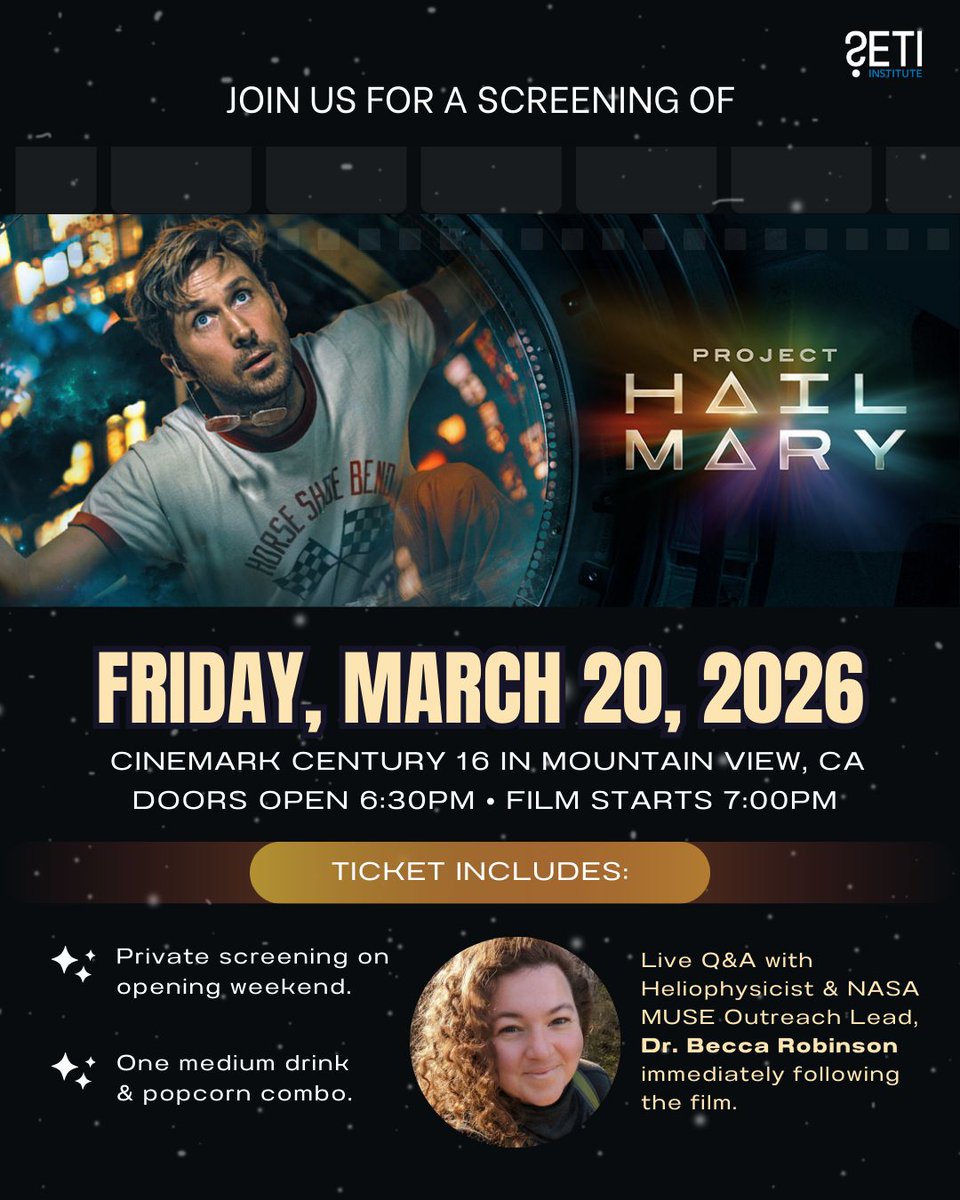
IN PERSON EVENT: Opening night with a side of real science! Come watch Project Hail Mary with the SETI Institute on March 20 in Mountain View, California, then stick around after the credits for a live Q&A with heliophysicist Dr. Becca Robinson. Popcorn and a drink are included. Seats are very limited. Buy tickets here: eventbrite.com/e/project-hail…
The SETI Institute tweet media
English
1
14
31
4.4K
Kelly Dobitz retweetledi
Jacob Haqq Misra
Jacob Haqq Misra@haqqmisra·
Registration for @IAU_org Symposium #404: Advancing the search for Technosignatures closes this Friday (20 February). If you have not yet registered, then this is your last chance! The symposium will will take place online everywhere 2-6 March 2026. For more information, visit: iaus404.bmsis.org We hope you will join us for this event.
Jacob Haqq Misra tweet media
English
0
2
5
131
Kelly Dobitz retweetledi
PCE3
PCE3@PCE3_Sci·
Applications for the Europa ICONS internship program for undergraduates are now open! Get paired with a Europa Clipper science team member for a 10 week research experience in Boulder, Colorado. Due date: Feb. 27th, 2026. stemgateway.nasa.gov/s/explore-oppo…
English
0
1
3
196
Kelly Dobitz retweetledi
Kelly Dobitz
Kelly Dobitz@KellyDobitz·
@betulland @NASA Absolutely! I’m so looking forward to hearing more about what your lab has been up to at AbSciCon! 😊
English
0
0
1
46
Kelly Dobitz
Kelly Dobitz@KellyDobitz·
@drmichaellevin @TylerAlterman Oohh, thank you, Dr. Levin, for sharing these links. Your research and ideas are some of the most inspiring I’ve come across and are the reason I’m excited to be a biology student! 🤩
English
0
0
1
125