

Killian Lync
2.6K posts
Killian Lync
@KillianLync
mvp @1stcollective, biz dev & ecosystem growth @D2_Finance formerly player @BigBrainVC, @jump_
.hl Katılım Ağustos 2012
1K Takip Edilen588 Takipçiler


Killian Lync retweetledi


Killian Lync retweetledi

Onchain perpetuals are the next evolution in derivatives markets, but U.S. law provides no pathway for Americans to participate.
HPC exists to change that.
Read more about our mission to advance new rules for decentralized markets in the United States:
Hyperliquid Policy Center@HyperliquidPC
English
Killian Lync retweetledi

Why looping in crypto is broken, why we stopped, why you're being sold repackaged credit risk as a savings account, and why we don't need it anymore. Thanks to @chameleon_jeff and @HyperliquidX.
Before founding D2, we spent a decade in institutional derivatives.Started at Bloomberg, then moved to global multi-billion-dollar hedge funds, and finished with a few years at PAG, a $55B Asian multi-strategy fund, trading volatility as a PM responsible for a multi-billion notional book.
Across that span we sat next to some of the best credit teams in the business. So when we say what the market is being sold as "stablecoin yield" looks like a leveraged credit strategy in a wrapper, this isn't theory. It's pattern recognition from watching credit professionals price this class of risk for a living.
Nothing inherently wrong with leveraged credit.
There is something wrong with selling it as "yield" without pricing the tail.
@ethena has executed beautifully on a favorable market setup.
Funding has been positive, basis has been wide, delta-hedged shorts have earned. Mechanically it remains a leveraged basis trade that pays until funding flips, liquidity thins, or the short leg breaks. That is not a savings account. That is a credit hedge fund wrapped in USDe.
The same logic applies to every looping stablecoin variant: sUSDe loops on Aave, syrup loops on Maple, avUSD, others. Same structure. Borrow cheaper stable, lend richer yield-bearing stable, pocket the spread, repeat 5x.
Works until it doesn't.
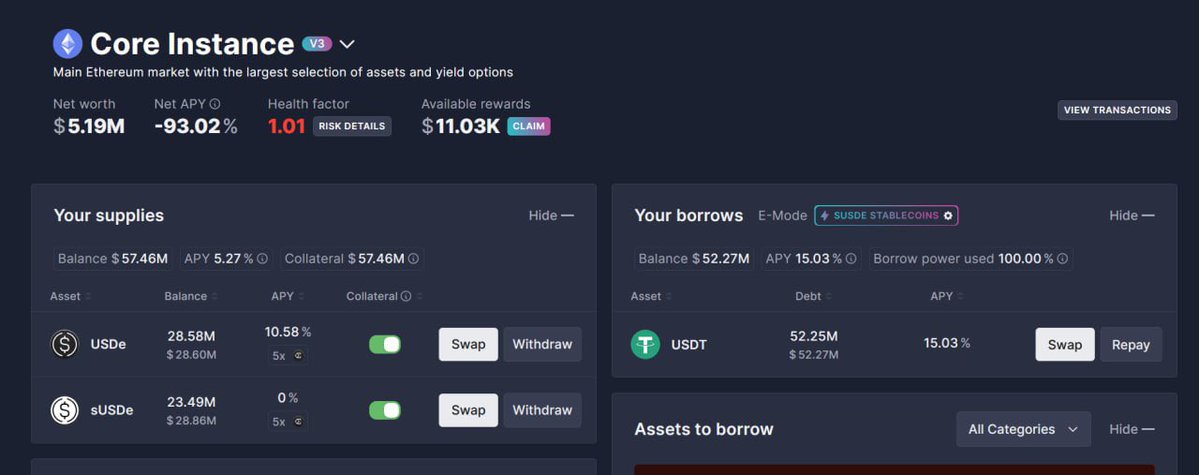
This week we documented two of these positions at -93% and -135% net APY, HF 1.01 and 1.02, ~$1B combined gross exposure.
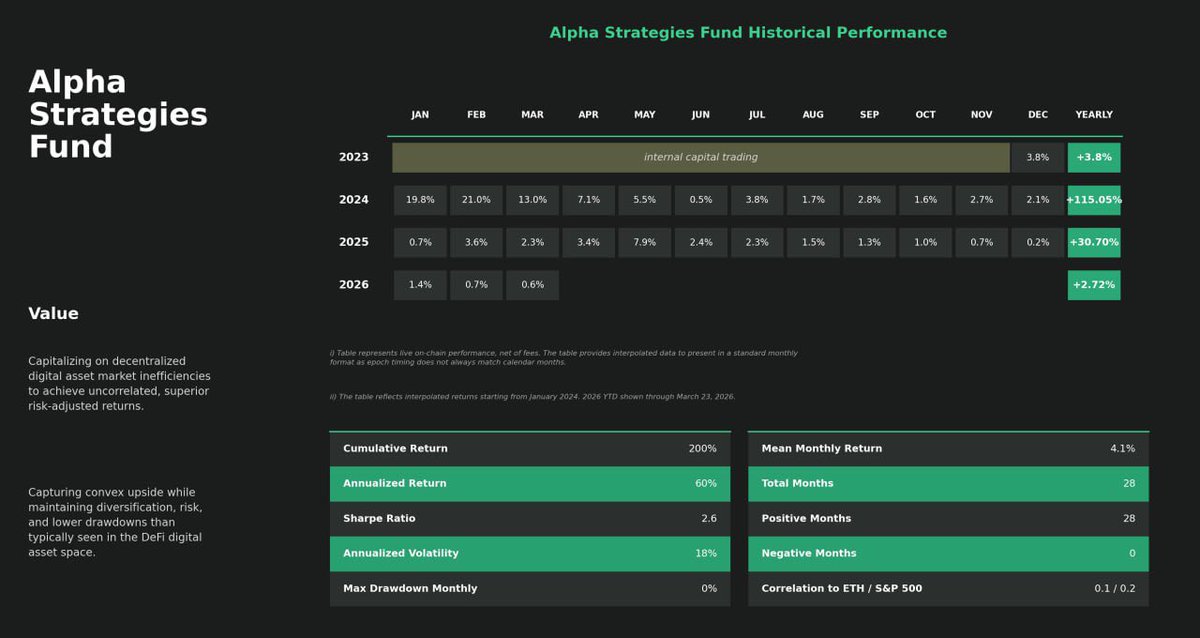
D2's on-chain auditable track record (attached):
+3.8% (Dec 2023)
+115% (2024)
+31% (2025)
+3% (2026 YTD)
2.6 Sharpe. 28 of 28 positive months. 200% cumulative.
We looped actively in February 2024. Long ETH looped into USDC on @aave , short ETH on @GMX_IO , at funding rates that peaked above 100% APR.
One of the trades that made 2024 our best year.
Nothing against looping when the risk is properly compensated.
In 2025 we did lighter looping on the @fundstrat ‘ ETH run from $1,500.
We exited when the setup started to look like a bubble, and rolled the delta exposure into call options on @DeriveXYZ. July expiry paid materially. August expired mostly worthless.
Net result: we captured the DAT mania with defined downside.
We did not need a crystal ball.We needed convex payoffs.Since then we have not found a looping setup worth taking. Not ideology, the risk-reward no longer clears.
The change that matters: Hyperliquid liquidity has made gamma replication, delta hedging, and structured payoffs executable at spreads that do not exist anywhere else on-chain. We can now replicate most of the payoff profiles we like, with defined downside and substantially better risk-reward, without taking liquidation risk at HF 1.01.
Do not let zero-fee gimmicks mislead you. Execution happens at the spread, not the fee. Hyperliquid spread is why this works. That is @chameleon_jeff and the team's real contribution to institutional DeFi.
For fund managers: if the risk profile of your product is "leveraged credit, short convexity, earn carry until you cannot," that is a legitimate strategy. Label it correctly. Do not package it as a stablecoin and compare it to money market yields.
For everyone else: if a product offers you double-digit "stable yield," ask what happens in tail conditions. "We have Umbrella coverage" or "the collateral is fully backed" is not an answer. That is a marketing line. Ask for the funding chart. The liquidity depth in stress. The concentration of the borrower base. The unwind mechanics.
We learned looping by running it when it paid. We stopped when it didn't.Looping pays carry until it doesn't. Options pay when it matters.
Thanks to @chameleon_jeff and the Hyperliquid team for making this possible.
Fade D2 at your own risk. 🫡
English
Killian Lync retweetledi

Thanks @domcooke for spending months on researching and writing this piece. Einstein once said, "If you can't explain it simply, you don't understand it well enough." By that measure, Dom has blown me away with how deeply he came to understand Hyperliquid and what we're all building together.
When someone asks what "housing all of finance" means, I'm proud to point them to this piece. I hope readers appreciate just how much Dom and his team put into their work. It reflects the thoughtful craft that is in Hyperliquid's DNA. Special thanks to @patrick_oshag for taking a bet on Hyperliquid's story.
Colossus@colossusmag
This is the story of Hyperliquid, the most profitable startup per employee on earth, told from a guarded office in Singapore. Last year, its team of 11 generated $900 million in profit. It's 3 years old, has never taken a dollar of venture capital, and is beginning to change how century-old markets work. Its founder, Jeffrey Yan (@chameleon_jeff), had never taken a physics class when he picked up a textbook at 16. Two years later, he won gold at the International Physics Olympiad. In 2019, he started trading with $10,000 from a living room in Puerto Rico—working off a television because he didn't own a monitor. Within 3 years, he was running one of the largest anonymous crypto trading firms. Then he shut it down. Yan was rich and free, but he had spent years inside crypto, watching it betray itself. Bitcoin's central premise was decentralization. Yet the biggest exchanges were centralized. Crypto kept reintroducing the dependence on trust it was built to eliminate. He set out to create what should have existed. Hyperliquid is a blockchain with a trading exchange on top, and anyone can build on it. Yan's vision is to house all of finance. In 3 years, it has done over $4 trillion in volume. And in the past few months, it has begun to outgrow crypto. Markets for oil, silver, and the S&P 500 now trade on Hyperliquid around the clock, weekends included, and are growing roughly 40% week on week. When the US and Israel bombed Iran on a Saturday in February, Hyperliquid was the venue traders turned to. Hyperliquid's success has cost Yan his freedom. He works out of a secret office in Singapore and cannot travel without two bodyguards. Even the team's housekeeper doesn't know what they do. In January, @domcooke spent a week at their office. Read his profile on Yan and @HyperliquidX below.
English
Killian Lync retweetledi
Looping stress isn’t isolated to Avant.
@YuzuMoneyX (managed by @OuroborosCap8) runs a $57M USDe/sUSDe loop on Aave Core at HF 1.01, -93% net APY, 100% borrow power.
Core is protected even if the war room throws L2s under the bus. But -90% APY carry is still bleeding.
Contagion protection doesn’t fix broken unit economics.
@avantprotocol’s transparency page shows ~$900M gross leveraged book across Aave Mantle, Maple (@syrupsid), and other venues. Single wallet on Mantle: $140M USDT0 + $20 USDC nominal at HF 1.02, -135% APY. (Not $20M as I wrote yesterday, clarifying.)
Pattern is systemic. Multiple protocols running deeply negative carry at liquidation threshold across multiple chains.
Governance is still debating rsETH fallout while the underlying strategy is structurally broken.
For context, D2 exited looping entirely since ~July 2025 when we derisked into the DAT / @fundstrat mania. Kept upside through call options with defined downside.
Made money on 10/10. Long gamma paid again this weekend. Looping pays carry until it doesn’t. Options pay when it matters.
Thanks to @DeriveXYZ and @flowdesk_co where our long gamma sits.
D2 Finance@D2_Finance
Live evidence for the @aave x @KelpDAO x @LayerZero_Core governance war room on second-order risk. @avantprotocol is currently running a single $156M sUSDe looping position on Aave Mantle. $140M USDT0 + $20M USDC borrowed against it. Net APY -135% (net of sUSDe embedded yield the pain is less, but still deeply negative). Health factor 1.02. Borrow power 100%. This isn’t a rounding error. It’s one of the largest single positions on @Mantle_Official, sitting at liquidation threshold, eating deep negative carry, structurally dependent on Aave Mantle staying unfrozen indefinitely. Under the L1-backstop / L2-zeroed proposal, forced unwinds of positions like this are the transmission vector back to Core via sUSDe depeg pressure on thin L2 secondary liquidity. You can believe this position is fine in isolation. You cannot believe this position is fine in isolation AND that L2 zeroing has no second-order cost to stakeholders like @avantprotocol. Pick one. More quants, fewer lawyers in the war room, for the sake of this industry. 🫡
English
Killian Lync retweetledi

Why Priority Fee is insanely bullish for $HYPE (and why I'm so excited)
Every single time someone uses these priority fees, they pay in HYPE — and a big part of it gets burned (permanently removed from supply).
That creates real, constant demand for HYPE:
- Market makers and serious traders need it to stay competitive.
- The more volume and chaos on Hyperliquid (which is already massive), the more HYPE gets used and burned.
- Even in quiet times, those 5 gossip slots keep creating baseline demand.
It's not just "governance" anymore. HYPE is becoming the fuel for speed and priority on the most sophisticated trading chain in crypto.
Read this for more details about priority fees:
Yaugourt.hl@Yaugourt
Priority fees just dropped on Hyperliquid testnet. Important context most people miss: on Hyperliquid, every trader uses the same public API. 1200 requests per minute per IP. No private endpoints. No backdoor feeds. The institutional HFT firm and the retail trader hit the exact same shared infrastructure. That means the edge today comes purely from engineering: optimizing your API stack, smart batching, parallel workers, predictive pre-fetching. Whoever pings the API 50ms faster wins. The infrastructure arms race isn't about colocation or private RPCs, it's about who has the best engineers fighting for milliseconds inside the same shared rate limit. Priority fees change that. Two priority line: Gossip priority (read priority & spot balance): you pay HYPE from your spot balance to get your transactions seen first by validators. 5 slots available, refreshed every 3 minutes. Order priority (write priority & staking balance): you pay a fee in HYPE from your undelegated staking balance to get matched ahead of other orders. Up to 20 bps of notional. Currently for IOC orders on HIP-3. Real example happening right now: Trump posts on Truth Social at 8pm ET threatening to bomb Iran's power plants if the Strait of Hormuz stays closed. Oil futures spike 16% in a single session. Crude goes from $94 to $112 in hours. Every trader on Hyperliquid trading oil perps wants to react first. Without priority fees: whoever has the best API optimization wins. If you ping the API at 51ms instead of 50ms, the position is already gone. No way to pay for an edge. Just engineering. With priority fees: you bid in HYPE. Whoever wants to be first pays the most. Same shared API, same rate limit, but now there's a financial lever accessible to anyone who holds HYPE. You don't need to be the best engineer anymore. You need to be the one willing to pay. Same logic for liquidations cascading after the move. Same logic for HIP-4 prediction markets settling on Trump's deadline. Same logic for arbitrage between HL and traditional venues during the chaos. Why HYPE holders should care: Every priority fee is paid in HYPE. Every bid creates demand for the token from spot AND staking balances. As Hyperliquid scales (HIP-3 stocks, HIP-4 predictions, more deployers, more macro events), priority fees become a continuous structural demand sink for HYPE. This isn't just a feature. It's value capture that scales with network sophistication. The underlying API is already democratized by design (everyone uses the same one), priority fees are the only legitimate way to pay for a competitive edge on Hyperliquid. The second tweet talk about the math behind👇 Just use Hyperliquid.
English
Killian Lync retweetledi

Killian Lync retweetledi
Lmao, these two CEX dinosaurs are at it again and I’m dying 😂
CZ drops his memoir, Star Xu immediately calls him a habitual liar, digs up decade-old QQ chats, and accuses him of faking a divorce. CZ fires back with “I’m divorced, bet me $1B right now or shut up” while refusing to post papers for “privacy reasons.” Classic.
Two billion-dollar egos still fighting over who lied harder back in 2015 OKCoin days.
Hyperliquid.

English
Killian Lync retweetledi

After further review, I’ve come to the conclusion that $CC is a centralized permissioned database.
English

Congrats @openfx_ !
Mason Nystrom@masonnystrom
We're excited to back @prabhakar2reddy and the rest of the @openfx_ team as they transform the future of global payments. In a short amount of time OpenFX has scaled to over $40B in annualized payment volume through 2025. Read more about our investment thesis for OpenFX 👇
English


Killian Lync retweetledi

LIVE NOW - Tempo Mainnet: The Race to Agentic Commerce
@tempo is live, and the big bet is clear: AI agents need a native payment layer.
@gakonst and Brendan Ryan join Bankless to explore:
- why Tempo launched with agentic payments front and center,
- how MPP turns payments into auth,
- why “give the agent the wallet” could unlock a new internet economy,
- where MPP fits against x402,
- what Tempo’s L1 design makes possible for builders.
Enjoy the episode.
---
TIMESTAMPS
0:00 Tempo Mainnet goes live
1:18 Why the launch is focused on agents
3:58 What MPP actually is
6:30 MPP vs x402
15:28 Why agentic commerce matters
20:08 The “original sin” of the internet
26:04 MCP, NLWeb, and the emerging agent stack
34:07 The onboarding flow: wallets for agents
37:11 How Tempo’s wallet security works
40:11 Tempo chain design and specs
51:13 Why build an L1 instead of an Ethereum L2?
56:10 The Ethereum tension
1:05:01 Agent identity, reputation, and ERC-8004
1:06:53 TIP20, stablecoins, and what can be built on Tempo
1:12:36 Builder opportunity in the agentic web
English
Killian Lync retweetledi

wild to imagine agents autonomously self-training & paying w/ stables
i built mpp-nanogpt-modal which deploys @karpathy's nanoGPT project on Modal using MPP and trains it w/o API keys, everything paid with stablecoins on Tempo
next up ill try longer runs & autoresearch
English
Killian Lync retweetledi


Killian Lync retweetledi

I am stepping up as CEO of @dv_labs. We have reduced our team by 30%. This reduction will increase our runway to ensure our success despite a potentially protracted bear market or high rate environment. Institutions take time to win over, but place a high premium on security and risk-adjusted returns. Ethereum staking will be no different. If you manage funds on behalf of a client with a multi-sig wallet, you should ensure you’re staking their funds with a multi-operator validator too.
Similarly for the Obol stack and the agent economy; this market will transform Ethereum, but the adoption will go through a Gartner hype cycle, and maturity will take time.
Obol’s mission is to secure and power the Ethereum economy, and these tough decisions are necessary to achieve these aims.
The team members leaving would make fabulous hires at other crypto firms, and have experience ranging across Cryptography, Data, Frontend, Content and Comms, and Operations. Drop into my DMs if I can make a connection.
English

We need a bull market asap
SB.hl@swansonbenson0
The penis and balls is 5000x more aesthetic than vagina Not gay. Just something ive noticed…
English
