Arnold Kling

4.1K posts

Arnold Kling

Arnold Kling

@KlingBlog

Economist, author of several books, including The Three Languages of Politics and Specialization and Trade. https://t.co/6Ifgdwf15K

Katılım Kasım 2014
7 Takip Edilen4.3K Takipçiler
Arnold Kling retweetledi
Deirdre Nansen McCloskey
Deirdre Nansen McCloskey@DeirdreMcClosk·
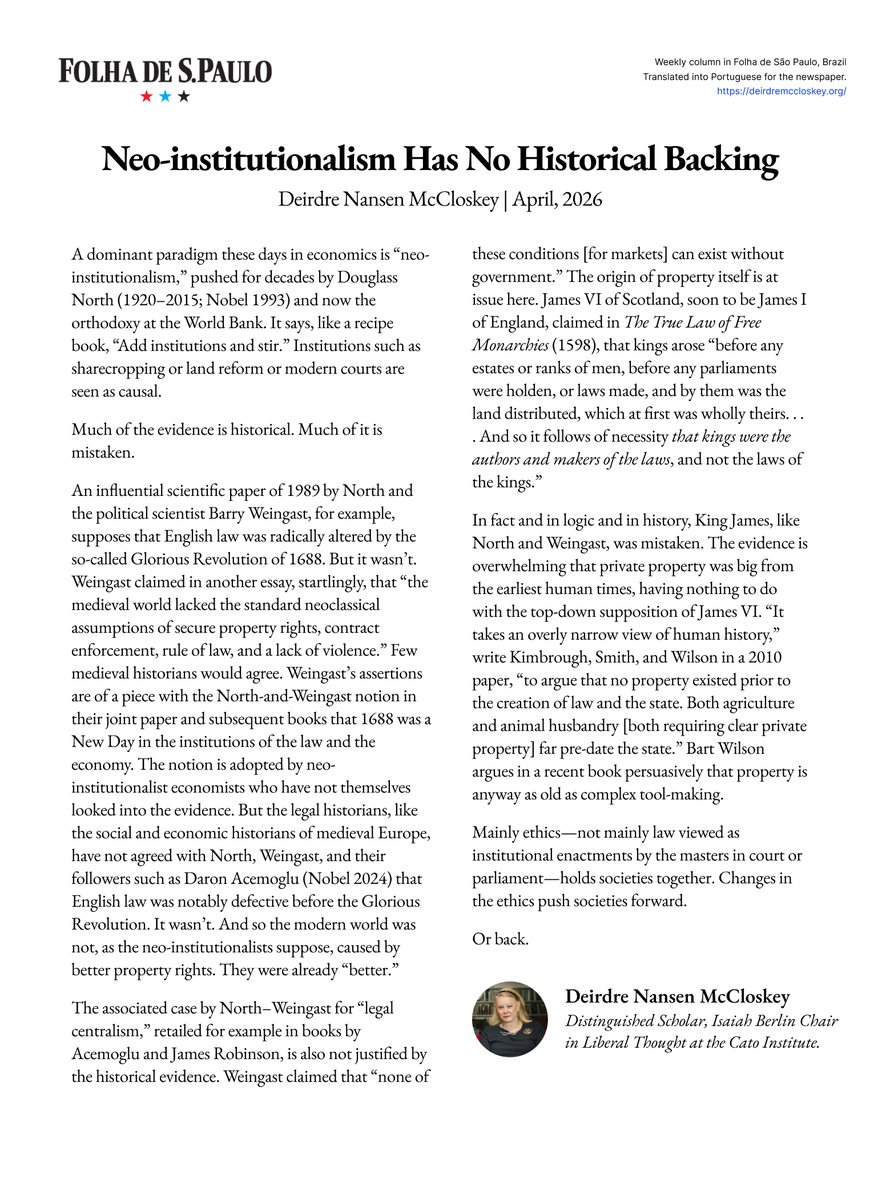
A dominant paradigm these days in economics is “neo-institutionalism.” Pushed for decades by Douglass North (1920–2015; Nobel 1993) and now the orthodoxy at the World Bank. It says, like a recipe book, “Add institutions and stir.” Institutions such as sharecropping or land reform or modern courts are seen as causal. Much of the evidence is historical. Much of it is mistaken. My latest column for @folha....
Deirdre Nansen McCloskey tweet media
English
17
78
447
43.8K
Arnold Kling
Arnold Kling@KlingBlog·
Moltbook: at the very minimum, it is an entertaining science fiction story being written incredibly quickly. At the maximum, ??? @moltbook
English
4
0
6
552
Arnold Kling
Arnold Kling@KlingBlog·
@clumma @patrickc The Great Depression also had massive structural effects. Nobody went back to doing the jobs that were lost in the early 1930s
English
1
0
1
74
Carl Lumma
Carl Lumma@clumma·
All recessions are like this. From 2008-2011 * Almost everyone changed their job and many changed professions * Optimism about technology, which had been the norm since ~ 1980, plummeted and did not begin to recover until ChatGPT (Q4 2022) * The meth epidemic ended; opioid epidemic began * People suddenly stopped buying Hummers * The "great feminization" began [1] * Manufacturing output and electrical generation stopped growing [2][3] * The employment:population ratio fell and never recovered [4] Different changes of similar magnitude took place in the wake of 9/11. Which was primarily a recession, i.e. the terrorist attack might have been met differently in an expansion (as indeed one was in 1993). [1] compactmag.com/article/the-gr… [2] fred.stlouisfed.org/series/IPMANSI… [3] eia.gov/totalenergy/da… [4] fred.stlouisfed.org/series/EMRATIO
English
2
2
23
18.2K
Patrick Collison
Patrick Collison@patrickc·
Maybe a very prosaic observation, but I've been reflecting on just how much the pandemic changed the world in ways that are completely unrelated to the pandemic itself. I think I've underestimated it 'till now. In a recent interview, I was struck by the comment that so many of the shops that we associate with the best of France—the poissonneries and the fromageries—closed during the pandemic, to be replaced by take-out pizza shops and the like. College professors almost uniformly describe big changes in student behavior: lecture attendance and willingness of students to complete reading assignments are both way down. A UK government official recently told me that British economic statistics have become much less reliable since the pandemic: data on trade, employment, and population is suspect. (The true GDP per capita figures are probably worse than what is indicated by the published data, since the 2021 census is believed to be an undercount.) In the West, there are far fewer bustling workplaces than there used to be. In recent conversation with a well-traveled friend, he bemoaned how so many cities—places like Madrid, Buenos Aires, and Bali—have lost so much of their erstwhile vibrant nightlife. Immigration accelerated enormously across many countries, including the US, the UK, Canada, and Australia. In China, I hear descriptions of how fear, caution, and conservatism have persisted since the COVID lockdowns. (And Western travel to China remains massively depressed.) Lots of the changes are neutral, or even good. Retail participation in the US stock market almost doubled overnight, say, and has persisted at that elevated rate. Firm creation in the US increased by around 50%, which is probably a very good thing. Overall, the number of time series (either literal or figurative) that jumped discontinuously during COVID and then didn’t return to baseline is just very striking. Which are the best historical analogs? Are there any apart from major wars? I want to read this book!
English
237
284
3.6K
763.7K
Arnold Kling
Arnold Kling@KlingBlog·
Invisible Wealth. Of 10 economists interviewed, 4 had won Nobels. Now it's up to 6. A remarkable book, if I may say so myself (3)
English
2
1
6
652
Arnold Kling
Arnold Kling@KlingBlog·
"if somebody put a gun to my head and said, “define technology,” what would I say? And the only answer I could come up with that really satisfied me was that it’s something in our own heads. " (1)
English
1
0
1
726
Arnold Kling
Arnold Kling@KlingBlog·
@turing_hamster I don't think that this scales well. As an organization gets large, people voting don't know the person that they are voting on. Even in a small organization, unless I'm hurting your productivity, why do you care? if the manager needs this tool, then fire the manager ;)
English
0
0
1
12
Arnold Kling
Arnold Kling@KlingBlog·
how Claud would prompt YOU
English
0
0
4
640
Arnold Kling
Arnold Kling@KlingBlog·
Instead of having a panic about students cheating with AI see how you can teach using AI. soccode.vercel.app a prototype seminar pick the chapter on game theory make sure to ask a question and see the responses
English
0
1
4
677
Arnold Kling
Arnold Kling@KlingBlog·
@johnarnold Enron's financial engineering was functionally like writing put options on its stock in order to boost earnings. This turned a decline in the stock price into a doom loop. GE did not do that.
English
0
0
1
109
John Arnold
John Arnold@johnarnold·
I spent 6 years at Enron right out of college, including through the bankruptcy, but I didn’t really grasp what happened until I studied GE. It’s basically the same story. GE was an industrial company that transformed into a conglomerate under a hard-charging, visionary CEO. Early success and a high-growth culture led to significant expansion and a variety of business lines, including heavy industry, healthcare, media, appliances, financial services, and insurance. The p/e multiple of each unit independently would have been roughly 10x (GE Capital) to 30x (Healthcare). But with years of high and consistent earnings growth, GE transcended their peer group and traded over 50x at the peak. But, this was dependent upon high and consistent earnings growth. If GE ever missed earnings, the company would be rerated. It wouldn't drop 10%; the stock would be cut in half. The pressure from the CEO to division heads was clear: make earnings or else. This led to a culture of aggressive accounting practices, including using the financial arm to prop up underperforming units. Jack Welch defended this practice even after leaving the company, saying earnings management was a sign of operational excellence. GE Capital, the pension fund, actuarial assumptions in the insurance business, and a portfolio of appreciated real estate became an endless well that was used to manage earnings, at least for a long time. Eventually severe underperformance in certain units, particularly insurance, after the 2000 bubble led to questions about quality of earnings, particularly in light of Enron's bankruptcy. The stock rerated over several years, falling 60% by 2003, where it stabilized until the GFC. By this point, GE Capital was roughly 50% of total earnings. It was easier to sell consumers more loans than refrigerators. The company had effectively become a bank, though avoided the capital requirements of one. The financial crash in 2008 was the exogenous shock that sent the company into crisis as it was undercapitalized for the portfolio risks and dependent on Wall Street for financing. Having lost the market's trust, the company couldn't roll over its short term debt and the company was days away from bankruptcy in October '08. Worried about contagion effects, the Federal Reserve and FDIC decided to guarantee over $200 billion of new GE debt. Without this, GE would have met the same fate as Enron. Still, GE was severely weakened and had to go back to its core. It took nearly 15 years for the company to recover and start to thrive again. Enron was a similar story but a different ending. Enron was an industrial company (pipelines) that transformed into conglomerate under its own hard-charging, visionary CEO. Early success and a growth culture led it to expand into finance (trading and merchant bank) and then retail electricity, international assets, and broadband. The alchemy of the agglomeration was similar to GE. Enron traded at 30-40x multiple for a collection of businesses that would have been worth <10x (trading) to maybe 20x (retail) if independent. During the broadband bubble in 2000, the p/e reached a staggering 60x. Enron transcended its peer group because of high and consistent earnings growth. And like GE, the knowledge that the stock would substantially rerate if it ever missed estimates created a culture of "make the numbers," which led to aggressive accounting. Like GE, underperformance in some units was hidden by both real and managed profits in the financial unit. It was easier to give the traders more risk capital than grow an electric utility in Brazil that it owned for some reason. The trigger for the initial decline was similar. A few outsiders pointed out major red flags in Enron’s financials, particularly the gap between reported profits and actual cash flow, which the company failed to adequately explain. This started a steady decline from the peak in 2000 through 2001. The broadband bubble popped, more accounting questions arose, the CEO resigned (within 1 month of Jack Welch leaving GE), and 9/11 happened. There was also a realization that the company, like GE, was heavily reliant on its trading operation. A credit downgrade could have jeopardized that entire unit. With outsiders, internal accountants, and external auditors digging into the company's financials, the company announced a $618 million loss for 3q '21. That triggered the announcement of an SEC investigation. Like GE, Enron had significant exposure to the short-term, commercial paper market. With Wall Street skittish post 9/11, significant debt maturing in the near-term, questions about undisclosed liabilities, and no government bailout coming, the company’s collapse became inevitable. The credit agencies downgraded the debt, triggering collateral calls and restricting access to capital. Four days late, in December, 2001, Enron declared bankruptcy. The similarities were stark: valuation that transcended the sector, earnings management, ‘growth at all costs’ culture, opaque and growing financial arms, reliance on short term debt, hyper-aggressive/illegal accounting, praise by analysts and media, weak internal controls, and hubris. Only government intervention in the case of GE kept their fates from being the same.
English
208
510
4.3K
866.4K
Arnold Kling
Arnold Kling@KlingBlog·
Tonight at 6 PM New York time, Moses Sternstein and I are planning to go on substack live. He wants to talk about Warren Buffett’s idea of “import certificates”and I want to talk about financial markets from the perspective that I call “total paranoia.”
English
0
0
5
652